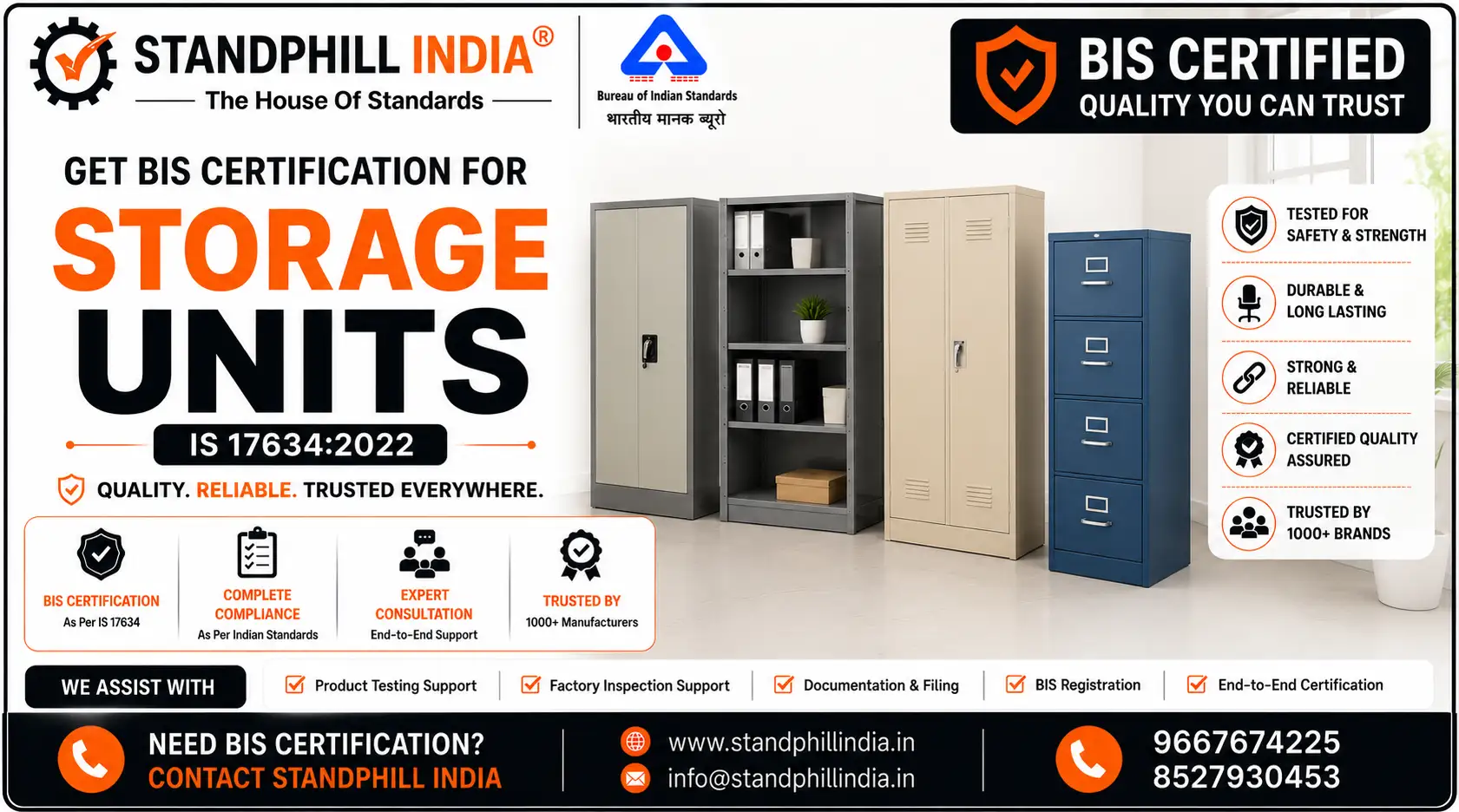
BIS Certification for Storage Units under IS 17634:2022
Wardrobes, Almirahs, Cabinets, Bookshelves & Cupboards - the ISI Mark Requirement for Storage Furniture Explained
BIS certification under IS 17634:2022 is mandatory for storage units - wardrobes, almirahs, cabinets, cupboards, bookshelves and shelving - under the Furniture (Quality Control) Order, 2025, enforced from 13 February 2026 (MSEs: 13 August 2026). Free-standing and wall-mounted units in wood, metal or plastic all need the ISI Mark with CM/L number, backed by lab testing (with tip-over stability a key focus) and a factory inspection under Scheme-I. Standphill India manages certification end-to-end. Call +91-9667674225.
Key Facts - Storage Units (IS 17634)
- Standard: IS 17634:2022 - storage units for adult domestic and non-domestic use; all materials; free-standing and wall-mounted.
- Legal basis: Furniture (Quality Control) Order, 2025 - S.O. 801(E); enforced 13 Feb 2026; micro & small enterprises from 13 Aug 2026.
- Covers: wardrobes/almirahs, cabinets, cupboards, bookshelves, filing & office storage, kitchen & utility storage furniture, modular/knock-down units.
- Important limit: for wall-mounted units the standard assesses the unit - wall strength and the fixing into the wall are not assessed.
- Safety focus: overturning/tip-over stability of tall units is a decisive test - a global child-safety concern with wardrobes and dressers.
- Transition: pre-13-Feb-2026 stock sellable till 12 Feb 2027 for certified/applied manufacturers with self-declaration (S.O. 774E); import BoL/PO windows close ~12 Aug 2026 (S.O. 1125E).
- Latest (25 Jun 2026): Transition Facilitation Order S.O. 3417(E) lists the Furniture QCO at Schedule entry 9 - a new risk-based sourcing pathway for established manufacturers; licences themselves now run up to 5 years (regulations amended 25 Feb 2026).
July 2026 update: Two later notifications now sit alongside the storage-unit rules. The Transition Facilitation (Quality Control) Order, 2026 (S.O. 3417(E), 25 June 2026) covers the Furniture QCO at Schedule entry 9 and lets an Implementation Committee grant established manufacturers a risk-based sourcing permission valid for five years - relevant if you build wardrobes or modular storage in Delhi-NCR, Gujarat or Maharashtra from certified component streams. And under the BIS (Conformity Assessment) Amendment Regulations of 25 February 2026, your licence is now granted for up to five years and renewable for up to five years at a time. To see exactly what the licence document contains, view our specimen furniture BIS licence.
Wardrobes & Cabinets - Tip-Over Safety Is Now a Legal Standard
Furniture tip-overs injure children worldwide, and IS 17634's stability tests exist for exactly that reason. Retailers and e-commerce platforms are demanding CM/L numbers on storage furniture listings.
What is IS 17634:2022 and Who Needs It?
IS 17634:2022 is the Indian Standard for storage units - the furniture that holds weight all day, every day: wardrobes and almirahs, kitchen and office cabinets, bookshelves, cupboards and shelving. Storage furniture has two characteristic failure modes the standard directly targets: tip-over (a loaded tall wardrobe overturning - a leading cause of child furniture injuries globally) and progressive collapse (shelves, rails and drawer runners sagging or failing under sustained load).
Under the Furniture QCO, every manufacturer and importer of storage furniture for the Indian market - from steel-almirah units to modular wardrobe brands to bookshelf importers - needs an IS 17634 licence from 13 February 2026.
| Product | Storage Units (wardrobes, cabinets, shelves, cupboards - all materials) |
| Indian Standard | IS 17634:2022 (latest edition incl. amendments applies) |
| Certification Scheme | BIS Scheme-I (ISI Mark), Schedule-II, Conformity Assessment Regulations 2018 |
| Governing Order | Furniture (Quality Control) Order, 2025 - S.O. 801(E) |
| Enforcement | 13 Feb 2026 (MSEs: 13 Aug 2026) |
| Authority | Bureau of Indian Standards; order issued by DPIIT |
| Marking | ISI Mark + CM/L number on every storage unit |
Scope of IS 17634 - Covered vs Watch-Outs
| Covered Under IS 17634:2022 | Watch-Outs / Related Standards |
|---|---|
| Wardrobes & almirahs (wood/steel) • Cabinets & cupboards • Bookshelves & shelving units • Filing & office storage • Kitchen & utility storage furniture • Modular / knock-down storage • Wall-mounted cabinets & shelves | Wall-mounted units: wall strength & wall fixing not assessed by the standard • Storage integrated into desks - interaction with IS 17633 • Storage beds - bed assessed under IS 17635 • Built-in/site-fabricated wardrobes - scope confirmation needed |
Brands selling wardrobes + beds + bookshelves span three standards and need a multi-licence plan. Get your range mapped free before testing.
Tests Required Under IS 17634:2022
Storage unit testing at a BIS-recognized laboratory concentrates on sustained load and overturning behaviour:
| Test | What It Evaluates |
|---|---|
| Design & Workmanship | Carcass construction, joints, edges and finish per the standard |
| Dimensional Verification | Overall and internal dimensions per IS 17634 |
| Overturning Stability | Tip-over resistance of the unit - with doors/drawers open and loaded; decisive for tall wardrobes |
| Shelf & Rail Strength | Shelves, hanging rails and bottoms under specified sustained loads without failure or excessive deflection |
| Doors & Drawers | Strength and durability cycling of hinged/sliding doors and drawer runners |
| Structural Integrity | Racking resistance and overall carcass strength under horizontal/vertical forces |
Tall, shallow units fail stability most often. Small design changes - base geometry, anti-tip provision, weight distribution - can turn a failing model into a passing one. We review designs against the standard before samples go to the lab.
Certification Route - Domestic ISI & Foreign FMCS
Scope
Confirm IS 17634
Documents
BIS formats
Apply
ManakOnline
Testing
BIS-recognised lab
Factory Audit
BIS officer visit
Licence
ISI + CM/L
Indian manufacturers - steel almirah units, modular furniture factories, carpentry workshops - follow the domestic ISI route: typically ~30 days after testing, about 3 months end-to-end. Full process, documents and fees: BIS Certification for Indian Manufacturers (ISI Mark).
Foreign manufacturers certify via FMCS with a mandatory Authorized Indian Representative and an overseas factory inspection - typically up to ~180 days. Complete route: BIS FMCS for Foreign Manufacturers.
Documents Required for IS 17634 Certification
- Business documents - company registration, GST, legal entity proof (Udyam if claiming MSME benefits)
- Factory layout plan - fabrication/panel processing, assembly and testing areas
- Plant & machinery list - sheet-metal lines or panel saws, edge banders, hardware-insertion equipment
- Raw-material specifications - CRCA sheet / boards / laminates, hinges, runners, locks, with supplier certificates
- Quality control manual and in-process inspection procedures
- Product drawings per IS 17634 for every model, incl. assembly instructions for knock-down units and mounting instructions for wall-mounted units
- Test reports from a BIS-recognised furniture laboratory
- In-house testing equipment list with calibration certificates
Wardrobes, Cabinets or Shelving? Get the ISI Mark Before Your Channel Demands It
Standphill India runs IS 17634 certification end-to-end - design review against stability tests, documentation, lab coordination, factory-audit prep and licence - for Indian and foreign storage-furniture makers.
Why Standphill India for Storage Unit Certification
Storage is where designs quietly fail - a wardrobe that passes every strength test but tips at the stability rig, a drawer runner that dies at cycling. As a specialist BIS consultant for furniture, Standphill India reviews your designs against IS 17634's pass/fail points before testing, prepares BIS-format documentation, coordinates the lab, readies your factory for inspection and follows the file to CM/L - one team, start to licence.
Related Furniture BIS Guides
BIS Certification for Furniture - Complete QCO 2025 + Amendments Guide BIS Certification for Tables & Desks (IS 17633) BIS Certification for Beds (IS 17635) BIS Consultant for Furniture - Our End-to-End Service BIS Certification for Indian Manufacturers (ISI Mark)Frequently Asked Questions - Storage Units BIS Certification
Ask About Storage Units BIS Certification
Tell us your product - we reply with your exact requirement & a quote within one business day.
★ Why Standphill India?
- 20+ Years of BIS Certification Experience
- 10,000+ Certifications Delivered Globally
- Dedicated Teams for CRS, FMCS & ISI Mark
- End-to-End Documentation & Filing Support
- Fast Response & Practical Compliance Guidance
- Support for Indian & Foreign Manufacturers
Get Free Call Back
Our Services
- BIS (ISI Mark) for Foreign Manufacturers
- Domestic BIS (ISI Mark) Certification
- BIS Certificate of Conformity (CoC)
- BIS Hallmarking
- BIS Licence for Toys
- ECO Mark Certification
- TAC Approval for Automobile
- Drug Licence
- Peso Certification
- BIS (CRS) Registration
- WPC-ETA Approval
- BEE Certification
- E-Waste Management (EPR)
- EPR for Plastic Waste
- EPR for Battery Waste
- CE Certification
- UL Certification
- ROHS Licence
- Standardization Division
- Import / Export Licence
- FSSAI Certification
- ISO Registration
- Trademark Registration
- Make in India Support
- AG-Mark Licence
- Third Party Monitoring
Client Testimonials
Their team was very knowledgeable and helped us every step of the way. Standphill India is the best BIS certification consultants for any type of BIS certification.

Chintan Shah (AGM)
Sudeep Nutrition P.Ltd



Featured Guide
Complete BIS CRS certification guide for electronic products in India — free to read.
Read CRS Certification Guide📞 Contact Standphill India
+91-9667674225 info@standphillindia.in WhatsApp Now Greater Noida West, UPGet Expert BIS Certification Support for Your Business
Connect with Standphill India for complete support with BIS certification, CRS registration, WPC approval, FMCS compliance, and related regulatory services. Our team helps businesses with documentation, testing coordination, application support, and end-to-end compliance guidance.
Request Free Consultation
Share your requirement and our team will contact you shortly.