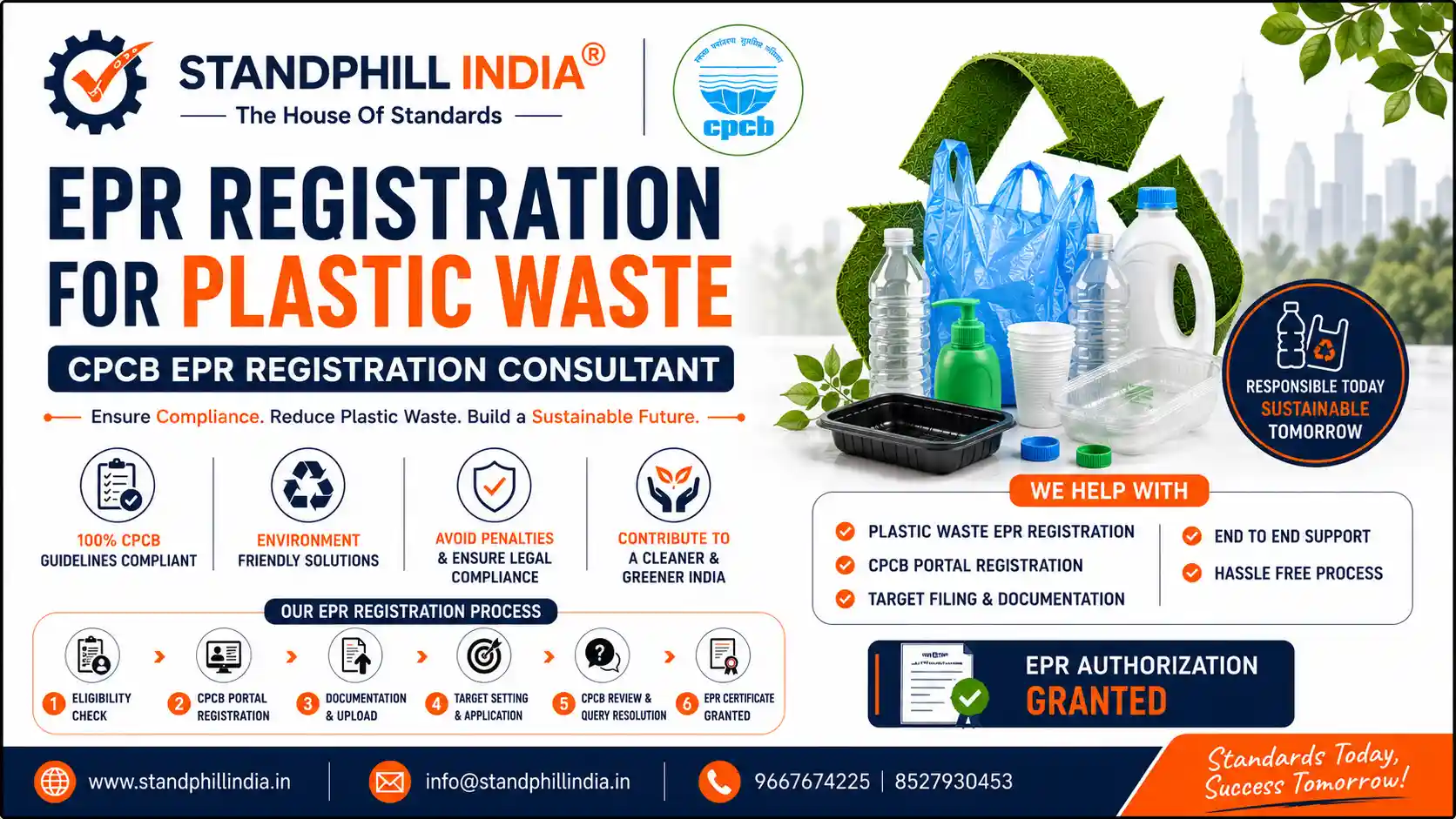
EPR Registration for Plastic Waste Management
Mandatory CPCB Plastic EPR Certificate for Producers, Importers & Brand Owners (PIBOs) | Plastic Waste Management Rules
EPR registration for plastic waste is a mandatory CPCB authorization that any producer, importer or brand owner (PIBO) using plastic packaging must obtain. The surprising part for many businesses: you do not have to make plastic to be liable - if your product is sold in, or even just arrives in, plastic packaging, bags or sheets, you need plastic EPR. Without it, importers can be blocked at customs and businesses face heavy fines. Standphill India handles the entire CPCB process end-to-end. Call +91-9667674225.
Plastic is everywhere in modern commerce - the pouch your product ships in, the bottle it is sold in, the shrink-wrap around a carton, the carry bag at the counter. India generates tens of thousands of tonnes of plastic waste every single day, and to manage it the Government applies the principle of Extended Producer Responsibility: the company that puts plastic on the market must take responsibility for collecting and recycling an equivalent amount. The way you formally accept that duty is by completing EPR registration for plastic waste on the CPCB's dedicated plastic portal.
What catches most businesses off guard is just how wide the net is. Plastic EPR does not only apply to plastic manufacturers. It applies to brand owners whose goods are packaged in plastic, to producers of plastic packaging, and crucially to importers - including importers whose products simply arrive wrapped in plastic film, bags or sheets. In other words, a company that imports, say, electronics or cosmetics in plastic packaging is an obligated entity for plastic EPR even though its core business has nothing to do with plastic manufacturing.
This is governed by the Plastic Waste Management (PWM) Rules (2016, as amended in 2022, 2024 and 2026), administered by CPCB through the centralised plastic EPR portal. The 2026 amendments have raised the bar further - introducing defined end-of-life categories, mandatory recycled-content declarations aligned to IS 14534:2023, and phased recycled-content targets. As part of the wider EPR registration framework, Standphill India handles your plastic EPR end-to-end, getting the category and targets right the first time.
Importing Goods in Plastic Packaging? You Likely Need Plastic EPR
Since July 2025 customs clearance is linked to EPR status - a missing plastic EPR certificate can strand your consignment. Get a free applicability check today.
What is EPR Registration for Plastic Waste?
EPR registration for plastic waste is the CPCB authorization that makes a business legally responsible for the plastic packaging it introduces into the Indian market. Under the principle of Extended Producer Responsibility, you are required to ensure that a defined percentage of the plastic you put out is collected back and recycled or processed each year, in line with annual targets that rise over time.
The rules sort plastic packaging into categories, broadly: rigid plastic packaging; flexible packaging of single or multi-layer (single-layer plastic); multi-layered plastic packaging with at least one layer of plastic and one of non-plastic; and plastic sheets or covers used for packaging, plus carry bags. Choosing the correct category is critical because each carries its own recycling and recycled-content obligations - and choosing the wrong one is one of the most common reasons an application is rejected and has to be re-filed.
To meet your targets, you typically partner with CPCB-registered recyclers or Plastic Waste Processors and buy EPR credits / certificates that prove the equivalent quantity was recycled. Standphill India sets up these tie-ups correctly so your obligation is met cleanly and your certificate stays valid.
Who Needs Plastic Waste EPR Registration?
Plastic EPR obligations fall on the entities that place plastic packaging on the market - the PIBOs - and the definition is deliberately broad:
Producers
Makers of plastic packaging & raw plastic
Brand Owners
Goods sold in plastic packaging
Importers
Even goods that merely arrive in plastic
Recyclers / PWPs
Registered plastic processors
The single most important thing to understand is the reach of the rule for importers and brand owners. You do not have to manufacture or sell plastic as a product - if plastic packaging is involved anywhere in how your goods reach the customer, you are very likely an obligated entity. If you are unsure, Standphill India will assess your exact position before you commit to anything.
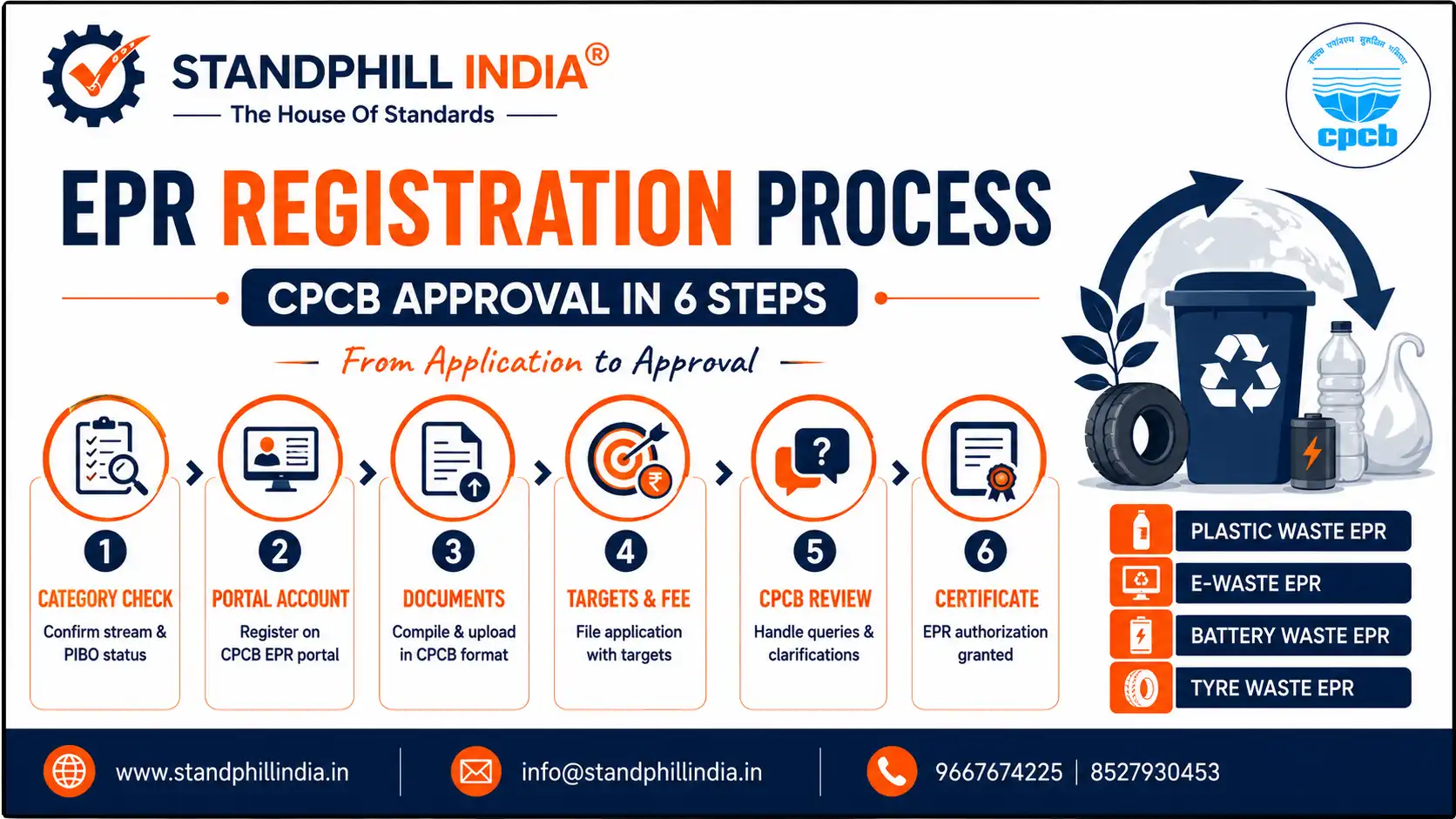
Plastic Waste EPR Registration Process
Plastic EPR is filed on the CPCB centralised plastic packaging portal. The journey to your certificate runs through these stages, all of which Standphill India manages for you:
Applicability
Confirm PIBO status
Portal Account
On the CPCB plastic portal
Documents
Compile in CPCB format
Targets & Fee
File with targets
CPCB Review
Handle queries
Certificate
EPR granted
A clean application is usually approved in 15-30 working days; queries can extend it to 35-40 days. For plastic specifically, the biggest delay-causers are picking the wrong plastic category and under-declaring your packaging quantity (in metric tonnes) - both of which trigger CPCB queries or audits. We get these exactly right before filing.
Documents Required for Plastic Waste EPR
The core document set CPCB expects for plastic EPR is consistent and straightforward when prepared correctly:
- Company PAN, GST and CIN / incorporation documents
- Import Export Code (IEC) - for importers
- Authorised signatory ID and authorisation letter
- Plastic packaging category and annual quantity data (in metric tonnes)
- Product / packaging details and material composition
- Tie-up agreements with CPCB-registered recyclers / Plastic Waste Processors
- EPR action plan with annual recycling targets
Get the tonnage and category right: CPCB assigns your targets based on the weight (in MT) and type of plastic packaging you declare. Under-declaring to reduce the burden triggers mandatory audits and Environmental Compensation that far exceeds the original target cost. Standphill India helps you declare accurately and defensibly.
Plastic Waste EPR - Targets, Validity & Penalties
| Issuing Authority | Central Pollution Control Board (CPCB), under MoEFCC |
| Legal Basis | Plastic Waste Management Rules, 2016 (amended 2022, 2024, 2026) |
| Who Registers | Producers, Importers, Brand Owners (PIBOs) & Plastic Waste Processors |
| Categories | Rigid, flexible (single-layer), multi-layered, and sheets / carry bags |
| Timeline | 15-30 working days (clean application); longer if CPCB raises queries |
| Targets | Annual recycling & recycled-content targets that rise over time (IS 14534:2023 labelling) |
| Penalty | Environmental Compensation up to ₹1 lakh/day; customs block; tender blacklisting |
The financial stakes are real and structured to keep you compliant. If you miss your annual recycling target, CPCB levies Environmental Compensation (EC) on the shortfall - and importantly, paying EC does not cancel the obligation. The unmet target is carried forward for up to three financial years, with partial EC refunds if you catch up (around 75% if fulfilled in year one, falling to 40% by year three, and forfeited after that). For importers there is an added pressure point: since July 2025, customs clearance is tied to EPR status, so a missing plastic EPR certificate can hold a shipment at the port. Standphill India helps you plan recycler tie-ups early so you never fall into the EC trap.
Get Your Plastic EPR Certificate - Accurately, the First Time
Whether you manufacture plastic packaging, sell goods packaged in plastic, or import products that arrive in plastic wrapping - Standphill India gets your category right, declares your tonnage correctly, sets up recycler tie-ups, and secures your CPCB plastic EPR certificate without costly re-filings or audits.
Why Choose Standphill India
Plastic EPR trips up businesses on two specific points: the wide reach of the rule (which pulls in importers and brand owners who never expected to be liable) and the technical detail of category and tonnage (which decides your targets). Standphill India is a specialist EPR registration consultant for plastic waste: we confirm your applicability, pick the correct plastic category, declare quantities accurately, arrange CPCB-registered recycler tie-ups, file on the plastic portal, and manage your annual returns - so your certificate is granted cleanly and stays valid.
Related EPR Registration Guides
EPR Registration - Complete Guide (All Waste Streams) EPR Registration for E-Waste Management EPR Registration for Battery Waste EPR Registration for Tyre Waste EPR Registration Consultant for Used OilFrequently Asked Questions
Ask About Plastic Waste EPR Registration
Tell us your product – we reply with your EPR obligation & a quote within one business day.
★ Why Standphill India?
- 20+ Years of BIS Certification Experience
- 10,000+ Certifications Delivered Globally
- Dedicated Teams for CRS, FMCS & ISI Mark
- End-to-End Documentation & Filing Support
- Fast Response & Practical Compliance Guidance
- Support for Indian & Foreign Manufacturers
Get Free Call Back
Our Services
- BIS (ISI Mark) for Foreign Manufacturers
- Domestic BIS (ISI Mark) Certification
- BIS Certificate of Conformity (CoC)
- BIS Hallmarking
- BIS Licence for Toys
- ECO Mark Certification
- TAC Approval for Automobile
- Drug Licence
- Peso Certification
- BIS (CRS) Registration
- WPC-ETA Approval
- BEE Certification
- E-Waste Management (EPR)
- EPR for Plastic Waste
- EPR for Battery Waste
- CE Certification
- UL Certification
- ROHS Licence
- Standardization Division
- Import / Export Licence
- FSSAI Certification
- ISO Registration
- Trademark Registration
- Make in India Support
- AG-Mark Licence
- Third Party Monitoring
Client Testimonials
Their team was very knowledgeable and helped us every step of the way. Standphill India is the best BIS certification consultants for any type of BIS certification.

Chintan Shah (AGM)
Sudeep Nutrition P.Ltd



Featured Guide
Complete BIS CRS certification guide for electronic products in India — free to read.
Read CRS Certification Guide📞 Contact Standphill India
+91-9667674225 info@standphillindia.in WhatsApp Now Greater Noida West, UPGet Expert BIS Certification Support for Your Business
Connect with Standphill India for complete support with BIS certification, CRS registration, WPC approval, FMCS compliance, and related regulatory services. Our team helps businesses with documentation, testing coordination, application support, and end-to-end compliance guidance.
Request Free Consultation
Share your requirement and our team will contact you shortly.