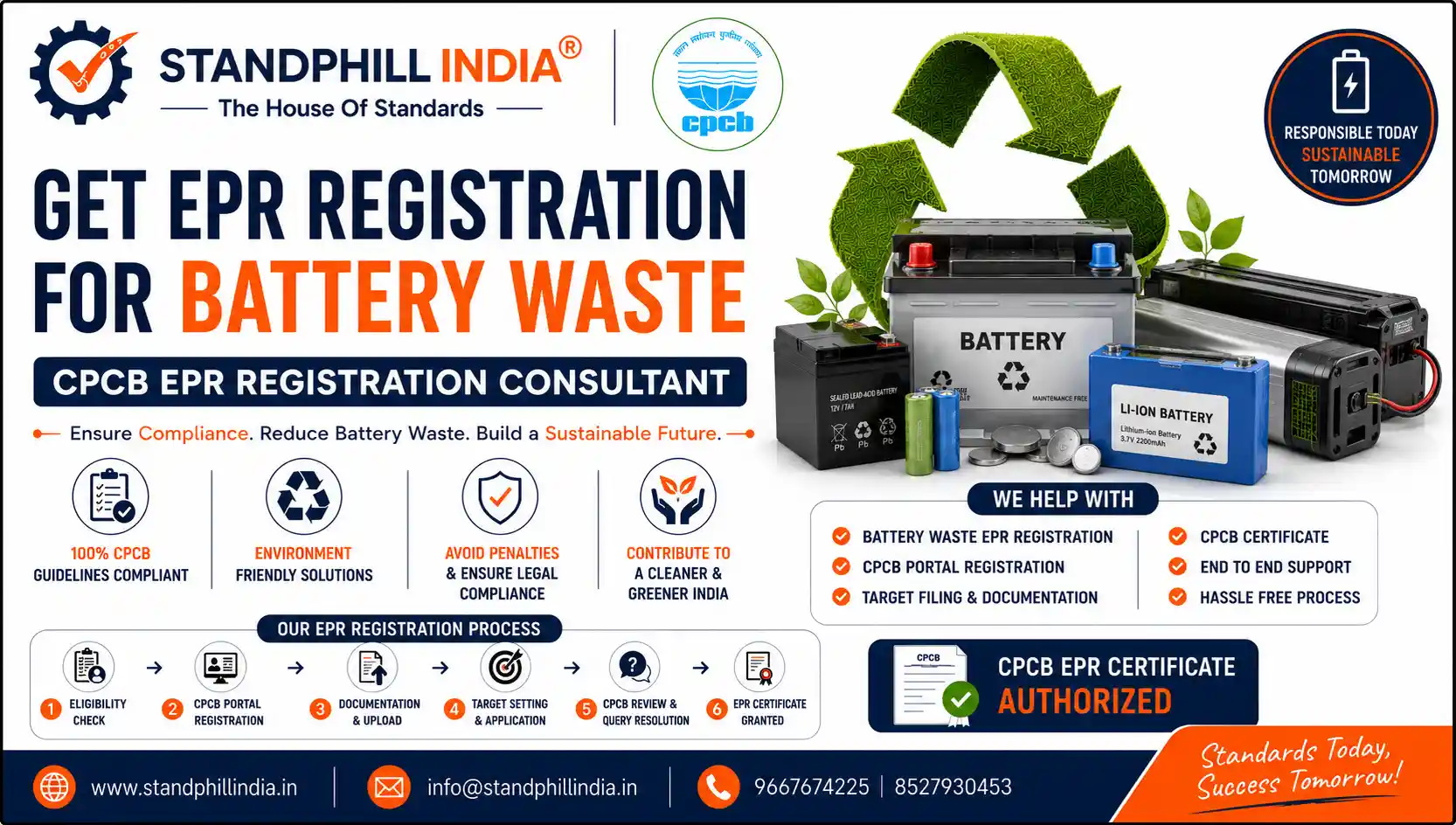
EPR Registration for Battery Waste Management in India
Mandatory CPCB Battery EPR Certificate under the Battery Waste Management Rules, 2022 | All Battery Types incl. Lithium-Ion
EPR registration for battery waste is a mandatory CPCB authorization that every manufacturer, importer and brand owner of batteries must obtain under the Battery Waste Management Rules, 2022. It covers all battery types - including lithium-ion, lead-acid, nickel and other chemistries - placed on the Indian market. From March 2026, batteries must also display EPR registration and traceability information via labels or QR codes. Standphill India handles the entire CPCB process end-to-end. Call +91-9667674225.
Batteries power everything from phones and laptops to electric vehicles and industrial backup systems - and when they reach end of life, they become one of the most hazardous and valuable waste streams there is. To ensure they are collected and recycled rather than dumped, the Government holds battery producers and importers responsible through EPR registration for battery waste, a CPCB authorization under the Battery Waste Management Rules, 2022.
Battery EPR applies to anyone who places batteries on the Indian market: manufacturers of batteries, importers of batteries (whether standalone or built into equipment and vehicles), and brand owners selling batteries under their own label. The rules cover all battery chemistries - portable batteries, automotive and industrial lead-acid, and increasingly the fast-growing category of lithium-ion batteries used in electronics and electric mobility.
A significant 2026 development affects every battery business: from March 2026, batteries are required to display EPR registration and traceability information via labels or QR codes, making compliance visible right on the product. Combined with rising recycling targets and the EPR-credit system, this makes accurate registration and target management essential. As part of the wider EPR registration framework, Standphill India handles your battery EPR end-to-end.
Selling or Importing Batteries? QR-Code EPR is Coming in 2026
From March 2026, batteries must carry EPR registration and traceability via QR codes. Get registered and compliant before the labelling requirement bites.
What is EPR Registration for Battery Waste?
EPR registration for battery waste is the CPCB authorization that makes battery producers and importers legally responsible for collecting back and recycling the batteries they place on the market. It is mandated under the Battery Waste Management Rules, 2022, which replaced the older Batteries (Management and Handling) Rules and apply a full Extended Producer Responsibility model to the sector.
The rules cover all types of batteries regardless of shape, size or chemistry - portable batteries, automotive batteries, industrial batteries, and electric-vehicle batteries, spanning lead-acid, nickel-cadmium, nickel-metal-hydride and lithium-ion. Producers are assigned annual recycling and refurbishment targets based on the quantity they placed on the market, and these obligations increase over time as the framework matures.
Compliance works through a centralised CPCB portal and an EPR-certificate system: producers must track battery sales volumes, calculate their recycling obligation, and obtain EPR certificates from registered recyclers to demonstrate the equivalent quantity was recycled. Planning these certificate purchases early in the financial year is critical, because last-minute gaps are a common cause of compliance failures. Standphill India manages this complete cycle for you.
Who Needs Battery Waste EPR Registration?
Battery EPR obligations fall on those who place batteries on the Indian market, in any form:
Manufacturers
Makers of any battery type
Importers
Batteries standalone or in equipment/EVs
Brand Owners
Batteries sold under own brand
Recyclers
Registered battery recyclers
An important nuance: you are covered not only if you sell batteries as a standalone product, but also if you import equipment or vehicles fitted with batteries. As electric mobility and lithium-ion electronics grow, more and more businesses are being pulled into battery EPR - often alongside their e-waste obligations. Standphill India confirms your exact obligations across both streams.
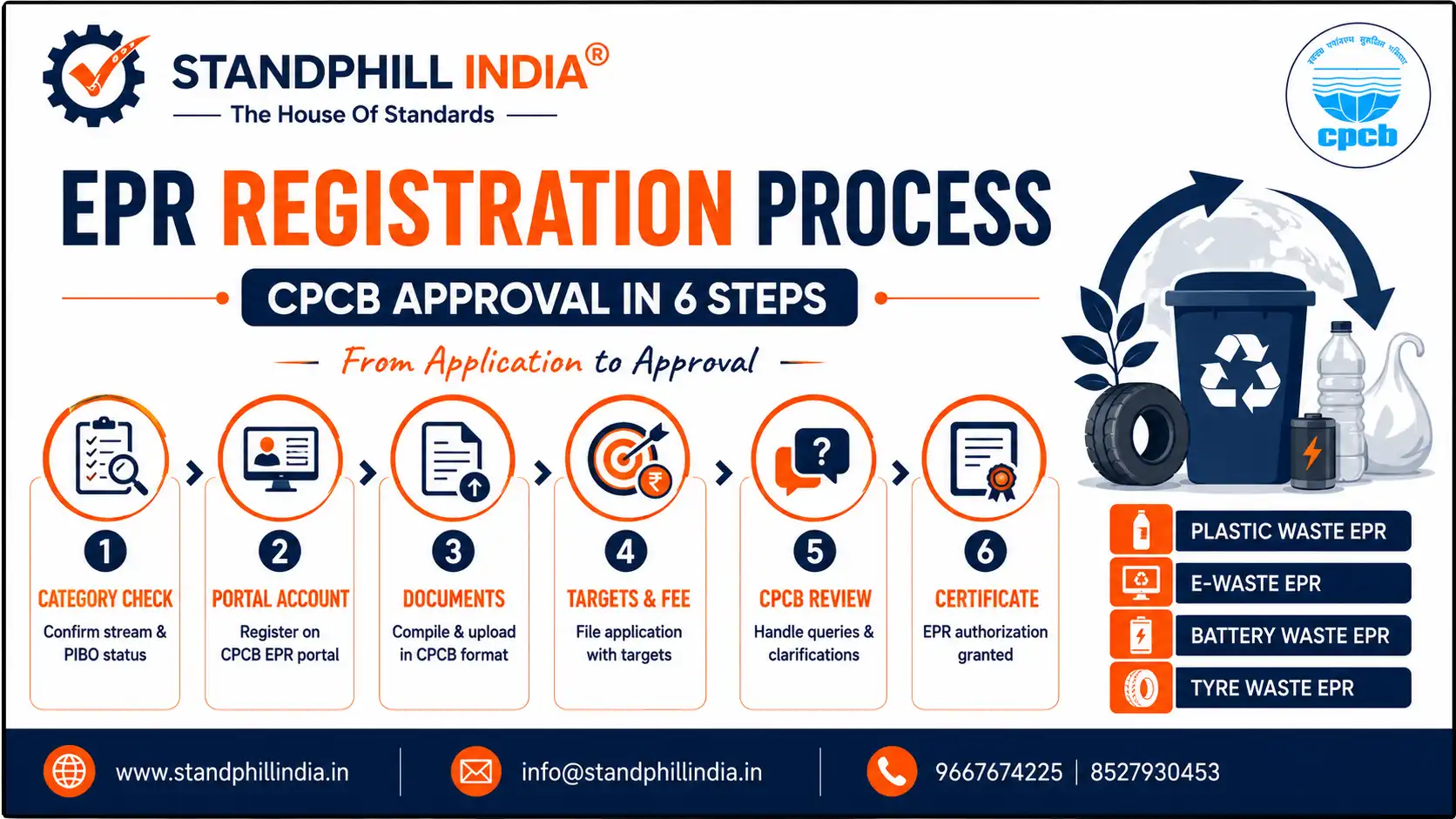
Battery Waste EPR Registration Process
Battery EPR is filed on the CPCB battery EPR portal. The path to your registration runs through these stages, all managed by Standphill India:
Applicability
Confirm PIBO status
Portal Account
On the CPCB battery portal
Documents
Compile in CPCB format
Targets & Fee
File with targets
CPCB Review
Handle queries
Certificate
EPR granted
A clean application is usually approved in 15-30 working days; queries can extend it to 35-40 days. For batteries, the key compliance risk is not just registration but ongoing target management - tracking sales volumes and buying recycling certificates in time. We set this up so you stay continuously compliant, not just registered.
Documents Required for Battery Waste EPR
The core documents CPCB expects for battery EPR are straightforward when prepared correctly:
- Company PAN, GST and CIN / incorporation documents
- Import Export Code (IEC) - for importers
- Authorised signatory ID and authorisation letter
- Battery type / chemistry and annual quantity data
- Product details (incl. batteries built into equipment or vehicles)
- Tie-up agreements with CPCB-registered battery recyclers
- EPR plan with annual recycling / refurbishment targets
Plan your recycling certificates early: battery compliance fails most often not at registration but at return-filing, when a producer discovers it has not bought enough EPR certificates to cover its obligation. Buying certificates early in the financial year avoids a year-end scramble and portal-flagged gaps. Standphill India plans this with you from the start.
Battery Waste EPR - Targets, Validity & Penalties
| Issuing Authority | Central Pollution Control Board (CPCB), under MoEFCC |
| Legal Basis | Battery Waste Management Rules, 2022 |
| Who Registers | Manufacturers, Importers, Brand Owners & registered recyclers |
| Scope | All battery types - portable, automotive, industrial & EV (incl. lithium-ion) |
| Timeline | 15-30 working days (clean application); longer if CPCB raises queries |
| 2026 Requirement | EPR registration & traceability via labels / QR codes from March 2026 |
| Penalty | Environmental Compensation; target carry-forward; enforcement action |
Battery EPR non-compliance is penalised through Environmental Compensation on unmet recycling obligations, and the way targets work means problems compound if ignored - tracked sales create obligations that must be matched with recycling certificates, and gaps get flagged by the CPCB portal at return-filing. There are documented cases where a missing certificate purchase delayed compliance approval by weeks. From March 2026, the added QR-code/labelling requirement makes a producer's EPR status visible on the product itself, raising the stakes for getting it right. Standphill India tracks your volumes, plans your certificate purchases, and files your returns so you stay continuously compliant.
Get Your Battery EPR Certificate - and Stay Compliant All Year
Whether you make batteries, import them standalone, or import equipment and EVs fitted with batteries, Standphill India secures your CPCB battery EPR registration, tracks your sales volumes, plans your recycling-certificate purchases, and keeps you ready for the 2026 QR-code traceability requirement.
Why Choose Standphill India
Battery EPR is unusual because the hard part is not registration but staying compliant all year - tracking volumes and buying recycling certificates in time, with QR-code traceability arriving in 2026. Standphill India is a specialist EPR registration consultant for battery waste: we register you on the CPCB portal, track your sales volumes, plan and time your recycling-certificate purchases, file your returns, and prepare you for the labelling requirement - so you are not just registered, but continuously compliant.
Related EPR Registration Guides
EPR Registration - Complete Guide (All Waste Streams) EPR Registration for Plastic Waste EPR Registration for E-Waste Management EPR Registration for Tyre Waste EPR Registration Consultant for Used OilFrequently Asked Questions
Ask About Battery Waste EPR Registration
Tell us your product – we reply with your EPR obligation & a quote within one business day.
★ Why Standphill India?
- 20+ Years of BIS Certification Experience
- 10,000+ Certifications Delivered Globally
- Dedicated Teams for CRS, FMCS & ISI Mark
- End-to-End Documentation & Filing Support
- Fast Response & Practical Compliance Guidance
- Support for Indian & Foreign Manufacturers
Get Free Call Back
Our Services
- BIS (ISI Mark) for Foreign Manufacturers
- Domestic BIS (ISI Mark) Certification
- BIS Certificate of Conformity (CoC)
- BIS Hallmarking
- BIS Licence for Toys
- ECO Mark Certification
- TAC Approval for Automobile
- Drug Licence
- Peso Certification
- BIS (CRS) Registration
- WPC-ETA Approval
- BEE Certification
- E-Waste Management (EPR)
- EPR for Plastic Waste
- EPR for Battery Waste
- CE Certification
- UL Certification
- ROHS Licence
- Standardization Division
- Import / Export Licence
- FSSAI Certification
- ISO Registration
- Trademark Registration
- Make in India Support
- AG-Mark Licence
- Third Party Monitoring
Client Testimonials
Their team was very knowledgeable and helped us every step of the way. Standphill India is the best BIS certification consultants for any type of BIS certification.

Chintan Shah (AGM)
Sudeep Nutrition P.Ltd




Featured Guide
Complete BIS CRS certification guide for electronic products in India — free to read.
Read CRS Certification Guide📞 Contact Standphill India
+91-9667674225 info@standphillindia.in WhatsApp Now Greater Noida West, UPGet Expert BIS Certification Support for Your Business
Connect with Standphill India for complete support with BIS certification, CRS registration, WPC approval, FMCS compliance, and related regulatory services. Our team helps businesses with documentation, testing coordination, application support, and end-to-end compliance guidance.
Request Free Consultation
Share your requirement and our team will contact you shortly.