Welcome to Standphill India

BIS Certification for Indian Manufacturers - Procedure, Documents, Fees
If you are an Indian manufacturer, seller, importer, or if you deal in purchasing or selling products, you have probably heard about BIS certification. Maybe someone told you that your product needs it, or you saw it mentioned in a government notice. In simple terms, BIS certification is an approval that shows your product meets Indian quality and safety standards.
It is important because many products cannot be legally sold in India without it. So, if you want to sell your goods smoothly and build trust with customers, BIS certification is something you should not ignore.
In this article, you will learn what exactly BIS Certification is, why it matters for Indian manufacturers, and how you can go about getting it. Let us break it down in the simplest way possible.
What is BIS Certification and What Does It Mean for Indian Manufacturers?
BIS stands for Bureau of Indian Standards. It is the national standards organization of India, working under the Ministry of Consumer Affairs, Food and Public Distribution. Under the Bureau of Indian Standards Act, 2016, BIS has the authority to set quality and safety standards for products sold in India. It also checks and certifies products to ensure they meet these standards.
For Indian manufacturers, this means that their products must follow the required quality rules set by BIS. Once the product meets these standards, it gets BIS certification, which allows it to be sold legally in the Indian market and builds trust among customers.
For Indian manufacturers, BIS certification is basically an official confirmation that your product has been tested and meets the Indian Standards (IS) set for that specific product category.
When a product carries the BIS mark, it clearly tells customers — and the market — that the product is safe, reliable, and made under proper quality-controlled conditions.
In simple terms, if your product is BIS certified, it means that the government has approved your product for quality. It is like a trust seal that gives your business credibility and assures customers that they are buying a safe and tested product.
BIS certification is not just a single certificate. It is actually a group of different schemes and certifications, each designed for different types of products and manufacturers. Depending on what you manufacture and where your business is based, the type of BIS certification you need can be different.
Types of BIS Product Certification for Indian Manufacturers
BIS offers several certification schemes, and each one serves a different purpose. Some are for Indian manufacturers, some are specially designed for foreign manufacturers who want to export their products to India, and some apply to specific product categories like jewellery or eco-friendly goods.
Here is a simple overview of the major BIS schemes available:
1. ISI Mark Certification (Scheme I) – For Indian manufacturers of standard industrial and consumer products. It shows that the product meets Indian quality standards.
2. Compulsory Registration Scheme (CRS) – Mainly for electronic and IT products, including both Indian-made and imported goods.
3. Foreign Manufacturer Certification Scheme (FMCS) – For manufacturers based outside India who want to sell their products in the Indian market.
4. BIS Hallmarking Scheme – For gold and silver jewellery and artefacts. It ensures the purity of precious metals.
5. Eco Mark Scheme – For products that meet environment-friendly standards and are safe for nature.
How Indian Manufacturers Can Apply for BIS Product Certification?
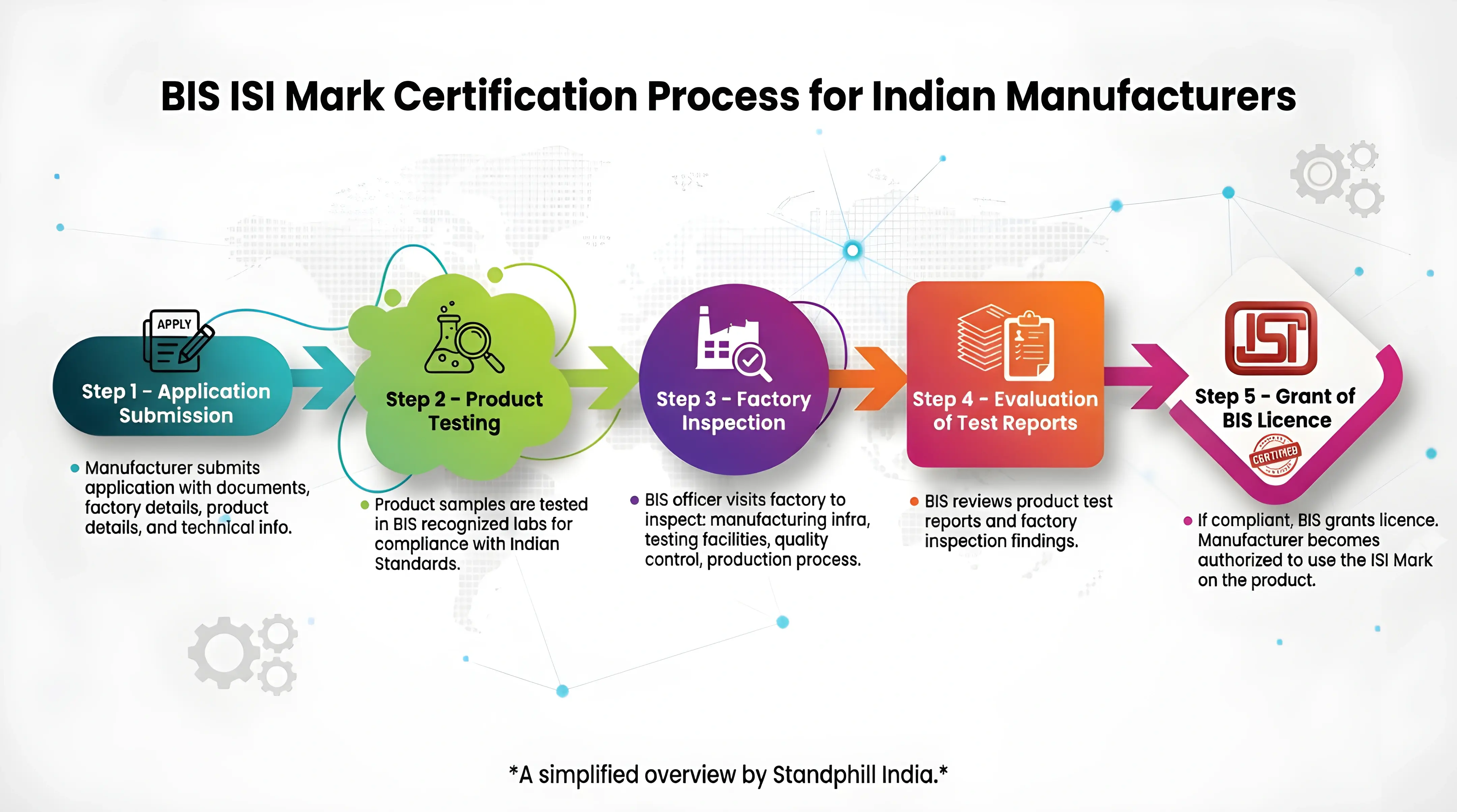
The process for getting BIS certification depends on the scheme, but the overall steps are quite similar. Here is a simple way to understand it:
First, you need to identify the correct Indian Standard (IS) for your product. Every product under BIS has a specific standard assigned to it. You can check this on the official BIS website or take help from a professional consultant to avoid confusion.
Once you know the correct IS standard, the next step is to submit your application to BIS. Along with the application, you must provide all required documents and send product samples for testing in a BIS-approved laboratory.
After the product testing is completed, BIS will inspect your manufacturing unit. During this audit, they check your production process, machinery, and quality control system to ensure everything meets the required standards.
If everything is found to be correct and compliant, BIS will issue the certification, allowing you to legally sell your product in the Indian market.
What Documents Are Required to Apply for BIS Certification?
The exact documents may differ depending on the scheme, but most BIS applications usually require the following:
1. Company registration certificate or business licence
2. Trademark registration certificate (if available)
3. ISO certificates of the manufacturer (if available)
4. Product manual and technical specifications
5. Lab test reports from a BIS-recognised laboratory
6. List of products to be certified
7. Authorisation letter (if applying through a consultant or representative)
8. Factory layout plan and details of the manufacturing process
9. Declaration of compliance with the relevant Indian Standard
It is always better to keep all these documents ready before starting the application. If even one document is missing, it can delay the BIS certification process.
Cost of BIS Certification for Indian Manufacturers
BIS certification fees are not fixed and can vary depending on the product type, testing requirements, and inspection process. Generally, for Indian manufacturers, the total cost can range from ₹25,000 to over ₹2,50,000.
Here is a simple breakdown of common costs:
| S. No. | Particulars | Amount |
|---|---|---|
| 1 | Application Fee | Around ₹1,000 |
| 2 | Audit / Inspection Fee (Plus travel and lodging expenses for BIS officers, if applicable) |
About ₹7,000 per man-day |
| 3 | Marking Fee (Varies by product) |
Minimum around ₹1,000 |
| 4 | Sample Testing Fee | Depends on product & lab |
| 5 | Licence Fee | Generally around ₹1,000 per product |
For electronic and IT products under the CRS scheme, the cost is usually higher. It may range from approximately ₹28,000 to ₹53,000 per model, plus testing charges and GST.
Important points to note:
• MSMEs may get concessions, such as discounts on marking fees (up to 80% for micro enterprises, 50% for small, and 20% for medium enterprises).
• The certification is usually valid for a limited period (often 2 years), after which renewal fees apply.
• The exact cost depends on your product category and certification scheme.
For accurate pricing, it is always best to check with BIS or consult a certified BIS consultant like Standphill India before applying.
How to Get BIS Certification for Your Products?
The process is simple and can be understood in a few basic steps:
Step 1 – Identify the Indian Standard (IS):
First, find the correct Indian Standard (IS) for your product from the BIS website, or take help from a consultant like Standphill India, who can guide you in selecting the right standard.
Step 2 – Submit Application:
Prepare and submit your application to BIS along with all the required documents.
Step 3 – Product Testing:
Send product samples to a BIS-recognised laboratory for testing and quality checks.
Step 4 – Clarifications (if required):
If BIS raises any questions or observations after testing, you need to respond and provide the required clarification.
Step 5 – Factory Inspection:
BIS will visit your manufacturing facility to inspect your production process and quality control system.
Step 6 – Certification Approval:
If everything meets the required standards, BIS will issue your certification, allowing you to sell your product legally in India.
BIS Certification Process for Indian Manufacturers
Detailed Explanation of All Major BIS Certifications and Schemes
1. ISI Mark Certification (Scheme I) – What It Is and Why It Matters
The ISI Mark is one of the most widely recognised quality marks in India. You may have seen it on products like electrical switches, helmets, LPG cylinders, and packaged drinking water. It is issued under BIS Scheme I, also known as the ISI Mark Certification Scheme.
What is it?
The ISI mark confirms that a product meets the required Indian Standard (IS) for quality, safety, and reliability. For many products, this certification is mandatory before selling in India.
Which products are covered?
• Electrical products (cables, switches, fans, MCBs, motors)
• Cement, steel, and construction materials
• Packaged drinking water
• LPG cylinders and regulators
• Safety helmets and PPE
• Infant food products
• Automotive components
Is it mandatory?
Yes, for many safety-related products it is mandatory. Selling such products without the ISI mark is illegal. For some categories, it is voluntary but still improves trust and credibility.
How to get it?
You must identify the correct IS standard, apply to BIS, test product samples in a BIS-approved lab, and pass a factory audit. After approval, BIS issues the ISI licence.
2. CRS Certification – Compulsory Registration Scheme
CRS is designed for electronic and IT products. It ensures that only safe and tested electronic products are sold in India.
Who is it for?
Both Indian manufacturers and importers.
Covered products include:
• Mobile phones and tablets
• LED lights
• Power banks and chargers
• Laptops and computers
• Smart watches
• Printers and routers
• Kitchen appliances
Is it mandatory?
Yes. If your product is listed under CRS, registration is compulsory before selling in India.
How to get it?
Apply online via the BIS portal, submit documents, test the product in a BIS-recognised lab, and after approval, registration is granted. No factory audit is required under CRS.
3. FMCS Certificate – Foreign Manufacturer Certification Scheme
FMCS is exclusively for foreign manufacturers who want to sell their products in India.
Purpose
To ensure imported products meet the same Indian quality standards as domestic products.
Who needs it?
Only manufacturers outside India exporting products to India.
Covered products
Same as ISI and CRS categories but for foreign companies.
Is it mandatory?
Yes, for products under compulsory BIS certification categories.
Process
Foreign manufacturers apply through an Authorized Indian Representative (AIR), send samples for testing, and BIS conducts an overseas factory audit before granting certification.
4. BIS Hallmarking Scheme
Hallmarking is related to gold and silver jewellery and ensures purity.
What does it certify?
It confirms the purity of gold and silver items after proper testing.
Covered products
• Gold jewellery
• Silver jewellery
• Gold coins
• Silver artefacts
Is it mandatory?
Yes, for 14, 18, and 22 carat gold jewellery in India.
How to get BIS Hallmarking?
Jewellers need to first get registered with BIS as a licensed jeweller. Once registered, they can send their jewellery to a BIS-recognised Assaying and Hallmarking Centre (AHC), where the purity of the jewellery is tested. If it passes the test, the hallmark is applied to the jewellery and the jeweller receives a certificate. The entire process is designed to be accessible to jewellers of all sizes, including small and local jewellers.
5. Eco Mark Scheme / Certification
The Eco Mark is a label issued by BIS for products that are considered environmentally friendly throughout their lifecycle — from manufacturing to disposal. Think of it as India's official green label for products.
Who is this scheme for?
Eco Mark is for Indian manufacturers who produce goods that have a lower environmental impact compared to conventional products. It is a voluntary certification, which means no product is legally required to have the Eco Mark.
However, having it can give your product a significant edge in a market where consumers are increasingly conscious about sustainability and the environment.
Which products are covered under Eco Mark?
Eco Mark certification is available for a wide range of product categories, including:
• Soaps and detergents
• Paper and paper products
• Paints and varnishes
• Packaging materials
• Lubricating oils
• Electrical and electronic products
• Food items and agricultural products
• Textiles and leather goods
How can you obtain Eco Mark certification for your products?
The process starts with identifying the relevant Eco Mark standard for your specific product category from the BIS website. Once you know the standard, you submit an application to BIS along with the required documents. Product samples are then sent for testing at a BIS-recognised laboratory to check whether they meet the environmental criteria defined in the Eco Mark standard.
After testing, your manufacturing facility goes through an environmental management system review and a BIS audit to ensure your production processes themselves are compliant with the Eco Mark requirements. Once your facility and products pass the audit successfully, BIS will grant you the Eco Mark certification. The certification is typically valid for a specific period and requires renewal along with periodic surveillance.
Difference Between Mandatory and Voluntary BIS Certifications
Mandatory BIS certifications — like ISI mark for certain products and CRS for electronics — are required by law. You simply cannot sell those products without the certification. Selling without it can lead to legal action, product seizure, and heavy penalties.
Voluntary BIS certifications — like Eco Mark and certain ISI categories — are not legally required. However, businesses that do carry them benefit from a positive brand image, better consumer preference, and in some cases, government incentives and preference in procurement.
Products Covered Under BIS Certification
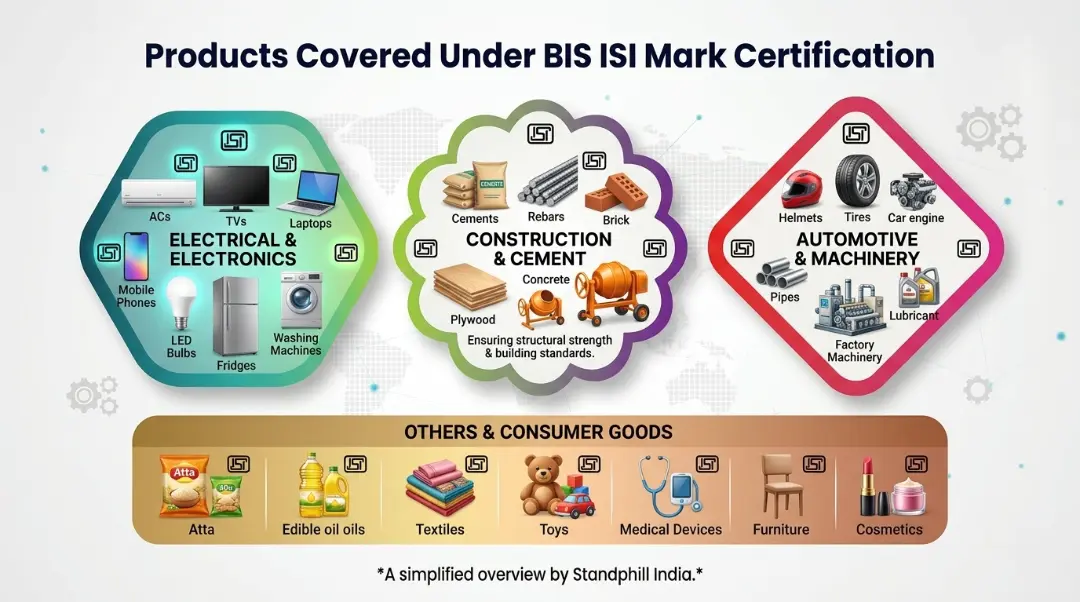
The BIS product certification scheme covers a wide range of regulated and quality-sensitive products across multiple industries.
Standphill India Presence Across India
Standphill India is a leading BIS certification consultancy with a strong presence across all States and Union Territories of India.
We support manufacturers from every major industrial cluster and production zone in the country, including MSMEs, medium enterprises, and large-scale manufacturers.
With our nationwide consultancy support network, we help businesses across India understand BIS requirements, prepare documentation, coordinate testing, and complete the certification process smoothly.
Standphill India has completed 10000+ domestic projects and continues to assist Indian manufacturers in meeting BIS compliance requirements across multiple industries.
Recent BIS Certifications Delivered by Standphill India
Standphill India has successfully assisted multiple manufacturers in obtaining BIS ISI Mark certification across different industries.
Shree Nagai Enterprises
Products Certified:
• Medical Textiles – Surgical Face Masks – IS 16289:2014
• Medical Textiles – Shoe Covers – IS 17349:2020
Himalayan Packaging Industries Pvt Ltd – Unit III
Product Certified:
• Safety of Toys – Mechanical and Physical Properties – IS 9873 (Part 1):2019
Soccer International Private Limited
Product Certified:
• Safety of Toys – Mechanical and Physical Properties – IS 9873 (Part 1):2019
Ampal Freeze Products LLP
Product Certified:
• Deep Freezers – Specification as per IS 7872:2020
These successful projects demonstrate Standphill India's expertise in handling BIS certification requirements across multiple industries and product segments.
Why Choose Standphill India for Your BIS Certification?
Getting BIS certification done on your own can be a long and confusing process — especially if this is your first time. Between identifying the right Indian Standard, preparing the correct documents, coordinating lab testing, responding to BIS observations, and managing the factory audit, there is a lot that can go wrong if you are not familiar with the process.
That is exactly where Standphill India comes in. We are one of the most trusted BIS Certification Consultants in India with deep experience across all major BIS schemes — ISI Mark, CRS, FMCS, Hallmarking, and Eco Mark. Our team has helped hundreds of manufacturers — small, medium, and large — successfully obtain their BIS certifications without unnecessary delays or complications.
Here is what makes us different:
1. Expert Guidance at Every Step
From finding the right IS number to the final certificate in your hands, we are with you throughout the process. You will never feel lost or confused.
2. Faster Processing
Because we know the process inside and out, we help you avoid common mistakes that lead to delays. Our clients typically get their certifications in significantly less time than manufacturers who apply on their own.
3. Document Preparation Support
We help you organise and prepare all the documents correctly the first time, so your application does not get rejected or stuck due to missing paperwork.
4. Lab Coordination
We work with BIS-recognised laboratories across India and can help coordinate your product testing smoothly.
5. Audit Readiness
We prepare your manufacturing facility for the BIS audit so that when the BIS officials arrive, everything is in perfect order.
6. Transparent Process
We believe in keeping our clients fully informed. You will always know where your application stands and what the next step is.
Whether you are a first-time applicant or someone looking to renew or expand your BIS certification, Standphill India has the expertise and experience to make the process simple and stress-free for you.
Simplify your BIS Certification process with Standphill India — because your business deserves certification done right.
Frequently Asked Questions (FAQ)
Q1. What is BIS Certification?
BIS Certification is an official approval issued by the Bureau of Indian Standards confirming that a product meets the required Indian Standards (IS) for quality, safety, and reliability. It allows manufacturers to legally sell their products in the Indian market.
Q2. How many types of BIS certification are there?
There are five major BIS certification schemes — ISI Mark Certification (Scheme I), Compulsory Registration Scheme (CRS), Foreign Manufacturer Certification Scheme (FMCS), BIS Hallmarking Scheme, and Eco Mark Scheme.
Q3. Is BIS certification mandatory for Indian manufacturers?
Yes, BIS certification is mandatory for products listed under Quality Control Orders. ISI Mark and CRS certification are legally required for many product categories before they can be sold in India.
Q4. What is the cost of BIS certification?
BIS certification cost typically ranges from ₹25,000 to over ₹2,50,000 depending on the product category, scheme and testing requirements. For the CRS scheme, the cost may range from ₹28,000 to ₹53,000 per model plus testing charges and GST.
Q5. How long does BIS certification take?
The BIS certification process typically takes 30 to 60 days, depending on product testing time, factory inspection scheduling, and documentation completeness.
Q6. What documents are required for BIS certification?
Common documents include the company registration certificate, trademark registration (if available), ISO certificates, product manual, lab test reports from a BIS-recognised laboratory, factory layout plan, list of products, authorisation letter, and declaration of compliance with the relevant Indian Standard.
Q7. What is the difference between ISI Mark and CRS Certification?
ISI Mark Certification (Scheme I) is for industrial and consumer products and requires a factory audit by BIS. CRS Certification is mainly for electronic and IT products like mobile phones, LED lights, and laptops, and does not require a factory audit.
Q8. Are MSMEs eligible for BIS fee concessions?
Yes. BIS provides concessions on marking fees for MSMEs — up to 80% for micro enterprises, 50% for small enterprises, and 20% for medium enterprises.
Q9. Is the Eco Mark scheme mandatory?
No. The Eco Mark scheme is entirely voluntary. However, products carrying the Eco Mark benefit from a positive brand image, better consumer preference, and in some cases, government incentives in procurement.
Q10. Does Standphill India provide support across India?
Yes. Standphill India has a strong presence across all States and Union Territories of India and supports manufacturers nationwide for ISI Mark, CRS, FMCS, Hallmarking, and Eco Mark certifications.
Get Expert BIS Certification Support for Your Business
Connect with Standphill India for complete support with BIS certification, CRS registration, WPC approval, FMCS compliance, and related regulatory services. Our team helps businesses with documentation, testing coordination, application support, and end-to-end compliance guidance.
Request Free Consultation
Share your requirement and our team will contact you shortly.