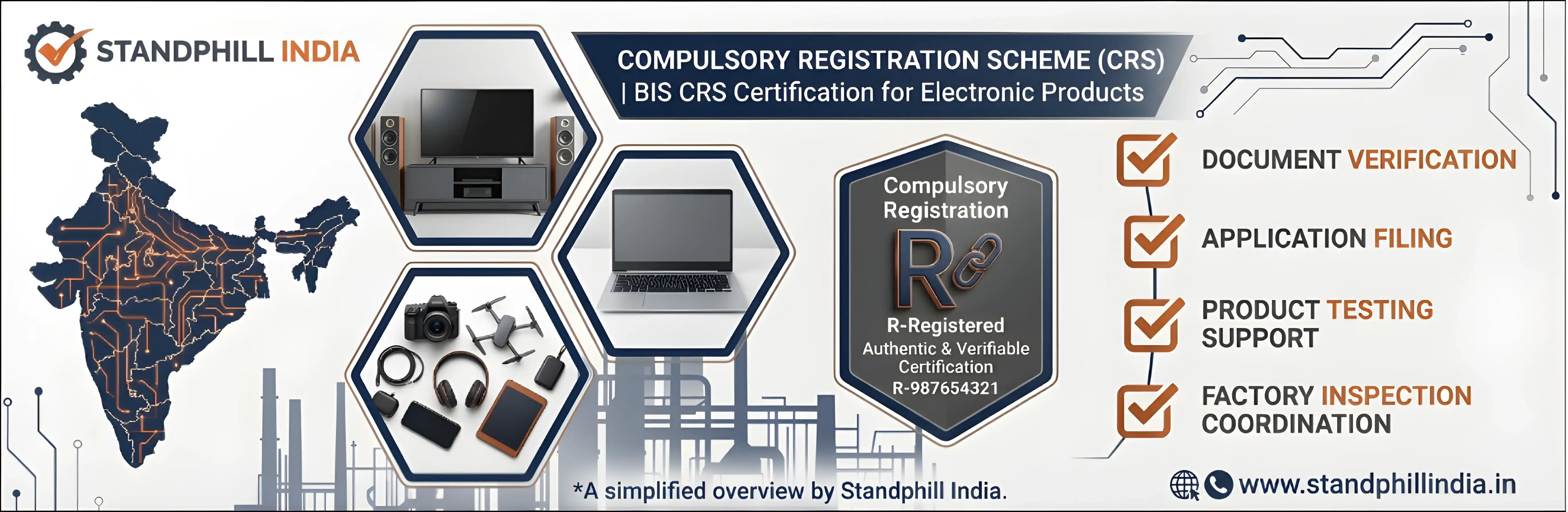
Compulsory Registration Scheme (CRS)
BIS CRS Certification for Electronic and IT Products in India
BIS CRS Certification - Key Facts
- CRS full form: Compulsory Registration Scheme, run by the Bureau of Indian Standards (BIS).
- What it covers: ~74 notified electronic and IT products (mobiles, laptops, LED lights, power banks, CCTV, and more).
- Mandatory: Yes - notified products cannot be made, imported, or sold in India without it.
- Factory audit: Not required - unlike ISI Mark or FMCS, CRS needs only lab testing plus self-declaration.
- Validity: Generally 2 years, renewable before expiry.
- Who applies: The manufacturer (foreign manufacturers need an Authorized Indian Representative).
- Output: A BIS registration with a unique R-Number and the BIS Standard Mark on the product.
- Overview
- What is BIS CRS Certification?
- What is the CRS Scheme?
- CRS vs ISI vs FMCS
- Authorities Involved
- Why Was CRS Introduced?
- Who Needs CRS Registration?
- Products Covered Under CRS
- Why CRS is Important
- CRS Certification Process
- Video Guide
- Documents Required
- Certification Cost
- Timeline
- Validity and Renewal
- Sample Grant Licence
- Recent Projects
- Why Standphill India?
- FAQ
Overview
The Compulsory Registration Scheme (CRS) is a mandatory BIS registration system for notified electronic and IT products in India. Under this scheme, the manufacturer must get the product tested in a BIS recognized laboratory, submit the registration application, and obtain BIS approval before the product is manufactured, imported, sold, or distributed in the Indian market.
Most businesses first hear about CRS when something goes wrong - a shipment held at customs, a marketplace listing rejected, or a buyer asking for mandatory BIS approval. In practice, if a product falls under the CRS product list, the manufacturer cannot legally enter the Indian market without BIS registration and proper product marking. This makes CRS one of the most important compliance routes for electronics and IT businesses entering or expanding in India.
CRS is also commonly referred to as BIS registration, CRS registration, CRS license, CRS (BIS) certificate, or simply the BIS CRS certificate - all describe the same approval.
| Authority | Bureau of Indian Standards (BIS) |
|---|---|
| Scheme Name | Compulsory Registration Scheme (CRS) |
| Regulatory Basis | Scheme II, BIS (Conformity Assessment) Regulations 2018 |
| Applicable Category | Electronic and IT Products (~74 notified products) |
| Type of Approval | BIS Registration with Product Marking (R-Number) |
| Testing Requirement | BIS Recognized Laboratory |
| Factory Audit | Not Required |
| Validity | Generally 2 Years (Renewable) |
| Applicant | Manufacturer |
What is BIS CRS Certification?
BIS CRS Certification is a mandatory BIS registration framework for many electronic and IT products sold in India. CRS stands for Compulsory Registration Scheme, introduced in 2012 by the Department of Electronics and Information Technology (now MeitY) together with BIS.
In simple words, if your electronic product falls under the notified product list, you cannot legally place that product in the Indian market unless the manufacturer completes BIS registration under the Compulsory Registration Scheme.
The system was created to make sure that products like electronic devices, power equipment, lighting products and IT goods entering the Indian market meet the applicable Indian safety and quality requirements. For manufacturers, CRS registration is not just a document - it is the formal compliance route that opens lawful market access in India, after which the product can carry the BIS Standard Mark and its unique R-Number.
What is the Compulsory Registration Scheme (CRS)?
The Compulsory Registration Scheme (CRS) is a product registration mechanism operated by the Bureau of Indian Standards (BIS) for electronic and IT products covered under notified orders of the Central Government. It runs under Scheme II of the BIS (Conformity Assessment) Regulations 2018 and is based on the manufacturer's self-declaration of conformity supported by product testing. Under this scheme:
- The product must conform to the applicable Indian Standard
- Testing must be done in a BIS recognized laboratory
- The manufacturer submits the registration application
- BIS scrutinizes the documents and technical report
- Registration is granted, and a unique R-Number is issued, when the submission is found satisfactory
Because it relies on lab testing and self-declaration rather than a physical factory inspection, CRS is generally faster than ISI Mark or FMCS certification.
CRS vs ISI Mark vs FMCS - Quick Comparison
Many businesses confuse the three main BIS routes. Here is how CRS differs at a glance:
| Basis | CRS (Scheme II) | ISI Mark (Scheme I) | FMCS |
|---|---|---|---|
| Best for | Electronics & IT products | Indian manufacturers (general goods) | Foreign manufacturers |
| Factory audit | Not required | Required | Required (overseas) |
| Mark issued | BIS Standard Mark + R-Number | ISI Mark + CM/L number | ISI Mark + CM/L number |
| Basis | Lab testing + self-declaration | Testing + inspection | Testing + inspection |
| Typical speed | Faster | Moderate | Longer (4–6 months) |
Not sure which one applies? Tell us your product and we'll confirm the right scheme and Indian Standard.
Why Was the CRS Scheme Introduced?
India's electronics market expanded rapidly over the years. With that growth came a major risk - low-quality, unsafe and substandard electronic products entering the market. The CRS scheme was introduced in 2012 to reduce that risk and protect consumers. The scheme helps ensure that products sold in India:
- Meet Indian safety standards
- Reduce the risk of unsafe electrical products
- Improve consumer protection
- Prevent unfair trade through poor-quality goods
- Improve product reliability and market confidence
For businesses, the scheme also improves trust, compliance credibility and market acceptance.
Who Needs BIS CRS Registration?
CRS registration is required for the manufacturer of the product. This includes:
- Indian manufacturers producing electronic or IT goods in India
- Foreign manufacturers exporting products into India
- Global electronics brands entering the Indian market through manufacturing entities
The registration is generally granted to the manufacturer, not to the importer, trader, or distributor. If the manufacturer is located outside India, an Authorized Indian Representative (AIR) is usually required.
Read also: BIS Certification for Indian Manufacturers | BIS FMCS for Foreign Manufacturers
Products Covered Under BIS CRS (Full List of 74)
The Compulsory Registration Scheme currently covers 74 notified electronic and IT products, each with its applicable Indian Standard (IS). Use the search box below to quickly find your product and its IS number. Manufacturing in India? See our BIS certification for Indian manufacturers. Exporting from abroad? See BIS FMCS certification.
The notified list is updated by BIS from time to time. Not sure if your product is covered or which IS applies? Talk to our team for a quick, free check.
Why BIS CRS Certification is Important
- Legal Market Access - Registration is mandatory before the product can be lawfully sold or imported in India
- Clears Customs - Notified products without CRS are denied entry at Indian ports
- Consumer Safety - The scheme requires compliance testing against the relevant Indian Standard
- Better Brand Trust - A registered product builds confidence among importers, distributors, and consumers
- Marketplace Listing - Amazon, Flipkart and other platforms require valid BIS registration for notified electronics
- Stronger Market Position - In a competitive electronics market, compliance is also a brand strength
BIS CRS Certification Process (Step by Step)
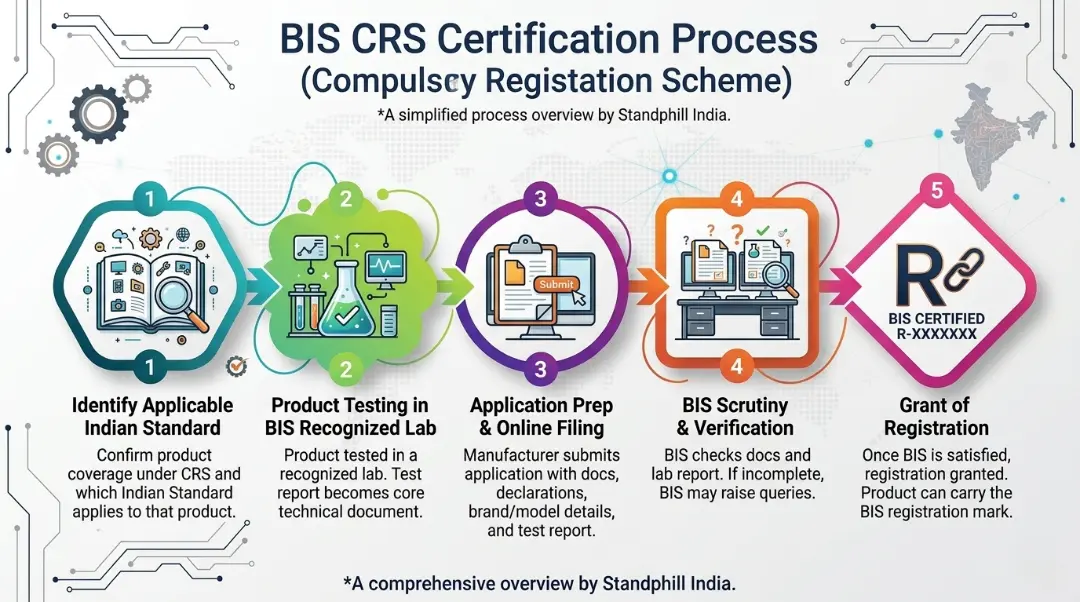
The BIS CRS registration process follows a structured regulatory path with no factory audit:
Step 1 – Identify the Applicable Indian Standard
Confirm whether the product is covered under CRS and which Indian Standard applies.
Step 2 – Product Testing in a BIS Recognized Laboratory
The product must be tested in a BIS recognized laboratory. The test report becomes one of the core technical documents in the application.
Step 3 – Application Preparation and Online Filing
The manufacturer submits the application with required documents, declarations, brand details, model information, and the test report.
Step 4 – BIS Scrutiny and Verification
BIS checks the submitted documents and the laboratory report. If the application is incomplete, BIS may raise queries.
Step 5 – Grant of Registration
Once BIS is satisfied, the registration is granted, the R-Number is issued, and the product can carry the required BIS registration marking.
BIS CRS Certification - Complete Process Explained
Watch our expert step-by-step video guide on the BIS CRS Certification process
Documents Required for CRS Certification
Manufacturers typically need the following documents for BIS CRS registration:
- Business registration or factory registration documents
- Manufacturing license or factory details
- Product model details
- Trademark certificate, where applicable
- BIS recognized lab test report
- Critical component list
- Authorized signatory documents
- Declarations and conformity documents
- AIR documents, where applicable for foreign manufacturers
Standphill India assists in document alignment, technical review, application structuring, and filing support to reduce avoidable delays.
BIS CRS Certification Cost
The total cost of CRS certification usually includes government-related fees plus product testing and documentation costs.
| S. No. | Particulars | Amount |
|---|---|---|
| 1 | Application Fee | ₹1,000/- |
| 2 | Processing Fee | ₹50,000/- |
| 3 | Registration Fee | ₹2,000/- |
Estimated government-side fee: ₹53,000/-
Additional costs may include laboratory testing charges, consultancy and documentation support, and model inclusion handling where applicable. Total project cost depends on the product type, number of models, and testing scope.
Timeline for BIS CRS Registration
Because CRS does not require a factory audit, it is faster than ISI Mark or FMCS. For most Indian manufacturers, registration is typically completed in around 3 to 6 weeks once documents and testing are ready. The timeline depends mainly on two stages:
- Laboratory testing time in a BIS recognized lab
- BIS scrutiny after the application is filed
Where the documents and test reports are complete and correctly aligned, the application moves faster. Foreign manufacturers may take longer due to coordination and AIR formalities. As a rule, businesses should begin CRS compliance planning well before any shipment or launch deadline - never wait until a product is already at customs.
Also Read
BIS Certification for Indian Manufacturers (ISI Mark) BIS FMCS Certification for Foreign ManufacturersValidity and Renewal of CRS Certificate
A BIS CRS registration is generally valid for two years and is renewable. Manufacturers should track the registration validity period carefully and apply for renewal before expiry to avoid any interruption to imports, sales or marketplace listings.
Renewal is filed with the applicable fees and updated documents. Because BIS may revise fees, validity periods or marking requirements from time to time, always verify the live renewal requirements at the time of filing - or let Standphill India track and manage the renewal for you.
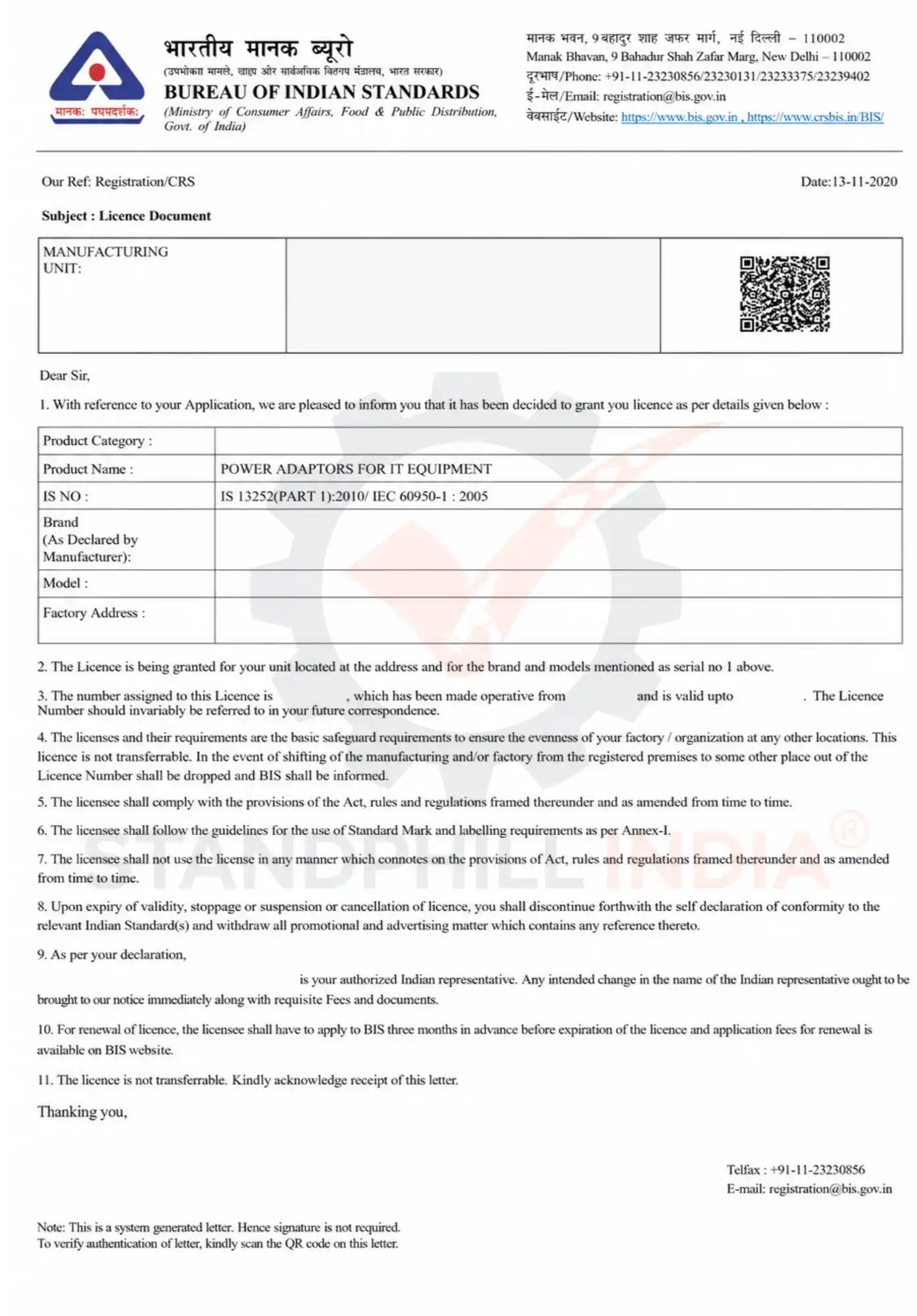
Sample of a BIS CRS Grant Licence
When BIS approves a CRS application, it issues a system-generated Licence Document confirming the product category, product name, applicable Indian Standard (IS), brand, model, factory address and the registration (R-Number) along with its validity period. The letter also carries a QR code to verify authenticity. Here is a sample CRS grant licence:
Recent CRS Certification Projects by Standphill India
Standphill India has successfully assisted multiple businesses in obtaining BIS CRS certification for electronic and IT products.
| # | Company | Product | Standard |
|---|---|---|---|
| 1 | Prepsafe Label India Pvt Ltd. | Printers, Plotters | IS 13252 (Part 1) |
| 2 | BULWARK INNOVATION PVT. Ltd. | Power Adaptors / Microphone | IS 13252 (Part 1) / IS 616 |
| 3 | Bitwell Band | Wrist Band & WPC Certificate | IS 13252 |
| 4 | JB International | Rice Cooker | IS 302 - 2 - 15 |
Why Choose Standphill India for BIS CRS Certification?
Obtaining BIS CRS certification requires more than simply uploading documents. It requires product applicability review, correct Indian Standard identification, lab coordination, technical document preparation, application filing accuracy, and consistent regulatory follow-up.
- Product applicability assessment
- BIS standard identification
- BIS recognized laboratory coordination
- Technical documentation preparation
- Application scrutiny and filing support
- BIS query handling support
- End-to-end approval assistance
We have completed 500+ CRS certification projects and support clients globally through a structured compliance process with separate expert teams for CRS, FMCS, and domestic BIS certification.
Get expert support for BIS CRS certification and launch your electronic products in India with confidence.
Ready to Register Your Electronic Product?
Free CRS applicability check · BIS lab coordination · Fast, accurate filing.
Frequently Asked Questions (FAQ)
Ask a Question
Have a query about BIS CRS Certification? Our team will get back to you shortly.
★ Why Standphill India?
- 20+ Years of BIS Certification Experience
- 10,000+ Certifications Delivered Globally
- Dedicated Teams for CRS, FMCS & ISI Mark
- End-to-End Documentation & Filing Support
- Fast Response & Practical Compliance Guidance
- Support for Indian & Foreign Manufacturers
Get Free Call Back
Our Services
- BIS (ISI Mark) for Foreign Manufacturers
- Domestic BIS (ISI Mark) Certification
- BIS Certificate of Conformity (CoC)
- BIS Hallmarking
- BIS Licence for Toys
- ECO Mark Certification
- TAC Approval for Automobile
- Drug Licence
- Peso Certification
- BIS (CRS) Registration
- WPC-ETA Approval
- BEE Certification
- E-Waste Management (EPR)
- EPR for Plastic Waste
- EPR for Battery Waste
- CE Certification
- UL Certification
- ROHS Licence
- Standardization Division
- Import / Export Licence
- FSSAI Certification
- ISO Registration
- Trademark Registration
- Make in India Support
- AG-Mark Licence
- Third Party Monitoring
Client Testimonials
Their team was very knowledgeable and helped us every step of the way. Standphill India is the best BIS certification consultants for any type of BIS certification.

Chintan Shah (AGM)
Sudeep Nutrition P.Ltd




Featured Guide
Complete BIS CRS certification guide for electronic products in India — free to read.
Read CRS Certification Guide📞 Contact Standphill India
+91-9667674225 info@standphillindia.in WhatsApp Now Greater Noida West, UPGet Expert BIS Certification Support for Your Business
Connect with Standphill India for complete support with BIS certification, CRS registration, WPC approval, FMCS compliance, and related regulatory services. Our team helps businesses with documentation, testing coordination, application support, and end-to-end compliance guidance.
Request Free Consultation
Share your requirement and our team will contact you shortly.