BIS Certification for Foreign Manufacturers
BIS FMCS Certificate & ISI Mark Licence under the Foreign Manufacturers Certification Scheme
- Quick Explanation
- What is BIS FMCS Certification?
- Role of BIS for Foreign Manufacturers
- Types of BIS Schemes
- Which Scheme Applies to You?
- ISI Mark for Foreign Manufacturers
- Who Needs BIS FMCS?
- Eligibility Criteria
- Authorized Indian Representative (AIR)
- FMCS Certification Process
- Documents Required
- Fees & Total Cost
- Timeline
- Validity & Renewal
- Sample Grant of Licence
- Products Covered
- Country-Specific Support
- Recent FMCS Projects
- Common Challenges
- Why Standphill India?
- FAQ
Quick Explanation
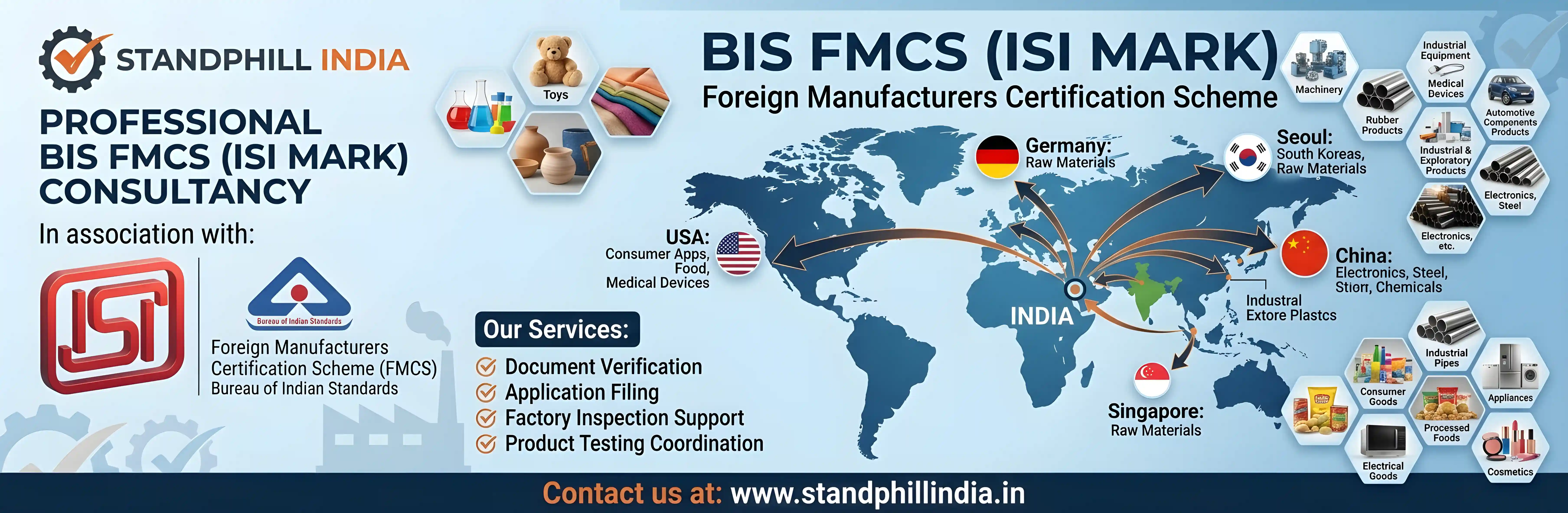
If you manufacture products outside India and want to sell them in the Indian market, there is one thing to sort out first — BIS certification for foreign manufacturers under the Foreign Manufacturers Certification Scheme (FMCS), operated by the Bureau of Indian Standards (BIS).
India is one of the fastest growing consumer markets in the world, and thousands of overseas companies export here every year. But products that fall under mandatory BIS categories cannot enter the Indian market without a valid BIS FMCS certificate. No licence means no legal import, no distribution, and no sale — the customs barrier is real.
Under FMCS, the manufacturer must show that the product complies with the relevant Indian Standard (IS). This involves document review, factory inspection, product testing and regulatory evaluation. Once approved, the manufacturer can use the ISI Mark on the certified product and export it to India legally.
Standphill India helps global manufacturers obtain the BIS FMCS certificate through documentation support, Authorized Indian Representative (AIR) assistance, inspection preparation, testing coordination and end-to-end regulatory management.
What is BIS Certification for Foreign Manufacturers (FMCS)?
BIS FMCS certification is the official approval that lets foreign manufacturers certify their products against Indian Standards before exporting to India. The Bureau of Indian Standards, India's national standards body under the Ministry of Consumer Affairs, Food and Public Distribution, issues it under the authority of the BIS Act 2016.
For Indian manufacturers, BIS certification is issued directly through the domestic ISI Mark scheme. A foreign company cannot apply under that route. Instead, overseas manufacturers apply through the Foreign Manufacturers Certification Scheme (FMCS) — a separate, dedicated route designed specifically for factories located outside India that want to export regulated products into the Indian market.
In short: if your factory is outside India, FMCS is your path to the ISI Mark and legal entry into India. The scheme has been operated by BIS since the year 2000 and runs under Scheme-I of Schedule-II of the BIS Act 2016 and the BIS (Conformity Assessment) Regulations 2018. The licence is issued by the Foreign Manufacturers Certification Department (FMCD) — the only BIS authority that issues licences to foreign manufacturers.
Role of BIS for Foreign Manufacturers
The job of BIS is not to restrict imports — it is to ensure imported products meet the same quality and safety standards as products made in India, so Indian buyers get the same assurance either way. BIS achieves this under FMCS through a strict, end-to-end evaluation:
- Setting the standard — defining the Indian Standard the product must comply with, regardless of where it is made
- Reviewing documentation — scrutinising company registration, manufacturing setup, testing facilities, quality systems and product data
- Factory inspection — BIS officers physically travel to the overseas facility to inspect the production process, in-house testing equipment and quality control
- Product testing — samples are sent to BIS-recognised laboratories in India for independent testing against the Indian Standard
- Licence grant — on satisfactory inspection and testing, BIS issues the FMCS licence and the right to use the ISI Mark
- Ongoing surveillance — periodic market checks and surveillance inspections confirm continued compliance
Types of BIS Certification Available for Foreign Manufacturers
The main path for foreign manufacturers. Overseas companies apply for the ISI Mark for products under mandatory or voluntary BIS standards — industrial goods, steel products, chemicals, electrical equipment, construction materials and more. The licence is issued by the FMCD department of BIS.
CRS (Compulsory Registration Scheme)Covers electronics and IT products — mobile phones, laptops, LED lights, power banks and similar goods. Foreign manufacturers exporting these to India register under CRS, not FMCS. CRS does not require a factory audit, making it somewhat faster, but lab testing is still mandatory.
BIS Hallmarking & Eco MarkHallmarking is for jewellers operating in India and is not usually applicable to foreign manufacturers. Eco Mark can be pursued voluntarily if products meet BIS environmental criteria, but this is rare in practice.
For most foreign manufacturers exporting industrial, electrical, construction or chemical products to India, FMCS is the applicable scheme.
Which BIS Scheme Applies to You?
| Your Situation | Applicable Scheme |
|---|---|
| Manufacturing industrial / steel / chemical / electrical products outside India for export to India | FMCS (Scheme-I) |
| Manufacturing electronics / IT products outside India for import to India | CRS (Compulsory Registration Scheme) |
| Importing jewellery into India | Not typically applicable — Hallmarking covers domestic jewellers |
| Want a voluntary BIS mark for a non-mandatory product from an overseas factory | FMCS (voluntary) |
Still not sure? Send us your product details and factory country, and we will confirm the correct scheme and the applicable Indian Standard — usually the same day.
What is the ISI Mark for Foreign Manufacturers?
The ISI Mark is the quality mark issued under BIS certification. It confirms that a product complies with the applicable Indian Standard. For foreign manufacturers, the ISI Mark carries the same format as the domestic mark:
- Indian Standard Number at the top
- Licence Number in the format CM/L-XXXXXXXXXX at the bottom
Once BIS grants the FMCS licence, the manufacturer is authorised to place the ISI Mark on the certified product, giving Indian buyers assurance that it meets the required safety and performance standards.
Who Needs BIS FMCS Certification?
Any foreign manufacturer whose product falls under a mandatory BIS standard cannot legally export it to India without FMCS certification. The key word is mandatory — BIS maintains a list of regulated products, and if yours is on it, there is no workaround.
Beyond mandatory products, voluntary FMCS certification is also available. Many overseas manufacturers pursue it proactively because the ISI Mark is widely trusted in India — government buyers, large distributors and project procurement authorities often prefer or require it even for non-mandatory goods. Common categories include:
- Stainless steel pipes and tubes
- Steel and metal products
- Electrical equipment
- Industrial and mechanical products
- Construction and infrastructure materials
- Chemicals and safety-related products
Eligibility for BIS FMCS Certification
Before applying, the foreign manufacturer must satisfy certain basic conditions:
- Manufacturing facility outside India — the scheme is meant for overseas production facilities
- Product complies with the Indian Standard — it must match the IS specification for its category
- Manufacturing and testing facilities — the factory must have the production setup and in-house testing capability required by the standard
- Quality control personnel — staff responsible for monitoring product quality must be in place
- Acceptance of BIS conditions — including the Scheme of Inspection and Testing (SIT), marking-fee requirements and licence conditions
Separate applications are required for each product standard and each manufacturing location.
Authorized Indian Representative (AIR)
Every foreign applicant under FMCS must appoint an Authorized Indian Representative (AIR). This is mandatory if the foreign company does not have a registered branch office in India. The AIR is an India-based point of contact between the foreign manufacturer and BIS.
Who Can Be Appointed as AIR?- Branch office of the foreign manufacturer in India
- Indian importer or distributor
- Independent Indian consultant or entity capable of handling BIS compliance
- Must be a resident of India
- Can represent only one foreign manufacturer at a time under FMCS
- Must hold at least a bachelor's degree and have working knowledge of the BIS Act 2016
- Must have no conflict of interest with sample testing in third-party labs
- Name must appear in all BIS licence documentation
- Must agree in writing to comply with all BIS rules and licence conditions on the manufacturer's behalf
- Submitting BIS applications on behalf of the foreign manufacturer
- Communicating with BIS authorities and responding to queries
- Coordinating inspection logistics and compliance matters
- Helping maintain licence conditions after approval
Standphill India assists foreign manufacturers in fulfilling AIR requirements correctly and keeps all AIR documentation in order from the start.
BIS FMCS Certification Process — Step by Step
- Application Submission The manufacturer compiles the documents and submits the application online through the BIS portal and in hard copy to the FMCD department in New Delhi. The AIR coordinates this.
- Application Scrutiny BIS reviews the application. If KYC, technical or testing documents are missing, BIS raises queries by email. On completeness, an acknowledgement number is assigned.
- Appointment of AIR The foreign manufacturer appoints an Authorized Indian Representative as the official contact for all regulatory communication with BIS.
- Factory Inspection / Audit A BIS officer travels to the overseas factory on a mutually agreed date to examine the production line, in-house lab, calibration and quality records. The inspection fee is paid before the visit.
- Product Sample Testing Sealed samples are sent to a BIS-recognised laboratory in India for testing against the Indian Standard. The test report goes directly to BIS; the manufacturer pays the testing charges.
- Grant of Licence If the inspection report and test results are satisfactory, BIS issues the Licence Grant Letter and authorises use of the ISI Mark on certified products.
- Agreement & Indemnity Bond An agreement and indemnity bond is signed covering fees, nomination details, licensee responsibilities, termination conditions and a Performance Bank Guarantee of USD 10,000 from an RBI-approved bank (refundable on withdrawal).
BIS FMCS Certification Process for Foreign Manufacturers
Documents Required for BIS FMCS Certification
Foreign manufacturers must prepare a comprehensive set of technical and compliance documents. Missing, outdated or incorrectly formatted documents are the most common reason applications stall at scrutiny. The full list:
- Covering letter from the manufacturer
- BIS application form in the prescribed format
- Payment remittance proof for the application fee
- Company registration certificate / manufacturing licence
- List of raw materials with supplier details (as applicable)
- Raw material test certificates with corresponding invoices
- List of all plant and machinery used in manufacturing
- Factory layout showing manufacturing and testing areas
- Process flow chart of the complete manufacturing process
- List of testing equipment available as per IS requirements
- Calibration certificates for all testing instruments
- Quality Control Engineer documents and designations
- Scope of licence as per the product manual format
- AIR documents (ID proof, PAN, academic degree certificate)
- Trademark registration certificate (if available)
- Undertaking accepting BIS licence conditions
Standphill India reviews every document before submission so your application moves forward without unnecessary hold-ups.
Also Read
BIS CRS Certification for Electronic and IT Products BIS Certification for Indian Manufacturers (ISI Mark)BIS FMCS Certification Fees & Total Cost
Knowing the full investment before you start matters. Here is a breakdown of the typical expenses under FMCS:
| Fee Component | Approximate Amount |
|---|---|
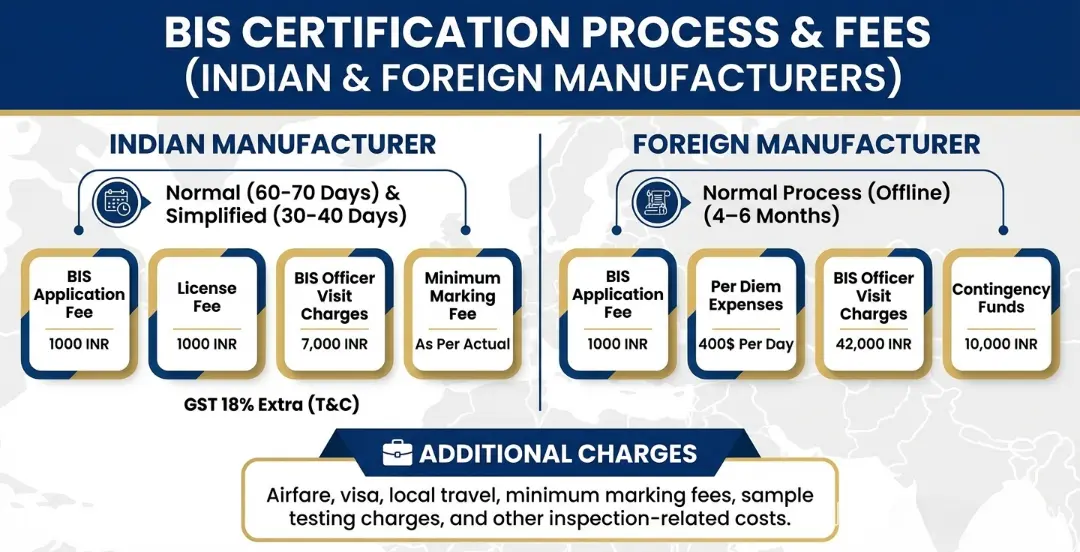
| Application Fee | INR 1,000 (approx. USD 12–15) |
| Performance Bank Guarantee | USD 10,000 (refundable on licence withdrawal) |
| Per Diem for BIS Officers | USD 300–400 per day (country dependent) |
| Factory Inspection / Visit Charges | Approx. INR 42,000 (may vary) |
| Contingency Fund | INR 10,000 |
| Airfare & Visa for BIS Officers | INR 2,00,000 – 5,00,000 (country dependent) |
| Sample Testing Fee | As applicable (product / IS dependent) |
| Minimum Marking Fee | As applicable (production volume dependent) |
| Licence Fee | As applicable |
| Consultant Fee | Varies — contact Standphill India for a quote |
Note: The USD 10,000 Performance Bank Guarantee is the largest upfront cost but is refundable. The most variable cost is the airfare and visa for BIS officers, which depends on the factory's country. Total investment for most FMCS projects ranges from INR 4 to 8 lakhs or more depending on country, product and number of products. We provide a clear, product-specific estimate before any work begins.
Timeline for BIS FMCS Certification
The average time to obtain the BIS FMCS certificate from the date of complete application is 4 to 6 months. The timeline depends on:
- Speed of BIS application scrutiny
- Factory inspection scheduling (BIS officer travel coordination)
- Product testing duration in BIS-recognised laboratories
- Response time to any BIS queries raised
Delays most commonly happen at the document scrutiny or inspection scheduling stage. Working with an experienced consultant who prepares the application correctly and coordinates inspection logistics can meaningfully reduce the overall timeline.
Validity and Renewal of the BIS FMCS Certificate
The BIS FMCS licence is initially granted for one year, though some manufacturers may opt for a two-year grant depending on the arrangement. After this, the licence must be renewed.
Renewal is done by submitting a renewal application with the required documents and fees, certified by a Chartered Accountant. If the manufacturer is in good standing, renewal is typically granted, and renewal periods can extend up to five years in certain cases. Timely renewal is critical — if a licence lapses, the manufacturer loses the right to use the ISI Mark and must stop exporting the certified product until it is reinstated.
Even after grant, BIS conducts periodic Scheme of Inspection and Testing (SIT) checks and may draw market samples to verify ongoing compliance. If complaints are received, BIS investigates under IS/ISO 10002 guidelines, and the manufacturer is responsible for corrective action; full liability for damages rests with the licensee.
Sample of a BIS Grant of Licence (ISI Mark)
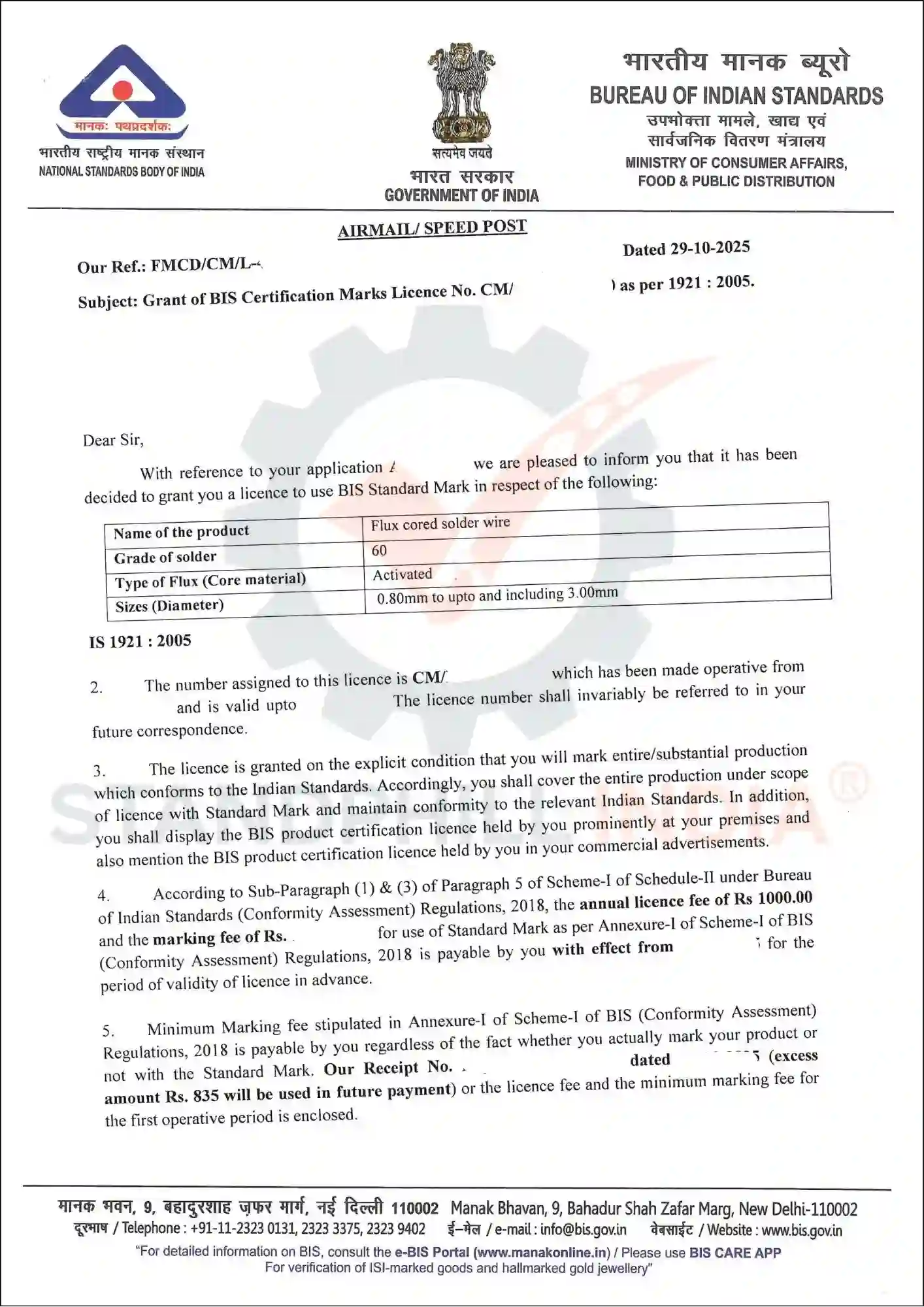
When BIS approves an application, it issues a formal Grant of BIS Product Certification Licence letter. It confirms the licence number (in the CM/L format), the product, the applicable Indian Standard and the validity period. Here is a sample grant letter:
Products Covered Under BIS FMCS Certification
The list of products under FMCS runs into hundreds of categories. Major ones include:
Steel & Metal ProductsStainless steel pipes and tubes, welded and seamless tubes, structural steel, wire rods, galvanised sheets and alloy steel products.
Electrical EquipmentCables, transformers, motors, switchgear, circuit breakers and wiring accessories.
Industrial & Mechanical GoodsBearings, belts, chains, pumps, compressors and valves.
Construction MaterialsCement, plasterboard, glass products and roofing sheets.
Chemicals & Consumer GoodsIndustrial chemicals, solvents, polymers, adhesives, certain appliances, packaging, textiles and safety/protective equipment.
Not sure which Indian Standard applies to your product? Send us your product details and we'll confirm it for you.
Country-Specific BIS Certification Support
Standphill India assists manufacturers from major global manufacturing hubs and has delivered 1000+ BIS certification projects across multiple industries.
BIS Certification for China ManufacturersChinese manufacturers exporting industrial products, steel goods or electrical equipment to India routinely need the BIS FMCS certificate before entering the market.
BIS Certification for South Korea ManufacturersSouth Korean manufacturers in steel, electronics and industrial sectors frequently need BIS approval for export to India.
BIS Certification for Germany ManufacturersGerman manufacturers exporting technical and industrial products must comply with applicable BIS requirements when the products fall under mandatory standards.
BIS Certification for USA & UK ManufacturersAmerican and British manufacturers exporting regulated goods to India may require the FMCS certificate for customs clearance and sale.
BIS Certification for Southeast Asian ManufacturersManufacturers from Malaysia, Singapore, Indonesia, Taiwan and nearby regions also frequently apply for FMCS certification.
Recent BIS FMCS Projects by Standphill India
A few recently completed projects from our growing international portfolio:
🏆 Project 1 — HYG Co., Ltd, South Korea
Product 1: Stainless Steel Welded Pipes & Tubes | IS 17876 : 2022
Product 2: Stainless Steel Seamless Pipes & Tubes | IS 17875 : 2022
Certification Date: 30 January 2026
Scope: regulatory documentation, BIS inspection preparation, laboratory testing coordination and successful licence approval. Manufacturer site: HYG Co., Ltd.
🏆 Project 2 — Electroloy, Malaysia
Country: Malaysia
Status: BIS FMCS certification successfully completed by Standphill India.
Full project details including product category and IS standard are available on request.
Beyond these, we have worked with manufacturers from South Korea, Malaysia, China, Germany, the USA, the UK, Singapore, Taiwan and Indonesia, across steel, electrical, industrial, chemical and construction product categories.
Common Challenges Faced by Foreign Manufacturers
1. Understanding Indian Standards
Foreign manufacturers often work with ISO, ASTM or EN standards. BIS certification requires matching the relevant Indian Standard precisely.
2. Documentation Gaps
Applications stall when technical documents, testing records or compliance papers are incomplete or wrongly formatted.
3. Factory Inspection Preparation
The audit needs proper coordination, ready testing facilities and clear manufacturing procedures.
4. AIR Selection and Coordination
Choosing the right Authorized Indian Representative is essential for smooth communication with BIS and timely query responses.
Standphill India's experience across 1000+ FMCS projects helps foreign manufacturers avoid these pitfalls and achieve faster, smoother certification.
Why Standphill India is the Right BIS FMCS Consultant
FMCS involves international coordination — a BIS officer travelling to your country, samples shipped to Indian labs, and documentation that must precisely match BIS requirements. One gap can delay the whole process by months. Here is what makes us the right partner for foreign manufacturers:
- End-to-end process management — from identifying the correct IS to the final licence
- Correct IS identification from day one — avoiding costly rework later
- Document preparation and review — caught before BIS raises a query, not after
- AIR support — fulfilling AIR requirements and handling the documentation correctly
- Factory inspection preparation — a thorough pre-inspection review of your setup, equipment, calibration and process
- Laboratory testing coordination — directly with BIS-recognised labs in India
- Transparent cost estimates — a clear breakdown before any work begins, no surprises
- Post-licence support — surveillance compliance, renewals and ongoing BIS queries
If you are a foreign manufacturer looking to enter the Indian market through BIS FMCS certification, share your product details and factory country — we will tell you exactly what your certification process looks like, how long it will take and what it will cost, clearly and upfront.
Enter the Indian market the right way with expert BIS FMCS certification support.
Ready to Get Your BIS FMCS Certificate?
Free scheme & standard check · AIR support · Transparent cost estimate.
Frequently Asked Questions (FAQ)
Ask a Question
Have a query about BIS FMCS Certification? Our team will get back to you shortly.
★ Why Standphill India?
- 20+ Years of BIS Certification Experience
- 10,000+ Certifications Delivered Globally
- Dedicated Teams for CRS, FMCS & ISI Mark
- End-to-End Documentation & Filing Support
- Fast Response & Practical Compliance Guidance
- Support for Indian & Foreign Manufacturers
Get Free Call Back
Our Services
- BIS (ISI Mark) for Foreign Manufacturers
- Domestic BIS (ISI Mark) Certification
- BIS Certificate of Conformity (CoC)
- BIS Hallmarking
- BIS Licence for Toys
- ECO Mark Certification
- TAC Approval for Automobile
- Drug Licence
- Peso Certification
- BIS (CRS) Registration
- WPC-ETA Approval
- BEE Certification
- E-Waste Management (EPR)
- EPR for Plastic Waste
- EPR for Battery Waste
- CE Certification
- UL Certification
- ROHS Licence
- Standardization Division
- Import / Export Licence
- FSSAI Certification
- ISO Registration
- Trademark Registration
- Make in India Support
- AG-Mark Licence
- Third Party Monitoring
Client Testimonials
Their team was very knowledgeable and helped us every step of the way. Standphill India is the best BIS certification consultants for any type of BIS certification.

Chintan Shah (AGM)
Sudeep Nutrition P.Ltd



Featured Guide
Complete BIS CRS certification guide for electronic products in India — free to read.
Read CRS Certification Guide📞 Contact Standphill India
+91-9667674225 info@standphillindia.in WhatsApp Now Greater Noida West, UPGet Expert BIS Certification Support for Your Business
Connect with Standphill India for complete support with BIS certification, CRS registration, WPC approval, FMCS compliance, and related regulatory services. Our team helps businesses with documentation, testing coordination, application support, and end-to-end compliance guidance.
Request Free Consultation
Share your requirement and our team will contact you shortly.