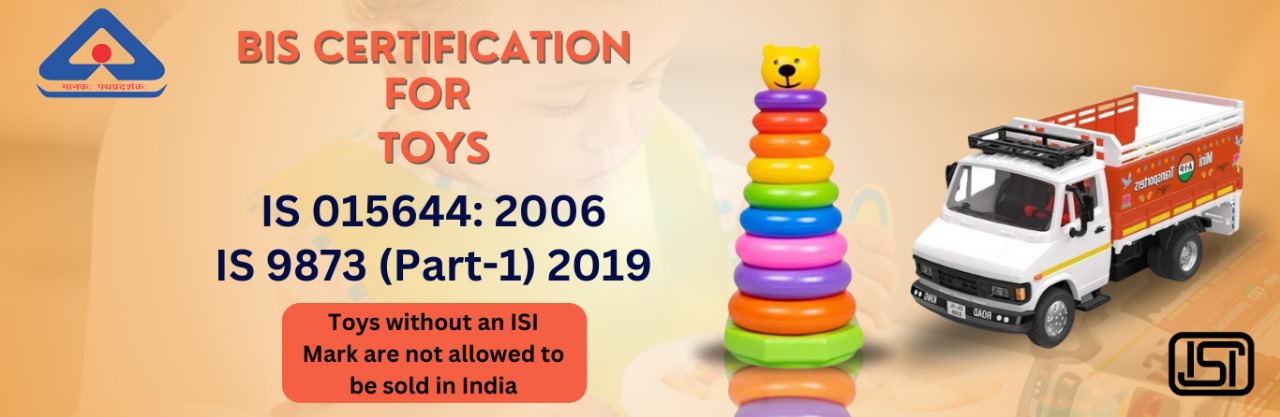
BIS Certification for Toys IS 9873 and IS 15644
ISI Mark Licence for Toy Manufacturers under the Toys (Quality Control) Order, 2020
BIS Certification for Toys is mandatory under the Toys (Quality Control) Order, 2020 notified by the Ministry of Commerce & Industry under the BIS Act, 2016. Every toy manufacturer, whether Indian or foreign, must obtain the ISI Mark licence before their products can legally be manufactured, imported, or sold in India. Non-compliance may result in product seizure, heavy fines, and legal action.
- Toys QCO 2020
- What is BIS Toy Certification?
- ISI Mark for Toys
- Indian Standards for Toy Safety
- Why BIS Certification is Important
- Who Needs BIS Certification?
- Eligibility Requirements
- Certification Process
- Documents Required
- Cost of BIS Certification
- Types of Toys Covered
- Testing Facility Requirements
- Benefits of BIS Certification
- BIS Enforcement & Compliance
- Surveillance & Renewal
- Recent Certifications
- Why Choose Standphill India
- Frequently Asked Questions
Toys Quality Control Order (QCO), 2020
The Toys (Quality Control) Order, 2020 was introduced by the Ministry of Commerce and Industry under the BIS Act, 2016. It came into force on 1 September 2020 and made BIS certification mandatory for all toy manufacturers, importers, and sellers in India.
Under this QCO, all those who manufacture, import, sell, keep for sale, or distribute toys in India are required to comply with the specified Indian safety standards and label their products with the ISI Mark. Toys without the ISI Mark are not permitted to be manufactured, imported, sold, or distributed legally within India.
- Covers toys designed for children under 14 years of age
- Applies equally to domestic manufacturers and foreign exporters
- BIS conducts regular market raids and factory inspections across India
- Violations attract penalties, seizure, and prosecution under BIS Act, 2016
Exemption: Toys produced exclusively for export and toys sold by artisans registered with the Office of the Development Commissioner (Handicrafts) are exempt from the Toys QCO 2020.
What is BIS Certification for Toys?
BIS Certification for Toys is the mandatory product certification system under which toy manufacturers must demonstrate that their products comply with Indian safety standards before placing them in the market. BIS evaluates the product and manufacturing facility — if everything is satisfactory, an ISI Mark licence is granted.
Key facts to understand:
- BIS certification is granted only to the manufacturer — not to importers, traders, or distributors
- If a manufacturer operates multiple factories, a separate licence is required for each location
- Separate applications are required for electrical and non-electrical toy categories
- Foreign manufacturers must appoint an Authorized Indian Representative (AIR)
What is the ISI Mark for Toys?
The ISI Mark is the official BIS Standard Mark confirming that the toy has been evaluated and found compliant with the applicable Indian Standard. Every ISI Mark on toys contains two important elements:
- Indian Standard Number — the applicable IS standard displayed above the mark
- Licence Number (CM/L-XXXXXXXXXX) — identifying the manufacturer's BIS licence, displayed below the mark
The ISI Mark is one of the most recognized quality symbols in the Indian market and directly signals to parents and buyers that the toy is certified safe for children.
Indian Standards for Toy Safety
BIS certification for toys is based on seven key Indian Standards under the Toys QCO, 2020, aligned with ISO and IEC international norms. Toys are categorized into two main types:
| S. No. | Type of Toy | Primary Standard | Secondary Standards |
|---|---|---|---|
| 1 | Non-Electrical Toys | IS 9873 (Part 1): 2025 – Mechanical & Physical Safety | IS 9873 Parts 2, 3, 4, 7 and 9 |
| 2 | Electrical Toys | IS 15644:2006 – Safety of Electric Toys | IS 9873 Parts 1, 2, 3, 4, 7 and 9 |
Standard-wise safety aspect breakdown:
| S. No. | Aspect of Toy Safety | Indian Standard |
|---|---|---|
| 1 | Physical and Mechanical Safety – sharp points, choking risks | IS 9873 (Part 1): 2025 |
| 2 | Flammability Safety – toys not catching fire easily | IS 9873 (Part 2): 2017 |
| 3 | Chemical Safety – limits for lead, cadmium, mercury, phthalates | IS 9873 (Part 3): 2017 & (Part 9): 2017 |
| 4 | Activity Toys – slides, swings, outdoor play equipment | IS 9873 (Part 4): 2016 |
| 5 | Finger Paints – non-toxicity for craft kits | IS 9873 (Part 7): 2017 |
| 6 | Phthalate Esters Restrictions in toys and children's products | IS 9873 (Part 9): 2017 |
| 7 | Electrical Safety for electric and electronic toys | IS 15644:2006 |
IS 9873 (Part 1): 2025 Update: This revised standard (aligned with ISO 8124-1) runs concurrently with IS 9873 (Part 1): 2019 until 22 March 2027. After that date, BIS will only grant licences under the 2025 version. New applicants are strongly advised to apply under the 2025 standard.
Why BIS Certification is Important
- Legal Compliance: Toys cannot be legally manufactured, imported, or sold in India without a valid ISI Mark licence. Non-compliance results in seizure, fines, and prosecution.
- Child Safety Assurance: BIS certification ensures rigorous testing for mechanical hazards, choking risks, toxic chemicals, flammability, and electrical safety — protecting children under 14 years.
- Consumer and Market Trust: The ISI Mark is recognized by parents, retailers, and institutional buyers as a reliable quality indicator, giving faster market acceptance.
- Import Clearance: Customs authorities verify BIS certification at import. Toys without the ISI Mark are held or rejected at ports of entry.
- International Standards Compliance: BIS toy standards align with ISO and IEC norms, helping manufacturers also position products for export markets.
- E-commerce Advantage: Major platforms and retail chains require BIS certification for toy listings. ISI-marked toys face fewer restrictions and gain better shelf access.
Who Needs BIS Certification for Toys?
- Indian manufacturers producing toys at factories located within India
- Foreign manufacturers exporting toys to the Indian market (under FMCS scheme)
- Global toy brands whose products are manufactured and sold in India
The ISI Mark licence is issued only to the manufacturer of the toy. A separate BIS licence is required for each manufacturing location and each toy category (electrical vs non-electrical).
Eligibility for BIS Toy Certification
- Operational manufacturing unit — active production facility ready for BIS inspection
- Product compliance — toy must meet IS 9873 (non-electrical) or IS 15644 (electrical) requirements
- In-house testing facilities — as specified under the BIS Scheme of Inspection and Testing (SIT)
- Quality control system — documented QC processes, trained personnel, and production records
- Factory inspection consent — acceptance of BIS audits during certification and ongoing surveillance
Note: Separate applications required for each manufacturing location and each toy category.
BIS Certification Process for Toys
Step 1 – Documentation Preparation
Compile all required documents: factory registration, manufacturing process flowchart, machinery list, QC procedures, and testing equipment details. Foreign manufacturers also prepare AIR appointment documents.
Step 2 – Filing Application with BIS
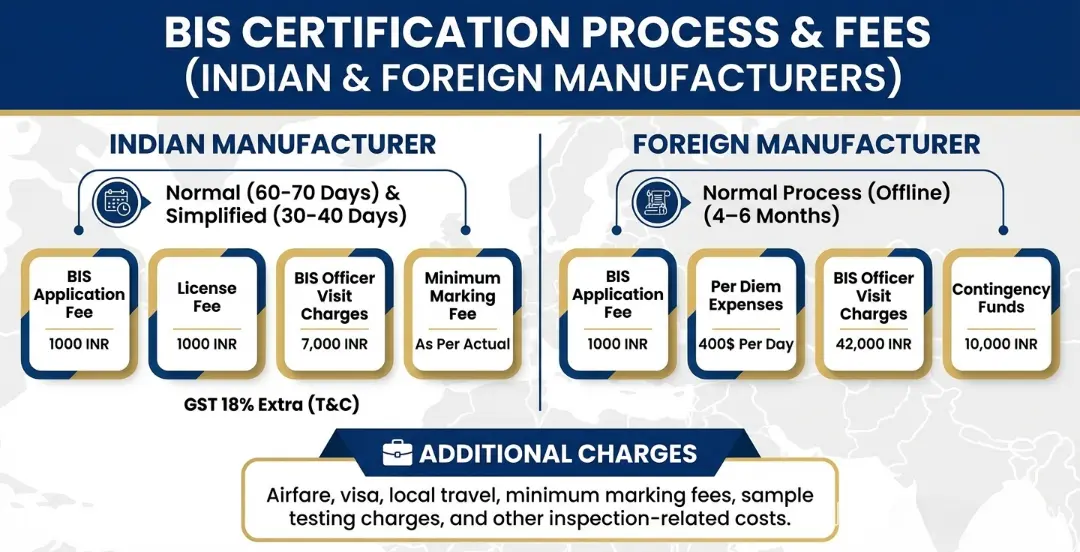
Domestic manufacturers apply online via BIS ManakOnline portal. Foreign manufacturers submit a physical application to BIS Foreign Manufacturers division. Application fee of INR 1,000 and 50% of minimum marking fee are paid at this stage.
Step 3 – Document Scrutiny by BIS
BIS reviews the submitted application. Any missing information or clarification queries must be responded to promptly to avoid processing delays.
Step 4 – Factory Audit by BIS Auditor
BIS nominates an auditor who inspects manufacturing infrastructure, in-house testing equipment, quality control systems, raw material controls, and process flow compliance.
Step 5 – Sample Draw for Independent Testing
The BIS auditor draws representative toy samples during the factory audit. Samples are sealed and sent to a BIS-recognized laboratory for independent testing.
Step 6 – Sample Testing in BIS Approved Laboratory
Samples are tested against all applicable clauses of IS 9873 (Parts 1–9) or IS 15644. Tests cover mechanical strength, flammability, chemical migration (lead, cadmium, phthalates), and electrical safety.
Step 7 – Evaluation and Grant of BIS Licence
BIS evaluates the factory audit report and lab test results. On successful compliance, the licence is granted. The manufacturer pays remaining fees and receives the BIS licence number to apply the ISI Mark.
Documents Required
- Factory registration certificate or manufacturing licence
- Company registration documents (GST, incorporation certificate, MSME if applicable)
- Identity proof of authorized signatory
- Factory layout plan
- Manufacturing process flow chart
- List of manufacturing machinery with specifications
- In-house testing equipment list with calibration certificates
- Quality control parameters and records
- Laboratory test records and reports (as per BIS norms)
- Product model specifications and design details
- Trademark registration certificate (if applicable)
- Raw material specifications and test certificates
- Board resolution or authorization letter
- AIR appointment documents (mandatory for foreign manufacturers)
Standphill India assists in complete documentation preparation, technical review, and BIS filing support to reduce processing delays at every stage.
Also Read
BIS Certification for Indian Manufacturers (Scheme I – ISI Mark) BIS FMCS Certification for Foreign Manufacturers BIS Certification for Electronic and IT Products (CRS)Cost of BIS Certification for Toys
| S. No. | Fee Type | Details | Amount (INR) |
|---|---|---|---|
| 1 | Application Fee | Payable at time of application for grant of licence | INR 1,000/- |
| 2 | Annual Licence Fee | Payable at licence grant and every year at renewal | INR 1,000/- |
| 3 | Renewal Application Fee | Payable after first year and with each renewal | INR 1,000/- |
| 4 | Minimum Marking Fee | 50% at application, 50% at grant. Annually at renewal. (Micro 80% off, Small 50%, Medium 20%) | As Applicable |
| 5 | Sample Testing Fee | Charges by BIS-recognized laboratory for testing toy samples | As Applicable |
The exact total cost varies depending on the toy category, applicable IS standard, number of product models, and testing scope. Contact Standphill India for a personalized cost estimate.
Types of Toys Covered Under BIS Certification
BIS toy certification applies to a wide range of toys intended for children under 14 years of age, including:
- Plastic toys and figurines
- Stuffed and soft plush toys
- Wooden toys and handcrafted toys
- Ride-on toys and tricycles
- Activity toys (swings, slides, outdoor play equipment)
- Electric and battery-operated toys
- Remote-controlled toys
- Toy craft kits including finger paints and crayons
- Board games and educational toys
- Diecast and metal toys
- Water toys and bath toys
- Puzzles and building block sets
- Modelling clay and art and craft toys
- Toy-like learning kits and story-telling devices
Testing Facility Requirements
The BIS Scheme of Inspection and Testing (SIT) specifies that certain tests must be conducted within the manufacturer's own in-house testing facilities. This is an important eligibility requirement many manufacturers overlook.
- Non-electrical toy manufacturers must ensure in-house facilities comply with IS 9873 (Part 1): 2025
- Electrical toy manufacturers must ensure in-house facilities meet IS 15644:2006
- Tests not requiring in-house facilities can be subcontracted to BIS Recognized Laboratories
- Calibration certificates for all in-house testing instruments must be current and valid at time of inspection
Benefits of BIS Certification for Toys
- Enhanced Child Safety: Rigorous testing minimizes risk of accidents and health issues for children from mechanical hazards, toxic materials, and electrical dangers
- Consumer Confidence & Brand Trust: ISI Mark assures parents of product safety; one of the most recognized quality symbols in India
- Legal Market Access: With a valid BIS licence, manufacturers have lawful access. Without it, products are illegal and can be seized at any point
- International Standards Alignment: BIS standards aligned with ISO 8124 and IEC norms help manufacturers position for export certifications
- Regulatory Risk Mitigation: Proactive compliance reduces costly seizures, fines, recalls, and licence penalties
- E-commerce & Retail Advantage: Major platforms increasingly require BIS certification for toy listings — ISI-marked toys get better shelf access
BIS Enforcement & Compliance Monitoring
BIS actively enforces the Toys QCO through market surveillance, factory inspections, and enforcement raids across India. The scale of enforcement has grown significantly since September 2020.
- By January 2023, nearly 2,500 toy samples tested — compliance rate approximately 83%
- As of June 2025, BIS conducted 159 search-and-seizure operations targeting non-compliant manufacturers and sellers
- Of over 17,000 toy samples tested since January 2021, approximately 91% found compliant
Consequences of Non-Compliance:
- Product seizure or destruction at factories, warehouses, or retail points
- Heavy fines on manufacturers or sellers under the BIS Act, 2016
- Suspension or cancellation of existing BIS licences
- Potential criminal liability including imprisonment for serious violations
Surveillance & Licence Renewal
After the BIS licence is granted, periodic surveillance continues to ensure ongoing compliance. These surveillance activities may include:
- Scheduled and surprise factory inspections
- Market sample testing of ISI-marked toys from retail outlets
- Review of production records, quality control documentation, and testing logs
The BIS toy licence must be renewed periodically. Failure to renew or maintain compliance during surveillance may result in suspension or cancellation of the licence, requiring immediate cessation of the ISI Mark.
Recent BIS Toy Certifications by Standphill India
Standphill India has successfully assisted multiple toy manufacturers across India in obtaining BIS ISI Mark certification with end-to-end support:
| Client Name | Location | Product / Standard |
|---|---|---|
| Himalayan Packaging Industries Pvt Ltd – Unit III | India | IS 9873 (Part 1): 2019 – Mechanical & Physical Safety |
| Soccer International Private Limited | Punjab | IS 9873 (Part 1): 2019 – Mechanical & Physical Safety |
| Quality Kids | Ghaziabad, UP | Non-electrical children's toys – Documentation & testing coordination |
| Shanu International Toys | Delhi | Educational & plastic toys – IS 9873 Parts 1–4 compliance |
| Adhyat Solution | Bangalore, Karnataka | Wooden and craft-based toys – flammability & chemical testing |
| Baby Forest Ayurveda Pvt Ltd | Noida, UP | Organic and eco-toys – phthalates testing, FMCS application |
| Uma Publications | Ranchi, Jharkhand | Toy learning kits & puzzles – IS 15644 electrical safety |
| Creative Craft Works | Hyderabad, Telangana | Craft & activity toys – SIT compliance, ManakOnline application |
| Tisser Rural Handicrafts Pvt Ltd | Mumbai, Maharashtra | Handcrafted toys – group test strategy, BIS branch liaison |
| Radiaant Expovision | Noida, UP | Display & educational toys – product clustering, sample submission |
| Gleebuds Creations Pvt Ltd | Kolkata, West Bengal | Plush toys – toxicity testing under IS 9873 Parts 3 & 9 |
| Strong Box | Jamshedpur, Jharkhand | Toy storage & activity playsets – pre-audit compliance checks |
| Europa Global Services | Maharashtra | Imported toy kits – FMCS application, BIS HQ liaison |
| Toy Hind | Maharashtra | Battery-operated ride-on toys – IS 15644 electrical safety & labelling |
Why Choose Standphill India?
Standphill India is a leading BIS certification consultancy with proven experience in helping toy manufacturers obtain ISI Mark licences efficiently and correctly. Our services include:
- Complete BIS toy certification consultancy from application to licence
- Identification of applicable Indian Standards for each toy category
- Documentation preparation, review, and BIS filing support
- Product testing coordination with BIS recognized laboratories
- Factory inspection preparation and in-house testing facility guidance
- Query resolution and BIS communication management throughout the process
- ISI Mark licence approval and post-licence renewal support
- FMCS application support for foreign toy manufacturers
Your Compliance. Our Commitment.
Contact Standphill India TodayFrequently Asked Questions (FAQ)
Ask a Question
Have a query about BIS Certification for Toys? Our team will get back to you shortly.
★ Why Standphill India?
- 20+ Years of BIS Certification Experience
- 10,000+ Certifications Delivered Globally
- Dedicated Teams for CRS, FMCS & ISI Mark
- End-to-End Documentation & Filing Support
- Fast Response & Practical Compliance Guidance
- Support for Indian & Foreign Manufacturers
Get Free Call Back
Our Services
- BIS (ISI Mark) for Foreign Manufacturers
- Domestic BIS (ISI Mark) Certification
- BIS Certificate of Conformity (CoC)
- BIS Hallmarking
- BIS Licence for Toys
- ECO Mark Certification
- TAC Approval for Automobile
- Drug Licence
- Peso Certification
- BIS (CRS) Registration
- WPC-ETA Approval
- BEE Certification
- E-Waste Management (EPR)
- EPR for Plastic Waste
- EPR for Battery Waste
- CE Certification
- UL Certification
- ROHS Licence
- Standardization Division
- Import / Export Licence
- FSSAI Certification
- ISO Registration
- Trademark Registration
- Make in India Support
- AG-Mark Licence
- Third Party Monitoring
Client Testimonials
Their team was very knowledgeable and helped us every step of the way. Standphill India is the best BIS certification consultants for any type of BIS certification.

Chintan Shah (AGM)
Sudeep Nutrition P.Ltd



Featured Guide
Complete BIS CRS certification guide for electronic products in India — free to read.
Read CRS Certification Guide📞 Contact Standphill India
+91-9667674225 info@standphillindia.in WhatsApp Now Greater Noida West, UPGet Expert BIS Certification Support for Your Business
Connect with Standphill India for complete support with BIS certification, CRS registration, WPC approval, FMCS compliance, and related regulatory services. Our team helps businesses with documentation, testing coordination, application support, and end-to-end compliance guidance.
Request Free Consultation
Share your requirement and our team will contact you shortly.