Welcome to Standphill India

WPC ETA Approval in India – Complete Guide – Products, Process, Fees, Documents – Standphill India

WPC ETA Approval in India – Products, Process, Fees, Documents and Validity – Complete Guide 2026

By Standphill India  |  WPC ETA Consultants  |  WPC ETA   Wireless Approval   Complete Guide 2026

Quick Answer – What is WPC ETA Approval?

WPC ETA (Equipment Type Approval) is a mandatory approval issued by the Wireless Planning and Coordination (WPC) Wing of the Department of Telecommunications (DoT), Ministry of Communications, Government of India. Any wireless device that uses radio frequency spectrum must obtain WPC ETA before it can be imported, manufactured, or sold in India. The approval is granted for a validity of 5 years. The process involves RF testing in an accredited laboratory, application submission on the SARAL portal, and WPC Wing scrutiny. Fees range from INR 500 to INR 50,000 per model depending on category. Standphill India provides complete WPC ETA approval consultancy with 20+ years of experience and 400+ global clients served.

You have built a wireless product — a WiFi router, a smart watch, a Bluetooth speaker, or perhaps an IoT sensor for an industrial application. The hardware is ready, the software is tested, and you are set to launch in India. But there is one critical approval that stands between your product and the Indian market, and it is one that many manufacturers discover far too late in their launch timeline.

It is the WPC ETA — Equipment Type Approval from the Wireless Planning and Coordination Wing of the Department of Telecommunications. Every product that transmits or receives radio frequency signals in India — WiFi, Bluetooth, Zigbee, LoRa, GPS, 4G/5G, or any other wireless technology — requires this approval before it can legally be imported, manufactured, or sold.

This guide covers everything you need to know about WPC ETA approval in India — what it is, which products need it, the step-by-step process, documents required, fees, validity, common pitfalls, and how to get expert support to navigate it successfully.

What is the WPC Wing?

The Wireless Planning and Coordination (WPC) Wing is a division of the Department of Telecommunications (DoT), Ministry of Communications, Government of India. Established under the Indian Wireless Telegraphy Act, 1933, the WPC Wing is the national radio regulatory authority of India.

The WPC Wing is responsible for:

Spectrum management — allocating and managing India's radio frequency spectrum across all users including government, defence, telecom operators, and the general public

Equipment type approval — certifying that wireless devices meet Indian radio frequency regulations before they enter the market

Licence issuance — issuing licences for the possession and use of wireless equipment that operates on licensed spectrum

Interference management — monitoring and resolving harmful interference between spectrum users

International coordination — representing India at international radio regulation forums including the International Telecommunication Union (ITU)

In practical terms for manufacturers and importers — the WPC Wing is the authority you must satisfy before any wireless product can legally enter the Indian market. Equipment Type Approval (ETA) is the certificate that confirms your product has passed that satisfaction.

What is WPC ETA (Equipment Type Approval)?

WPC Equipment Type Approval (ETA) is the mandatory certification issued by the WPC Wing confirming that a wireless product complies with Indian radio frequency regulations. It certifies that the device:

• operates within the permitted frequency bands for its category

• transmits at power levels within the limits prescribed for its frequency band in India

• does not generate spurious emissions that could interfere with other spectrum users

• meets the applicable Indian technical standards for wireless equipment

Think of WPC ETA as the wireless spectrum equivalent of BIS certification. Just as BIS ensures a product meets safety standards, WPC ETA ensures a wireless product is radio-frequency safe — meaning it will operate within its permitted parameters and not disrupt India's radio frequency environment.

Without WPC ETA, importing, manufacturing, distributing, or selling a wireless product in India is illegal under the Indian Wireless Telegraphy Act, 1933 and the Telecommunications Act, 2023. Customs authorities routinely check for WPC ETA certificates at ports of entry. Products without valid approval face detention, seizure, and return to origin.

⚠️ Important

WPC ETA and BIS CRS are two separate mandatory approvals for most wireless electronic products in India. WPC ETA covers radio frequency compliance. BIS CRS covers electrical safety. If your product needs both, you must obtain both — one does not substitute for the other.

Which Products Require WPC ETA Approval in India?

Any product that incorporates a wireless radio frequency transmitter or receiver — regardless of whether it uses licensed or unlicensed spectrum — requires WPC ETA approval before it can be imported or sold in India.

Here is a comprehensive breakdown by product category:

Consumer Electronics and Communication Devices

WiFi routers and access points — 2.4 GHz, 5 GHz, 6 GHz (WiFi 6E)

Mobile phones and smartphones — 2G, 3G, 4G LTE, 5G

Tablets and iPads with cellular or WiFi connectivity

Laptops and notebooks with built-in WiFi or cellular modules

Bluetooth devices — speakers, headphones, earbuds, keyboards, mice

Smart watches and fitness bands with Bluetooth or WiFi

Smart TVs with WiFi or Bluetooth

Set-top boxes with wireless connectivity

Wireless headsets — DECT cordless phones

IoT and Smart Home Devices

Smart home hubs and controllers — Zigbee, Z-Wave, WiFi

Smart plugs and switches with WiFi or Zigbee

Smart lighting systems — Philips Hue type devices

Smart locks and doorbells with WiFi or Bluetooth

Smart meters and energy monitors with wireless data transmission

Industrial IoT sensors — LoRa, Sigfox, NB-IoT modules

Healthcare IoT devices — Bluetooth medical monitors, pulse oximeters with wireless data

Security and Surveillance Equipment

Wireless CCTV cameras — WiFi IP cameras

Wireless alarm systems — RF-based intruder detection

GPS trackers — vehicle trackers, asset trackers

RFID equipment — readers and tags operating at 13.56 MHz, 865-868 MHz, 902-928 MHz

Drones and Unmanned Aerial Vehicles

Consumer drones — DJI type multi-rotor drones

Agricultural drones — crop spraying UAVs

Industrial UAVs — survey, inspection, delivery drones

FPV racing drones and remote control aircraft with radio control systems

Note: Drones require both WPC ETA and DGCA type certification — WPC ETA covers the radio frequency aspects of the drone's communication and control systems.

Industrial and Professional Wireless Equipment

Walkie-talkies and two-way radios — VHF and UHF handheld radios

Industrial wireless modules — embedded WiFi, Bluetooth, Zigbee, LoRa modules used in industrial equipment

Wireless point-of-sale terminals with Bluetooth or WiFi

Wireless barcode scanners

Medical wireless devices — remote patient monitoring systems

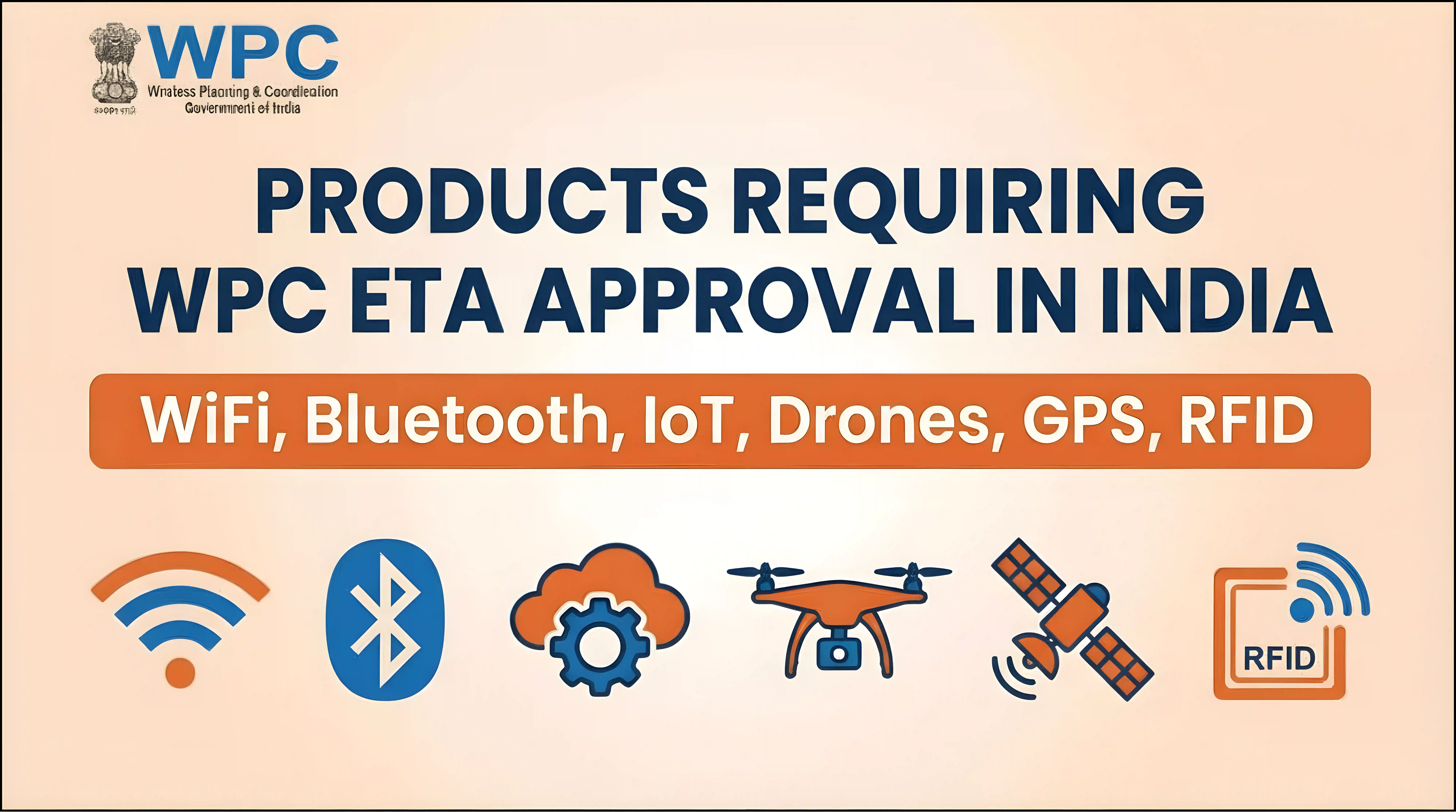
Products Requiring WPC ETA Approval in India – WiFi Bluetooth IoT Drones GPS RFID

All products using radio frequency spectrum in India require WPC ETA approval before they can be legally imported or sold.

Real Life Example – What Happens Without WPC ETA

Consider a startup that spent 18 months developing a smart home energy monitoring system with WiFi and Zigbee connectivity. They sourced hardware from a Taiwanese manufacturer, completed software development, and arranged logistics for a container shipment from Taipei to JNPT Mumbai. The shipment arrived — and was immediately held at customs.

The reason: no WPC ETA for the WiFi and Zigbee wireless modules in the product. The product had CE certification from Europe and FCC approval from the USA — but neither of those substitutes for WPC ETA in India. WPC ETA is an India-specific approval, and it does not matter how many international certifications a product holds.

The shipment sat in a bonded warehouse for over 60 days while the company scrambled to get the WPC ETA application filed, tested, and approved. During this time, they paid daily demurrage charges, missed their launch window for the Diwali season, and lost their first major retail distribution agreement.

The total cost of that missed approval — in demurrage, lost sales, and broken commercial commitments — was estimated at over INR 25 lakhs. The WPC ETA application itself cost a fraction of that. This is not an unusual story. It plays out regularly with importers who discover WPC ETA only when their shipment is already in transit or at port.

Key Lesson

WPC ETA must be obtained before the first shipment arrives in India — not during or after. The approval process takes 30 to 60 working days. Plan accordingly and engage a consultant well in advance of your planned import or product launch date.

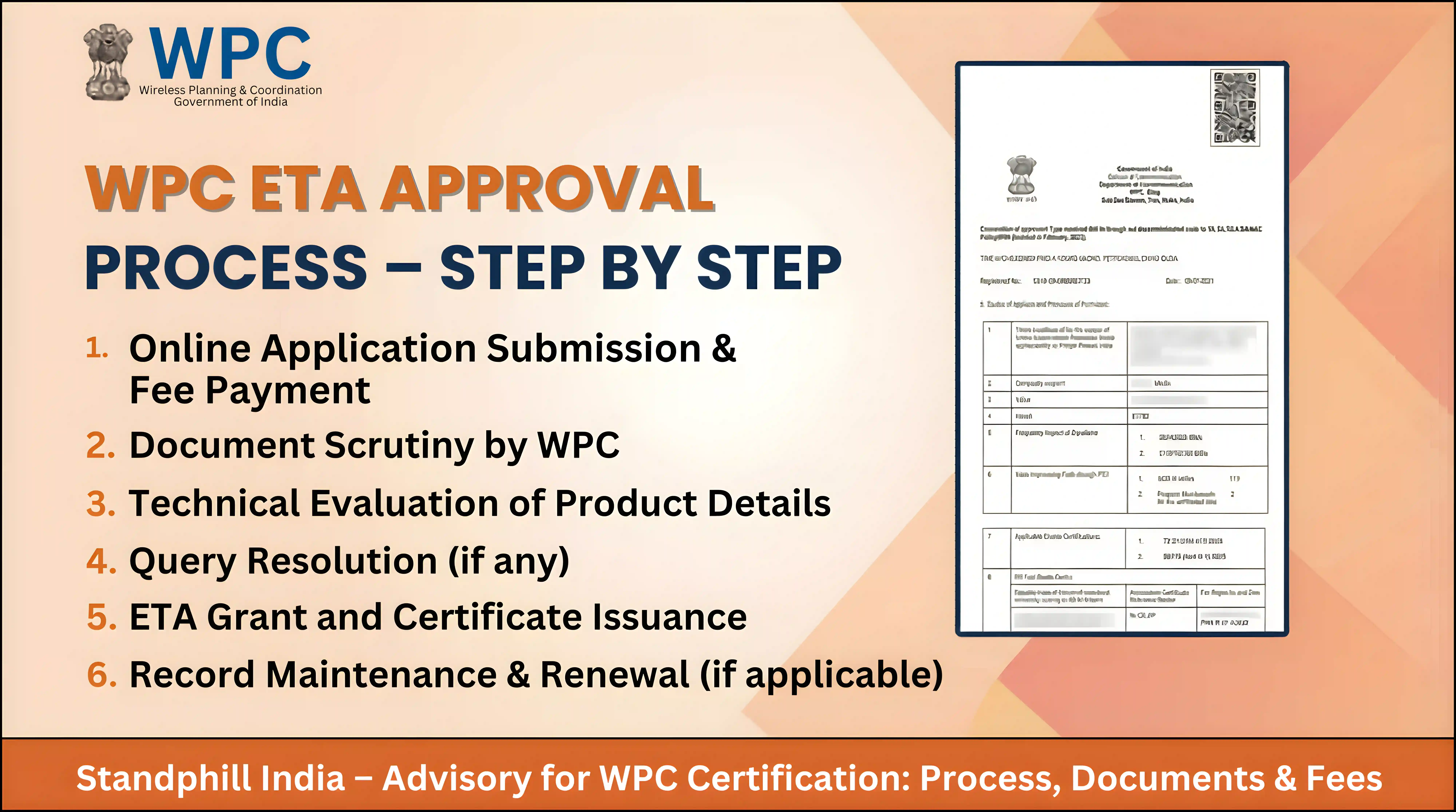
WPC ETA Approval Process – Step by Step

The WPC ETA approval process follows a defined sequence. Here is the complete step-by-step guide for 2026:

Step 1 – Product Assessment and Wireless Technology Identification

The first step is a thorough technical assessment of your product. Every wireless technology incorporated in the device must be identified — WiFi (2.4 GHz or 5 GHz or both), Bluetooth (Classic, BLE, or both), Zigbee, Z-Wave, LoRa, GPS, NB-IoT, LTE, or any combination. Each wireless technology and its operating frequency band determines the specific WPC approval category and the applicable Indian technical standards.

Products with multiple wireless technologies — for example, a smart watch with both WiFi and Bluetooth — may require separate approval for each technology or combined approval depending on the WPC categorization. Getting this assessment right at the start prevents the need for multiple separate applications and additional testing costs.

Step 2 – RF Testing in an Accredited Laboratory

This is the technical backbone of the WPC ETA application. The product must be tested in a laboratory accredited by the National Accreditation Board for Testing and Calibration Laboratories (NABL) or recognized by WPC for the specific tests required.

RF tests typically include:

Frequency accuracy — confirming the device operates within its permitted frequency band

RF output power — confirming transmit power is within limits prescribed for the frequency band in India

Spurious emissions — confirming the device does not emit significant energy at frequencies outside its intended band

Occupied bandwidth — confirming the signal bandwidth is within permitted limits

Adjacent channel power — for certain frequency bands and device types

Antenna gain — for devices with external antennas

If the product already holds FCC approval (USA) or CE marking (Europe) with test reports covering the relevant parameters, some of these test results may be reusable for the WPC ETA application — but this must be verified on a case-by-case basis. Indian frequency band limits and power limits sometimes differ from FCC or CE requirements, meaning full or partial re-testing may still be required.

Step 3 – Document Preparation

A complete WPC ETA application requires careful preparation of all technical and business documents. See the full documents checklist below. Incomplete documentation is the most common cause of WPC ETA application delays — a single missing document can hold an application for weeks.

Step 4 – Online Application Submission on the SARAL Portal

WPC ETA applications are submitted online through the SARAL (Simplified Access to Radio Approval and Licensing) portal maintained by the WPC Wing at dot.gov.in. The application requires registration on the portal, selection of the correct approval category, upload of all technical documents and test reports, and payment of the prescribed government fee.

Selecting the correct approval category on the SARAL portal is critical. Incorrect category selection leads to application rejection or delays while WPC requests re-categorization. Standphill India's team ensures correct category selection for every application based on the device's technical specifications.

Step 5 – WPC Wing Technical Scrutiny

After submission, WPC Wing officers review the application, technical documentation, and RF test reports. They verify that the device's operating parameters fall within the limits prescribed for its frequency band and device category in India. If the WPC team raises technical queries — requesting clarification on test parameters, additional test data, or document corrections — these must be responded to promptly and accurately. Slow or incomplete query responses are the leading cause of application delays.

Step 6 – Grant of WPC ETA Certificate

When the WPC Wing is satisfied that the application and test results are complete and compliant, it issues the Equipment Type Approval (ETA) Certificate. The certificate specifies:

• the product name and model number

• the applicant/company name

• the approved frequency band(s) and power levels

• the unique ETA number for the product

• the validity period — 5 years from date of issue

• any specific conditions of approval that must be observed

Once the WPC ETA certificate is received, the product can be legally imported, manufactured, and sold in India for the validity period of the approval.

WPC ETA Approval Process – Step by Step

WPC ETA Approval Process India Step by Step – SARAL Portal – Standphill India

Documents Required for WPC ETA Approval

Here is the complete checklist of documents typically required for a WPC ETA application in India:

Company and Business Documents

• company registration certificate (CIN, GST, or Import Export Code as applicable)

• authorized signatory details and authorization letter or board resolution

• identity proof of authorized signatory

Product Technical Documents

• product name, model number, and product description

• product user manual (English version)

• product block diagram showing the RF section

• circuit diagram of the RF transmitter/receiver section

• list of all wireless technologies incorporated with their operating frequency bands and maximum transmit power levels

• antenna specifications (type, gain, connector type) for external antenna products

• product photographs from multiple angles

RF Test Reports

• RF test report from a NABL-accredited or WPC-recognized laboratory

• the test report must cover all wireless technologies in the product

• test report must include frequency accuracy, output power, spurious emissions, and other parameters as applicable to the device category

• if FCC or CE test reports are being used (where permissible), original copies or certified true copies are required

Existing Certifications (if available)

• FCC ID certificate (if USA approval has been obtained)

• CE Declaration of Conformity (if European approval has been obtained)

• BIS CRS registration certificate (if already obtained)

• any other country-specific wireless certifications

Declaration

• Declaration of Conformity signed by the authorized signatory confirming that the product meets Indian wireless regulations

• declaration that the product's RF parameters will remain unchanged from the approved configuration

WPC ETA Approval Fees in India

WPC ETA fees are prescribed by the Department of Telecommunications and vary by product category and the type of approval. Here is an overview of the fee structure:

Approval Type / Category Government Fee (Approx.)
Low Power Devices (Unlicensed – WiFi 2.4 GHz, Bluetooth, Zigbee) INR 500 – INR 1,000
WiFi 5 GHz Devices INR 1,000 – INR 5,000
Cellular Devices (4G LTE, 5G) INR 5,000 – INR 50,000
Drones / UAVs INR 1,000 – INR 10,000
GPS and GNSS Devices INR 500 – INR 5,000
RFID Equipment (865-868 MHz) INR 500 – INR 5,000
Industrial Radio Equipment (VHF/UHF) INR 5,000 – INR 20,000
Combined Multi-Band Devices (WiFi + BT + Cellular) As per component approvals

Note: Government fees are subject to revision by DoT. Additionally, separate charges apply for RF laboratory testing — which vary from INR 15,000 to INR 1,50,000+ depending on the complexity of the wireless technologies and the number of test parameters required. Contact Standphill India for a personalized cost estimate for your specific product.

WPC ETA Validity and Renewal

WPC ETA approval is valid for 5 years from the date of issue. After the 5-year validity period expires, the approval must be renewed to continue legally importing, manufacturing, or selling the product in India.

What Triggers a Fresh Application (Not Just Renewal)?

While a renewal handles the expiry of an existing approval, certain changes to the product require a completely fresh WPC ETA application — not just renewal:

Change in wireless technology — adding a new wireless module or technology to the product

Change in frequency band — operating on a different frequency band than what was approved

Change in transmit power — operating at a higher power level than what was approved

Change in antenna — using an external antenna with higher gain than the approved configuration

Hardware redesign — significant changes to the RF section of the product

Minor software or firmware updates that do not change the RF parameters of the product generally do not require fresh WPC ETA. However, any update that changes how the product uses the radio frequency spectrum — its power output, frequency accuracy, duty cycle, or channel access method — must be evaluated and may require fresh approval.

5 Years
WPC ETA Validity Period
30–60 Days
Typical Approval Timeline
SARAL
Online Application Portal

WPC ETA vs BIS CRS – Understanding Both Approvals

One of the most common questions from manufacturers of wireless electronic products in India is the relationship between WPC ETA and BIS CRS registration. Understanding both approvals and how they interact is essential for compliant product launch.

Aspect WPC ETA BIS CRS
Issuing Authority WPC Wing, DoT, Ministry of Communications BIS, MeitY
What it Covers Radio frequency compliance — spectrum use, power levels, emissions Electrical safety standards — product safety testing
Testing Focus RF test parameters — frequency, power, spurious emissions Electrical safety — IS 13252, IS 616, IS/IEC 62368-1:2023
Portal SARAL portal (dot.gov.in) BIS ManakOnline portal
Validity 5 years 2 years
Factory Inspection? No No
Products All wireless/RF products Notified electronic and IT products
Do Both Apply? Yes — most wireless electronic products need BOTH WPC ETA and BIS CRS

For example, a WiFi router sold in India needs:

WPC ETA — for its WiFi radio frequency compliance

BIS CRS — for its electrical safety compliance under IS 13252 (Part 1) or IS/IEC 62368-1:2023

Neither approval substitutes for the other. Both must be obtained before the product can legally enter the Indian market.

Common Mistakes to Avoid in WPC ETA Approval

Based on Standphill India's experience managing WPC ETA applications for clients across India and internationally, here are the most frequent mistakes manufacturers and importers make:

Mistake 1 – Starting After the Shipment is Booked

The most expensive mistake is treating WPC ETA as something to sort out after the product is ready to ship. The approval process takes 30 to 60 working days from complete application submission — not from when you first call a consultant. Start the WPC ETA process at least 90 days before your planned import date.

Mistake 2 – Assuming FCC or CE Covers India

FCC approval (USA), CE marking (Europe), and TELEC certification (Japan) are country-specific wireless approvals. None of them substitute for WPC ETA in India. India has its own frequency band plans, power limits, and technical standards. Every wireless product needs India-specific WPC ETA regardless of what other approvals it holds.

Mistake 3 – Missing a Wireless Technology

Modern products often incorporate multiple wireless technologies — a smart speaker might have WiFi, Bluetooth, and Zigbee. If the WPC ETA application covers only WiFi but the product also uses Bluetooth and Zigbee, the approval is incomplete and the product is still non-compliant for those technologies. Every wireless technology in the product must be covered in the approval.

Mistake 4 – Using Non-Accredited Laboratory Test Reports

WPC Wing requires RF test reports from NABL-accredited or WPC-recognized laboratories. Test reports from non-accredited facilities — even if technically accurate — are not acceptable for WPC ETA applications and will result in application rejection.

Mistake 5 – Changing the Product After Approval

Making hardware changes to the RF section of a product after WPC ETA is obtained — without updating the approval — makes the existing approval invalid for the modified product. Any change that affects RF parameters requires re-evaluation and potentially fresh approval.

How Standphill India Helps with WPC ETA Approval

Standphill India provides complete end-to-end WPC ETA approval support for Indian and international manufacturers and importers. With over 20 years of experience and 400+ global clients served, we have managed WPC ETA applications across virtually every wireless product category.

1. Product Technical Assessment

We assess your product's technical specifications and identify all wireless technologies, frequency bands, and power levels involved. We determine the correct WPC approval category and identify whether existing FCC or CE test data can be leveraged to reduce testing costs and time.

2. Laboratory Coordination

We coordinate RF testing with NABL-accredited laboratories, manage sample submission, track testing progress, and review test reports before submission to ensure they meet WPC Wing requirements. This prevents the common issue of application rejection due to test report format or parameter gaps.

3. Complete Documentation Preparation

We prepare and compile every document required for the WPC ETA application — technical specifications, user manual review, block diagrams, declarations, and company documents — ensuring the application is complete and correctly formatted for SARAL portal submission.

4. SARAL Portal Application Filing

We handle the complete application submission on the SARAL portal — selecting the correct approval category, uploading all documents, and paying the government fee. Correct category selection on the first attempt prevents the delays caused by WPC Wing requesting re-categorization.

5. WPC Query Resolution

We monitor application status actively and respond to WPC Wing queries promptly and technically accurately — preventing the delays that slow down unmanaged applications by weeks or months.

6. Combined WPC ETA + BIS CRS Support

For wireless electronic products needing both WPC ETA and BIS CRS, Standphill India manages both approvals simultaneously — coordinating the testing, documentation, and application timelines to achieve both approvals as efficiently as possible.

20+
Years of Experience
400+
Global Clients Served
All
Wireless Categories Covered
24 Hrs
Initial Consultation Response

Get Your WPC ETA Approval — Start Today

Don't let a missing WPC approval delay your product launch. Standphill India's WPC ETA experts will assess your product, coordinate testing, prepare documentation, and manage your application through to approval.

📞 +91-9667674225  /  +91-85279 30453

📧 info@standphillindia.in

Monday to Saturday, 9:00 AM – 8:00 PM

Conclusion

WPC ETA approval is not a technicality that wireless product manufacturers and importers can discover at the last minute. It is a fundamental legal requirement for every product that uses radio frequency spectrum in India — from the simplest Bluetooth earphone to the most complex 5G smartphone. And with the Indian wireless product market growing rapidly across consumer electronics, IoT, industrial applications, and smart infrastructure, the volume of products requiring WPC ETA is expanding every year.

The process is structured and navigable — with the right guidance. Getting it right means understanding your product's wireless technologies completely, testing at the right laboratory, submitting a complete and correctly categorized application, and responding promptly to WPC Wing queries. Getting it wrong means shipments held at customs, product seizure, missed launch windows, and costs that dwarf what expert consultancy would have cost.

Planning to launch a wireless product in India? Contact Standphill India today — and let us get your WPC ETA sorted before your first shipment arrives.

Frequently Asked Questions – WPC ETA Approval India

Q1. What is WPC ETA approval?

WPC ETA (Equipment Type Approval) is the mandatory wireless approval issued by the WPC Wing of the Department of Telecommunications (DoT), Government of India. Any product that transmits or receives radio frequency signals must obtain WPC ETA before it can be imported, manufactured, or sold in India. It certifies that the device operates within permitted frequency bands and power levels and will not cause harmful interference.

Q2. Which products require WPC ETA in India?

All wireless products require WPC ETA in India including WiFi routers, Bluetooth devices, mobile phones, smart watches, IoT devices, drones, wireless CCTV cameras, GPS trackers, RFID equipment, smart home devices, walkie-talkies, wireless keyboards and mice, and any other product incorporating a radio frequency transmitter or receiver.

Q3. How long does WPC ETA approval take?

WPC ETA approval typically takes 30 to 60 working days from complete application submission. The timeline depends on product complexity, documentation completeness, laboratory testing schedules, and WPC Wing processing time. Start the process at least 90 days before your planned import or launch date.

Q4. What is the validity of WPC ETA approval?

WPC ETA approval is valid for 5 years from the date of issue. After expiry, the approval must be renewed. Changes to the product's wireless technology, frequency band, or power levels during the validity period may require fresh approval.

Q5. What are the fees for WPC ETA approval?

Government fees range from INR 500 for simple low-power unlicensed devices to INR 50,000 for cellular devices. Additional laboratory testing charges range from INR 15,000 to INR 1,50,000+ depending on the product's wireless complexity. Contact Standphill India for a personalized cost estimate.

Q6. Is WPC ETA approval the same as BIS CRS registration?

No. WPC ETA and BIS CRS are two separate mandatory approvals. WPC ETA covers radio frequency compliance (issued by DoT). BIS CRS covers electrical safety (issued by BIS). Most wireless electronic products require both approvals before they can be legally sold in India.

Q7. Does FCC or CE approval substitute for WPC ETA in India?

No. FCC (USA) and CE (Europe) are country-specific wireless approvals and do not substitute for WPC ETA in India. India has its own frequency allocation plan, power limits, and technical standards. Every wireless product needs India-specific WPC ETA regardless of any other international approvals it holds.

Q8. How can Standphill India help with WPC ETA approval?

Standphill India provides complete WPC ETA approval support including product technical assessment, laboratory coordination for RF testing, documentation preparation, SARAL portal application filing, WPC query resolution, and post-approval renewal support. We also manage combined WPC ETA and BIS CRS approvals for wireless electronic products. Contact us at +91-9667674225 or info@standphillindia.in.

Tags: WPC ETA Approval  |  WPC License India  |  Wireless Approval India  |  WPC ETA Process  |  WPC ETA Fees  |  WPC ETA Documents  |  SARAL Portal  |  WiFi Approval India  |  Bluetooth Approval India  |  Standphill India WPC  |  DoT WPC Wing

Request a call back.

For Business:   For Business inquiry fill our short feedback form or you can also send us an and we’ll get in touch shortly, or Toll Free Number +91 85279 30453.

Office Hours : 09:00 and 20:00 Mon to Sat, Sun - Closed

Send Message