BIS Certification for Non-Electric Toys – IS 9873
ISI Mark Licence under IS 9873 – Safety of Toys | Toys Quality Control Order, 2020
Quick Answer — BIS Certification for Non-Electric Toys
BIS certification is mandatory for non-electric toys in India under the Toys (Quality Control) Order 2020. All non-electric toys must comply with IS 9873 (Part 1): 2025 — the primary standard for mechanical and physical safety — along with secondary standards IS 9873 Parts 2, 3, 4, 7 and 9 covering flammability, chemical safety, activity toys, finger paints, and phthalates. Manufacturers must obtain an ISI Mark licence by submitting an application, undergoing a factory audit, and passing laboratory testing. The standard applies to all toys without electrical functions designed for children under 14 years. Standphill India provides complete BIS non-electric toy certification consultancy with over 20 years of experience and 10,000+ domestic and 400+ foreign certification projects completed.
Overview
BIS Certification for Non-Electric Toys is a mandatory product certification issued by the Bureau of Indian Standards (BIS) for all toys without electrical functions sold, manufactured, or imported in India. Under the Toys (Quality Control) Order, 2020 — notified by the Department for Promotion of Industry and Internal Trade (DPIIT) under Section 16 of the BIS Act, 2016 — every non-electric toy manufacturer must obtain an ISI Mark licence under IS 9873 (Part 1) before their products can legally enter the Indian market.
Non-electric toys are the largest category of toys in India — covering plastic toys, wooden toys, stuffed toys, puzzles, board games, activity toys, craft kits, and hundreds of other product types. While they do not carry electrical risks, they pose significant safety concerns including choking hazards from small parts, physical injuries from sharp edges, exposure to toxic chemicals in paints and plastics, and flammability risks from materials used in soft toys and craft items.
Standphill India provides end-to-end BIS certification consultancy for non-electric toy manufacturers across India, covering IS 9873 compliance, documentation preparation, BIS recognized laboratory coordination, factory inspection preparation, and ISI Mark licence approval support.
What is BIS Certification for Non-Electric Toys?
BIS Certification for Non-Electric Toys is the mandatory product certification system under which manufacturers of toys without any electrical function must demonstrate that their products comply with IS 9873 (Part 1) and applicable secondary standards before placing them in the Indian market.
In simple terms, if a manufacturer produces non-electric toys intended for children in India — whether manufacturing domestically or exporting into India — BIS evaluates whether the product and the manufacturing facility meet the required safety standards. If everything is satisfactory, BIS grants an ISI Mark licence authorizing the manufacturer to sell ISI-marked non-electric toys in India.
This certification is not optional. Without a valid ISI Mark licence under IS 9873 (Part 1), non-electric toys cannot be manufactured, imported, sold, supplied, or distributed in India.
It is important to note that non-electric toys and electric toys require separate BIS licences. A manufacturer producing both types must submit separate applications — one under IS 9873 (Part 1) for non-electric toys and one under IS 15644:2006 for electric toys. If you are looking for electric toy certification, please visit our BIS Certification for Electric Toys page.
What is IS 9873 – Indian Standard for Non-Electric Toys?
IS 9873 is a series of Indian Standards for the Safety of Toys, issued by the Bureau of Indian Standards. The series covers multiple aspects of toy safety through nine separate parts. For non-electric toys, IS 9873 (Part 1) is the primary standard under which the BIS ISI Mark licence is issued.
The IS 9873 series is aligned with the international ISO 8124 series — the globally recognized standard for toy safety issued by the International Organization for Standardization (ISO). This alignment ensures Indian toy safety requirements are consistent with global norms.
Key Highlights of IS 9873 for Non-Electric Toys:
Product: Non-Electric Toys
Primary Standard: IS 9873 (Part 1): 2025
International Equivalent: ISO 8124-1
Certification Scheme: ISI Mark Scheme (Scheme I)
Compliance: Mandatory under Toys QCO 2020
Applicable to: Children under 14 years
Previous Standard: IS 9873 (Part 1): 2019 (valid until 22 March 2027)
IS 9873 Parts – All Standards for Non-Electric Toy Safety
The IS 9873 series covers different aspects of non-electric toy safety through multiple parts. For BIS certification, IS 9873 (Part 1) is the primary standard and remaining parts are secondary standards that require additional testing.
| Standard | Type | Safety Aspect Covered |
|---|---|---|
| IS 9873 (Part 1): 2025 | Primary Standard | Mechanical and Physical Safety – sharp edges, sharp points, choking hazards, small parts, structural integrity, toy bags |
| IS 9873 (Part 2): 2017 | Secondary Standard | Flammability – ensuring toys and toy materials do not easily catch fire |
| IS 9873 (Part 3): 2017 | Secondary Standard | Chemical Safety – migration of toxic elements including lead, cadmium, chromium, mercury, antimony, arsenic, barium, selenium |
| IS 9873 (Part 4): 2016 | Secondary Standard | Activity Toys – swings, slides, climbing frames, home use play equipment for structural safety |
| IS 9873 (Part 7): 2017 | Secondary Standard | Finger Paints – non-toxicity requirements for craft kits and art materials for children |
| IS 9873 (Part 9): 2017 | Secondary Standard | Phthalate Esters – restrictions on certain phthalates in toys and children's products |
Important Note on IS 9873 (Part 1): 2025
BIS released the revised standard IS 9873 (Part 1): 2025 in alignment with international ISO 8124-1 requirements. This updated standard runs concurrently with IS 9873 (Part 1): 2019 until 22 March 2027, after which the 2019 version will be officially withdrawn and BIS will only grant new licences under the 2025 standard. All new applicants are strongly encouraged to apply under IS 9873 (Part 1): 2025 to avoid future re-testing and documentation rework.
Which Non-Electric Toys Require BIS Certification Under IS 9873?
Any toy without electrical functions designed for children under 14 years requires BIS certification under IS 9873 (Part 1). This is the largest and most diverse toy category. Common non-electric toy types covered include:
• plastic toys and figurines — action figures, dolls, plastic animals
• stuffed and soft plush toys — teddy bears, soft animals, fabric dolls
• wooden toys — wooden blocks, wooden vehicles, wooden puzzles
• ride-on toys without motors — push-along cars, tricycles, scooters without electric drive
• activity toys — swings, slides, climbing frames, seesaws for home use
• puzzles — jigsaw puzzles, 3D puzzles, shape sorters
• building blocks and construction sets — block sets, LEGO-type sets without electrical components
• board games — board games, card games, dice games intended for children
• toy craft kits — art and craft sets, finger paints, crayons, modelling clay
• diecast and metal toys — model cars, metal figures, diecast vehicles
• water toys and bath toys — inflatable floats, bath toys, water squirters
• outdoor play equipment — balls, skipping ropes, frisbees, kites
• handcrafted and artisanal toys — fabric toys, clay toys, handmade wooden toys
• educational non-electric toys — alphabet blocks, flash cards with play elements, non-electric learning kits
Why BIS Certification is Important for Non-Electric Toy Manufacturers
1. Legal Compliance
Non-electric toys without a valid ISI Mark licence under IS 9873 (Part 1) cannot be legally manufactured, imported, or sold in India. Non-compliance leads to product seizure, heavy fines, and legal action under the BIS Act, 2016.
2. Child Physical Safety
Non-electric toys pose real safety risks — choking from small parts, cuts from sharp edges, exposure to toxic chemicals in paints and plastics, fire risk from flammable materials. IS 9873 certification ensures all these risks are tested and controlled before the product reaches children.
3. Chemical Safety Assurance
IS 9873 (Part 3) tests for migration of eight toxic heavy metals — lead, cadmium, chromium, mercury, antimony, arsenic, barium, and selenium — from toy materials. IS 9873 (Part 9) restricts harmful phthalates in plastics. These protections are critical for toys that children handle, mouth, and play with closely.
4. Import Clearance at Customs
Customs authorities in India verify BIS certification at ports of entry. Non-electric toys without the ISI Mark are held or rejected at import. Certification ensures smooth customs clearance and uninterrupted market entry.
5. Consumer and Retail Trust
The ISI Mark on non-electric toys signals to parents, retailers, and e-commerce platforms that the product has passed rigorous safety testing. This directly improves market acceptance and brand credibility.
6. Government and Institutional Procurement
Government schools, anganwadis, child care institutions, and public sector buyers increasingly require BIS-certified toys for procurement. The ISI Mark opens access to these institutional buyers.
Who Needs BIS Certification for Non-Electric Toys?
BIS non-electric toy certification under IS 9873 (Part 1) is required for:
• Indian manufacturers producing non-electric toys at factories located within India
• Foreign manufacturers exporting non-electric toys to the Indian market (under the FMCS scheme)
• Global non-electric toy brands whose products are manufactured or sold in India
The ISI Mark licence is issued only to the manufacturer — not to importers, distributors, or sellers. Foreign manufacturers must appoint an Authorized Indian Representative (AIR) to manage BIS communication and compliance formalities.
A separate BIS licence is required for non-electric toys (IS 9873 Part 1) and electric toys (IS 15644:2006) even if produced by the same manufacturer. Separate licences are also required for each manufacturing location.
Exemption: Toys sold by artisans registered with the Office of the Development Commissioner (Handicrafts) are exempt from the Toys QCO 2020.
Eligibility for BIS Non-Electric Toy Certification
To obtain BIS certification under IS 9873 (Part 1), non-electric toy manufacturers must meet the following requirements.
1. Manufacturing Unit Must Be Operational
The factory must have an active production facility with the required machinery for non-electric toy manufacturing and must be ready for BIS factory inspection.
2. Product Must Comply with IS 9873 (Part 1): 2025
The toy must meet all technical requirements of IS 9873 (Part 1): 2025 as the primary standard, plus applicable secondary standards from IS 9873 Parts 2, 3, 4, 7 and 9 based on the toy type and materials used.
3. In-House Testing Facilities Must Be Available
Manufacturers must maintain testing equipment as specified under the BIS Scheme of Inspection and Testing (SIT) for IS 9873 (Part 1). Certain tests may be subcontracted to BIS recognized laboratories but key in-house testing capability is required.
4. Quality Control System Must Be in Place
The manufacturer must demonstrate documented quality control processes, trained quality personnel, and production records to ensure consistent compliance throughout production.
5. Factory Inspection Must Be Accepted
The manufacturer must agree to BIS factory audits during certification and ongoing BIS surveillance inspections after the licence is granted.
Separate applications are required for each manufacturing location and each product category (non-electric and electric toys).
Key Tests Under IS 9873 for BIS Non-Electric Toy Certification
IS 9873 series specifies a comprehensive set of safety tests that non-electric toys must pass. Tests are divided between those that can be conducted in BIS-recognized laboratories and those specified as in-house under the SIT.
1. Mechanical and Physical Safety Tests – IS 9873 (Part 1): 2025
These are the primary tests for all non-electric toys covering:
• small parts test — choking hazard assessment for toys intended for children under 3 years
• sharp edges and sharp points test — evaluating cutting and puncture risks
• structural integrity and drop test — verifying toys do not break into dangerous pieces
• toy bag and plastic film test — suffocation risk evaluation
• projectile test — for toys that launch projectiles
• folding and hinges test — for toys with moving parts
• mouth actuated toys test — for toys designed to be used near the mouth
2. Flammability Testing – IS 9873 (Part 2): 2017
Tests the toy's materials — fabrics, foam, hair, beard — against flammability requirements to ensure they do not catch fire easily under normal use conditions.
3. Chemical Safety Testing – IS 9873 (Part 3): 2017
Tests for migration of eight toxic heavy metals from toy materials including surface coatings, paints, and plastics — lead, cadmium, chromium, mercury, antimony, arsenic, barium, and selenium. Migration limits are set for each element.
4. Activity Toy Safety Testing – IS 9873 (Part 4): 2016
Applies to swings, slides, climbing frames, and similar activity toys for home use. Tests cover structural load, stability, entrapment hazards, and surface finish requirements.
5. Finger Paint Safety Testing – IS 9873 (Part 7): 2017
Tests finger paints and art materials for children for toxicity, microbial contamination, pH levels, and chemical content to ensure they are safe for direct skin contact.
6. Phthalate Restriction Testing – IS 9873 (Part 9): 2017
Tests for the presence and concentration of restricted phthalate esters in PVC and other plastic materials used in toys, particularly those that children may mouth or handle closely.
BIS Certification Process for Non-Electric Toys
Step 1 – Identify the Applicable Standard and Product Category
Confirm IS 9873 (Part 1): 2025 applicability for your specific toy type. Identify which secondary standards apply based on toy materials — for example, IS 9873 (Part 2) for flammability if the toy uses fabric or foam, IS 9873 (Part 4) if it is an activity toy, and IS 9873 (Part 7) if it includes finger paints.
Step 2 – Documentation Preparation
Compile all required documents including factory registration, manufacturing process flowchart, list of machinery, testing equipment list with calibration certificates, quality control records, raw material specifications, and product model specifications.
Step 3 – Product Testing in BIS Recognized Laboratory
Toy samples are tested in a BIS recognized laboratory against IS 9873 (Part 1): 2025 as the primary standard and applicable secondary IS 9873 standards. The test report is the core technical basis of the BIS application.
Step 4 – Application Submission
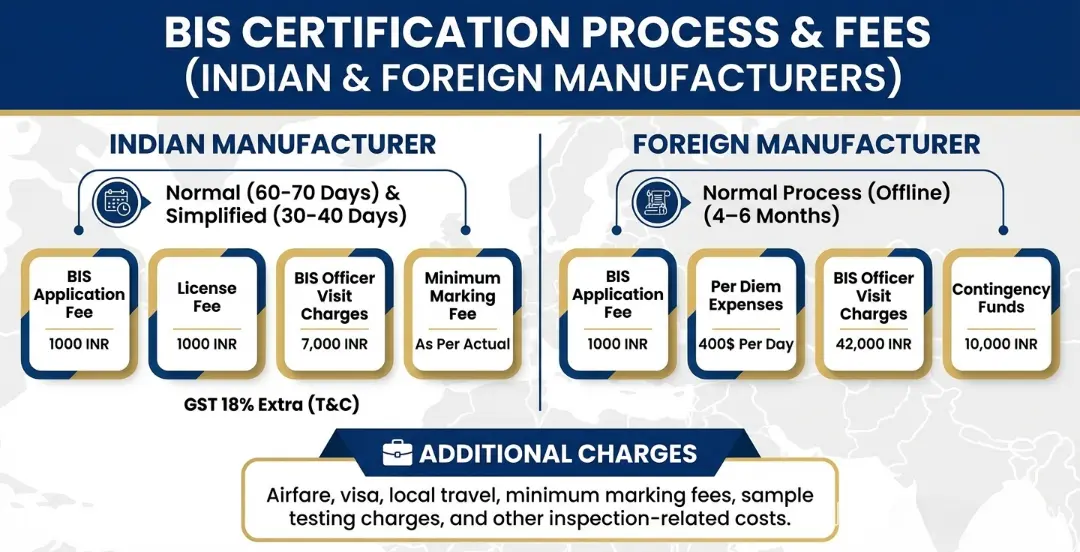
Domestic manufacturers apply through the BIS ManakOnline portal selecting IS 9873 (Part 1): 2025 as the primary standard. Foreign manufacturers submit a physical application to the BIS Foreign Manufacturers division. The application fee of INR 1,000 and 50% of the minimum marking fee are paid at this stage.
Step 5 – BIS Scrutiny
BIS reviews the submitted application and documents. If queries arise, the manufacturer must respond promptly through the portal to avoid delays in processing.
Step 6 – Factory Audit by BIS
A BIS auditor visits the manufacturing premises to inspect:
• manufacturing infrastructure and non-electric toy production machinery
• in-house testing facilities and calibrated testing equipment
• quality control systems, production records, and process documentation
• raw material controls, storage conditions, and supplier records
Step 7 – Sample Draw and Laboratory Testing
The BIS auditor draws representative non-electric toy samples during the factory visit. These are sealed and sent to a BIS-recognized laboratory for independent testing against IS 9873 (Part 1): 2025 and applicable secondary standards.
Step 8 – Evaluation and Grant of ISI Mark Licence
BIS evaluates the factory audit report and laboratory test results. If the product and factory comply with all IS 9873 requirements, the ISI Mark licence is granted and the manufacturer is authorized to apply the ISI Mark on certified non-electric toys.
BIS Certification Process for Non-Electric Toys – IS 9873
Documents Required for BIS Certification of Non-Electric Toys
Manufacturers must prepare and submit the following documents. Incomplete documentation is the most common cause of BIS certification delays.
Typical documents include:
• factory registration certificate or manufacturing licence
• company registration documents (GST certificate, company incorporation certificate)
• identity proof of authorized signatory
• factory layout plan
• manufacturing process flow chart
• list of manufacturing machinery with specifications
• list of in-house testing equipment with calibration certificates
• quality control parameters and records
• BIS recognized laboratory test report (IS 9873 Part 1: 2025 and applicable secondary standards)
• product model specifications and design details
• raw material specifications and supplier details
• material safety data sheets for paints, coatings, and plastics used
• trademark registration certificate (if applicable)
• authorized signatory board resolution or authorization letter
• AIR documents (mandatory for foreign manufacturers)
Standphill India assists in documentation preparation, technical review, and BIS filing support to improve approval efficiency and reduce delays at every stage.
Timeline for BIS Non-Electric Toy Certification
The BIS non-electric toy certification process typically takes 30 to 60 days for Indian manufacturers.
The timeline depends on:
• completeness of application and documents at submission
• laboratory testing schedule at BIS recognized lab for IS 9873 tests
• factory inspection scheduling by BIS
• response time to BIS queries if raised
• number of product models and applicable secondary IS 9873 standards
• complexity of raw materials requiring chemical safety testing
BIS Certification Fees for Non-Electric Toys
The cost of BIS non-electric toy certification may include the following standard fee components:
| S. No. | Particulars | Amount |
|---|---|---|
| 1 | APPLICATION FEE | INR 1,000/- |
| 2 | PRELIMINARY INSPECTION CHARGES | INR 7,000/- |
| 3 | ANNUAL LICENCE FEE | INR 1,000/- |
| 4 | MINIMUM MARKING FEE (Micro Scale 80% Off, Small 50%, Medium 20%) |
As Applicable |
| 5 | Sample Testing Fee (BIS Recognized Lab) | As Applicable |
The exact total cost depends on the toy type, applicable IS 9873 secondary standards, number of models, material complexity, testing scope, and factory inspection requirements. Manufacturers with multiple toy models may need to plan for multiple test runs covering different IS 9873 parts.
Benefits of BIS Certification for Non-Electric Toys
1. Legal Market Access
Without a valid ISI Mark licence under IS 9873 (Part 1), non-electric toys cannot be legally sold in India. Certification provides lawful market access and eliminates the risk of product seizure or legal action.
2. Child Physical and Chemical Safety
IS 9873 certification ensures non-electric toys are tested for choking hazards, sharp edges, toxic chemical migration, flammability, and phthalate restrictions — all critical safety aspects for toys that children handle, mouth, and play with closely.
3. Consumer Trust and Brand Reputation
ISI-marked non-electric toys build stronger trust with parents and retailers. The ISI Mark is one of the most recognized quality symbols in India and directly improves product credibility and shelf positioning.
4. E-Commerce Platform Access
Major e-commerce platforms including Amazon India, Flipkart, and Meesho increasingly require BIS certification for listing toys. ISI-marked non-electric toys face fewer listing restrictions and gain wider market reach.
5. Institutional and Government Procurement
Government schools, child development institutions, and public sector buyers require BIS-certified toys. The ISI Mark is often a mandatory requirement for government toy procurement tenders.
6. Export Credibility
Since IS 9873 is aligned with ISO 8124, BIS certification demonstrates compliance with internationally recognized toy safety standards, supporting export credibility to markets that accept ISO-aligned certifications.
BIS Enforcement and Penalties for Non-Compliant Non-Electric Toys
BIS actively enforces the Toys QCO 2020 through regular market surveillance, factory inspections, import checks, and enforcement raids across India. As of June 2025, BIS had conducted 159 search-and-seizure operations targeting non-compliant toy manufacturers and sellers.
Consequences of selling non-electric toys without BIS certification include:
• seizure of toy batches at factories, warehouses, or retail outlets
• heavy fines under the BIS Act, 2016
• rejection of consignments at customs for imported non-electric toys
• suspension or cancellation of existing BIS licences
• potential criminal liability for serious violations
• prohibition on sale and distribution in India
Surveillance and Licence Renewal
BIS non-electric toy certification does not end with the grant of licence. After approval, BIS conducts periodic surveillance to ensure the manufacturer continues to comply with IS 9873 licence conditions.
These surveillance activities may include:
• scheduled and surprise factory inspections
• market sample testing of ISI-marked non-electric toys from retail outlets
• review of production records, quality control documentation, and testing logs
The BIS non-electric toy licence must be renewed periodically. Failure to renew on time or maintain compliance during surveillance may result in suspension or cancellation of the licence.
Recent BIS Non-Electric Toy Certifications Delivered by Standphill India
Standphill India has successfully assisted multiple non-electric toy manufacturers across India in obtaining BIS ISI Mark certification under IS 9873.
Himalayan Packaging Industries Pvt Ltd – Unit III
Product Certified
Safety of Toys – Mechanical and Physical Properties
Specification as per IS 9873 (Part 1): 2019
Soccer International Private Limited – Punjab
Product Certified
Safety of Toys – Mechanical and Physical Properties
Specification as per IS 9873 (Part 1): 2019
Shanu International Toys – Delhi
Product Certified
Educational and plastic toys — IS 9873 Parts 1 to 4 compliance, audit support
Adhyat Solution – Bangalore, Karnataka
Product Certified
Wooden and craft-based toys — IS 9873 flammability and chemical testing support
Gleebuds Creations Pvt Ltd – Kolkata, West Bengal
Product Certified
Plush stuffed toys — IS 9873 Parts 3 and 9 toxicity testing and in-house testing guidance
These successful projects demonstrate Standphill India's expertise in handling BIS certification for non-electric toys across diverse toy categories and manufacturing scales.
Why Choose Standphill India for BIS Non-Electric Toy Certification?
Standphill India is a leading BIS certification consultancy with over 20 years of experience and a proven track record of 10,000+ domestic and 400+ foreign product certifications completed across India and worldwide.
Our specific services for BIS non-electric toy certification under IS 9873 include:
• IS 9873 (Part 1): 2025 applicability assessment for your specific toy type and materials
• identification of applicable secondary IS 9873 standards based on toy materials and design
• complete documentation preparation and BIS ManakOnline application filing
• coordination with BIS recognized laboratories for IS 9873 testing
• material safety data sheet review for chemical safety compliance
• factory inspection preparation and audit readiness support
• BIS query resolution and regulatory communication management
• ISI Mark licence approval support and post-licence renewal assistance
• FMCS application support for foreign non-electric toy manufacturers
Conclusion
BIS Certification for Non-Electric Toys under IS 9873 is a mandatory legal and safety compliance requirement for all non-electric toy manufacturers, importers, and sellers in India. The Toys (Quality Control) Order, 2020 makes it compulsory for every non-electric toy to carry the ISI Mark before entering the Indian market.
The certification process requires compliance with IS 9873 (Part 1): 2025 as the primary standard along with applicable secondary IS 9873 standards covering flammability, chemical safety, activity toy requirements, finger paint safety, and phthalate restrictions. With the new IS 9873 (Part 1): 2025 standard now in force and the 2019 version being withdrawn from 22 March 2027, manufacturers should plan to apply under the updated standard without delay.
With Standphill India as your certification partner, non-electric toy manufacturers can complete the entire BIS certification journey — from standard identification and laboratory testing to factory inspection and ISI Mark licence approval — with expert guidance and full regulatory confidence.
Get expert support for BIS certification for non-electric toys and bring your products to the Indian market with full compliance and confidence.
Frequently Asked Questions (FAQ)
Q1. Is BIS certification mandatory for non-electric toys in India?
Yes. BIS certification is mandatory for all non-electric toys in India under the Toys (Quality Control) Order, 2020. Non-electric toys must carry the ISI Mark under IS 9873 (Part 1) before they can be manufactured, imported, or sold in India. Selling without certification is illegal and can result in seizure and penalties under the BIS Act, 2016.
Q2. What is IS 9873 (Part 1): 2025?
IS 9873 (Part 1): 2025 is the latest Indian Standard for mechanical and physical safety of non-electric toys, aligned with international ISO 8124-1. It covers choking hazards, sharp edges, structural integrity, and other mechanical risks. It replaces IS 9873 (Part 1): 2019 with effect from 22 March 2027. All new applicants should apply under the 2025 standard.
Q3. Which secondary IS 9873 standards apply to non-electric toys?
Secondary standards applicable to non-electric toys include IS 9873 (Part 2): 2017 for flammability, IS 9873 (Part 3): 2017 for chemical safety (toxic element migration), IS 9873 (Part 4): 2016 for activity toys, IS 9873 (Part 7): 2017 for finger paints, and IS 9873 (Part 9): 2017 for phthalate restrictions. Which parts apply depends on the specific toy type and materials used.
Q4. Do I need a separate BIS licence for non-electric toys and electric toys?
Yes. Separate BIS applications and licences are required for non-electric toys (IS 9873 Part 1) and electric toys (IS 15644:2006). If a manufacturer produces both categories, two separate applications must be filed with BIS. Separate licences are also required for each manufacturing location.
Q5. How long does BIS certification for non-electric toys take?
The BIS non-electric toy certification process typically takes 30 to 60 days depending on documentation completeness, laboratory testing schedules for IS 9873 tests, and factory inspection scheduling by BIS.
Q6. What is the cost of BIS certification for non-electric toys?
Standard government fees include application fee INR 1,000, preliminary inspection charges INR 7,000, and annual licence fee INR 1,000. Additional costs include laboratory testing charges for IS 9873 series standards and marking fees as applicable based on production scale.
Q7. Can foreign manufacturers get BIS certification for non-electric toys?
Yes. Foreign manufacturers must apply under the BIS Foreign Manufacturers Certification Scheme (FMCS) and appoint an Authorized Indian Representative (AIR) in India. The safety standards, testing requirements, and process are the same as for Indian manufacturers.
Q8. What types of non-electric toys are covered under IS 9873?
IS 9873 covers all toys without electrical functions designed for children under 14 years — including plastic toys, wooden toys, stuffed toys, puzzles, board games, building blocks, activity toys, craft kits, diecast toys, water toys, outdoor play equipment, and handcrafted toys.
Q9. What happens if non-electric toys are sold without BIS certification?
Non-electric toys sold without a valid ISI Mark under IS 9873 (Part 1) can be seized at customs, retail outlets, or during BIS market raids. The manufacturer or importer faces heavy fines and legal penalties under the BIS Act, 2016. BIS had conducted 159 enforcement operations as of June 2025 targeting non-compliant toy products.
Q10. Does Standphill India provide BIS non-electric toy certification support across India?
Yes. Standphill India has a strong presence across all States and Union Territories of India and supports non-electric toy manufacturers nationwide with complete BIS certification consultancy under IS 9873 — from standard identification and documentation to factory inspection preparation and ISI Mark licence approval.
★ Why Standphill India?
- 20+ Years of BIS Certification Experience
- 10,000+ Certifications Delivered Globally
- Dedicated Teams for CRS, FMCS & ISI Mark
- End-to-End Documentation & Filing Support
- Fast Response & Practical Compliance Guidance
- Support for Indian & Foreign Manufacturers
Get Free Call Back
Our Services
- BIS (ISI Mark) for Foreign Manufacturers
- Domestic BIS (ISI Mark) Certification
- BIS Certificate of Conformity (CoC)
- BIS Hallmarking
- BIS Licence for Toys
- ECO Mark Certification
- TAC Approval for Automobile
- Drug Licence
- Peso Certification
- BIS (CRS) Registration
- WPC-ETA Approval
- BEE Certification
- E-Waste Management (EPR)
- EPR for Plastic Waste
- EPR for Battery Waste
- CE Certification
- UL Certification
- ROHS Licence
- Standardization Division
- Import / Export Licence
- FSSAI Certification
- ISO Registration
- Trademark Registration
- Make in India Support
- AG-Mark Licence
- Third Party Monitoring
Client Testimonials
Their team was very knowledgeable and helped us every step of the way. Standphill India is the best BIS certification consultants for any type of BIS certification.

Chintan Shah (AGM)
Sudeep Nutrition P.Ltd



Featured Guide
Complete BIS CRS certification guide for electronic products in India — free to read.
Read CRS Certification Guide📞 Contact Standphill India
+91-9667674225 info@standphillindia.in WhatsApp Now Greater Noida West, UPGet Expert BIS Certification Support for Your Business
Connect with Standphill India for complete support with BIS certification, CRS registration, WPC approval, FMCS compliance, and related regulatory services. Our team helps businesses with documentation, testing coordination, application support, and end-to-end compliance guidance.
Request Free Consultation
Share your requirement and our team will contact you shortly.