BIS Certification for Indian Manufacturers
ISI Mark Certification under Scheme-I (Product Certification Scheme)
- BIS Certification - ISI Mark Scheme-I Process, Fees & Documents
- What is BIS Certification?
- What is the ISI Mark?
- Reading the Standard Mark
- Why It Matters
- Who Needs It
- Eligibility Criteria
- ISI Certification Process
- Normal vs Simplified Procedure
- Documents Required
- Certification Fees
- Sample Grant of Licence
- Surveillance & Renewal
- Products Under Scheme-I
- Recent Projects
- Why Standphill India?
- FAQ
BIS Certification - ISI Mark Scheme-I Process, Fees & Documents
If you manufacture, sell, or import goods in India, chances are you have already come across the term BIS certification. Maybe a buyer asked for it, or your product showed up in a government notice. Put simply, BIS certification is the official proof that your product meets Indian quality and safety standards, and for a large number of products it is the difference between selling legally and not selling at all.
BIS Certification for Indian Manufacturers is granted by the Bureau of Indian Standards (BIS) under Scheme-I of Schedule-II of the BIS Act, 2016. Once approved, it allows an Indian manufacturer to stamp the ISI Mark on a product, confirming that the item meets the applicable Indian Standard (IS) for quality, safety and performance.
For products that fall under a mandatory Quality Control Order (QCO), this licence is not optional. The goods cannot be made, stored, sold or distributed in India until BIS grants it. The ISI Mark remains one of the most trusted quality symbols Indian buyers recognise on sight.
Standphill India handles the full journey for manufacturers, from picking the right standard and preparing documents to coordinating lab testing, getting the factory audit-ready and following the file through to licence grant.
What is BIS Certification for Indian Manufacturers?
BIS stands for the Bureau of Indian Standards, India's national standards body, working under the Ministry of Consumer Affairs, Food and Public Distribution. Under the BIS Act, 2016, it sets the quality and safety standards for products sold in the country and certifies products that meet them.
For a manufacturer with a factory in India, the idea is straightforward. If your product is governed by an Indian Standard, BIS checks both the product and the factory against that standard. When everything lines up, BIS issues a licence and you are allowed to carry the ISI Mark on your goods.
That mark is essentially a trust seal. It tells dealers, institutional buyers, government departments and ordinary customers that the product was tested, found compliant and made under proper quality control. For many regulated items, holding this licence is a legal requirement before the product reaches the market.
What is the BIS ISI Mark?
The ISI Mark is the most familiar quality symbol in the Indian market. You have probably seen it on electrical switches, helmets, LPG cylinders, cement bags and packaged drinking water. It is issued under Scheme-I and confirms that a product was assessed under the BIS product certification system and found to meet its Indian Standard.
When a product carries the ISI Mark, the message to the buyer is simple: this item has been independently checked for quality and safety. The mark applies across a broad mix of industries, including:
- Steel and construction materials
- Electrical and household appliances
- Pipes, fittings and plumbing products
- Footwear, helmets and protective gear
- Toys and medical textiles
- Packaging and consumer goods
- Industrial and engineering products
How to Read the BIS Standard Mark (ISI Mark)
The ISI Mark is the certification mark BIS allows licensees to use. A genuine mark carries two key details around the familiar ISI monogram:
- Indian Standard Number — printed above the mark, showing which IS standard the product was certified against
- Licence Number (CM/L-XXXXXXXXXX) — printed below the mark, identifying the manufacturer's specific BIS licence
Seeing both elements means the manufacturer has cleared product quality requirements, the relevant safety standard, manufacturing process controls and the prescribed quality inspection routine. A mark without a valid licence number is illegal and punishable under the BIS Act, 2016.
Why BIS Certification Matters for Indian Manufacturers
- It keeps you legal — products under a QCO simply cannot be sold in India without the licence
- It builds buyer trust — the ISI Mark is instantly recognised, which makes purchasing decisions easier
- It strengthens your brand — certified goods are seen as more reliable and better controlled
- It opens markets — tenders, institutions and large procurement channels often insist on ISI-marked supply
- It proves safety and quality — the licence confirms your product meets Indian performance benchmarks
Who Needs ISI Mark Certification under Scheme-I?
An Indian manufacturer should apply for an ISI licence when any of the following is true:
- The product is covered under a mandatory Quality Control Order
- The product category sits within the BIS product certification scheme
- A customer, institution or tender specifically asks for ISI-marked goods
- The manufacturer wants to demonstrate compliance with the relevant Indian Standard
Where certification is mandatory, the licence must be in hand before the product is sold in India.
Eligibility for ISI Mark Certification
To qualify under Scheme-I, a manufacturer needs to satisfy a few core conditions:
- Factory located in India — Scheme-I is meant for production units operating inside the country
- Product meets the IS standard — the item must match the technical requirements of its Indian Standard
- Suitable machinery in place — the factory should have the equipment needed to make the product
- In-house testing capability — basic testing facilities required by the standard should be available
- Working quality control system — production and quality checks must be in place to keep output consistent
- Willingness to follow BIS norms — including the prescribed Scheme of Inspection and Testing (SIT)
A separate BIS licence is required for each manufacturing location and each product standard.
BIS ISI Mark Certification Process for Indian Manufacturers
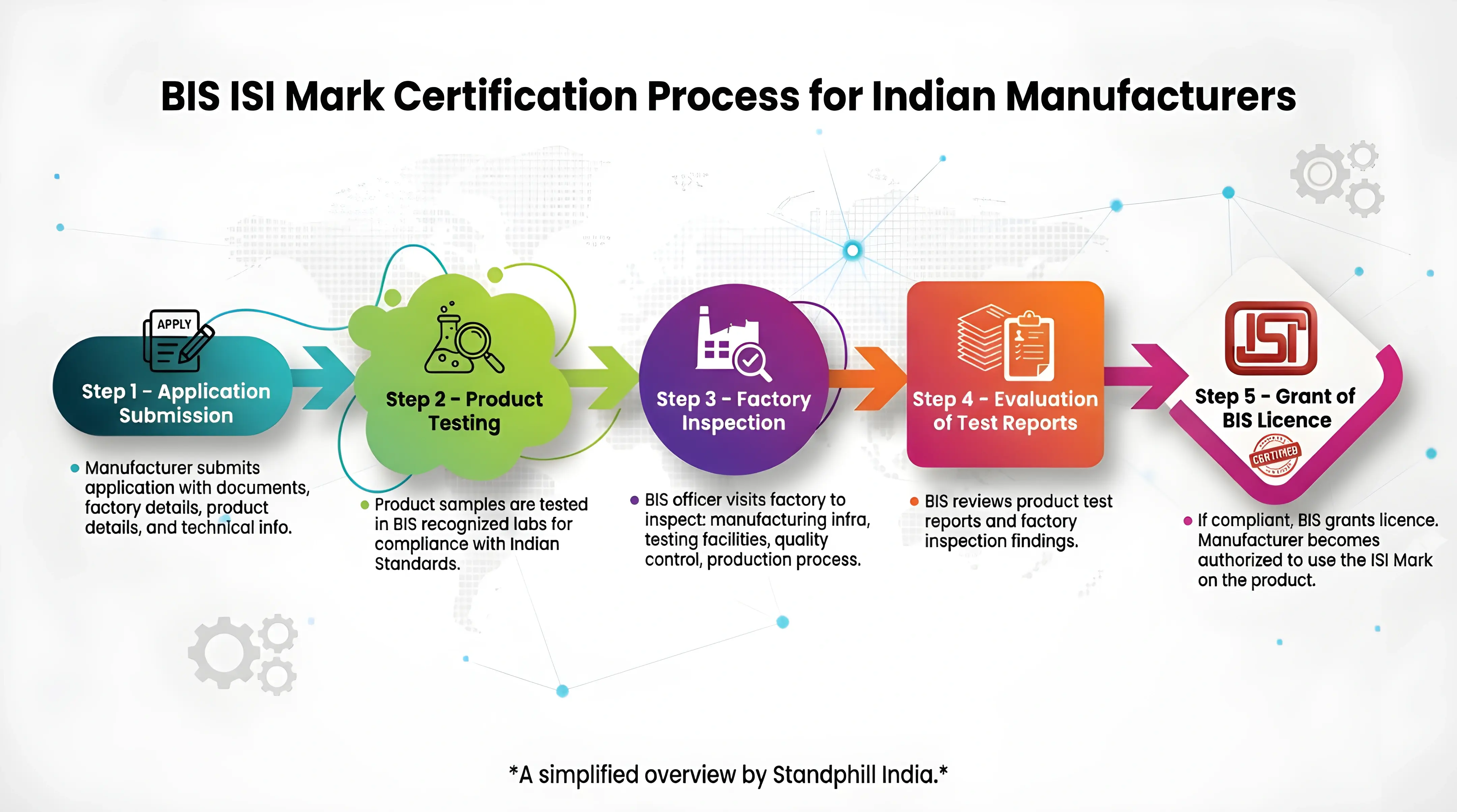
People usually ask the same thing in two ways: "How do I apply for the ISI Mark?" or "How do I get ISI certification for my product?" Either way, the route is the same five stages:
BIS ISI Mark Certification Process
Normal Procedure vs Simplified Procedure
BIS certification can be obtained through two different routes. The right one depends on whether your product samples have already been tested and approved against the Indian Standard.
- The applicant first prepares to meet BIS requirements — setting up the in-house lab and getting products ready as per the Indian Standard, along with the required documents.
- A BIS official then carries out an inspection of the products and the factory.
- After the inspection, sealed samples of the goods are sent for testing at a BIS approved laboratory.
- If the product clears every test parameter, BIS approves it and issues the licence in roughly 60 to 65 days from the date of application.
- The applicant first submits a sample test report that has already been tested and approved by BIS as per the Indian Standard.
- The online registration application is then filed, along with the certification cost and the rest of the documents.
- While the documents are under scrutiny, a BIS official inspects the products and the factory.
- Once the inspection is done, sealed samples are sent for testing at a BIS approved laboratory.
- After verification against the recommended standard, the licence is granted within about 30 to 35 days of application.
In short, the Simplified Procedure is faster because the testing groundwork is largely done up front. The Normal Procedure runs the testing after inspection, which adds to the overall timeline.
Documents Required for ISI Mark Certification
Keeping paperwork ready before you apply saves real time, since a single missing document can hold up the whole file. The common set includes:
- Factory registration certificate / business licence
- Manufacturing licence
- Manufacturing process flow chart
- Factory layout plan
- List of manufacturing machinery
- List of testing equipment
- Calibration certificates of testing instruments
- Quality control records
- Product test reports from a BIS recognised lab
- Raw material test certificates
- Trademark certificate and ISO certificates (if available)
- Authorisation letter (if applying through a consultant)
Standphill India organises, scrutinises and files this documentation for you, which keeps queries and rejections to a minimum.
Also Read
BIS Certification for Electronic and IT Products (CRS) BIS FMCS Certification for Foreign Manufacturers How to apply for Renewal of BIS LicenseISI Mark Certification Fees
BIS fees are not a single fixed figure. The total depends on the product, the applicable standard, testing needs and the scope of the factory inspection. The standard fee components are:
| S. No. | Particulars | Amount |
|---|---|---|
| 1 | Application Fee | INR 1,000/- |
| 2 | Preliminary Inspection / Audit Charges | INR 7,000/- per man-day* |
| 3 | Annual Licence Fee | INR 1,000/- |
| 4 | Minimum Marking Fee (Micro 80% off, Small 50% off, Medium 20% off) | As Applicable |
| 5 | Sample Testing Fee | As Applicable |
*Audit charges are charged per man-day, plus travel and lodging for the BIS officer where applicable. For most Indian manufacturers the all-in cost typically ranges from around INR 25,000 to INR 2,50,000 depending on the product. MSMEs receive concessions, and the licence is usually valid for up to two years before renewal.
Registered as an MSME? You may qualify for a marking-fee concession of up to 80%. Check your eligibility →
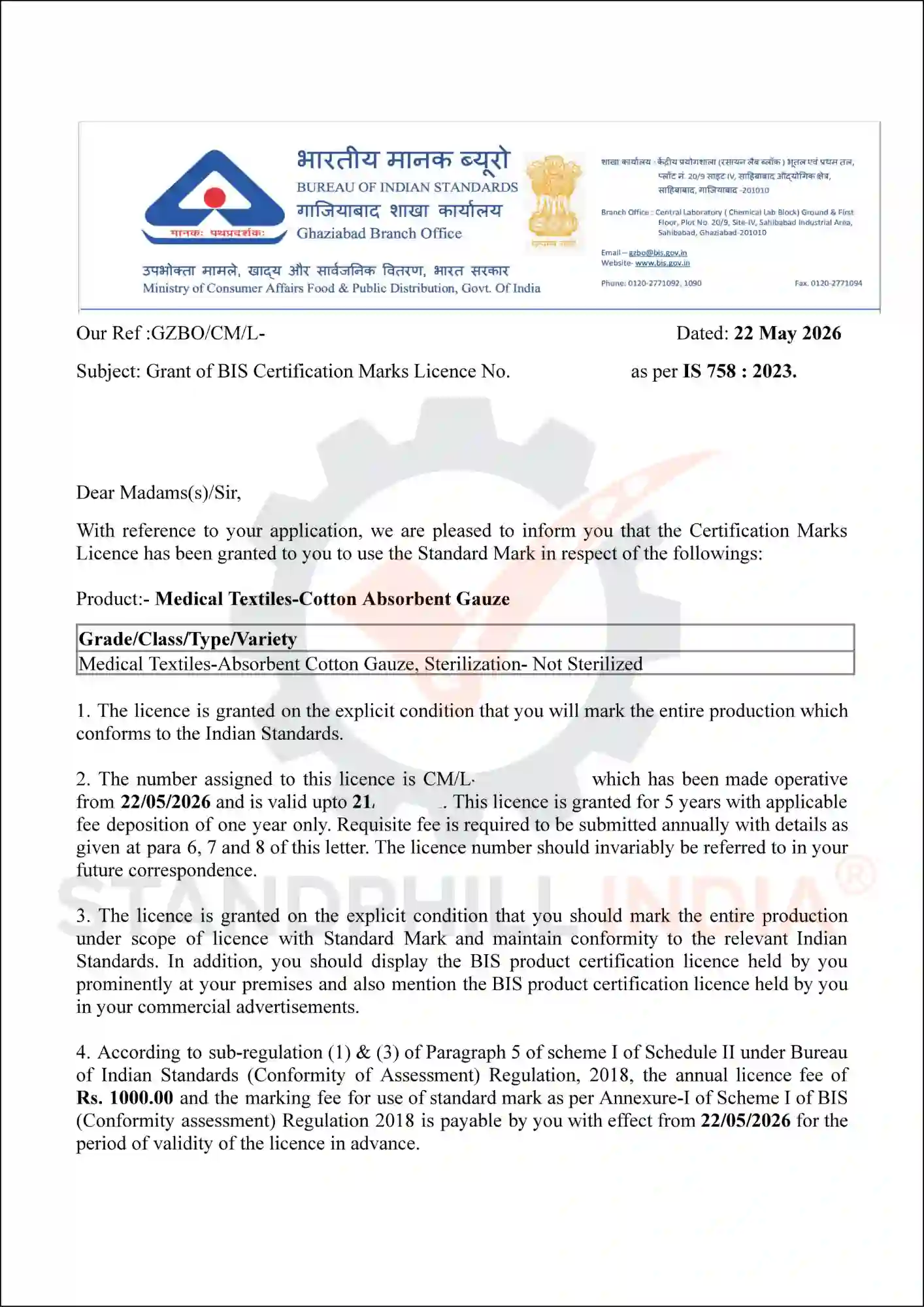
Sample of a Grant of Licence for ISI Mark
When BIS approves an application, it issues a formal Grant of BIS Product Certification Licence letter. The letter confirms the licence number (in the CM/L format), the product, the applicable Indian Standard, and the period for which the licence stays valid. Here is a sample of such a grant letter:
Surveillance and Licence Renewal
Getting the licence is not the finish line. BIS keeps an eye on licensees through ongoing surveillance to make sure compliance is maintained. This can involve:
- Periodic factory inspections by BIS officers
- Testing of samples drawn from the market
- Review of production and quality control records
The licence also has to be renewed before it expires so you can keep using the ISI Mark without a break.
Products Under BIS Scheme-I (ISI Mark Scheme)
A wide range of products requires mandatory BIS certification under Scheme-I before they can be manufactured or sold in India. Use the search box below to quickly find your product and its Indian Standard. This is a representative list of major categories — for the complete official list, refer to the BIS website.
Not sure which IS standard applies to your product? Talk to our team for a quick, free assessment.
Recent ISI Certifications Delivered by Standphill India
We have helped manufacturers across several industries secure their ISI Mark licence. A few recent examples:
| Company | Product | Standard |
|---|---|---|
| CDC PRINTERS PRIVATE LIMITED | Medical Textiles – Surgical Face Masks | IS 9873 Part1:2025 |
| Shree Nagai Enterprises | Medical Textiles – Shoe Covers | IS 17349:2020 |
| Himalayan Packaging Industries Pvt Ltd | Non-Electric Picture-matching puzzles Toys & Physical Properties | IS 9873 (Part 1):2019 |
| Soccer International Pvt. Ltd. | Safety of Toys – Mechanical & Physical Properties | IS 9873 (Part 1):2019 |
| Ampal Freeze Products LLP | Deep Freezers – Specification | IS 7872:2020 |
Why Choose Standphill India for ISI Mark Certification?
Doing the BIS process alone can get confusing fast, especially the first time. Between finding the right IS number, preparing documents, coordinating lab testing, answering BIS queries and getting the factory ready for audit, there are plenty of places to slip up. That is where we come in.
- Guidance at every step — from the right IS number to the licence in your hands, you are never left guessing
- Faster processing — we help you sidestep the common mistakes that cause delays
- Document support — paperwork prepared correctly the first time, so files don't get stuck
- Lab coordination — smooth testing through BIS recognised laboratories across India
- Audit readiness — your unit prepared so everything is in order when BIS officers arrive
- A transparent process — you always know where your application stands and what comes next
Whether you are applying for the first time, renewing, or expanding your existing licence, we make the process simpler and far less stressful.
Get expert support for BIS certification for Indian manufacturers and grow your business with confidence.
Your Compliance. Our Commitment.
Contact Standphill India TodayFrequently Asked Questions (FAQ)
Ask a Question
Have a query about ISI Mark Certification? Our team will get back to you shortly.
★ Why Standphill India?
- 20+ Years of BIS Certification Experience
- 10,000+ Certifications Delivered Globally
- Dedicated Teams for CRS, FMCS & ISI Mark
- End-to-End Documentation & Filing Support
- Fast Response & Practical Compliance Guidance
- Support for Indian & Foreign Manufacturers
Get Free Call Back
Our Services
- BIS (ISI Mark) for Foreign Manufacturers
- Domestic BIS (ISI Mark) Certification
- BIS Certificate of Conformity (CoC)
- BIS Hallmarking
- BIS Licence for Toys
- ECO Mark Certification
- TAC Approval for Automobile
- Drug Licence
- Peso Certification
- BIS (CRS) Registration
- WPC-ETA Approval
- BEE Certification
- E-Waste Management (EPR)
- EPR for Plastic Waste
- EPR for Battery Waste
- CE Certification
- UL Certification
- ROHS Licence
- Standardization Division
- Import / Export Licence
- FSSAI Certification
- ISO Registration
- Trademark Registration
- Make in India Support
- AG-Mark Licence
- Third Party Monitoring
Client Testimonials
Their team was very knowledgeable and helped us every step of the way. Standphill India is the best BIS certification consultants for any type of BIS certification.

Chintan Shah (AGM)
Sudeep Nutrition P.Ltd




Featured Guide
Complete BIS CRS certification guide for electronic products in India — free to read.
Read CRS Certification Guide📞 Contact Standphill India
+91-9667674225 info@standphillindia.in WhatsApp Now Greater Noida West, UPGet Expert BIS Certification Support for Your Business
Connect with Standphill India for complete support with BIS certification, CRS registration, WPC approval, FMCS compliance, and related regulatory services. Our team helps businesses with documentation, testing coordination, application support, and end-to-end compliance guidance.
Request Free Consultation
Share your requirement and our team will contact you shortly.