BIS Certification for Solar Storage Batteries in India – IS 16270:2023 and IS 16046 Complete Guide
By Standphill India | BIS Certification Consultants | IS 16270:2023 IS 16046 CRS Guide 2026
Quick Answer – BIS Certification for Solar Storage Batteries
BIS certification for solar storage batteries is mandatory in India under the Compulsory Registration Scheme (CRS) to ensure safety and quality standards. Solar storage batteries must comply with IS 16270:2023 (formerly IS 16270:2014). Lithium-ion batteries used in these systems often follow IS 16046 (Part 2):2018. Manufacturers must get their products tested in BIS-recognized laboratories covering safety, electrical, and thermal parameters to receive a BIS licence required for legal sales and importing in India. The BIS certificate is valid for 2 years and can be renewed. The process typically takes 6 to 12 weeks. Standphill India provides complete BIS certification consultancy for solar storage battery manufacturers across India and worldwide.
India's solar energy capacity has crossed 90 GW and is expanding faster than almost any market in the world. Behind every solar installation — from rooftop panels in Jaipur to utility-scale farms in Rajasthan — sits the energy storage system that makes solar power reliable beyond daylight hours. And behind every battery in those storage systems sits a regulatory requirement that many manufacturers and importers still discover too late.
BIS certification for solar storage batteries is mandatory in India under the Compulsory Registration Scheme (CRS). Without it, solar storage batteries cannot be legally imported, sold, or distributed in the Indian market — regardless of CE marking, UL certification, or any other international approval the product may carry.
This guide covers everything you need to know — the applicable Indian Standards (IS 16270:2023 and IS 16046), why certification is mandatory, what the testing requirements are, the step-by-step certification process, documents required, fees, validity, key compliance considerations, and how Standphill India can support your certification from start to finish.
Why Solar Storage Battery Certification Matters in India Right Now
India's National Solar Mission targets 500 GW of renewable energy by 2030. Energy storage is central to achieving this — batteries that can store solar power during the day and release it at night or during grid fluctuations are critical infrastructure, not consumer products.
The Indian government recognizes this reality. As solar storage batteries carry significant electrical energy and involve lithium-ion or other electrochemical technologies, substandard batteries pose serious risks — fires, thermal runaway, toxic gas release, and electrical hazard. These risks are not theoretical. Poorly manufactured lithium-ion batteries have caused fires in residential solar installations, electric vehicles, and commercial energy storage systems across the world.
BIS certification under IS 16270:2023 and IS 16046 exists precisely to prevent this — ensuring every solar storage battery sold in India has been independently verified to meet safety, electrical, and thermal standards before it reaches the consumer.
For manufacturers and importers, this is not just a safety consideration. It is a hard legal requirement. Customs authorities in India verify BIS certification for solar storage batteries at ports of entry. Products without valid CRS registration are held, detained, and potentially returned to origin.
What is BIS CRS Registration for Solar Storage Batteries?
BIS certification for solar storage batteries is issued under the Compulsory Registration Scheme (CRS) — Scheme VI of the BIS conformity assessment framework. Under CRS, manufacturers self-declare conformity to the applicable Indian Standard, supported by test reports from BIS-recognized laboratories.
Unlike BIS Scheme I (ISI Mark), which requires physical factory inspection by BIS officers, CRS is a registration-based system. The manufacturer gets the battery tested in a BIS-recognized laboratory, prepares the required technical documentation, submits the application on the BIS ManakOnline portal, and upon satisfactory review, receives a CRS registration number.
However — this does not mean CRS is a rubber stamp. The laboratory testing requirements for solar storage batteries under IS 16270:2023 and IS 16046 are rigorous. Batteries must pass comprehensive safety, electrical, and thermal tests. Only products that genuinely meet the standard receive registration.
Key Fact
BIS CRS registration for solar storage batteries is product-specific and manufacturer-specific. The registration is granted to the manufacturer — not the importer or dealer. Separate registrations are required for different product models and for different factory locations, even when the same company manufactures the same product at two different facilities.
Key Indian Standards for Solar Storage Battery BIS Certification
Two primary Indian Standards govern BIS certification for solar storage batteries in India:
1. IS 16270:2023 – Secondary Cells and Batteries for Portable Applications
IS 16270:2023 is the updated Indian Standard for secondary cells and batteries used in portable applications — including solar storage systems. It replaces the earlier IS 16270:2014 and reflects updated safety and performance requirements aligned with international norms.
This standard is the primary certification standard for solar storage batteries under BIS CRS. It covers:
• Safety requirements — protection against overcharge, over-discharge, short circuit, and thermal events
• Electrical performance requirements — capacity, charge retention, cycle life, and internal resistance
• Thermal requirements — performance across a range of temperatures, thermal stability testing
• Mechanical requirements — vibration, shock, and drop testing to verify structural integrity
• Marking requirements — mandatory information on battery cells and packs including manufacturer identification, capacity, voltage, and safety warnings
Standard Update Note
IS 16270:2023 supersedes IS 16270:2014. Manufacturers who previously obtained BIS CRS registration under IS 16270:2014 must ensure their registration is updated to IS 16270:2023 at renewal. New applications should be filed under IS 16270:2023.
2. IS 16046 (Part 2):2018 – Secondary Lithium Cells and Batteries for Portable Applications
IS 16046 (Part 2):2018 is the Indian Standard specifically for lithium-ion and lithium-polymer secondary cells and batteries used in portable applications. Given that lithium-ion chemistry dominates the solar storage battery market — due to its high energy density, cycle life, and declining cost — this standard is particularly relevant for the solar energy storage sector.
IS 16046 (Part 2):2018 covers:
• Electrochemical safety tests — overcharge test, forced discharge test, external short circuit test
• Mechanical safety tests — crushing, nail penetration, drop, vibration, and shock tests
• Thermal safety tests — thermal abuse, external heating, and temperature cycling tests
• Environmental tests — altitude simulation (low pressure), humidity cycling
• Performance tests — capacity, charge retention, and cycle life requirements
The nail penetration and thermal abuse tests under IS 16046 (Part 2):2018 are particularly demanding — they are designed to verify that a lithium-ion battery does not catch fire or explode even under severe abuse conditions. These tests reflect the real-world risk profile of lithium-ion energy storage in solar applications.
Which Solar Storage Batteries Require BIS Certification in India?
The following battery types and applications require BIS CRS certification before they can be legally imported or sold in India:
By Chemistry:
• Lithium-ion (Li-ion) batteries — including NMC (Nickel Manganese Cobalt), LFP (Lithium Iron Phosphate), NCA (Nickel Cobalt Aluminium) chemistries — IS 16046 + IS 16270
• Lithium polymer (LiPo) batteries — IS 16046 + IS 16270
• Lead-acid batteries used in solar storage — separate BIS standards apply depending on the type
• Nickel-Metal Hydride (NiMH) batteries used in solar storage — IS 16270
By Application:
• Residential rooftop solar storage systems — home solar battery packs for grid-tie or off-grid use
• Commercial and industrial solar storage — large format battery packs for commercial premises
• Solar street lighting batteries — batteries in solar-powered street lights and outdoor lighting
• Solar water pumping system batteries — energy storage for solar-powered irrigation systems
• Portable solar storage products — power banks and portable solar generators
• Solar-powered IoT and monitoring devices — batteries in solar-powered sensors and remote monitoring equipment
Mandatory Testing Requirements for BIS Certification of Solar Storage Batteries
Battery samples must undergo rigorous testing in BIS-recognized laboratories across three critical dimensions — safety, electrical, and thermal. Here is what each testing category covers:
Safety Tests
• External short circuit test — the battery's positive and negative terminals are connected through a low-resistance external circuit to verify the battery does not catch fire, explode, or rupture
• Overcharge test — the battery is charged beyond its maximum voltage to verify protection mechanisms activate correctly
• Forced discharge test — the battery is discharged below its minimum voltage to verify safe response
• Crush test — the battery cell is mechanically crushed between flat plates to verify it does not catch fire or explode
• Nail penetration test (lithium-ion only) — a steel nail is driven through the battery cell to simulate internal short circuit — the battery must not fire or explode
• Drop test — the battery is dropped from a specified height onto a hard surface to verify no hazardous failure
Electrical Tests
• Capacity test — verifying the battery delivers its rated energy capacity under standard discharge conditions
• Charge retention test — measuring energy retained after a specified storage period at defined temperature
• Cycle life test — verifying the battery maintains acceptable capacity over a defined number of charge-discharge cycles
• Internal resistance measurement — verifying internal resistance is within specified limits
Thermal Tests
• Thermal abuse test — the battery is exposed to elevated temperatures to verify it does not catch fire or explode
• Temperature cycling test — the battery is cycled between high and low temperatures to verify structural and electrical integrity
• Altitude simulation test — the battery is tested at low pressure equivalent to high altitude to verify no leakage or hazardous failure
• External heating test (lithium-ion) — the battery is heated externally to verify thermal protection mechanisms
IS 16270:2023 vs IS 16046 (Part 2):2018 – Which Standard Applies to Your Battery?
| Aspect | IS 16270:2023 | IS 16046 (Part 2):2018 |
|---|---|---|
| Full Name | Secondary Cells and Batteries for Portable Applications | Secondary Lithium Cells and Batteries for Portable Applications – Safety Requirements |
| Battery Chemistry Covered | All rechargeable chemistries — Li-ion, LiPo, NiMH, NiCd etc. | Lithium-ion and Lithium-polymer only |
| Primary Focus | Safety + Electrical performance | Safety — specific to lithium chemistry risks |
| Includes Nail Penetration Test? | No (general batteries) | Yes (lithium-specific) |
| Thermal Abuse Test? | Yes | Yes (more stringent) |
| For Solar Li-ion Storage? | ✅ Required | ✅ Also Required |
| BIS Scheme | CRS (Compulsory Registration Scheme) | CRS (Compulsory Registration Scheme) |
For most solar storage batteries using lithium-ion chemistry — which is the dominant technology — compliance with both IS 16270:2023 and IS 16046 (Part 2):2018 is required. Manufacturers should confirm the specific testing requirements for their battery chemistry and product category with Standphill India before initiating laboratory testing.
BIS Certification Process for Solar Storage Batteries – Step by Step
Step 1 – Identify Product Category and Applicable Standard
Determine whether your solar storage battery falls under IS 16270:2023, IS 16046 (Part 2):2018, or both based on battery chemistry and application. This step is critical — testing against the wrong standard means the test reports cannot be used for BIS registration and the testing cost is wasted.
For lithium-ion solar storage batteries — the most common category — both standards typically apply. Standphill India confirms the exact testing scope for every client's product before any laboratory engagement.
Step 2 – Appoint Authorized Indian Representative (Foreign Manufacturers Only)
Foreign manufacturers exporting solar storage batteries to India must appoint an Authorized Indian Representative (AIR) before the BIS application can be filed. The AIR is a legally registered entity in India that manages all BIS communication, documentation, and compliance on behalf of the foreign manufacturer.
Standphill India serves as AIR for foreign solar battery manufacturers from China, South Korea, USA, Germany, Malaysia, and other countries. Our AIR service covers the complete BIS FMCS or CRS process — not just application filing.
Step 3 – Laboratory Testing
Battery samples are sent to a BIS-recognized laboratory for comprehensive testing against the applicable Indian Standard(s). The laboratory must be specifically recognized by BIS for the relevant test parameters under IS 16270:2023 and/or IS 16046.
Testing typically takes 4 to 8 weeks depending on the battery type, number of test parameters, and laboratory scheduling. Planning laboratory testing early is the single most important timeline management decision in the BIS certification process for solar batteries — because the testing phase is the longest and least controllable step.
Key practical point: battery samples must be shipped to the Indian laboratory in appropriate quantities and packaging. For lithium-ion batteries, international shipping regulations (IATA Dangerous Goods Regulations) require specific packaging, labelling, and documentation. Standphill India guides clients through sample shipping requirements to prevent costly delays at customs or rejection by the laboratory.
Step 4 – Document Preparation
While laboratory testing is underway, all required documents for the BIS CRS application are prepared. See the complete documents checklist below. Preparing documents in parallel with testing saves significant time — manufacturers who wait for the test report before starting documentation preparation add unnecessary weeks to their timeline.
Step 5 – Application Submission on BIS ManakOnline Portal
The complete BIS CRS application is submitted through the BIS ManakOnline portal. The application includes all technical documents, the laboratory test report, company registration details, and payment of the applicable government fee. For solar storage batteries, correct product categorization on the portal is essential — incorrect categorization leads to application rejection or BIS requesting re-filing.
Step 6 – BIS Scrutiny
BIS officials review the application, technical documents, and laboratory test reports. For battery products — particularly lithium-ion — BIS scrutiny tends to be thorough given the safety risks associated with the product category. Queries may be raised requesting additional technical information or clarification on test parameters. Responding promptly and accurately to all BIS queries is essential to keep the application moving.
Step 7 – Grant of CRS Registration
Upon satisfactory review, BIS grants the CRS registration number. The manufacturer receives an official registration certificate that is required for customs clearance, legal sales, and platform listings in India. The registration is valid for 2 years and must be renewed before expiry.
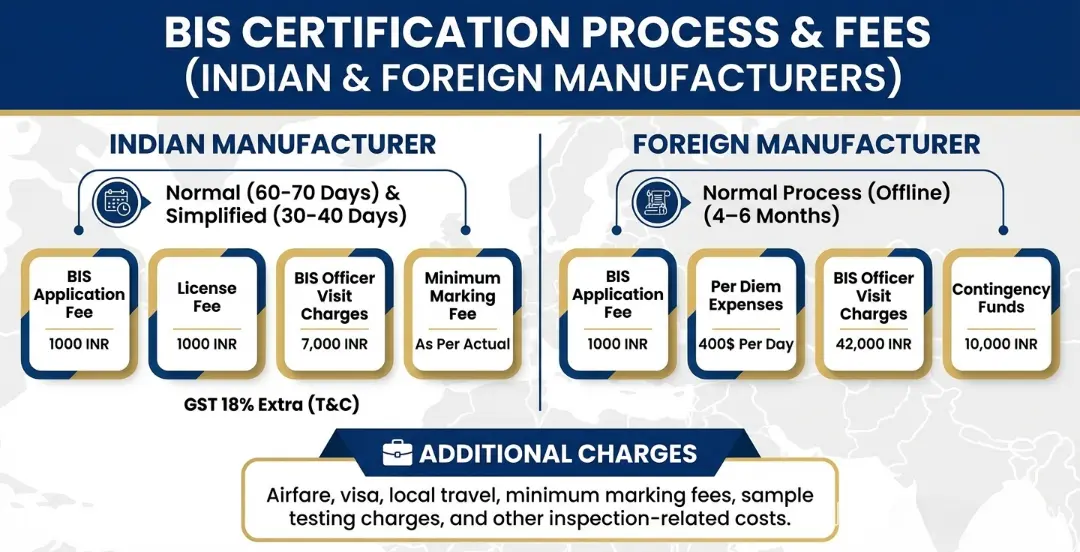
BIS CRS Certification Process for Solar Storage Batteries
Documents Required for BIS Certification of Solar Storage Batteries
Here is the complete checklist of documents required for BIS CRS registration of solar storage batteries:
Company and Business Documents
• company registration certificate (CIN, GST certificate, Import Export Code as applicable)
• ISO 9001:2015 quality management system certificate — this is a specific requirement for battery CRS applications and distinguishes battery certification from many other CRS products
• authorized signatory details and board resolution or authorization letter
• factory registration documents
• AIR appointment documents (mandatory for foreign manufacturers)
Product Technical Documents
• product name and model number
• CCL/CDF forms — Cell Compliance List and Cell Data Form — detailed technical specifications of each battery cell used in the pack, including chemistry, capacity, voltage, and manufacturer details
• product technical specification sheet
• battery pack design documentation — circuit diagram, BMS (Battery Management System) specifications
• user manual and product safety warnings
• product photographs
Laboratory Test Reports
• test report from a BIS-recognized laboratory covering all required test parameters under IS 16270:2023
• test report from a BIS-recognized laboratory covering all required test parameters under IS 16046 (Part 2):2018 (for lithium-ion batteries)
• test reports must be current — typically not older than 3 years — and must cover the exact product model being registered
Self-Declaration
• Declaration of Conformity signed by the authorized signatory confirming that the product meets IS 16270:2023 and/or IS 16046 requirements
BIS CRS Registration Fees for Solar Storage Batteries
| Fee Component | Amount |
|---|---|
| Application Fee | INR 1,000/- |
| CRS Processing Fee (per registration) | INR 50,000/- |
| Annual Licence / Registration Fee | INR 2,000/- |
| Laboratory Testing Fee (IS 16270:2023) | INR 50,000 – INR 1,50,000+ (varies by product) |
| Laboratory Testing Fee (IS 16046 Part 2:2018) | INR 50,000 – INR 2,00,000+ (varies by product) |
Note: Laboratory testing fees for battery products are higher than most other CRS product categories due to the large number of test parameters, test duration (some cycle life tests run over weeks), and specialized testing equipment required. Contact Standphill India for a product-specific cost estimate.
Validity and Renewal of BIS Certification for Solar Storage Batteries
BIS CRS registration for solar storage batteries is valid for 2 years from the date of grant. After expiry, the registration must be renewed to continue legal import and sale of the product in India.
When Does a Fresh Application Become Necessary?
While renewal handles the expiry of an existing registration, the following changes to the product require a fresh BIS CRS application:
• change in battery chemistry — for example, switching from NMC to LFP chemistry in an existing product
• change in battery cell supplier — different cells have different chemical compositions and require fresh testing
• change in cell capacity or voltage — any electrical specification change
• change in Battery Management System (BMS) that affects safety or electrical parameters
• change in product model number or configuration
Key Compliance Considerations for Solar Storage Battery Manufacturers
1. Manufacturer Specific — Not Importer or Dealer
The BIS CRS registration is granted to the manufacturer of the solar storage battery — not the importer, dealer, distributor, or brand owner. If a brand is importing solar batteries manufactured by a third-party factory, the factory must obtain the BIS registration (not the brand). Importers whose contract manufacturers in China, South Korea, or elsewhere are not BIS registered face immediate non-compliance at Indian customs.
2. Location Specific — Separate Licences for Different Factories
Separate BIS CRS registrations are required for different factory locations — even for the same product and the same company. A manufacturer producing the same solar battery model at two different facilities in China must obtain two separate BIS registrations, one for each facility. The registration covers the specific product as manufactured at a specific location.
3. ISO 9001:2015 is a Mandatory Requirement
Unlike many other CRS product categories, solar storage battery BIS certification specifically requires the manufacturer to hold a valid ISO 9001:2015 quality management system certificate. Manufacturers who do not yet hold ISO 9001:2015 certification must obtain it before or alongside the BIS application. Standphill India can advise on ISO 9001:2015 certification options for manufacturers who need both ISO and BIS certification simultaneously.
4. CCL/CDF Forms Are Critical Technical Documents
The Cell Compliance List (CCL) and Cell Data Form (CDF) are technical documents specific to battery certification. They capture detailed information about every cell type used in the battery pack — including cell chemistry, manufacturer, model, capacity, voltage range, and testing data. These forms are reviewed carefully by BIS and must be accurate and complete. Errors in CCL/CDF forms are a common cause of BIS queries and application delays for solar battery certifications.
5. Cell-Level vs Pack-Level Testing
Some BIS test parameters for solar storage batteries apply at the cell level (individual battery cells), while others apply at the pack level (the assembled battery pack). Understanding which tests apply at which level — and ensuring the correct samples are submitted to the laboratory — is essential to avoid incomplete test reports that require repeat testing.
Also Read
→ BIS CRS Registration – Complete Guide for Electronic Products
→ BIS FMCS Certification for Foreign Manufacturers
→ Authorized Indian Representative (AIR) for BIS Certification
Real World Context – What Happens Without BIS Certification for Solar Batteries
The consequences of importing or selling solar storage batteries without BIS CRS registration in India are immediate and serious:
At the Port of Entry
Customs authorities verify BIS CRS registration for solar storage batteries at Indian ports. A shipment of lithium-ion solar batteries without a valid BIS registration certificate is flagged, detained, and held in bonded storage at the importer's cost. The importer must either obtain BIS registration while the goods are held — which is not possible for that specific shipment since the manufacturer must be registered, not the importer — or return the goods to the origin country.
One solar equipment distributor importing LFP battery packs from a Chinese manufacturer discovered this precisely when a 40-foot container arrived at Nhava Sheva without the manufacturer holding BIS CRS registration. The container sat in bonded storage for over 90 days accumulating demurrage charges, during which the Chinese manufacturer had to rush through the BIS application. Some of the goods were ultimately released after BIS registration was obtained — but the financial and commercial damage from the delay was substantial.
In the Market
Solar storage batteries sold through e-commerce platforms including Amazon India, Flipkart, and Moglix increasingly require BIS CRS registration for listing. Products without valid registration face delisting. In the institutional and government solar project market, buyers require BIS certification as a mandatory procurement condition. Without it, a solar battery supplier is simply excluded from this significant and growing market segment.
How Standphill India Helps with BIS Certification for Solar Storage Batteries
Standphill India provides complete end-to-end BIS CRS certification support for solar storage battery manufacturers — both Indian manufacturers and foreign manufacturers exporting to India.
Our solar battery BIS certification services include:
• Standard identification — confirming whether IS 16270:2023, IS 16046 (Part 2):2018, or both apply to your specific battery chemistry and product configuration
• Laboratory selection and coordination — identifying the correct BIS-recognized laboratory for solar battery testing, managing sample submission and testing timelines
• CCL/CDF form preparation — preparing the Cell Compliance List and Cell Data Form accurately for every battery model
• Complete documentation preparation — factory registration, ISO 9001:2015 guidance, technical specifications, and all supporting documents
• BIS ManakOnline application filing — submitting the CRS application with correct product categorization and complete documentation
• BIS query resolution — managing all BIS correspondence and responding to technical queries accurately and promptly
• AIR services for foreign manufacturers — serving as Authorized Indian Representative for Chinese, Korean, German, and other international solar battery manufacturers
• Post-registration renewal management — tracking registration expiry and managing timely renewal before the 2-year validity lapses
Get BIS Certification for Your Solar Storage Battery
Whether you are an Indian manufacturer or a foreign exporter, Standphill India provides complete BIS CRS certification support for solar storage batteries under IS 16270:2023 and IS 16046. Start your certification today — before your next shipment reaches Indian customs.
📞 +91-9667674225 / +91-85279 30453
Monday to Saturday, 9:00 AM – 8:00 PM IST
Conclusion
BIS certification for solar storage batteries is a mandatory legal requirement in India under the Compulsory Registration Scheme (CRS). Solar storage batteries must comply with IS 16270:2023 — and lithium-ion batteries additionally with IS 16046 (Part 2):2018 — before they can be legally imported or sold in India. The certification is manufacturer-specific, location-specific, and valid for 2 years.
As India's solar energy ambitions accelerate and the energy storage market expands, BIS certification will only become more critical — both as a legal requirement and as a market access credential. Battery manufacturers who are BIS-certified today are positioned to capture the growing demand from residential solar installations, commercial energy storage projects, and government procurement programs that increasingly specify BIS certification as a mandatory condition.
The process — while rigorous — is manageable with the right expertise. The testing scope is demanding but defined. The documentation requirements are specific but achievable. And the timeline of 6 to 12 weeks, while meaningful, is entirely workable when planned properly.
Planning to sell solar storage batteries in India? Contact Standphill India today — and get your BIS CRS certification on track before your first shipment arrives.
Disclaimer: Information in this guide is based on BIS regulations and Indian Standards as of April 2026. BIS requirements and applicable standards are subject to revision. Manufacturers should verify current requirements with Standphill India or directly with BIS before initiating the certification process. Compliance with the latest BIS amendments is the ongoing responsibility of the licence holder.
Frequently Asked Questions – BIS Certification for Solar Storage Batteries
Q1. Is BIS certification mandatory for solar storage batteries in India?
Yes. BIS certification is mandatory for solar storage batteries in India under the Compulsory Registration Scheme (CRS). Solar storage batteries must comply with IS 16270:2023 (formerly IS 16270:2014). Lithium-ion batteries additionally follow IS 16046 (Part 2):2018. Without valid BIS CRS registration, solar storage batteries cannot be legally imported, sold, or distributed in India.
Q2. What Indian Standards apply to solar storage batteries?
Solar storage batteries must comply with IS 16270:2023 — Secondary Cells and Batteries for Portable Applications. Lithium-ion solar storage batteries additionally require compliance with IS 16046 (Part 2):2018 — Secondary Lithium Cells and Batteries for Portable Applications (Safety Requirements). Both standards are under BIS CRS.
Q3. What is the certification process for solar storage batteries?
The process involves: identifying the applicable standard (IS 16270 or IS 16046 or both), foreign manufacturers appointing an AIR, sending samples to a BIS-recognized laboratory for testing, preparing documents including factory registration, ISO 9001:2015 certificate and technical specifications, submitting the application via BIS ManakOnline portal, and BIS scrutinizing the report and granting the registration number. The process takes 6 to 12 weeks.
Q4. What is the validity of BIS certification for solar storage batteries?
BIS CRS registration for solar storage batteries is valid for 2 years and can be renewed before expiry. Any changes to battery chemistry, cell supplier, BMS specifications, or product model during the validity period may require fresh testing and a new application.
Q5. What documents are required for BIS certification of solar storage batteries?
Key documents include factory registration, ISO 9001:2015 certificate, technical specifications including CCL/CDF forms, BIS-recognized laboratory test reports as per IS 16270:2023 and IS 16046, company registration proof, authorized signatory details, Declaration of Conformity, and AIR appointment documents for foreign manufacturers.
Q6. How long does BIS certification for solar storage batteries take?
BIS certification for solar storage batteries typically takes 6 to 12 weeks from complete application submission. Laboratory testing alone takes 4 to 8 weeks for battery products given the comprehensive safety and thermal test requirements. Start the process at least 4 to 5 months before your planned import or sales date.
Q7. Can foreign manufacturers get BIS certification for solar storage batteries?
Yes. Foreign manufacturers must appoint an Authorized Indian Representative (AIR) in India and apply under BIS CRS or FMCS depending on their product and scheme eligibility. Standphill India serves as AIR for solar battery manufacturers from China, South Korea, Germany, USA, Malaysia, and other countries. Contact us at +91-9667674225 or info@standphillindia.in.
Tags: BIS Certification Solar Batteries | IS 16270 2023 | IS 16046 | Solar Storage Battery India | CRS Registration Batteries | Lithium Ion Battery BIS | Solar Battery BIS India | Standphill India | BIS CRS | LFP Battery BIS India
★ Why Standphill India?
- 20+ Years of BIS Certification Experience
- 10,000+ Certifications Delivered Globally
- Dedicated Teams for CRS, FMCS & ISI Mark
- End-to-End Documentation & Filing Support
- Fast Response & Practical Compliance Guidance
- Support for Indian & Foreign Manufacturers
Get Free Call Back
Our Services
- BIS (ISI Mark) for Foreign Manufacturers
- Domestic BIS (ISI Mark) Certification
- BIS Certificate of Conformity (CoC)
- BIS Hallmarking
- BIS Licence for Toys
- ECO Mark Certification
- TAC Approval for Automobile
- Drug Licence
- Peso Certification
- BIS (CRS) Registration
- WPC-ETA Approval
- BEE Certification
- E-Waste Management (EPR)
- EPR for Plastic Waste
- EPR for Battery Waste
- CE Certification
- UL Certification
- ROHS Licence
- Standardization Division
- Import / Export Licence
- FSSAI Certification
- ISO Registration
- Trademark Registration
- Make in India Support
- AG-Mark Licence
- Third Party Monitoring
Client Testimonials
Their team was very knowledgeable and helped us every step of the way. Standphill India is the best BIS certification consultants for any type of BIS certification.

Chintan Shah (AGM)
Sudeep Nutrition P.Ltd




Featured Guide
Complete BIS CRS certification guide for electronic products in India — free to read.
Read CRS Certification Guide📞 Contact Standphill India
+91-9667674225 info@standphillindia.in WhatsApp Now Greater Noida West, UPGet Expert BIS Certification Support for Your Business
Connect with Standphill India for complete support with BIS certification, CRS registration, WPC approval, FMCS compliance, and related regulatory services. Our team helps businesses with documentation, testing coordination, application support, and end-to-end compliance guidance.
Request Free Consultation
Share your requirement and our team will contact you shortly.