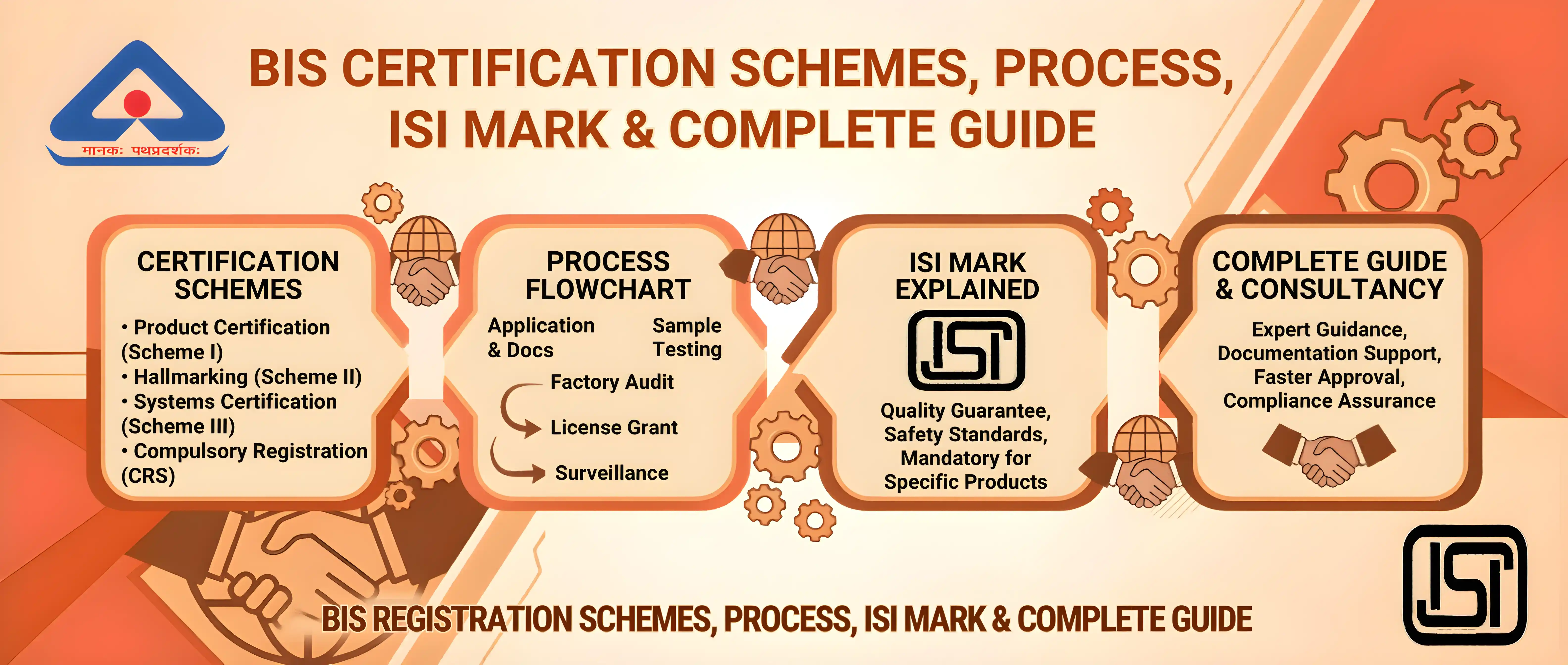
Bureau of Indian Standards BIS Certification Schemes, Process, ISI Mark & Complete Guide
Complete Guide to BIS, BIS Certification Schemes, ISI Mark, Process, Compliance and Expert Consultancy in India
What is Bureau of Indian Standards and BIS Certification?
The Bureau of Indian Standards (BIS) is India's national standards body established under the BIS Act, 2016, operating under the Ministry of Consumer Affairs, Food and Public Distribution, Government of India. BIS certification is a product quality and safety certification confirming that a product complies with the applicable Indian Standard (IS). For hundreds of products covered under Quality Control Orders (QCOs), BIS certification is mandatory before the product can be manufactured, imported, or sold in India. BIS operates multiple certification schemes — the ISI Mark Scheme I for Indian manufacturers, FMCS for foreign manufacturers, CRS for electronic products, BIS Hallmarking for jewellery, Scheme X, and ECO Mark. Standphill India is one of India's most trusted BIS certification consultants with 20+ years of experience, 10,000+ domestic and 400+ foreign product certifications completed across India and worldwide.
Table of Contents
2. What is the Bureau of Indian Standards (BIS)?
6. Why is BIS Certification Mandatory?
7. All BIS Certification Schemes in India
8. Scheme I – ISI Mark for Indian Manufacturers
9. FMCS – BIS Certification for Foreign Manufacturers
10. CRS – Compulsory Registration Scheme for Electronics
12. BIS Scheme X – Type Approval
14. Quality Control Orders (QCOs)
15. Products Covered Under BIS Certification
16. General BIS Certification Process
18. Benefits of BIS Certification
19. BIS Enforcement and Penalties
20. Why You Need a BIS Certification Consultant
21. The Standphill India Story
The Story – Why the Bureau of Indian Standards Exists
Imagine walking into a market and not knowing whether the electrical switch you are buying will safely carry current, whether the toy you are giving your child contains toxic paint, or whether the steel used in your building meets minimum strength standards. That was the reality India faced in the decades after independence — a rapidly industrializing nation with no unified system to ensure the quality and safety of the products its people used every day.
The answer was the Indian Standards Institution (ISI), established in 1947. Its symbol — the ISI Mark — became one of the first quality signals Indian consumers could trust. Over the decades, as India's economy grew, its manufacturing base expanded, and imports from across the world began flooding the market, the need for a stronger, more empowered standards body became clear.
In 1986, the Bureau of Indian Standards was formally established. And in 2016, the BIS Act, 2016 gave BIS the full legal authority to make certification mandatory, enforce compliance, and protect Indian consumers from substandard products — not just from domestic manufacturers but from every factory in the world that wants to sell into India.
Today, BIS certification is the single most important quality and safety compliance requirement for manufacturers and importers selling in the Indian market. And understanding it — how it works, which scheme applies to your product, what the process involves — is the first step toward market access, consumer trust, and legal compliance in India.
This is what this page is about. And Standphill India is here to guide you through every step of it.
What is the Bureau of Indian Standards (BIS)?
The Bureau of Indian Standards (BIS) is the national standards body of India, established under the BIS Act, 2016. It operates under the Ministry of Consumer Affairs, Food and Public Distribution, Government of India. BIS is headquartered in New Delhi and has a network of regional offices, branch offices, and laboratories across the country.
The primary functions of BIS include:
• Standard Formulation — developing and publishing Indian Standards (IS) for products, processes, and services across all industries
• Product Certification — operating certification schemes to verify that products comply with applicable Indian Standards
• Hallmarking — certifying the purity of gold and silver jewellery under the BIS Hallmarking scheme
• Laboratory Services — operating and recognizing BIS laboratories for product testing
• Training and Awareness — conducting training programs on standards and quality management
• International Cooperation — representing India in international standardization bodies like ISO and IEC
• Consumer Affairs — protecting consumer interests through quality and safety certification and enforcement
In simple terms — BIS sets the standards, certifies the products, and enforces compliance. It is the guardian of product quality in India.
The BIS Act, 2016 – The Legal Foundation
The BIS Act, 2016 is the primary legislation governing BIS in India. It replaced the earlier BIS Act, 1986 and significantly expanded BIS's scope, powers, and enforcement authority. Think of the BIS Act, 2016 as the legal backbone that gives every BIS certification requirement its force.
1. Mandatory Certification Power
The Act empowers the Central Government to make BIS certification mandatory for specific products through Quality Control Orders (QCOs). When a QCO is issued, manufacturers and importers must comply — no exceptions.
2. The Standard Mark – ISI Mark
The Act defines the BIS Standard Mark (ISI Mark) and protects it legally. Only licensed manufacturers can use it. Misusing the ISI Mark without a valid licence is a criminal offence under the Act.
3. Hallmarking Authority
The Act provides the legal basis for BIS Hallmarking of precious metals — making India one of the few countries with a legally mandated hallmarking system for gold jewellery.
4. Strict Penalties
The BIS Act, 2016 prescribes penalties for violations including fines, product seizure, and imprisonment — giving BIS real enforcement teeth that the 1986 Act lacked.
5. Laboratory Recognition
The Act empowers BIS to recognize laboratories for product testing, creating a network of accredited testing facilities whose reports form the basis of BIS certification decisions.
What is BIS Certification?
BIS certification is a product quality and safety certification issued by the Bureau of Indian Standards confirming that a product complies with the applicable Indian Standard (IS). It is a third-party assurance — not a self-declaration — that gives manufacturers, consumers, buyers, and regulators confidence that a product meets specified quality, safety, and performance benchmarks.
The process works like this: BIS evaluates the product through laboratory testing and the manufacturing facility through inspection. If both are satisfactory, BIS grants a licence. The manufacturer can then display the ISI Mark on certified products — a symbol that tells every buyer in India that this product has been independently verified to meet national standards.
BIS certification applies to two categories of products:
Mandatorily Certified Products — products covered under QCOs that cannot be manufactured, imported, or sold in India without BIS certification. This is now applicable to hundreds of product categories.
Voluntarily Certified Products — manufacturers can also voluntarily seek BIS certification for products not covered under QCOs, to demonstrate quality and build market trust.
The key point to understand is this — BIS certification is not a one-time event. It is a continuous compliance commitment. After the licence is granted, BIS conducts periodic surveillance, market sample testing, and factory inspections throughout the licence validity period. Manufacturers must maintain compliance at all times, not just at the moment of initial certification.
What is the ISI Mark?
The ISI Mark is the official BIS Standard Mark — and one of the most recognized quality symbols in India since 1955. The name ISI comes from Indian Standards Institution, the predecessor to the Bureau of Indian Standards. For nearly seven decades, the ISI Mark has stood for one thing: this product has been tested, inspected, and certified to meet India's national quality standards.
When you see the ISI Mark on a product, it tells you:
• the product has been evaluated by BIS against the applicable Indian Standard
• the manufacturing facility has been physically inspected by BIS officers
• product samples have been independently tested in BIS recognized laboratories
• the manufacturer holds a valid BIS licence — not just claimed it
• the product is under ongoing BIS surveillance — not a one-time certification
The ISI Mark contains two mandatory elements:
• Indian Standard Number — the applicable IS standard displayed above the mark
• Licence Number (CM/L-XXXXXXXXXX) — the manufacturer's unique BIS licence number displayed below the mark
For consumers — the ISI Mark is trust. For government buyers and institutional purchasers — it is often a mandatory requirement. For manufacturers — it is the passport to the Indian market.
Why is BIS Certification Mandatory in India?
The straightforward answer is that the Indian government has determined that for certain product categories, the consequences of a substandard product reaching the consumer are too serious to leave to voluntary compliance. Every QCO that mandates BIS certification is a direct response to a real market problem — unsafe electrical appliances causing fires, toxic toys harming children, substandard medical textiles putting patients at risk, non-compliant steel weakening structures.
1. Consumer Safety First
Products like electrical appliances, electronics, toys, food packaging, and medical textiles carry real safety risks when substandard. Mandatory BIS certification ensures minimum safety standards before these products reach consumers.
2. Preventing Market Flood of Substandard Products
Without mandatory certification, cheaper non-compliant products — particularly imports — can undercut compliant manufacturers and expose Indian consumers to harm. Mandatory BIS certification creates a quality floor that every product must meet.
3. Supporting Make in India
Mandatory certification levels the playing field. Indian manufacturers who invest in quality compliance are protected from unfair competition from imports that may not meet the same standards. BIS certification directly supports the Government of India's Make in India initiative.
4. Alignment with Global Standards
Indian Standards are increasingly aligned with ISO and IEC international standards. Mandatory BIS certification ensures Indian products meet internationally recognized quality benchmarks — making them credible both domestically and in export markets.
5. Giving BIS Enforcement Authority
Without mandatory certification, BIS has limited powers to act against non-compliant products. When certification is mandatory, BIS can inspect factories, seize products, and initiate legal action — creating a genuinely effective enforcement system.
All BIS Certification Schemes in India – The Complete Picture
BIS does not operate one certification scheme for all products. It operates multiple distinct schemes, each designed for a specific type of product, manufacturer, or compliance requirement. Understanding which scheme applies to your product is the single most important first step in the BIS certification journey.
| Scheme | Name | Who It Is For | Factory Inspection? |
|---|---|---|---|
| Scheme I | ISI Mark Product Certification | Indian manufacturers — most common scheme | Yes |
| Scheme II | Quality System Certification | Manufacturers with established QMS | Yes |
| Scheme III | Self Declaration of Conformity | Specific product categories | No |
| Scheme IV | Simplified Procedure for Small Scale | Small scale manufacturers | Yes (simplified) |
| Scheme V (FMCS) | Foreign Manufacturers Certification Scheme | Foreign manufacturers exporting to India | Yes (overseas) |
| Scheme VI (CRS) | Compulsory Registration Scheme | Electronic and IT product manufacturers | No |
| Scheme VII (ECO Mark) | ECO Mark Certification | Environmentally friendly products | Yes |
| Scheme VIII (Hallmarking) | BIS Hallmarking Scheme | Gold and silver jewellery | Yes (assaying centre) |
| Scheme X | Type Approval Scheme | Specific product types requiring type approval | No (type testing only) |
Scheme I – ISI Mark Certification for Indian Manufacturers
If you are an Indian manufacturer and your product is covered under a mandatory Quality Control Order — or if you simply want to carry the ISI Mark to improve market trust — Scheme I is your path. It is the most widely used BIS certification scheme in India and the one most people mean when they say "BIS certification."
Under Scheme I, BIS does not just take your word for it. It tests your product in a recognized laboratory and inspects your factory to verify that your production and quality systems are capable of consistently producing a compliant product. Only when both are satisfactory does BIS grant the licence.
Who Needs Scheme I?
• Indian manufacturers producing products covered under mandatory QCOs
• Indian manufacturers who want to voluntarily certify products with the ISI Mark
• Manufacturers supplying to government tenders, institutional buyers, or e-commerce platforms requiring ISI-marked products
Scheme I — Step by Step Process:
Step 1 – Standard Identification — Identify the applicable Indian Standard (IS) for your product. This is the foundation of the entire certification.
Step 2 – Documentation Preparation — Prepare factory registration, process flow chart, machinery list, testing equipment list, quality control records, and product specifications.
Step 3 – Application Submission — Apply on the BIS ManakOnline portal. Pay application fee INR 1,000 and 50% of minimum marking fee.
Step 4 – BIS Scrutiny — BIS reviews submitted documents. Respond promptly to any queries to avoid delays.
Step 5 – Factory Inspection — A BIS auditor visits your factory, inspects manufacturing infrastructure, in-house testing facilities, and quality systems, and draws product samples.
Step 6 – Laboratory Testing — Samples are tested in BIS recognized laboratories against the applicable Indian Standard.
Step 7 – Grant of ISI Mark Licence — BIS evaluates results. If compliant, the ISI Mark licence is granted.
Step 8 – Ongoing Surveillance — BIS conducts periodic factory inspections and market sample testing throughout the licence period.
Timeline: 30 to 60 days for Indian manufacturers.
Read Complete Guide: BIS Certification for Indian Manufacturers →
FMCS – BIS Certification for Foreign Manufacturers
India is one of the world's largest and fastest-growing consumer markets. For foreign manufacturers, it is an enormous opportunity. But entering the Indian market with regulated products is not as simple as booking a shipment. If your product falls under a mandatory QCO, you need BIS certification before your products can cross Indian customs. That is where the Foreign Manufacturers Certification Scheme (FMCS) comes in.
FMCS — Scheme V — is BIS's dedicated pathway for overseas manufacturers. Under FMCS, BIS sends its officers to your factory — wherever in the world it is located — to conduct a factory inspection, just as it would for an Indian manufacturer. Your product is tested against Indian Standards. If everything is compliant, you receive an ISI Mark licence and can legally export your certified products to India.
The AIR — Your Bridge to BIS in India
Because BIS is an Indian authority, foreign manufacturers must appoint an Authorized Indian Representative (AIR) — an entity based in India that acts as the official communication bridge between the foreign manufacturer and BIS. The AIR handles application filing, BIS communication, query responses, and ongoing compliance management. Standphill India regularly serves as AIR for foreign manufacturers seeking BIS certification.
FMCS — Step by Step Process:
Step 1 – AIR Appointment — Appoint an Authorized Indian Representative in India.
Step 2 – Documentation Preparation — Compile all required technical and business documents.
Step 3 – Application Submission — Submit physical application to BIS Foreign Manufacturers division, New Delhi.
Step 4 – BIS Scrutiny — BIS reviews application and raises queries if needed.
Step 5 – Overseas Factory Inspection — BIS officers travel to the overseas factory for inspection and sample drawing.
Step 6 – Laboratory Testing — Samples tested in BIS-approved laboratories against applicable Indian Standard.
Step 7 – Grant of Licence — FMCS licence granted. ISI Mark can be applied on products exported to India.
Timeline: Approximately 4 to 6 months. A Performance Bank Guarantee of USD 10,000 is required.
Read Complete Guide: BIS FMCS Certification for Foreign Manufacturers →
CRS – Compulsory Registration Scheme for Electronic and IT Products
India's electronics market is one of the largest in the world and growing rapidly. To manage the volume and diversity of electronic products entering the market, BIS and MeitY designed a faster, more scalable certification pathway — the Compulsory Registration Scheme (CRS).
CRS is fundamentally different from Scheme I. There is no factory inspection. Instead, the manufacturer gets the product tested in a BIS recognized laboratory, submits the test report along with a self-declaration of conformity, and registers the product with BIS. It is faster, more product-focused, and designed for the high volume and rapid iteration pace of the electronics industry.
However — BIS does conduct market surveillance under CRS, and non-compliant products can be de-registered, seized, and penalized just as under Scheme I.
CRS — Step by Step Process:
Step 1 – Product Testing — Test the product in a BIS recognized laboratory against the applicable Indian Standard.
Step 2 – Application Submission — Submit CRS application on BIS ManakOnline portal with test report and documents.
Step 3 – BIS Scrutiny — BIS reviews the application. Respond promptly to queries.
Step 4 – Grant of CRS Registration — Registration granted. No factory inspection required.
Timeline: 30 to 45 days. Government fees: Application INR 1,000 + Processing INR 50,000 + Annual Licence INR 2,000.
Important — IS/IEC 62368-1:2023 Migration:
BIS issued implementation guidelines on 9 March 2026 for migration of 38 electronic product categories from IS 13252 (Part 1):2010 and IS 616:2017 to the new standard IS/IEC 62368-1:2023. The last date of concurrent running is 1 November 2028. All existing CRS licensees must plan their migration now.
Read Complete Guide: BIS CRS Registration for Electronic Products →
BIS Hallmarking – Certifying the Purity of Gold and Silver
India is the world's second-largest consumer of gold. Yet for decades, Indian consumers had no reliable way to verify whether the gold jewellery they were buying was actually the purity they were paying for. A necklace marked "22 Karat" could legally contain far less gold than that claim suggested.
BIS Hallmarking changed that. Since June 2021, BIS Hallmarking has been mandatory for gold jewellery sold in India — making India one of the few countries in the world with a legally mandated precious metal hallmarking system.
What Does a BIS Hallmark on Gold Jewellery Contain?
• BIS Mark — the official BIS triangle logo
• Purity/Fineness — in parts per thousand (e.g., 916 for 22 Karat, 750 for 18 Karat, 585 for 14 Karat)
• HUID — a 6-digit alphanumeric Hallmark Unique Identification number traceable to the specific jewellery piece
Who Needs BIS Hallmarking?
• jewellers and retailers selling gold jewellery in India must obtain BIS registration
• BIS recognized Assaying and Hallmarking Centres that physically test and hallmark articles
• silver jewellery manufacturers (voluntary hallmarking available)
Read Complete Guide: BIS Hallmarking Certification →
BIS Scheme X – Type Approval Scheme
BIS Scheme X is a type approval scheme where a representative sample of a product type is tested — and if it passes, the entire product type is approved without the recurring factory inspection cycle of Scheme I. It is designed for specific product categories where type-level testing is sufficient to establish compliance.
Under Scheme X, manufacturers submit product samples to BIS recognized laboratories. Based on type test results, BIS grants a type approval certificate. The manufacturer can then produce and sell the certified product type in India without periodic BIS factory surveillance.
Key Features:
• type testing of representative product samples — no regular factory inspection
• faster certification path for applicable product categories
• applies to specific product categories notified by BIS
Read Complete Guide: BIS Scheme X Certification →
BIS ECO Mark – Voluntary Environmental Certification
The BIS ECO Mark is BIS's voluntary environmental certification — awarded to products that are not just of good quality but are also environmentally responsible in their manufacture, use, and disposal. It is India's equivalent of international eco-labels and demonstrates that a product has been evaluated for both quality (ISI Mark standard) and environmental performance.
ECO Mark product categories include soaps, detergents, lubricating oils, paints, paper, plastic packaging, electrical goods, and food additives. A product must first meet ISI Mark quality requirements before being eligible for the ECO Mark.
Read Complete Guide: BIS ECO Mark Certification →
Quality Control Orders (QCOs) – How BIS Certification Becomes Mandatory
Every time BIS certification becomes mandatory for a new product category, it is because the Government of India has issued a Quality Control Order (QCO) under Section 16 of the BIS Act, 2016. QCOs are issued by the relevant ministry — MeitY for electronics, Ministry of Commerce for toys and furniture, Ministry of Textiles for medical textiles, and so on.
A QCO effectively says: "From this date forward, no product of this type may be manufactured, imported, or sold in India without valid BIS certification." The moment a QCO is issued, the clock starts for every manufacturer and importer dealing in that product category.
Major QCOs Currently in Force:
• Toys (Quality Control) Order, 2020 — mandatory BIS for all toys under IS 9873 and IS 15644:2006. Already fully in force.
• Medical Textiles (Quality Control) Order, 2023 — 54 medical textile categories. Compliance deadline: 31 December 2025
• Furniture Quality Control Order — work chairs (IS 17631) and other furniture categories
• Electronics and IT Goods CRS Order, 2021 — electronic and IT products under CRS. IS/IEC 62368-1:2023 migration deadline: 1 November 2028
• Steel products QCOs — structural steel, stainless steel pipes, and other steel products
• Electrical appliances QCOs — fans, switches, wiring devices, cables
• Cement QCOs — OPC, PPC, and other cement types
• Footwear QCOs — shoes and footwear products
Products Covered Under BIS Certification in India
BIS certification now covers products across virtually every industry in India. Here is a sector-by-sector overview:
Steel and Metal Products — stainless steel pipes and tubes, structural steel, steel plates and strips, reinforcement bars
Electrical Appliances and Equipment — fans, switches, sockets, wiring devices, circuit breakers, cables, transformers, UPS systems, deep freezers
Electronic and IT Products (CRS) — mobile phones, laptops, LED TVs, CCTV cameras, power banks, smart watches, Bluetooth speakers, LED lamps
Toys — non-electric toys (IS 9873 series), electric toys (IS 15644:2006)
Medical Textiles — surgical face masks, surgical gowns, bio-protective coveralls, baby diapers, sanitary napkins, bandages, dressings, shoe covers, caps
Furniture — work chairs (IS 17631), other furniture categories
Construction Materials — cement (OPC, PPC), construction steel
Food Packaging — plastic packaging, food contact materials
Consumer Goods — household products, kitchenware, footwear, automotive components
General BIS Certification Process in India
While each scheme has its specific requirements, the core BIS certification process follows a consistent flow across most product categories:
Step 1 – Identify Standard and Scheme — Which Indian Standard? Which BIS scheme — Scheme I, FMCS, CRS?
Step 2 – Prepare Documentation — Factory registration, process flowchart, machinery list, testing equipment records, QC documentation. Incomplete documentation is the most common cause of delays.
Step 3 – Product Testing — Test in a BIS recognized laboratory. Under CRS, this is the primary basis for registration. Under Scheme I and FMCS, BIS draws fresh samples during factory inspection.
Step 4 – Application Submission — ManakOnline portal for Scheme I and CRS. Physical application to BIS headquarters for FMCS.
Step 5 – BIS Scrutiny — BIS reviews application and documents. Respond promptly to queries.
Step 6 – Factory Inspection — Required for Scheme I and FMCS. BIS auditor inspects infrastructure, testing facilities, quality systems, and draws samples.
Step 7 – Evaluation and Licence Grant — BIS evaluates findings and grants ISI Mark licence or BIS registration.
Step 8 – Surveillance and Renewal — Periodic BIS surveillance and timely licence renewal to maintain certification validity.
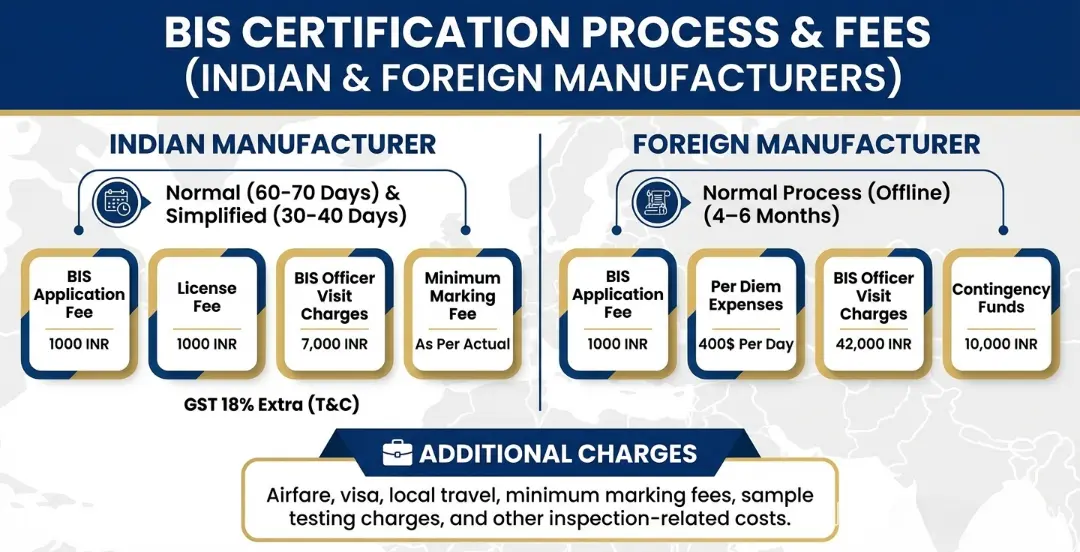
BIS Certification Process in India – Standphill India
BIS Certification Fees in India
BIS certification fees vary by scheme and product category. Here are the standard government fee components:
| Fee Component | Scheme I (ISI Mark) | CRS (Electronics) | FMCS (Foreign) |
|---|---|---|---|
| Application Fee | INR 1,000/- | INR 1,000/- | As applicable |
| Inspection Charges | INR 7,000/- | N/A | As applicable |
| Processing Fee | N/A | INR 50,000/- | N/A |
| Annual Licence Fee | INR 1,000/- | INR 2,000/- | INR 1,000/- |
| Marking Fee | As applicable | As applicable | As applicable |
| Bank Guarantee (FMCS) | N/A | N/A | USD 10,000/- |
| Sample Testing Fee | As per lab charges | As per lab charges | As per lab charges |
Benefits of BIS Certification for Manufacturers and Importers
1. Legal Market Access — Without BIS certification for regulated products, you simply cannot sell in India. With it, you have full, lawful access to one of the world's largest consumer markets.
2. Consumer and Retailer Trust — The ISI Mark is trusted by Indian consumers, retailers, and institutional buyers. It improves acceptance, reduces sales friction, and builds long-term brand credibility.
3. Import Clearance Without Complications — Customs authorities verify BIS certification at ports. Certified products clear smoothly. Non-certified products are held or rejected.
4. Government and Institutional Procurement — Government tenders and institutional procurement often require ISI-marked products. BIS certification opens this significant procurement channel.
5. E-Commerce Platform Access — Amazon India, Flipkart, and other platforms increasingly require BIS certification for regulated product listings. Certification ensures uninterrupted platform access.
6. Forced Quality Improvement — The certification process — testing, inspection, ongoing surveillance — compels manufacturers to maintain consistent quality. This improves overall product reliability beyond the certification itself.
7. International Standards Alignment — Indian Standards are aligned with ISO and IEC. BIS-certified products demonstrate global quality benchmarks, supporting export credibility.
BIS Enforcement and Penalties for Non-Compliance
BIS is not a passive regulator. It actively enforces certification requirements through market surveillance, factory inspections, import checks, and enforcement raids. And the consequences of non-compliance are real and significant.
• Product Seizure — BIS officers can confiscate non-compliant products at factories, warehouses, and retail outlets
• Heavy Fines — monetary penalties under the BIS Act, 2016 for manufacturing or selling without mandatory certification
• Import Rejection — customs authorities reject consignments without valid BIS certification
• Licence Cancellation — BIS can suspend or cancel existing licences for manufacturers who fail surveillance
• Criminal Liability — serious violations can result in imprisonment
• Market Withdrawal — BIS can direct product withdrawal from the market
Real Numbers: BIS has conducted 159 search-and-seizure operations targeting non-compliant toy products as of June 2025. Of 17,000+ toy samples tested since January 2021, 91% were compliant — the remaining 9% faced consequences. The BIS Care App also allows consumers to report uncertified products, creating additional enforcement pressure.
Why You Need a BIS Certification Consultant
The BIS certification process is multi-stage, technically demanding, and time-sensitive. Here is the reality manufacturers face without expert support:
• Wrong Standard Selection — Hundreds of Indian Standards exist. Selecting the wrong standard means your entire application is invalid and you have to restart. A consultant identifies the correct standard immediately.
• Documentation Gaps — BIS applications require specific technical documents in specific formats. Incomplete or incorrectly prepared documents are the single most common reason for application delays and rejections.
• Factory Audit Failures — BIS factory inspections are unforgiving. If your in-house testing facilities, quality control records, or production documentation are not ready, the audit fails and the process restarts from the inspection stage.
• Laboratory Coordination Complexity — Not all laboratories are recognized by BIS for all product categories. Finding the right lab, understanding which tests are in-house mandatory versus outsourceable, and managing test timelines requires experience.
• Query Response Management — BIS raises queries during scrutiny. Slow or incorrect responses delay the application significantly. An experienced consultant manages this communication proactively.
• Post-Licence Compliance — Getting the licence is not the finish line. Surveillance preparation, renewal management, and new model additions require ongoing expertise.
Every delay in BIS certification is a delay in your market access. Every rejection means restarting a process that takes weeks or months. An experienced BIS certification consultant is not a luxury — it is the most cost-effective and time-efficient way to navigate BIS successfully.
The Standphill India Story – 20 Years of BIS Certification Excellence
Every organization has an origin story. Standphill India's begins in Laxmi Nagar, Delhi — one of India's most vibrant trading and manufacturing hubs. It was here, over two decades ago, that our founders recognized a clear gap in the market: manufacturers across India were losing time, money, and market opportunities because the BIS certification process was opaque, complex, and poorly supported by accessible expertise.
The mission was simple — make BIS certification accessible, clear, and achievable for every manufacturer, regardless of size, industry, or location. Not just for the large enterprises that could afford expensive legal and compliance teams, but for the MSME manufacturer in Agra making safety switches, the toy manufacturer in Delhi seeking an ISI Mark for the first time, and the South Korean steel company wanting to export to India.
Over the years, that mission has delivered results that speak for themselves:
Today, Standphill India is headquartered in Greater Noida West, Uttar Pradesh, with a consultancy presence spanning all States and Union Territories of India. We have served manufacturers from Delhi NCR, Mumbai, Bangalore, Chennai, Hyderabad, Kolkata, Pune, Ahmedabad, Ludhiana, Jaipur, Surat and every major industrial cluster across India.
Internationally, we have delivered BIS certifications for manufacturers from the United States, United Kingdom, Germany, China, South Korea, Malaysia, Indonesia, Singapore, and Taiwan — helping them navigate a regulatory system that, without a knowledgeable Indian partner, can be extraordinarily difficult to navigate from overseas.
Our 10,000+ domestic projects span electronics, steel, toys, packaging, medical textiles, automotive components, consumer goods, food products, and industrial equipment. Each project is a story of a manufacturer who needed compliance support and found it at Standphill India.
What Standphill India Does as Your BIS Certification Consultant
We do not just file applications. We guide you through the entire BIS certification journey — from the very first question of "which standard applies to my product?" to the day your ISI Mark licence is in hand and beyond.
1. Standard and Scheme Identification
The most critical first step — and the one most manufacturers get wrong on their own. With hundreds of Indian Standards and multiple BIS schemes, identifying the correct standard and the right scheme for your specific product is foundational. We analyze your product and confirm the correct path before a single document is prepared.
2. Documentation Preparation and Review
We prepare, review, and organize every document required for your BIS application — factory registration, process flowcharts, machinery lists, testing equipment records, quality control documentation, and product technical specifications. Complete, correctly prepared documentation is the single biggest factor in application speed.
3. Laboratory Testing Coordination
We coordinate with the appropriate BIS recognized laboratories for your product category, manage sample submission, track testing progress, and review test reports before BIS submission. For products requiring in-house mandatory tests, we guide you on the specific equipment and procedures required.
4. Factory Inspection Preparation
We prepare your factory for BIS audits — reviewing in-house testing facility readiness, quality control documentation, production records, machinery compliance, and process flow documentation. A well-prepared factory audit means no surprises, no re-inspections, and a faster path to certification.
5. BIS Application Filing
We handle complete application filing — on the ManakOnline portal for domestic manufacturers and CRS, and through BIS headquarters for FMCS. Every application we file is complete, accurate, and structured for fastest possible processing.
6. BIS Query Resolution
BIS routinely raises queries during application scrutiny. Our team monitors applications actively and responds to every query promptly and accurately — preventing the delays that slow down unmanaged applications by weeks or months.
7. Post-Licence Support
Certification is not the finish line. We support clients with licence marking requirements, surveillance inspection preparation, licence renewal, new product model additions, and ongoing compliance advisory — ensuring that the ISI Mark remains valid and the certification investment continues to deliver value.
BIS Certification Schemes Standphill India Covers
Standphill India provides complete consultancy for every major BIS certification scheme:
• Scheme I – ISI Mark for Indian manufacturers across all regulated product categories
• FMCS — BIS certification for foreign manufacturers from USA, UK, Germany, China, South Korea, Malaysia and beyond, including AIR services
• CRS — BIS registration for electronic and IT products, including IS/IEC 62368-1:2023 migration support
• BIS Hallmarking — registration and compliance support for jewellery manufacturers and retailers
• Scheme X — type approval certification consultancy
• ECO Mark — environmental certification consultancy
• Toys — IS 9873 (non-electric toys) and IS 15644:2006 (electric toys) under Toys QCO 2020
• Medical Textiles — BIS certification for all 54 standards under Medical Textiles QCO 2023 (deadline 31 December 2025)
• Furniture — IS 17631 work chairs and other furniture categories under Furniture QCO
• Steel and Metal Products — stainless steel, structural steel, and all metal product certifications
• Electrical Appliances — fans, switches, cables, wiring devices, and all electrical equipment certifications
Explore Our BIS Certification Services
→ BIS Certification for Indian Manufacturers (ISI Mark – Scheme I)
→ BIS FMCS Certification for Foreign Manufacturers
→ BIS CRS Registration for Electronic and IT Products
→ BIS Hallmarking Certification
→ BIS Certification for Toys (IS 9873 and IS 15644:2006)
→ BIS Certification for Medical Textiles (QCO 2023)
→ BIS Certification Consultants in India – Standphill India
→ BIS Migration to IS/IEC 62368-1:2023 – CRS Implementation Guidelines 2026
How to Get Started with Standphill India
Getting BIS certification with Standphill India is straightforward. Here is exactly how it works:
Step 1 – Contact Us
Call us at +91-9667674225, email us at info@standphillindia.in, or fill in the contact form on our website. Share your product details, manufacturing location, and the BIS certification you are looking for.
Step 2 – Free Initial Consultation
Our team assesses your product, identifies the applicable Indian Standard and BIS scheme, explains the complete process clearly, and provides an honest timeline and cost estimate — with no vague commitments and no hidden charges.
Step 3 – Documentation and Testing Kickoff
Once you engage us, we immediately begin documentation preparation, identify the correct BIS recognized laboratory, and prepare your factory for the upcoming BIS audit — running everything in parallel to minimize total certification time.
Step 4 – Application, Inspection and Approval
We file your BIS application, manage all BIS communication and query responses, coordinate inspection logistics, and track the application through to final ISI Mark licence approval — with clear updates at every stage.
Step 5 – Post-Licence Support
After your licence is granted, we continue to support you with surveillance preparation, licence renewal, marking compliance, and new product additions — because your BIS compliance journey does not end at the first licence.
Conclusion – BIS Certification is Not a Barrier, It is a Bridge
Many manufacturers approach BIS certification as a regulatory hurdle — a bureaucratic obstacle between them and the market. The right perspective is the opposite. BIS certification is a bridge — to consumer trust, to legal market access, to institutional procurement, to e-commerce platforms, and to the confidence that comes from knowing your product has been independently verified to meet national quality standards.
The Bureau of Indian Standards, through its multiple certification schemes, has built a regulatory framework that protects Indian consumers and supports quality manufacturing. Understanding that framework — and navigating it efficiently — is what separates manufacturers who enter the Indian market on time from those who are delayed, penalized, or excluded.
With Standphill India as your BIS certification consultant, you have 20 years of experience, 10,000+ completed domestic projects, 400+ foreign certifications, and a team that knows the BIS certification process inside out — working on your behalf at every step.
Contact Standphill India today — and let us build that bridge for your business.
Frequently Asked Questions (FAQ)
Q1. What is the Bureau of Indian Standards (BIS)?
The Bureau of Indian Standards (BIS) is India's national standards body established under the BIS Act, 2016, operating under the Ministry of Consumer Affairs, Food and Public Distribution. BIS is responsible for standard formulation, product certification, hallmarking, laboratory services, and regulatory enforcement across all industries in India. It was originally established as the Indian Standards Institution (ISI) in 1947.
Q2. What is BIS certification and why is it important?
BIS certification is a product quality and safety certification confirming that a product complies with the applicable Indian Standard. It is important because for products covered under mandatory Quality Control Orders, it is the legal requirement for manufacturing, importing, or selling in India. Without it, products face seizure, import rejection, and legal penalties. With it, manufacturers have full market access and consumer trust through the ISI Mark.
Q3. What is the ISI Mark?
The ISI Mark is the official BIS Standard Mark — India's most recognized quality certification symbol since 1955. It confirms that a product has been evaluated by BIS against the applicable Indian Standard, the factory has been inspected, and product samples have been independently tested. It contains the IS number and the manufacturer's BIS licence number (CM/L-XXXXXXXXXX).
Q4. What are the different types of BIS certification schemes?
The main BIS certification schemes are Scheme I (ISI Mark for Indian manufacturers), FMCS Scheme V (for foreign manufacturers), CRS Scheme VI (for electronics), BIS Hallmarking Scheme VIII (for gold and silver jewellery), Scheme X (Type Approval), and ECO Mark Scheme VII (voluntary environmental certification). Each scheme has different processes, timelines, and requirements.
Q5. Is BIS certification mandatory for all products in India?
No. BIS certification is mandatory only for products covered under Quality Control Orders (QCOs). For other products, it is voluntary. However, the list of mandatory products continues to expand as new QCOs are notified — currently covering steel, electrical appliances, electronics, toys, cement, medical textiles, furniture, footwear, and hundreds more.
Q6. What is the difference between BIS Scheme I (ISI Mark) and CRS?
BIS Scheme I requires factory inspection by BIS plus product testing and is used for most physical goods. CRS is a faster registration system for electronic and IT products based on product test reports from BIS recognized laboratories without factory inspection. Both result in BIS approval but through fundamentally different processes designed for different product types.
Q7. Can foreign manufacturers get BIS certification?
Yes. Foreign manufacturers apply through the FMCS scheme where BIS conducts overseas factory inspections and tests samples against Indian Standards. Foreign manufacturers must appoint an Authorized Indian Representative (AIR) in India. Standphill India has completed 400+ foreign product certifications for manufacturers from the USA, UK, Germany, China, South Korea, Malaysia and more.
Q8. Why do manufacturers need a BIS certification consultant?
BIS certification involves correct standard identification, specific documentation preparation, in-house testing facility readiness, laboratory coordination, factory audit preparation, BIS portal filing, and query management — all requiring specialized knowledge. Wrong standard selection, incomplete documentation, or failed factory audits mean restarting a process that takes weeks or months. An experienced consultant like Standphill India eliminates these risks and delivers faster, more reliable certification outcomes.
Q9. How long does BIS certification take?
BIS Scheme I for Indian manufacturers typically takes 30 to 60 days. FMCS for foreign manufacturers takes 4 to 6 months. CRS registration for electronics takes 30 to 45 days. Timelines depend on documentation readiness, laboratory schedules, and factory inspection availability. Standphill India prepares clients thoroughly to achieve the fastest possible timelines.
Q10. How can Standphill India help with BIS certification?
Standphill India provides complete BIS certification consultancy for all schemes — Scheme I, FMCS, CRS, Hallmarking, Scheme X, ECO Mark — for all product categories across India. Our services cover standard identification, documentation preparation, laboratory coordination, factory inspection preparation, application filing, query resolution, and post-licence renewal support. With 20+ years of experience and 10,000+ domestic and 400+ foreign certification projects completed, we are one of India's most trusted BIS certification consultants. Contact us at +91-9667674225 or info@standphillindia.in.
★ Why Standphill India?
- 20+ Years of BIS Certification Experience
- 10,000+ Certifications Delivered Globally
- Dedicated Teams for CRS, FMCS & ISI Mark
- End-to-End Documentation & Filing Support
- Fast Response & Practical Compliance Guidance
- Support for Indian & Foreign Manufacturers
Get Free Call Back
Our Services
- BIS (ISI Mark) for Foreign Manufacturers
- Domestic BIS (ISI Mark) Certification
- BIS Certificate of Conformity (CoC)
- BIS Hallmarking
- BIS Licence for Toys
- ECO Mark Certification
- TAC Approval for Automobile
- Drug Licence
- Peso Certification
- BIS (CRS) Registration
- WPC-ETA Approval
- BEE Certification
- E-Waste Management (EPR)
- EPR for Plastic Waste
- EPR for Battery Waste
- CE Certification
- UL Certification
- ROHS Licence
- Standardization Division
- Import / Export Licence
- FSSAI Certification
- ISO Registration
- Trademark Registration
- Make in India Support
- AG-Mark Licence
- Third Party Monitoring
Client Testimonials
Their team was very knowledgeable and helped us every step of the way. Standphill India is the best BIS certification consultants for any type of BIS certification.

Chintan Shah (AGM)
Sudeep Nutrition P.Ltd




Featured Guide
Complete BIS CRS certification guide for electronic products in India — free to read.
Read CRS Certification Guide📞 Contact Standphill India
+91-9667674225 info@standphillindia.in WhatsApp Now Greater Noida West, UPGet Expert BIS Certification Support for Your Business
Connect with Standphill India for complete support with BIS certification, CRS registration, WPC approval, FMCS compliance, and related regulatory services. Our team helps businesses with documentation, testing coordination, application support, and end-to-end compliance guidance.
Request Free Consultation
Share your requirement and our team will contact you shortly.