Welcome to Standphill India
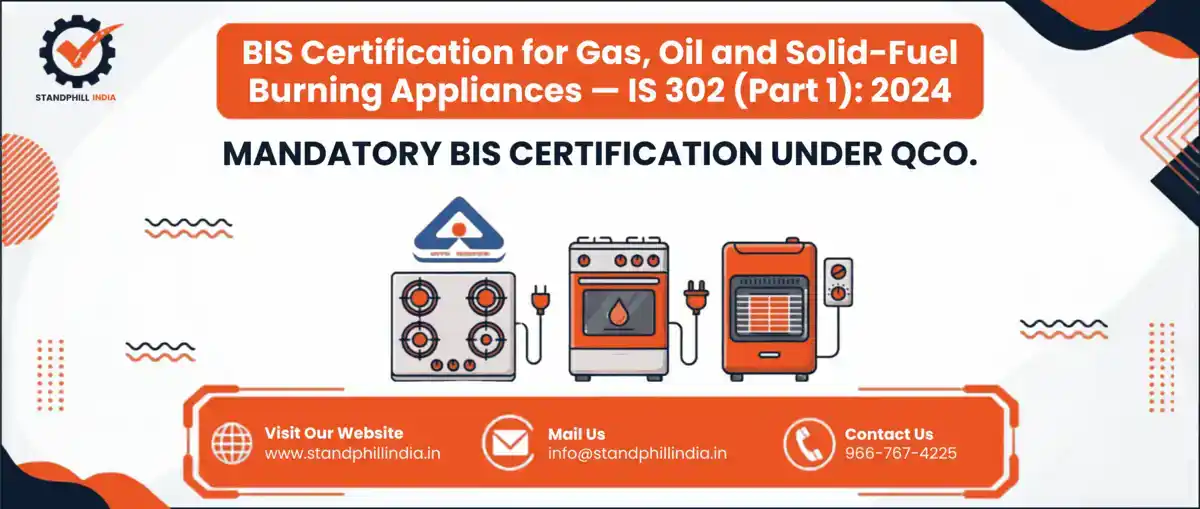
BIS Certification for Gas, Oil and Solid-Fuel Burning Appliances Having Electrical Connections — IS 302 (Part 1): 2024
By Standphill India | BIS Certification Consultants | Updated: 2026 Category: BIS Certification | IS 302 Part 1 | QCO 2026 | Electrical Appliances
Gas, oil, and solid-fuel burning appliances that incorporate electrical connections are among the most technically misunderstood products in the BIS QCO 2026 compliance framework. Most manufacturers of these appliances already hold certifications for the fuel-burning side of their products — but the electrical component now independently requires BIS ISI Mark certification under IS 302 (Part 1): 2024 before these appliances can be manufactured, imported, or sold in India after 1 October 2026. This page explains precisely what is being certified, which manufacturers are actually affected, and what the compliance path looks like for this specific product category.
What Exactly Is Being Certified — and Why This Product Category Is Unique
This is the compliance question that matters most for manufacturers in this category, and it is the one most BIS certification guides fail to answer clearly.
A gas cooker, oil-fired boiler, or solid-fuel heating system is not purely an electrical appliance. Its primary function is combustion. But virtually every modern appliance of this type incorporates electrical components — electronic ignition systems, thermostat controls, safety cut-offs, motorised dampers, fan-assisted combustion systems, digital displays, timer circuits, or electrically operated gas valves. These electrical elements are what bring the appliance within the scope of IS 302 (Part 1): 2024 and therefore within the mandatory BIS certification requirement under the QCO 2026.
IS 302 (Part 1): 2024 does not certify the combustion performance of the appliance. It certifies the electrical safety of the appliance as a whole — specifically addressing the hazards that arise from the interaction between electrical components and the combustion environment. This is a stricter and more specific testing requirement than standard electrical appliance certification, because the electrical components in these appliances operate in environments with elevated temperatures, combustion gases, fuel vapours, and thermal cycling that are not present in purely electrical household appliances.
Which Appliances Are Actually Covered
The QCO 2026 lists this product category as: "Gas, Oil and Solid-Fuel Burning Appliances Having Electrical Connections" (Sr. No. 76). The key qualifier is "having electrical connections" — meaning any appliance in this combustion category that incorporates any electrical component at all is covered.
In practice, this covers a wide range of products sold in the Indian market:
• Gas cookers and ranges with electronic ignition — any gas hob or range where ignition is triggered electrically rather than manually, or where the appliance includes electrical safety interlocks, timers, or display panels
• Gas-electric combination cooking ranges — appliances where gas burners and electric heating elements coexist in a single unit
• Oil-fired boilers and water heaters with electrical controls — including domestic and commercial heating boilers that use electrical pump motors, thermostats, safety switches, and control boards
• Solid-fuel burning stoves with electrical fans or controls — wood pellet stoves, biomass heaters, and similar appliances with electrically driven feed mechanisms, fans, or control systems
• Gas fireplaces and room heaters with electrical ignition or controls — including wall-mounted gas heaters, gas log fires, and decorative gas fireplaces with any electrical component
• Commercial burner units with electrical control panels — industrial and commercial kitchen equipment, bakery equipment, and catering appliances using gas or oil combustion with electrical management systems
• Gas-fired air heaters with electrical fans — used in workshops, warehouses, and commercial spaces, where electrical fans force-distribute heat from gas combustion
If your appliance burns gas, oil, or solid fuel — and has any electrical connection whatsoever — it is covered. There is no minimum electrical complexity threshold. A single electronic ignition circuit is sufficient to bring the appliance within scope.
The Dual Compliance Trap — Why This Category Carries Higher Compliance Risk Than Most
This is the compliance issue that Standphill India considers the most significant risk specific to this product category — and it is rarely discussed in generic BIS certification guides.
Manufacturers and importers of gas, oil, and solid-fuel appliances with electrical connections frequently assume that existing certifications or approvals they hold for their products — whether CE marking under European Gas Appliance Regulation, UL certifications in the United States, or IS 1239 / IS 554 approvals for gas fittings in India — provide coverage or exemption from the IS 302 (Part 1): 2024 requirement. They do not.
IS 302 (Part 1): 2024 is an independent Indian Standard with its own specific test parameters. It is not substituted by CE marking, UL listing, or any other international certification. BIS will not accept test reports from non-approved laboratories regardless of how well-recognized those laboratories are internationally. And the ISI Mark is the only mark that satisfies the QCO 2026 compliance requirement — no foreign equivalent substitutes for it in the Indian market.
The practical implication is that a manufacturer who has CE-marked their gas boiler with full European Gas Appliance Regulation compliance must still obtain a separate BIS ISI Mark licence under IS 302 (Part 1): 2024 specifically for the Indian market. The CE test reports cannot be submitted directly to BIS. Testing must be repeated at a BIS-approved, NABL-accredited Indian laboratory.
Additionally, some appliances in this category may also require compliance with other Indian regulations — such as IS 15777 for LPG domestic cooking appliances, petroleum safety regulations, or PESO (Petroleum and Explosives Safety Organisation) approvals for certain fuel-handling equipment. IS 302 (Part 1): 2024 BIS certification does not satisfy or replace these other requirements. Manufacturers must map their full regulatory compliance picture, not just the BIS requirement in isolation.
What IS 302 (Part 1): 2024 Tests for in This Product Category
IS 302 (Part 1): 2024 is aligned with IEC 60335-1: 2020 — Household and Similar Electrical Appliances Safety — Part 1: General Requirements. For gas, oil, and solid-fuel burning appliances with electrical connections, the standard addresses electrical hazards that are specific to the combustion environment:
Electrical insulation under thermal stress. The insulation of electrical components in these appliances is subject to significantly higher temperatures than in purely electrical appliances. Testing verifies that insulation does not degrade, deform, or fail under the operating temperatures generated by the combustion system — including flue gas temperatures, radiant heat from combustion chambers, and conducted heat through metal components.
Protection against ignition of fuel by electrical faults. Electrical faults — arcing, sparking, or overheating — in the vicinity of fuel supply lines, fuel tanks, or combustion chambers present a risk of ignition that does not exist in non-combustion appliances. The standard tests that electrical components are designed and positioned to prevent this hazard.
Control circuit safety and fail-safe behaviour. The standard verifies that the electrical control system of the appliance behaves safely under fault conditions — including that safety cut-off circuits operate correctly, that thermostat failures do not result in uncontrolled combustion, and that electrical failures do not leave the appliance in a hazardous operating state.
Leakage current and earthing. Standard electrical safety parameters — leakage current limits, earth continuity, dielectric strength — are tested with particular attention to the higher-temperature operating environment of combustion appliances.
Moisture resistance of electrical components. Commercial kitchen and catering appliances in this category are frequently exposed to steam, water splashing, and cleaning processes. The standard verifies appropriate ingress protection ratings for electrical components in such environments.
Marking and instructions compliance. The appliance must carry the ISI Mark with the BIS licence number, and the instructions must accurately describe safe installation, operation, and maintenance of the electrical connections.
Who Is Most Affected — The Manufacturer and Importer Landscape
The manufacturers and importers most directly affected by this QCO 2026 requirement for gas, oil, and solid-fuel burning appliances with electrical connections fall into three groups, each with a different compliance position and different urgency level.
Indian manufacturers of gas cooking appliances. India has a significant domestic manufacturing base for gas cooking ranges, hobs, and combination appliances — concentrated in industrial clusters in Gujarat, Maharashtra, and Delhi NCR. Manufacturers who produce gas appliances with electronic ignition, electronic safety systems, or integrated electrical cooking elements are covered. Many of these manufacturers may not have previously engaged with IS 302 (Part 1) because their primary compliance focus has been on gas safety standards. For these manufacturers, the QCO 2026 creates a new certification obligation that requires action before 1 October 2026.
Foreign manufacturers and importers of boilers, heaters, and commercial kitchen equipment. India's commercial kitchen, hotel, and food processing sectors import significant quantities of gas-fired and oil-fired professional cooking and heating equipment from manufacturers in China, Italy, South Korea, Germany, and other countries. These products — commercial ranges, combination ovens with gas and electric operation, oil-fired boilers — are directly covered. Foreign manufacturers must obtain BIS FMCS certification. Importers sourcing from uncertified foreign manufacturers cannot legally clear these goods after 1 October 2026.
Manufacturers of wood pellet stoves, biomass heaters, and similar solid-fuel appliances. This is an emerging category in India driven by industrial and rural energy transition. Wood pellet boilers, biomass cooking stoves with electrical feed systems, and agro-waste burning heaters with electrical controls all fall within scope. This segment is the least prepared for BIS compliance in this category and requires immediate attention.
Implementation Deadlines Under QCO 2026
| Enterprise Category | Compliance Deadline |
|---|---|
| General Manufacturers and Foreign Importers (excl. Micro & Small) | 1 October 2026 |
| Small Enterprises | 1 January 2027 |
| Micro Enterprises | 1 April 2027 |
For foreign manufacturers applying under FMCS, the practical deadline to initiate the certification process is no later than June 2026 — factoring in laboratory testing time, documentation preparation, BIS portal submission, document scrutiny, and overseas factory audit scheduling. Foreign manufacturers who submit applications after July 2026 face a significant risk of not receiving their licence before October 1st.
The BIS Certification Process for This Product Category
Step 1 — Scope Confirmation
Confirm that your specific appliance model — including its electrical components, voltage rating, and intended use category (household, commercial, or similar) — falls within the scope of IS 302 (Part 1): 2024 under the QCO 2026. This step also identifies whether the appliance has overlapping requirements with other Indian Standards or regulatory schemes that must be addressed in parallel.
Step 2 — Product Testing at a BIS-Approved Laboratory
Representative product samples are submitted to a BIS-recognized, NABL-accredited laboratory for testing against IS 302 (Part 1): 2024. For gas, oil, and solid-fuel appliances, this testing specifically addresses the electrical safety parameters under the combustion operating conditions described above. Each model and variant must be individually tested.
Step 3 — Documentation and BIS Application
A complete application package is compiled — including test reports, factory layout, quality management plan, machinery list, product specifications, technical drawings for the electrical sub-system, label artwork with ISI Mark placement, and required declarations — and submitted through the BIS ManakOnline portal (manakonline.in).
Step 4 — BIS Factory Inspection
BIS officials inspect the manufacturing facility to verify production infrastructure, in-house testing capability for the electrical components of the appliance, and quality control systems. For this product category, inspectors pay particular attention to the manufacturer's capability to consistently control the electrical component assembly and testing in a combustion appliance manufacturing environment.
Step 5 — Grant of BIS ISI Mark Licence
Upon successful completion of document scrutiny and factory inspection, BIS grants the Certification Mark Licence (CM/L). The ISI Mark with licence number must be displayed on all certified appliances before they are placed on the Indian market.
Documents Required for BIS Certification
• Company registration certificate and address proof
• Complete product technical specification — covering both the combustion system and the electrical sub-system
• Electrical circuit diagram and wiring schematic for the appliance
• Factory layout showing production, electrical component assembly, and testing areas
• Machinery and equipment list — including equipment used for electrical component assembly and in-house testing
• Quality management procedures — specifically including in-process testing procedures for electrical safety parameters
• Calibration certificates for all in-house electrical testing instruments
• Raw material and component supplier details — particularly for electrical components
• Test reports from BIS-approved, NABL-accredited laboratory covering all IS 302 (Part 1): 2024 parameters
• Label artwork showing ISI Mark placement with licence number
• Product photographs
• Undertakings and declarations as required by BIS
• For foreign manufacturers: Authorized Indian Representative appointment letter and apostilled power of attorney
Three Compliance Mistakes Manufacturers in This Category Must Avoid
1. Assuming existing gas safety approvals substitute for IS 302 (Part 1): 2024 certification. They do not. IS 302 (Part 1): 2024 is an independent requirement that applies to the electrical aspects of the appliance. A manufacturer may hold an approval for the gas safety performance of their product under IS 15777 or another standard, but this does not satisfy the IS 302 (Part 1): 2024 BIS certification requirement under the QCO 2026.
2. Submitting international test reports directly to BIS. BIS requires testing at BIS-approved, NABL-accredited laboratories. Test reports from international laboratories — including DEKRA, TÜV, UL, or Bureau Veritas — are not accepted for BIS certification purposes regardless of their international standing. Re-testing at a BIS-approved Indian laboratory is mandatory.
3. Certifying only the most popular model and assuming all variants are covered. Each model and variant of the appliance must be independently tested and covered in the BIS licence scope. A manufacturer who certifies their 4-burner gas range with electronic ignition has not automatically certified their 2-burner or 6-burner variants. The licence scope must explicitly include each variant for that variant to be legally marketed.
Related Pages
1. ) BIS CRS Certification Process
2. )BIS FMCS Certification for Foreign Manufacturers
3. ) BIS ISI Mark Certification for Indian Manufacturers
How Standphill India Supports BIS Certification for This Product Category
Standphill India provides complete end-to-end BIS certification for gas, oil, and solid-fuel burning appliances having electrical connections — for both Indian manufacturers and foreign manufacturers under FMCS. Our technical team maps the complete compliance picture for appliances in this category — identifying overlapping standards, defining the correct scope of IS 302 (Part 1): 2024 testing for hybrid appliances, coordinating testing at BIS-approved laboratories with experience in combustion appliance electrical safety, and preparing manufacturers thoroughly for BIS factory inspection.
With over 20 years of exclusive BIS certification expertise and 10,000+ certification projects, Standphill India is the partner that manufacturers of complex, multi-standard products trust to get certification right — on time and without avoidable complications.
Get in touch for a free compliance assessment for your specific appliance.
📞 +91 96676 74225
✉️ info@standphillindia.in
🌐 standphillindia.in
Standphill India — India's Leading BIS Certification Consultant. Your trusted partner in global compliance.
Frequently Asked Questions
Q1. My gas cooker already has CE marking. Does it need BIS certification separately for India?
Yes. CE marking under European Gas Appliance Regulation does not satisfy BIS certification requirements under IS 302 (Part 1): 2024. BIS certification is a mandatory, independent Indian compliance requirement. CE-marked products must be separately tested at a BIS-approved Indian laboratory and licensed by BIS before they can be sold in India after 1 October 2026.
Q2. My appliance is primarily a gas appliance — why does it need BIS certification under an electrical appliances standard?
The QCO 2026 specifically covers "Gas, Oil and Solid-Fuel Burning Appliances Having Electrical Connections" (Sr. No. 76). Any combustion appliance that incorporates electrical components — including electronic ignition, thermostats, control panels, safety circuits, or electric fans — is covered under IS 302 (Part 1): 2024. The standard certifies the electrical safety of the appliance, not its combustion performance.
Q3. Does BIS certification under IS 302 (Part 1): 2024 cover all safety requirements for my gas appliance in India?
No. IS 302 (Part 1): 2024 certifies the electrical safety aspects of the appliance. Other applicable Indian Standards and regulatory requirements — such as gas safety standards, petroleum safety regulations, or PESO approvals — apply independently and must be assessed separately for your specific product and application.
Q4. I import commercial gas kitchen equipment from Italy. What is my compliance path under QCO 2026?
As an importer, you can only legally import and sell these appliances in India after 1 October 2026 if the foreign manufacturer has obtained a valid BIS FMCS licence for the specific product under IS 302 (Part 1): 2024. If the manufacturer is not yet certified, you should engage Standphill India immediately to initiate the FMCS process — the overseas factory audit and full documentation process typically takes 8 to 12 weeks minimum.
Q5. Each of our gas appliance models has a different electrical control configuration. Do each need separate certification?
Yes. Each model and variant with a distinct electrical configuration must be independently tested and included in the BIS licence scope. Standphill India assesses your full product range at the outset to determine the optimal testing strategy — which may include family grouping where BIS guidelines permit — to minimise testing costs while ensuring all variants are covered.
★ Why Standphill India?
- 20+ Years of BIS Certification Experience
- 10,000+ Certifications Delivered Globally
- Dedicated Teams for CRS, FMCS & ISI Mark
- End-to-End Documentation & Filing Support
- Fast Response & Practical Compliance Guidance
- Support for Indian & Foreign Manufacturers
Get Free Call Back
Our Services
- BIS (ISI Mark) for Foreign Manufacturers
- Domestic BIS (ISI Mark) Certification
- BIS Certificate of Conformity (CoC)
- BIS Hallmarking
- BIS Licence for Toys
- ECO Mark Certification
- TAC Approval for Automobile
- Drug Licence
- Peso Certification
- BIS (CRS) Registration
- WPC-ETA Approval
- BEE Certification
- E-Waste Management (EPR)
- EPR for Plastic Waste
- EPR for Battery Waste
- CE Certification
- UL Certification
- ROHS Licence
- Standardization Division
- Import / Export Licence
- FSSAI Certification
- ISO Registration
- Trademark Registration
- Make in India Support
- AG-Mark Licence
- Third Party Monitoring
Client Testimonials
Their team was very knowledgeable and helped us every step of the way. Standphill India is the best BIS certification consultants for any type of BIS certification.

Chintan Shah (AGM)
Sudeep Nutrition P.Ltd



Featured Guide
Complete BIS CRS certification guide for electronic products in India — free to read.
Read CRS Certification Guide📞 Contact Standphill India
+91-9667674225 info@standphillindia.in WhatsApp Now Greater Noida West, UPGet Expert BIS Certification Support for Your Business
Connect with Standphill India for complete support with BIS certification, CRS registration, WPC approval, FMCS compliance, and related regulatory services. Our team helps businesses with documentation, testing coordination, application support, and end-to-end compliance guidance.
Request Free Consultation
Share your requirement and our team will contact you shortly.