BIS Certification for Chemical Products in India
ISI Mark for Chemicals | Quality Control Orders | 58+ Notified Chemicals | Complete Compliance Guide
BIS Certification for chemical products is mandatory under various Quality Control Orders (QCOs) issued under the BIS Act, 2016 by the Ministry of Chemicals and Fertilizers (Department of Chemicals and Petrochemicals) and DPIIT. Any notified chemical product cannot be legally manufactured for sale, imported, or distributed in India without a valid BIS licence and the ISI Mark. The list of notified chemicals is continuously growing — with over 58 chemicals already covered and more being added.
- What is BIS Certification for Chemicals?
- Why Has It Become Mandatory?
- Recent QCOs — February 2024
- List of 45+ Notified Chemicals
- New BIS Standards for Chemicals
- Certification Process — Step by Step
- Documents Required
- Cost & Timelines
- For Foreign Manufacturers (FMCS)
- Benefits of BIS Certification
- Why Choose Standphill India?
- Frequently Asked Questions
- Conclusion
What is BIS Certification for Chemical Products?
BIS Certification for chemicals means that a chemical product — before it can be manufactured for sale or imported into India — must be tested against the relevant Indian Standard (IS code) and the manufacturer must hold a valid BIS licence. Once the licence is granted, the product must carry the ISI Mark on its packaging and labels.
This is not a voluntary quality badge. It is a legal requirement enforced by the Bureau of Indian Standards under the BIS Act, 2016. Products sold without this certification can be seized, and the manufacturers or importers behind them can be prosecuted.
There are two issuing bodies for chemical QCOs in India:
- Ministry of Chemicals and Fertilizers (Department of Chemicals and Petrochemicals) — covers polymers, resins, solvents, intermediates, and petrochemicals
- DPIIT (Department for Promotion of Industry and Internal Trade) — covers some chemicals under broader QCO frameworks
The certification itself is always granted by the Bureau of Indian Standards (BIS) — which is the certifying and enforcing authority for all chemical QCOs.
Customs detention is real. Chemical shipments without valid BIS certification are being stopped at Indian ports. If your product is on the notified list and you don't have a BIS licence number, your cargo will not clear customs. This is not a future risk — it is happening right now.
Why Has BIS Certification for Chemicals Become Mandatory?
For many years, BIS certification for most chemical products was voluntary — manufacturers could apply for the ISI Mark if they wanted, but no one was compelled to. That has changed significantly since 2018, when the Government of India began systematically bringing chemical products under mandatory Quality Control Orders.
The reasons are straightforward. Substandard or adulterated chemicals enter industrial processes — paints, polymers, adhesives, pharmaceuticals, water treatment, food packaging — and their quality directly affects the safety and reliability of the final products that reach Indian consumers. A substandard PVC resin affects the pipes in a building. A contaminated solvent affects the paints on walls. A poorly tested polymer affects the packaging of food.
Since 2018, the government has added over 63 chemicals to the mandatory BIS list across successive QCO notifications. The pace has been accelerating — and more chemicals are expected to be added over the coming years. The message from the government is clear: chemical quality in India will be regulated, verified, and enforced.
- 63+ chemicals brought under mandatory BIS certification since 2018
- QCOs have been issued by the Ministry of Chemicals, Ministry of Petroleum, and DPIIT
- India's Department of Chemicals consulted on adding 58 additional chemicals under the Rotterdam Convention framework
- Each QCO notification gives manufacturers a window — typically 180 days — to become compliant before enforcement begins
- BIS officers and customs authorities are actively enforcing compliance at ports and in the market
Recent QCO Notifications — February 2024
In February 2024, the Ministry of Chemicals and Fertilizers issued a series of new Quality Control Orders that brought additional chemical and polymer products under mandatory BIS certification. All three orders came into force 180 days after their publication in the Official Gazette, issued under the BIS Act, 2016:
These three QCOs came into effect 180 days from their February 2024 notification date. If you manufacture or import any of these products and have not yet obtained your BIS licence, contact Standphill India immediately — you may already be in violation.
List of Notified Chemicals Requiring BIS Certification
The following table lists the key chemicals currently notified under mandatory BIS Quality Control Orders, along with the applicable Indian Standard. This is not exhaustive — the list is continuously updated. If your chemical is not listed here, contact Standphill India for a current applicability check.
| # | Chemical / Product | Indian Standard (IS Code) |
|---|---|---|
| 1 | Caustic Soda | IS 252 |
| 2 | Boric Acid | IS 10116 |
| 3 | Poly Aluminium Chloride | IS 15573 |
| 4 | Pyridine | IS 8058 |
| 5 | Methanol | IS 517 |
| 6 | Aniline | IS 2833 |
| 7 | Acetic Acid | IS 695 |
| 8 | Phthalic Anhydride | IS 5158 |
| 9 | Gamma Picoline | IS 16113 |
| 10 | Beta Picoline | IS 16112 |
| 11 | Morpholine | IS 12084 |
| 12 | Sodium Sulphide | IS 297 |
| 13 | Potassium Carbonate | IS 7129 |
| 14 | Acetone | IS 170 |
| 15 | Phosphorous Trichloride | IS 4581 |
| 16 | Phosphorous Pentachloride | IS 11744 |
| 17 | Phosphorous Oxychloride | IS 11657 |
| 18 | Stabilised Hydrogen Peroxide | IS 2080 |
| 19 | Precipitated Barium Carbonate, Technical | IS 3205 & IS 12928 |
| 20 | Sodium Tripolyphosphate, Anhydrous, Technical | IS 6100 |
| 21 | n-Butyl Acrylate | IS 14709 |
| 22 | Ether | IS 336 |
| 23 | Ethylene Glycol | IS 5295 |
| 24 | Toluene | IS 537 |
| 25 | Terephthalic Acid | IS 15030 |
| 26 | SM (Styrene Monomer) | IS 4105 |
| 27 | Methyl Acrylate | IS 14707 |
| 28 | Ethyl Acrylate | IS 14708 |
| 29 | Vinyl Acetate Monomer | IS 12345 |
| 30 | Maleic Anhydride | IS 5149 |
| 31 | Acrylonitrile | IS 12540 |
| 32 | Ethylene Vinyl Acetate Copolymers | IS 13601 |
| 33 | Polyethylene Material for Moulding and Extrusion | IS 7328 |
| 34 | Linear Alkyl Benzene | IS 12795 |
| 35 | SBR Latex | IS 11356 |
| 36 | Synthetic Micro-Fibres for Cement Matrix | IS 16481 |
| 37 | Polyester | IS 17261, 17262, 17263, 17264 |
| 38 | Acrylonitrile-Butadiene Styrene (ABS) | IS 17077 |
| 39 | p-Xylene | IS 17370 |
| 40 | Vinyl Chloride Monomer | IS 17442 |
| 41 | Polyurethanes | IS 17397 (Part 1) |
| 42 | Polycarbonate | IS 14434 |
| 43 | EDC (Ethylene Dichloride) | IS 869 |
| 44 | Ortho Phosphoric Acid | IS 798 |
| 45 | Sodium Formaldehyde Sulphoxylate | IS 4505 |
| 46 | Poly Vinyl Chloride (PVC) Homopolymers | IS 17658:2021 — QCO Feb 2024 |
| 47 | Polypropylene (PP) for Moulding & Extrusion | IS 10951:2020 — QCO Feb 2024 |
| 48 | Diesel Engine NOx Reduction Agent AUS 32 | IS 17042 (Part 1):2018 — QCO Feb 2024 |
This list is indicative. The full notified list is continuously updated. Contact Standphill India for a current and complete applicability check for your specific product.
New BIS Standards for Chemicals — What Manufacturers Need to Know
In recent years, BIS has published a series of new Indian Standards specifically for chemical products that were previously not covered or were covered under older standards. These new standards are now the basis for BIS certification — and some of them are tied to active or upcoming QCOs. Here are the most important ones:
Covers both PVC Suspension Resin (PVC-SR) and PVC Paste/Emulsion Resin (PVC-PR). Mandatory under the PVC Homopolymers QCO, 2024. Used in pipes, cables, flooring, packaging, and fittings. If you manufacture or import PVC resin, this standard applies to you.
Covers TDI-80, a mixture of 80% 2,4-TDI and 20% 2,6-TDI, used in foam, coatings, and adhesives. Sets purity, stability, and acidity limits. Critical for polyurethane foam manufacturers — a poorly specified TDI batch can cause production-level quality failures.
Applies to EVA with 3% to 50% vinyl acetate content — used in footwear, films, cables, and food packaging. The standard defines designation by vinyl acetate content and melt mass-flow rate, ensuring batch-to-batch consistency in processing and performance.
Covers PMMA homopolymers and MMA copolymers with at least 80% MMA content, in granule or bead form. Used in signage, displays, lenses, and automotive. Standards focus on optical clarity, softening temperature, and melt flow characteristics.
The monomer behind PMMA. Covers purity, water content, colour, and density requirements. Used in paints, coatings, adhesives, and plastics. If you supply MMA to downstream manufacturers, BIS certification confirms your product's purity and stability.
Chlorinated Polyvinyl Chloride, used in hot and cold water pipes. The standard covers chlorine content, viscosity, particle size, and volatile matter. Complements IS 15778 (CPVC pipes) — the resin standard ensures the raw material used in pipe production is consistent and safe.
Sodium polyacrylate resin for absorbing blood and urine in hygiene products — baby diapers, sanitary pads, adult incontinence products. The standard sets water absorption, retention capacity, and toxicological safety parameters. Particularly important given the direct consumer contact these products involve.
Used as a flocculant in water treatment, mining, and papermaking. The standard establishes a designation system and prescribes requirements for polyacrylamide materials — important for water sector applications where contamination or substandard performance directly affects public health.
Covers polyether polyols used in polyurethane foam, adhesives, coatings, and elastomers. Specifies hydroxyl number, viscosity, and water content. Does not cover bio-based polyols, formulated polyols, or polyols with blowing agents or flame retardants. The furniture and bedding sectors are directly affected.
Important: Many of these new standards are already linked to active QCOs. Even where a QCO has not yet been issued for a specific standard, it is prudent to get BIS certified proactively — QCOs are often issued with only 180 days' notice, and testing plus certification takes 8 to 16 weeks.
BIS Certification Process for Chemical Products — Step by Step
The BIS certification process for chemicals is the same Scheme-I process used across all BIS-certified products — but chemical products have their own specific documentation requirements, testing parameters, and sometimes specialised laboratory requirements. Here is how it works in practice:
The first thing is to confirm whether your specific chemical is notified under a QCO, and if so, which Indian Standard applies to it. This sounds simple, but chemicals with similar names can fall under different IS codes, and some chemicals have multiple grades or forms with different applicability. Getting this wrong means your entire application is built on the wrong standard — a costly mistake.
You need to compile your business registration documents, manufacturing process flowchart, product formulation and composition, quality control procedures, and factory details in the exact format BIS requires. For chemicals, the Safety Data Sheet (SDS), packaging and labelling details, and raw material sourcing information are all particularly important. Missing or incorrectly formatted documents are the most common cause of BIS application delays.
Your chemical product must be tested at a BIS-recognised, NABL-accredited laboratory. The lab tests the product against all parameters specified in the applicable Indian Standard — purity, composition, physical properties, stability, and any safety-related characteristics. The lab issues a test report on completion. If the product fails any parameter, you need to address the non-conformity and retest — which adds weeks and cost.
Submit the formal BIS application through the ManakOnline portal (manakonline.in) with all documents, the laboratory test report, and payment of the applicable government fee. The application is reviewed by BIS officers for completeness and technical accuracy. Queries raised by BIS must be resolved within the prescribed timeline — missed deadlines can result in the application being cancelled.
A BIS officer visits the manufacturing facility to verify that the production setup, quality control systems, testing equipment, and processes are consistent with what was declared in the application and with the requirements of the applicable IS standard. For chemical plants, the inspector will specifically look at raw material handling, reaction controls, quality sampling, in-process testing, packaging, and finished product storage.
Once testing and inspection are satisfactory, BIS grants the ISI Certification Licence (CM/L number). You can now legally apply the ISI Mark to your certified chemical product's packaging and labels. The licence number must be displayed as required under the BIS marking regulations.
BIS conducts periodic surveillance inspections and may collect market samples for independent retesting. Chemical BIS licences are typically valid for two years and must be renewed before expiry. Any changes to the product formulation, raw material sources, or process that could affect compliance must be reported to BIS immediately.
Documents Required for BIS Certification of Chemical Products
For Domestic Manufacturers (Scheme-I):
- Certificate of Incorporation, GST Registration, and authorised signatory letter
- Factory licence and manufacturing address proof
- Factory layout plan showing production areas, storage, laboratory, and quality control zones
- Detailed manufacturing process flowchart — raw material intake to finished product dispatch
- Product composition and formulation details — including percentage composition of each component
- Safety Data Sheet (SDS) for the product, compliant with Indian regulations
- Raw material specifications and supplier list
- Quality Control Plan — in-process testing parameters, frequency, and acceptance criteria per IS standard
- List of in-house testing equipment with current calibration certificates
- Product test report from a BIS-recognised, NABL-accredited laboratory
- Packaging details and label artwork — showing proposed ISI Mark placement, IS number, and licence number format
- Undertakings and declarations as required by BIS in prescribed format
Additional Requirements for Foreign Manufacturers (FMCS Route):
- Appointment letter for an Authorized Indian Representative (AIR) — mandatory before application
- AIR's company registration, GST, PAN, and KYC documents
- Foreign manufacturer's notarised and apostilled business registration certificate
- Power of attorney granted to the AIR by the foreign manufacturer
- Overseas factory details and inspection readiness confirmation
- Existing international chemical test reports (for reference — BIS lab testing is still mandatory)
- BIS application fee and overseas inspection charges in foreign currency
From experience: Chemical BIS applications are frequently delayed because of incomplete SDS documentation, incorrect label artwork, or formulation descriptions that don't match the IS standard's terminology. Standphill India reviews every document before submission — so BIS doesn't have to ask you to resubmit.
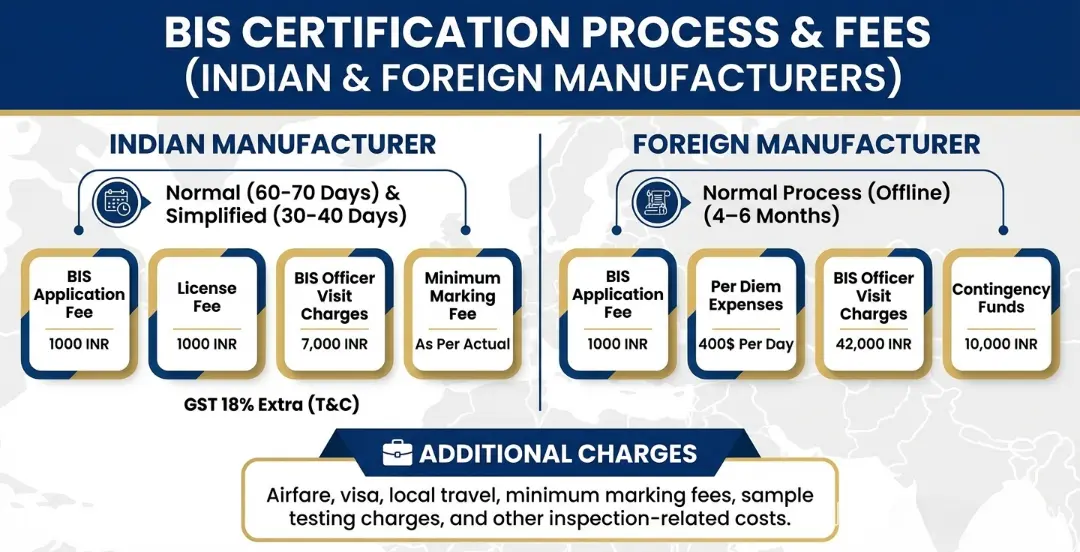
Cost and Timelines for BIS Certification of Chemicals
Costs for chemical BIS certification vary depending on the product category, number of variants, and whether specialised testing is required. Here is a realistic breakdown:
| Cost Component | Indicative Range | Notes |
|---|---|---|
| BIS Application Fee | ~INR 1,000 | One-time, non-refundable government fee |
| Product Testing at BIS-Recognised Lab | INR 30,000 – INR 2,50,000 | Varies significantly by chemical type, number of test parameters, and lab; hazardous chemicals may require specialised facilities |
| BIS Factory Inspection Fee | ~INR 7,000 per inspection | Government fee for domestic factory visit |
| Annual Licence Fee | ~INR 1,000 per annum | Government fee |
| Annual Marking Fee | INR 1,000+ per annum | Plus unit-based marking fee on production volume |
| Consultancy Fee | Contact Standphill India | Transparent, all-inclusive quote — no hidden charges |
Indicative total cost:
- Indian Manufacturers: INR 1,50,000 to INR 5,00,000 for one chemical product — depending on complexity and testing scope
- Foreign Manufacturers (FMCS): USD 15,000 to USD 30,000+ per product — including BIS officer overseas travel, AIR services, testing, and government fees
The cost of not having BIS certification far exceeds the certification cost itself. Port detention, product seizure, production stoppages, and lost contracts are all very real consequences. Contact Standphill India for a transparent, product-specific cost estimate.
For Foreign Manufacturers — BIS FMCS Route for Chemicals
If you manufacture chemicals outside India and supply them to Indian buyers, importers, or distributors — you need to understand a critical point: the BIS licence for a notified chemical must be held by the foreign manufacturer, not by the Indian importer. An Indian importer cannot obtain a BIS licence on behalf of a foreign manufacturer under Scheme-I.
This is where the Foreign Manufacturers Certification Scheme (FMCS) comes in. Under FMCS, a foreign manufacturer applies directly to BIS, appoints an Authorized Indian Representative (AIR), undergoes product testing in India, and has their overseas facility inspected by BIS officers who travel abroad for the audit.
- The foreign manufacturer must appoint an Authorized Indian Representative (AIR) — an Indian company or individual who acts as the official point of contact with BIS throughout the process
- Product samples must be shipped to a BIS-recognised laboratory in India for testing
- BIS officers travel to the overseas manufacturing facility for a factory inspection — this cost (travel, accommodation, per diem) is borne by the manufacturer
- All documents must be in English; foreign-language documents must be officially translated and, where required, notarised and apostilled
- Government fees for FMCS applications are charged in USD, not INR
Standphill India provides complete FMCS support for chemical manufacturers worldwide — including AIR services, document coordination, overseas inspection scheduling, sample dispatch management, and BIS liaison. We have handled FMCS certifications for chemical manufacturers from South Korea, China, Germany, the UAE, and other countries.
Also Read
BIS Certification for Indian Manufacturers (Scheme I – ISI Mark) BIS FMCS Certification for Foreign Manufacturers BIS Certification for Household Electrical Appliances – QCO 2026 BIS Certification for Furniture – QCO 2025 BIS Certificate Renewal ProcessBenefits of BIS Certification for Chemical Products
| ✅ Compliance & Legal Benefits | 🏆 Business & Commercial Advantages |
|---|---|
|
|
Over 20 years, Standphill India has delivered more than 10,000 certifications globally — serving 8,000+ clients across every product category and every Indian state, with a consistent first-attempt success rate that no other BIS consulting firm can match.
Why Choose Standphill India for Chemical Products BIS Certification?
Standphill India has been handling BIS certification for chemical manufacturers and importers for over 20 years. Chemical products are technically demanding — the IS codes are specific, the lab testing parameters require expertise, and the factory inspection for a chemical plant is very different from a simple assembly unit. You need a consultant who has done this before.
- 20+ years of BIS certification experience across chemical, polymer, and petrochemical categories
- 10,000+ successful BIS certifications — domestic and international manufacturers
- Chemical sector expertise — we understand IS codes, test parameters, and the specific documentation requirements for chemical products
- BIS-recognised lab network — we coordinate testing at accredited labs for chemical products and ensure correct sample preparation and submission
- Pre-submission document review — every document is reviewed and verified before filing, so BIS queries are minimised
- Factory inspection preparation — we prepare chemical manufacturers for BIS inspections including QC plan review, testing equipment checklist, and process documentation alignment
- FMCS support for foreign manufacturers — complete AIR services, document apostille coordination, overseas inspection scheduling, and BIS liaison for international chemical manufacturers
- Multi-product strategy — if you manufacture multiple notified chemicals, we plan a consolidated certification approach
- Renewal and surveillance management — we track your licence renewal dates and prepare you for surveillance inspections
- Transparent pricing — clear, upfront cost breakdown with no hidden charges
Get BIS Certification for Your Chemical Products — Fast and Right the First Time
Whether you make PVC resin in Gujarat, polyols in Vadodara, or import TDI-80 from overseas — Standphill India handles your BIS certification from start to licence, every time.
Contact Standphill India Now +91-9667674225Frequently Asked Questions (FAQ)
Conclusion
BIS certification for chemical products is not something you can defer indefinitely. The mandatory list is growing, enforcement is active, and the window between a QCO notification and its implementation date — typically just 180 days — is not long enough for a rushed, unprepared certification effort. Chemical manufacturers and importers who plan ahead, understand which standards apply to them, and work with an experienced consultant get through the process smoothly. Those who don't find themselves on the wrong side of a customs seizure or a lost supply contract.
If you know your chemical is on the notified list and you are not yet certified, the right time to start was yesterday. If you are not sure whether your chemical is covered, the right time to find out is today.
Let Standphill India help you figure out exactly where you stand — and get you where you need to be.
Your Compliance. Our Commitment.
20+ years experience · 10,000+ certifications · 8,000+ clients · First-attempt success that no other BIS consulting firm consistently delivers.
Contact Standphill India Today +91-9667674225📍 A-1024, 10th Floor, T-3, NX One, Greater Noida West, UP | Mon–Sat, 9:00 AM – 8:00 PM
Ask a Question About Chemical Products BIS Certification
Not sure if your chemical needs BIS certification? Ask us — we will check and respond promptly.
★ Why Standphill India?
- 20+ Years of BIS Certification Experience
- 10,000+ Certifications Delivered Globally
- Dedicated Teams for CRS, FMCS & ISI Mark
- End-to-End Documentation & Filing Support
- Fast Response & Practical Compliance Guidance
- Support for Indian & Foreign Manufacturers
Get Free Call Back
Our Services
- BIS (ISI Mark) for Foreign Manufacturers
- Domestic BIS (ISI Mark) Certification
- BIS Certificate of Conformity (CoC)
- BIS Hallmarking
- BIS Licence for Toys
- ECO Mark Certification
- TAC Approval for Automobile
- Drug Licence
- Peso Certification
- BIS (CRS) Registration
- WPC-ETA Approval
- BEE Certification
- E-Waste Management (EPR)
- EPR for Plastic Waste
- EPR for Battery Waste
- CE Certification
- UL Certification
- ROHS Licence
- Standardization Division
- Import / Export Licence
- FSSAI Certification
- ISO Registration
- Trademark Registration
- Make in India Support
- AG-Mark Licence
- Third Party Monitoring
Client Testimonials
Their team was very knowledgeable and helped us every step of the way. Standphill India is the best BIS certification consultants for any type of BIS certification.

Chintan Shah (AGM)
Sudeep Nutrition P.Ltd




Featured Guide
Complete BIS CRS certification guide for electronic products in India — free to read.
Read CRS Certification Guide📞 Contact Standphill India
+91-9667674225 info@standphillindia.in WhatsApp Now Greater Noida West, UPGet Expert BIS Certification Support for Your Business
Connect with Standphill India for complete support with BIS certification, CRS registration, WPC approval, FMCS compliance, and related regulatory services. Our team helps businesses with documentation, testing coordination, application support, and end-to-end compliance guidance.
Request Free Consultation
Share your requirement and our team will contact you shortly.