Top Epr Registration – Consultants in Delhi & India
Expert EPR Registration & CPCB Compliance for Plastic Waste, E-Waste, Battery Waste, Tyre Waste and Used Oil
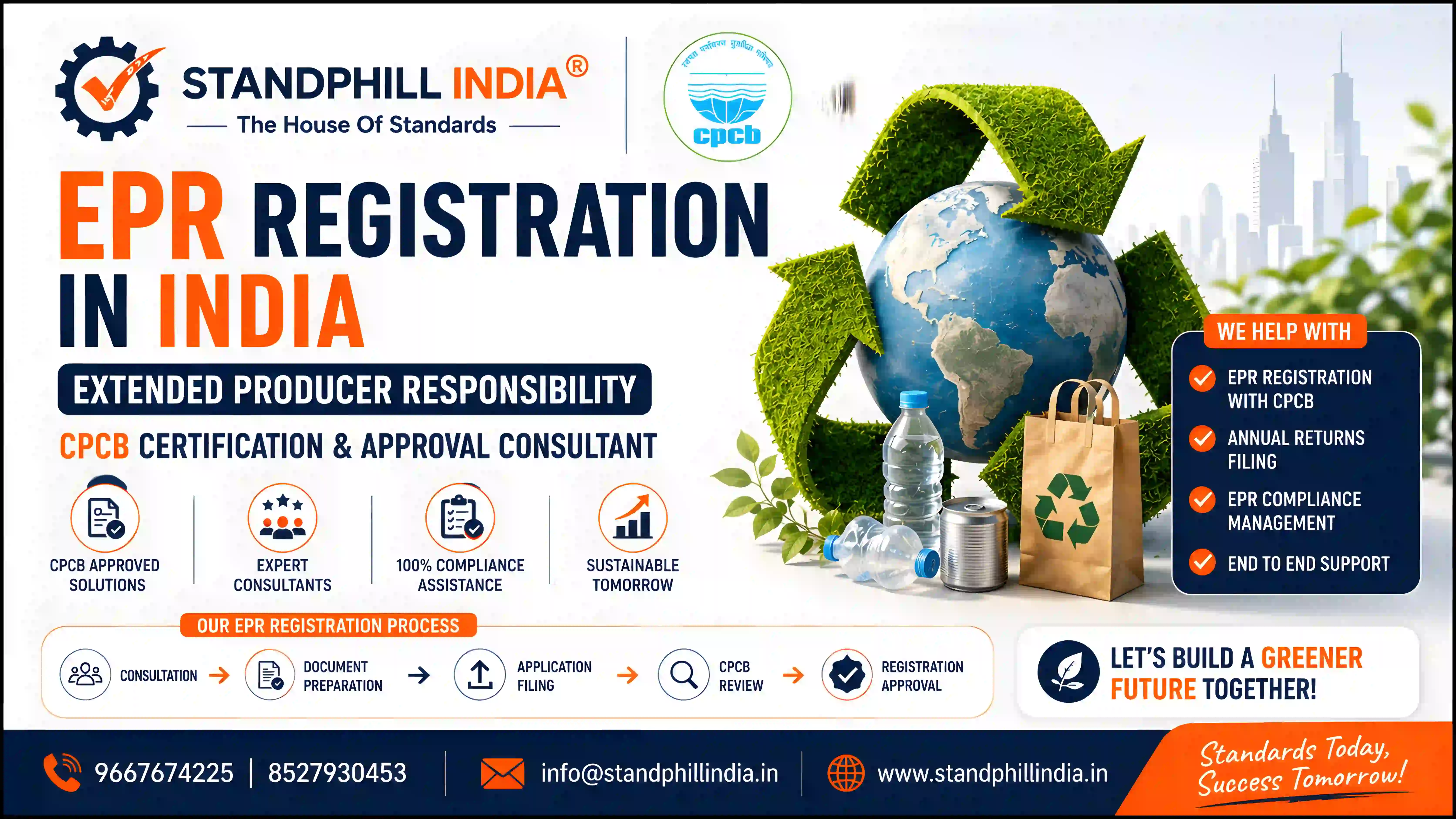
Standphill India is an experienced EPR Registration Consultant helping Producers, Importers and Brand Owners (PIBOs) obtain Extended Producer Responsibility (EPR) Registration from the Central Pollution Control Board (CPCB). Our experts assist businesses with documentation, CPCB portal registration, compliance planning, annual returns, and post-registration support across India.
Whether you manufacture products in India or import products from overseas, our EPR Registration Consultants help you understand your legal obligations and complete the registration process in accordance with the latest CPCB Guidelines.
Extended Producer Responsibility (EPR) is an environmental policy introduced by the Government of India to ensure that businesses take responsibility for managing the waste generated from the products they introduce into the market. Under the applicable Waste Management Rules, eligible Producers, Importers, and Brand Owners (PIBOs) must obtain EPR Registration from the Central Pollution Control Board (CPCB) before carrying out regulated business activities.
EPR Registration applies to businesses dealing with plastic packaging, electrical and electronic equipment (E-Waste), batteries, tyres, and used oil. The registration process requires businesses to comply with CPCB guidelines, maintain prescribed documentation, submit applications through the official portal, and fulfil ongoing compliance obligations such as annual returns and recycling targets.
Since every waste category has different regulatory requirements, selecting the correct registration category and preparing accurate documentation is essential. Errors in business details, product classification, supporting documents, or compliance declarations may result in delays, queries from CPCB, or rejection of the application.
No EPR Certificate? Your Imports Can Be Blocked at Customs
Since July 2025, customs clearance is linked to EPR status, and Environmental Compensation fines can reach ₹1 lakh per day. Get your EPR registration sorted before it costs you a shipment.
What is EPR Registration?
EPR Registration (Extended Producer Responsibility) is a mandatory authorization issued through the Central Pollution Control Board (CPCB) for eligible Producers, Importers, and Brand Owners (PIBOs) under India's Waste Management Rules. It requires businesses to take responsibility for the collection, recycling, and environmentally sound disposal of the waste generated from their products after they reach the end of their lifecycle.
The EPR Registration framework has been introduced to promote sustainable waste management and support a circular economy. Depending on the type of product or packaging, businesses may be required to obtain registration under Plastic Waste EPR, E-Waste EPR, Battery Waste EPR, Tyre Waste EPR, or Used Oil EPR. Each category has its own compliance requirements, documentation standards, recycling targets, and reporting obligations prescribed by the CPCB.
After successful verification of the application and supporting documents, the CPCB grants an EPR Registration Certificate, allowing eligible businesses to comply with applicable environmental regulations. Registered entities are also required to maintain ongoing compliance by submitting annual returns, meeting recycling obligations, and following the latest regulatory guidelines.
The 5 EPR Waste Streams – Which One Applies to You?
EPR is not a single rulebook. It is a set of parallel regimes, each with its own standard, targets and CPCB portal. Most businesses fall under one or two; some large manufacturers fall under several. Here are the streams – click through for a detailed, stream-specific guide:
EPR for Plastic Waste
For anyone using plastic packaging or selling plastic products – including goods that merely arrive in plastic wrapping. Governed by the Plastic Waste Management Rules.
EPR for E-Waste
For producers and importers of electrical & electronic equipment (EEE) listed in Schedule I. Governed by the E-Waste (Management) Rules, 2022.
EPR for Battery Waste
For makers and importers of all battery types, including lithium-ion. Governed by the Battery Waste Management Rules, 2022, with QR-code traceability from 2026.
EPR for Tyre Waste
For producers, recyclers and retreaders of new and waste tyres. Governed by Schedule IX of the Hazardous & Other Wastes (M&TM) Amendment Rules, 2022.
EPR for Used Oil
For producers, importers and bulk consumers of lubricants and industrial oils. Governed under the Hazardous & Other Wastes Rules.
Not sure which stream applies to you – or fall under more than one? Get a free applicability check.
Tyre waste EPR is a fifth stream, covering manufacturers and importers of new and waste tyres under the Hazardous & Other Wastes Rules (certificates commonly valid for two years). If you deal in tyres, ask us about tyre EPR registration too. Not sure which stream is yours? Get a free applicability check.
Who Needs EPR Registration? (PIBOs Explained)
EPR obligations fall on the entities that introduce a product into the Indian market – collectively known as PIBOs. The label you fall under determines how you register and what targets you carry:
Producers
Manufacturers of covered products or packaging
Importers
Anyone importing covered goods – even if made abroad
Brand Owners
Selling under your own brand/label
Recyclers
Registered recyclers generating EPR credits
A point that catches many businesses off guard is how wide the net is for plastic EPR in particular. You do not have to manufacture plastic to be liable – if your product is sold in plastic packaging, or even arrives in plastic wrapping, bags or sheets, you are an obligated entity. Likewise, importers are pulled in regardless of where manufacturing happens: the responsibility attaches to whoever places the goods on the Indian market. If you are unsure whether you qualify, Standphill India will tell you plainly, before you spend anything.
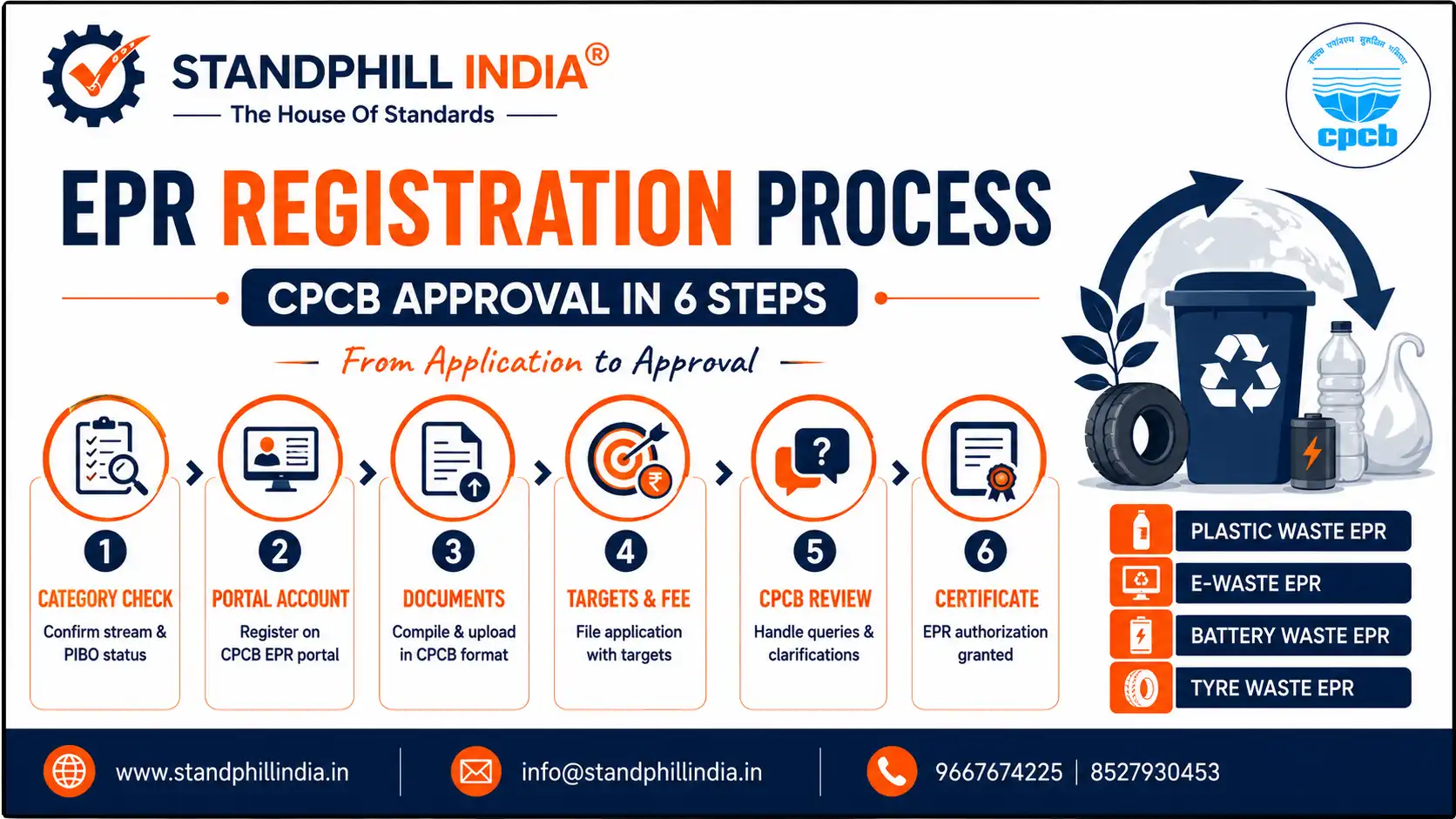
EPR Registration Process – Step by Step
While each waste stream has its own portal, the underlying journey to an EPR certificate follows the same shape. Here is how Standphill India runs it end-to-end:
Category Check
Confirm stream & PIBO status
Portal Account
Register on CPCB EPR portal
Documents
Compile & upload in CPCB format
Targets & Fee
File application with targets
CPCB Review
Handle queries & clarifications
Certificate
EPR authorization granted
Typical timeline: a clean, complete application is usually approved in 15–30 working days; applications that attract CPCB queries can stretch to 35–40 days. The three errors that most often cause delay or rejection are choosing the wrong waste category, under-declaring quantities, and a mismatch between the company name on your PAN and GST – all of which we eliminate before submission.
Documents Required for EPR Registration
Exact requirements vary slightly by waste stream, but the core document set CPCB expects is consistent. Having these ready, correctly formatted and internally consistent is the single biggest factor in a fast approval:
- Company PAN, GST and CIN / incorporation documents
- Import Export Code (IEC) – for importers
- Manufacturing or trading licence / Udyam (MSME) certificate
- Authorised signatory ID and authorisation letter
- Product details and annual quantity / waste-generation data
- Tie-up agreements with CPCB-authorised recyclers / PROs (where applicable)
- EPR action plan and annual collection & recycling targets
Consistency is everything: CPCB raises a query if your company name differs even slightly between PAN and GST (for example "Pvt. Ltd." versus "Private Limited"). Standphill India cross-checks every document for these exact mismatches before filing, which is why our applications clear faster.
EPR Fees, Validity, Targets & Penalties
| Issuing Authority | Central Pollution Control Board (CPCB), under MoEFCC |
| Legal Basis | Environment (Protection) Act, 1986 + stream-specific rules (Plastic, E-Waste 2022, Battery 2022, Tyre, Used Oil) |
| Who Registers | Producers, Importers, Brand Owners (PIBOs), manufacturers & recyclers |
| Timeline | 15–30 working days (clean application); 35–40 days if CPCB raises queries |
| Validity | Generally 1 to 3 years depending on the waste stream (tyre certificates commonly 2 years) |
| Annual Obligation | Meet yearly collection/recycling targets & file annual returns |
| Penalty for Non-Compliance | Environmental Compensation up to ₹1 lakh/day for serious breaches; customs blocks; tender blacklisting |
It is worth being clear-eyed about the stakes. Environmental Compensation (EC) is not a one-time fine you can simply pay and forget – paying it does not waive the underlying obligation, and unmet targets are carried forward for up to three financial years (with partial EC refunds if you catch up in time). For importers, the consequences are even more immediate: since July 2025, customs clearance has been linked to EPR status, so a missing certificate can leave a consignment stranded at the port. There have been real cases of crore-level EC penalties and month-long operational shutdowns for major companies that fell short. In short, EPR is no longer a paperwork formality – it is a live commercial risk that a good consultant helps you manage.
What's New in EPR for 2026
EPR is tightening fast, and 2026 brings several changes that obligated businesses must plan for. The Government's expanded EPR framework is widening the net beyond the traditional streams, while enforcement is becoming far more automated and harder to slip past:
- Customs & BIS database linking – CPCB EPR data is being cross-checked against customs and BIS records, so products without valid EPR can face import-clearance issues
- Battery QR-code traceability – from 2026, batteries must display EPR registration and traceability information via labels or QR codes
- Recycled-content labelling – plastic rules now require recycled-content declarations aligned to IS 14534:2023, with phased recycled-content targets
- Stricter, rising targets – annual recycling obligations are escalating across plastic, e-waste and battery streams
- Wider scope – expanded EPR rules are extending producer responsibility toward additional materials and household packaging
The direction of travel is unmistakable: more products covered, higher targets, and enforcement wired directly into customs. The businesses that register early and manage targets properly will move freely; those that wait will increasingly find their goods stuck and their costs rising. Standphill India keeps you ahead of each change.
Get Your EPR Certificate the Right Way – With India's Trusted EPR Consultants
Whether you import electronics, manufacture plastic-packaged goods, sell batteries, or deal in tyres and used oil – Standphill India takes your EPR registration from applicability check to certificate-in-hand. Accurate category selection, CPCB portal filing, recycler tie-ups, target planning, and annual returns managed for you.
Benefits of EPR Registration
Beyond simply staying legal, a properly managed EPR registration delivers real commercial and reputational value:
- Uninterrupted market access – for importers especially, a valid EPR certificate keeps consignments moving through customs
- Avoided penalties – no Environmental Compensation fines, no operational shutdowns, no CPCB notices
- Tender & corporate eligibility – government and large-buyer contracts increasingly require proof of EPR compliance
- Stronger ESG & brand image – demonstrable sustainability credentials that investors and partners value
- Smoother import/export – compliance status verified and ready at the border
- Long-term savings – planned recycler tie-ups cost far less than reactive EC penalties
EPR Registration by Waste Stream - Detailed Guides
EPR Registration for Plastic Waste Management EPR Registration for E-Waste Management EPR Registration for Battery Waste Management EPR Registration Consultant for Used Oil EPR Registration for Tyre Waste Talk to an EPR Registration Consultant - Free ConsultationWhy Choose Standphill India as Your EPR Registration Consultant
EPR compliance is moving quickly – new portals, rising targets, customs integration and steep penalties for getting it wrong. You need a partner who knows each waste stream's rules cold and tells you the truth about your obligations. Standphill India guides producers, importers and brand owners through the entire EPR journey – correct category selection, CPCB portal filing, recycler tie-ups, target planning, query handling and annual returns – so your authorization is granted on time and stays valid. We don't just file forms; we manage your compliance.
Frequently Asked Questions – EPR Registration
Ask Our EPR Registration Consultants
Tell us your product & waste stream – we reply with your EPR obligation & a quote within one business day.
★ Why Standphill India?
- 20+ Years of BIS Certification Experience
- 10,000+ Certifications Delivered Globally
- Dedicated Teams for CRS, FMCS & ISI Mark
- End-to-End Documentation & Filing Support
- Fast Response & Practical Compliance Guidance
- Support for Indian & Foreign Manufacturers
Get Free Call Back
Our Services
- BIS (ISI Mark) for Foreign Manufacturers
- Domestic BIS (ISI Mark) Certification
- BIS Certificate of Conformity (CoC)
- BIS Hallmarking
- BIS Licence for Toys
- ECO Mark Certification
- TAC Approval for Automobile
- Drug Licence
- Peso Certification
- BIS (CRS) Registration
- WPC-ETA Approval
- BEE Certification
- E-Waste Management (EPR)
- EPR for Plastic Waste
- EPR for Battery Waste
- CE Certification
- UL Certification
- ROHS Licence
- Standardization Division
- Import / Export Licence
- FSSAI Certification
- ISO Registration
- Trademark Registration
- Make in India Support
- AG-Mark Licence
- Third Party Monitoring
Client Testimonials
Their team was very knowledgeable and helped us every step of the way. Standphill India is the best BIS certification consultants for any type of BIS certification.

Chintan Shah (AGM)
Sudeep Nutrition P.Ltd




Featured Guide
Complete BIS CRS certification guide for electronic products in India — free to read.
Read CRS Certification Guide📞 Contact Standphill India
+91-9667674225 info@standphillindia.in WhatsApp Now Greater Noida West, UPGet Expert BIS Certification Support for Your Business
Connect with Standphill India for complete support with BIS certification, CRS registration, WPC approval, FMCS compliance, and related regulatory services. Our team helps businesses with documentation, testing coordination, application support, and end-to-end compliance guidance.
Request Free Consultation
Share your requirement and our team will contact you shortly.