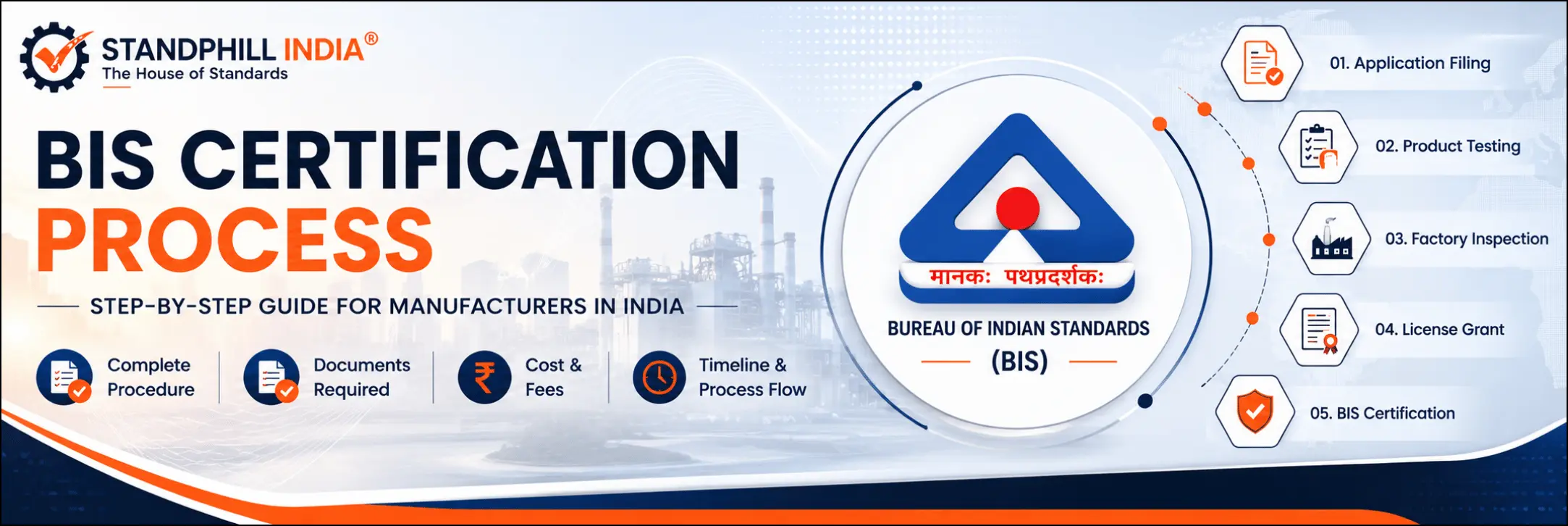
BIS Registration Process in India
The Complete 2026 Guide to BIS Registration & Certification
For more than 400 product categories in India, BIS registration is mandatory - without it, a product cannot legally be manufactured, imported or sold anywhere in the country. The BIS registration process (also called the BIS certification process) is detailed, but it follows a clear, predictable sequence once it is broken down. This guide covers the whole picture: who needs it, which scheme applies, the documents, the step-by-step process, cost, timeline and the most common questions - for Indian manufacturers, importers and foreign brands alike.
What Is BIS Registration?
BIS stands for the Bureau of Indian Standards - India's national standards body and the authority that defines what acceptable quality and safety mean for products sold in India. Every regulated product category has an Indian Standard (IS): a technical document specifying exactly what a product must do, how safe it must be, and the quality levels it must meet.
BIS registration - also called BIS certification or a BIS licence - is the official government approval a manufacturer or importer receives after proving their product meets the relevant Indian Standard. Holding it makes you legally authorised to manufacture, import and sell that product in India.
The legal backbone is the BIS Act, 2016, which gives BIS the authority to set standards, certify products, conduct market surveillance and take enforcement action against non-compliant manufacturers and importers.
Who Needs BIS Registration?
More businesses than most expect. Here is each category clearly:
Indian Manufacturers
If you manufacture products in India that fall under any mandatory BIS category, you need certification before you can legally sell - covering steel, cement, electrical cables, helmets, water purifiers, pressure cookers, kitchen appliances and far more.
Importers Bringing Products into India
Even products made overseas to the highest international standards - CE marked, UL certified or otherwise - still need BIS certification to legally enter India. Foreign certifications are not accepted as a substitute for BIS registration.
Foreign Manufacturers Exporting to India
Manufacturers based outside India use the Foreign Manufacturers Certification Scheme (FMCS), which requires a physical factory audit at the overseas facility by BIS officials - they travel to your factory wherever it is located.
Electronics and IT Product Brands
Mobile phones, laptops, tablets, televisions, LED lights, air conditioners, chargers and power banks - Indian or international brands - fall under the Compulsory Registration Scheme (CRS).
Jewellery Manufacturers and Jewellers
BIS Hallmarking is mandatory for gold and silver jewellery sold in India.
The Different Types of BIS Certification
BIS registration is not a single unified process. Different schemes apply depending on your product type and your situation. Applying under the wrong scheme wastes time and money and leads to rejection - so get this clear before anything else.
The familiar triangular ISI logo on steel, cables, helmets, cement and pressure cookers.
Applies to: Indian manufacturers of industrial goods, construction materials, safety-critical and household products
Process: Full factory inspection + ongoing surveillance
Validity: Renewable (typically 1–2 years)
The Compulsory Registration Scheme for electronics and IT products.
Applies to: Mobile phones, laptops, TVs, LED lights, ACs (Indian & international brands)
Process: Lab testing + online application, no factory inspection
Validity: 2 years
The Foreign Manufacturers Certification Scheme for overseas manufacturers.
Applies to: Manufacturers in China, Korea, Germany, USA, Japan, etc.
Process: Overseas factory audit + mandatory Authorised Indian Representative
Note: Most time-consuming and expensive scheme
Mandatory certification for precious-metal jewellery.
Applies to: Jewellers and jewellery manufacturers (gold & silver)
Process: Industry-specific with its own infrastructure requirements
The BIS Certification & License Process - Step by Step (In Detail)
This is the heart of the guide. The BIS certification process - whether you call it the BIS registration process or the BIS license process - follows one logical sequence, and the order matters: a slip at any one stage delays every stage after it. Below is the entire process explained the way an experienced consultant would walk you through it in person, with what BIS checks at each stage and where applications most often go wrong.
Step 1 - Identify Your Product Category & the Applicable IS Code
Every BIS-certified product is pegged to a unique Indian Standard (IS) number. TMT steel bars are governed by IS 1786, two-wheeler helmets by IS 4151, LED lights by IS 16102, and so on. This is the single most important decision in the whole process - file against the wrong standard and the application is returned or rejected. BIS does not guess your intent or redirect you to the right standard.
- Confirm whether your product falls under a mandatory Quality Control Order (QCO). If it does, certification is not optional - you cannot manufacture, import or sell without it.
- Pin down the exact IS number; some products map to more than one standard, and only the correct one will be accepted.
- Confirm the right scheme - ISI Mark (Scheme-I) for Indian manufacturers, CRS for electronics, FMCS for foreign manufacturers.
Step 2 - Understand the Technical Requirements of the Standard
The IS document spells out exactly what your product must achieve - dimensions, material composition, performance benchmarks, safety thresholds and labelling rules. If your product does not currently meet every requirement, you need to know that before sending samples for testing. A failed lab test costs you both time and money, and means starting the testing stage over.
Step 3 - Get the Product Tested at a BIS-Recognised Laboratory
Samples must be tested at a laboratory that is both NABL-accredited and recognised by BIS for your specific product category. A report from any other lab - however internationally reputable - will not be accepted. This step is non-negotiable: BIS will not grant a licence without a conforming test report covering every parameter of the IS.
- Choose a lab that holds BIS recognition for your exact IS - not just any accredited lab.
- Send genuine production samples, not specially prepared "show" pieces - surveillance later draws from real stock.
- Keep the test report within its validity period; an expired report stalls the file.
Step 4 - Prepare a Complete, Consistent Document Set
This is the stage most businesses underestimate. Documentation is detailed, precise work, and every document must tell the same consistent story - the entity name, address, product description and machinery details must match across the entire file and, later, against the factory itself. Inconsistent or wrongly formatted paperwork is the number-one cause of delay.
See the full scheme-by-scheme documents required for BIS certification checklist.
Step 5 - Submit the Application on the BIS MANAK Online Portal
All BIS applications are filed online through the official government portal, manakonline.in. For Scheme-I, the prescribed form is Form V, submitted to the BIS office with jurisdiction over your manufacturing unit. The quality of the submission matters enormously - a clean, well-prepared application can clear in weeks, while one that triggers repeated query rounds can drag on for months.
Step-by-step portal walkthrough: how to apply for BIS certification on MANAK Online.
Step 6 - BIS Document Scrutiny & Technical Review
BIS officers review the application in detail and may raise queries - formal written questions asking for clarification or extra documents. These are time-bound: an unanswered query puts the file on hold and directly extends the timeline. Responding within 2–3 working days, completely and accurately, is the single biggest lever you have on how fast the licence is granted.
Step 7 - Factory Inspection (ISI Mark & FMCS)
For ISI Mark and FMCS applications, a BIS officer inspects the manufacturing facility. The factory must be fully operational and compliant on the day of the visit. The officer checks the manufacturing process against the IS and the submitted flow chart, raw-material controls, installed machinery (matched against your list), the in-house testing lab and its calibration records, and quality-control registers - then seals and draws product samples for independent testing. Preparation is everything here; non-conformities found on the day must be corrected before the process can move on.
Step 8 - Grant of BIS License / Registration
Once document scrutiny and (where applicable) the factory inspection are cleared and the test report confirms compliance, BIS grants certification:
- ISI Mark - a formal BIS licence with a unique CM/L number; the ISI Mark must appear on every certified unit alongside the IS number and CM/L number.
- CRS - a registration number (R-number) for the product/packaging.
- FMCS - a certificate confirming approval of the overseas factory.
Step 9 - Ongoing Compliance: Surveillance & Renewal
Certification is the start of an ongoing obligation, not the finish line. BIS runs a surveillance programme - periodic factory visits, market sample testing and quality-record reviews - to verify continued compliance. Licences must be renewed before expiry (CRS every 2 years; ISI Mark annually with surveillance; FMCS periodically). Begin renewal 2–3 months before the expiry date, because operating on an expired licence is a violation of the BIS Act, 2016.
Documents Required for BIS Registration
A complete, consistent document set is what moves an application forward. At a high level you will need company & legal documents (incorporation, PAN, GST, address proof), factory & premises documents (address proof, layout plan), an infrastructure and machinery list, product specifications, quality-system records, a valid test report from a BIS recognised lab, and personnel details. Foreign (FMCS) applicants need additional documents including the Authorised Indian Representative appointment.
The exact list differs by scheme - ISI, CRS and FMCS each have their own requirements, and overseas applicants need extra paperwork. We've broken down the full scheme-by-scheme checklist, file-format rules and the most common document mistakes on a dedicated page.
See the complete documents required for BIS certification checklist.
Explore the Full Guides
Documents Required for BIS Certification – Full Checklist How to Apply for BIS Certification on MANAK Online BIS CRS Certification for Electronic & IT Products BIS FMCS Certification for Foreign ManufacturersBIS Registration Timeline & Cost
How Long Does BIS Registration Take?
- CRS Registration: typically 3 to 6 weeks
- ISI Mark Certification: typically 2 to 4 months
- FMCS Certification: typically 3 to 6 months
- BIS Hallmarking: typically 2 to 3 weeks
Timelines assume complete documentation and no major BIS queries. A clean application moves far faster than one that triggers repeated query rounds.
What Does BIS Registration Cost?
| Cost Component | Estimated Range |
|---|---|
| Lab Testing Costs | ₹15,000 to ₹1,00,000+ (varies by product) |
| BIS Application Fees | From ₹1,000 (varies by scheme) |
| Factory Inspection Fees | ₹7,000 per man-day (domestic); higher for FMCS overseas audits |
| Annual Licence / Marking Fees | Based on production output (ISI Mark) |
| Consultant Fees | Professional charges vary by scope |
MSMEs registered under the MSME Act receive marking-fee concessions of up to 80% (Micro), 50% (Small) and 20% (Medium).
Selling Without BIS Registration - The Risks
Under the BIS Act, 2016, selling products that require mandatory BIS certification without obtaining it is an offence. The consequences are serious:
- First-time offenders: fines up to ₹5 lakh per violation
- Repeat offenders: imprisonment up to 2 years plus higher fines
- Product seizure and destruction at your expense
- Removal from e-commerce platforms (Amazon India, Flipkart)
- Automatic disqualification from government tenders
Do You Really Need a BIS Consultant?
Technically you can apply yourself - the BIS portal is open to anyone. But for most first-time applicants, self-application tends to look like this:
- Weeks lost identifying the correct Indian Standard
- Samples sent to a lab that isn't BIS-recognised for your product
- Application rejected over document inconsistencies
- BIS queries received with no clear idea how to respond
- Three to four months wasted, or more
A specialist BIS consultant removes that friction - a faster process, a higher first-attempt approval rate, and quicker market access that has real commercial value.
Why Choose Standphill India?
BIS registration touches your product, a lab, the MANAK Online portal, a BIS office and - for ISI/FMCS - an inspection officer, all in a sequence where one slip delays everything after it. We manage the whole journey so it moves cleanly the first time.
- Right scheme & IS code from the start - confirmed before you spend on testing or documentation
- Deficiency-free documentation - prepared and verified to BIS specifications
- Lab coordination - direct liaison with BIS recognised labs across India
- Factory audit preparation - your unit ready on inspection day
- Query resolution - BIS notices answered promptly to protect your timeline
- All schemes covered - ISI Mark, CRS, FMCS and Hallmarking
- 20+ years of experience and 1,000+ brands certified across India and abroad
Your Compliance. Our Commitment.
From IS code to grant of licence - we handle every step so you reach the market faster, without rejections or wasted lab costs.
Get Expert ConsultationCall +91 96676 74225 | info@standphillindia.in
Frequently Asked Questions (FAQ)
Ask a Question
Have a query about the BIS Registration Process? Our team will get back to you shortly.
★ Why Standphill India?
- 20+ Years of BIS Certification Experience
- 10,000+ Certifications Delivered Globally
- Dedicated Teams for CRS, FMCS & ISI Mark
- End-to-End Documentation & Filing Support
- Fast Response & Practical Compliance Guidance
- Support for Indian & Foreign Manufacturers
Get Free Call Back
Our Services
- BIS (ISI Mark) for Foreign Manufacturers
- Domestic BIS (ISI Mark) Certification
- BIS Certificate of Conformity (CoC)
- BIS Hallmarking
- BIS Licence for Toys
- ECO Mark Certification
- TAC Approval for Automobile
- Drug Licence
- Peso Certification
- BIS (CRS) Registration
- WPC-ETA Approval
- BEE Certification
- E-Waste Management (EPR)
- EPR for Plastic Waste
- EPR for Battery Waste
- CE Certification
- UL Certification
- ROHS Licence
- Standardization Division
- Import / Export Licence
- FSSAI Certification
- ISO Registration
- Trademark Registration
- Make in India Support
- AG-Mark Licence
- Third Party Monitoring
Client Testimonials
Their team was very knowledgeable and helped us every step of the way. Standphill India is the best BIS certification consultants for any type of BIS certification.

Chintan Shah (AGM)
Sudeep Nutrition P.Ltd




Featured Guide
Complete BIS CRS certification guide for electronic products in India — free to read.
Read CRS Certification Guide📞 Contact Standphill India
+91-9667674225 info@standphillindia.in WhatsApp Now Greater Noida West, UPGet Expert BIS Certification Support for Your Business
Connect with Standphill India for complete support with BIS certification, CRS registration, WPC approval, FMCS compliance, and related regulatory services. Our team helps businesses with documentation, testing coordination, application support, and end-to-end compliance guidance.
Request Free Consultation
Share your requirement and our team will contact you shortly.