Welcome to Standphill India

BIS Certification for Import in India: Mandatory Certificate for Import Items (Updated 2026)
Importing products into India requires strict compliance with Indian quality and safety regulations. Many imported goods must obtain BIS certification or BIS registration before customs clearance. The Bureau of Indian Standards (BIS), along with DGFT notifications and Quality Control Orders (QCOs), governs this requirement.
Failure to comply can result in customs detention, rejection of consignments, penalties, re-export orders, and reputational damage. Early compliance is not only a legal necessity but also a commercial advantage.
Standphill India supports importers and foreign manufacturers with end-to-end BIS certification services, ensuring smooth customs clearance and uninterrupted market access.
Why BIS Certification Is Mandatory for Imports
The Government of India has declared certain products as critical for:
• Consumer safety
• Public health
• Product quality
• Fair trade practices
Any product covered under a mandatory BIS Quality Control Order (QCO) cannot be imported, sold, or distributed in India without valid BIS approval.
Customs authorities verify BIS compliance at ports. Non-certified shipments may be held, tested, fined, or rejected outright.
BIS Certificate Required for Import – Product Categories
The BIS mandatory import list is extensive and expanding. It includes, but is not limited to:
• Electrical appliances and equipment
• IT and electronic products
• Lighting and luminaires
• Medical devices and healthcare products
• Steel, metal, and construction materials
• Cement and building inputs
• Chemicals and industrial materials
• Food contact materials and glassware
• Toys, furniture, footwear, and safety products
Each product is mapped to a specific Indian Standard (IS code). Applicability is determined through DGFT notifications and BIS product lists, not HS code alone.
Where to Check the Official BIS Import List
For accurate and updated information, always rely on:
• BIS official product and standards lists
• DGFT notifications referencing BIS QCOs
Third-party lists may be outdated. Customs authorities follow DGFT notifications linked to BIS standards, which are legally binding.
Standphill India continuously monitors BIS and DGFT updates (including 2025 expansions) to protect your shipments from regulatory surprises.
Who Must Obtain BIS Certification for Imported Goods
Compliance responsibility applies to:
• Foreign manufacturers
• Exporters supplying to India
• Indian importers clearing goods at customs
For most notified products:
• The foreign manufacturer must obtain BIS certification or registration
• Indian importers must present valid BIS proof at customs
Importers cannot bypass this obligation.
Types of BIS Compliance for Imports
There are two primary BIS schemes applicable to imports:
1. BIS Certification (Scheme I – ISI Mark)
• Requires product testing
• Requires factory audit by BIS (for foreign manufacturers)
• Applies to steel, cement, appliances, chemicals, construction materials, etc.
2. BIS Compulsory Registration Scheme (CRS – Scheme II)
• Applicable mainly to electronics and IT products
• Requires testing in BIS-recognized labs
• No factory audit in most cases
The applicable scheme depends on the product category and IS standard.
Foreign Manufacturer Certification Scheme (FMCS)
For imported products requiring the ISI mark:
• The foreign manufacturer must apply under FMCS
• An Authorized Indian Representative (AIR) is mandatory
• BIS conducts factory inspection abroad
• License validity is typically 2 years
Standphill India assists foreign manufacturers and Indian importers with AIR appointment, testing, audits, and license management.
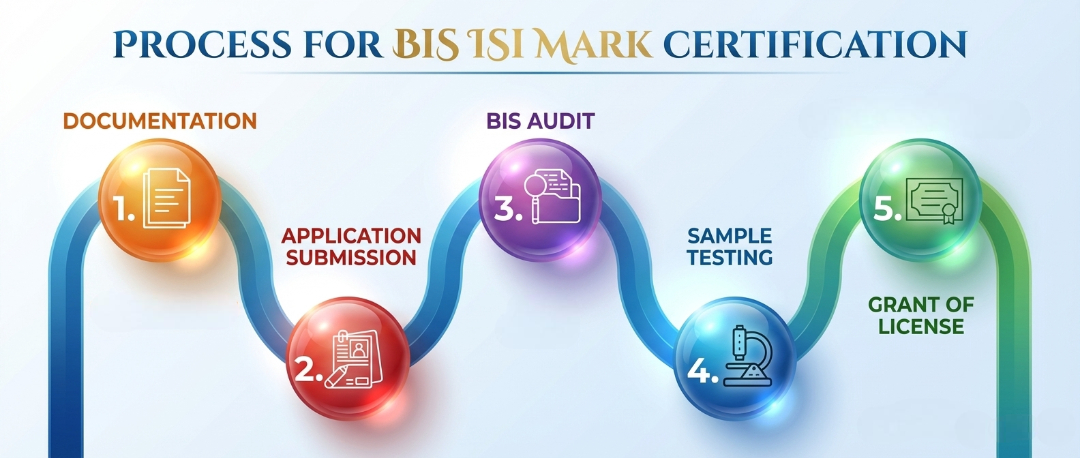
BIS Certification Process for Imported Products
Typical Documents Required at Customs
Customs authorities may request:
• Valid BIS license or CRS registration number
• BIS test reports from NABL-accredited labs
• FMCS registration proof (for foreign manufacturers)
• Invoice, packing list, bill of lading
• Product labeling and traceability details
Well-prepared documentation significantly reduces clearance time.
How to Map HS Code to BIS Mandatory List
1. Start with your HS code
2. Cross-verify product description against BIS IS standards
3. Match with DGFT QCO notifications
Misclassification is a major cause of shipment delays.
Standphill India performs accurate HS-to-IS mapping to eliminate compliance risks.
Testing & BIS-Recognized Laboratories
• Testing must strictly follow the relevant Indian Standard
• Labs must be NABL-accredited and BIS-recognized
• Test samples must match production and shipment specifications
Incorrect testing or lab selection can result in certificate rejection.
Recent BIS Updates (2025 You Must Know)
• Expansion of mandatory coverage under new QCOs
• Inclusion of additional categories such as furniture, footwear, and steel inputs
• Increased customs enforcement and inspection frequency
The BIS import list is dynamic, not fixed. Continuous monitoring is essential.
Practical Compliance Plan for Importers
1. Check if your product appears on the BIS mandatory list
2. Identify the applicable BIS scheme (Certification or CRS)
3. Coordinate with the foreign manufacturer for BIS compliance
4. Arrange NABL-approved product testing
5. Upload BIS documents before shipment arrival
6. Keep buffer time for audits or re-testing
Common Importer Mistakes to Avoid
• Using outdated third-party BIS lists
• Submitting non-NABL test reports
• Assuming the importer can certify without manufacturer involvement
• Discovering BIS applicability only after goods reach port
Early planning prevents demurrage, penalties, and re-exports.
Costs & Timelines – What to Expect
| Certification Scheme | Timeline | Key Features |
|---|---|---|
| FMCS (ISI Mark) | 3–6 months | Factory audit required, overseas inspection |
| CRS Registration | 2–6 weeks | Testing dependent, no factory audit |
Costs vary by product complexity, testing requirements, and inspection scope.
Why Importers Choose Standphill India
Standphill India is a trusted BIS certification consultant for importers and foreign manufacturers.
We provide:
• BIS applicability analysis
• HS-to-IS code mapping
• FMCS and CRS registration support
• NABL lab coordination
• AIR appointment assistance
• Customs-ready documentation
• Ongoing compliance monitoring
Our structured approach ensures fast clearance, zero surprises, and long-term compliance.
Final Note
BIS certification for imports is not optional—it is a legal requirement that protects consumers and strengthens your brand. With expanding Quality Control Orders, importers must act proactively.
If you want your imports to clear customs smoothly and your brand to earn market trust, partner with Standphill India your reliable BIS certification consultant for imports.
Get in touch today for expert guidance and compliance clarity.
Frequently Asked Questions (FAQ)
Yes. BIS certification or registration is mandatory for products notified under Quality Control Orders (QCOs) issued by the Government of India. Customs authorities will not clear such goods without valid BIS proof.
You must check the official BIS product list and DGFT notifications that reference BIS standards. Matching the product description and IS standard is more important than the HS code alone.
The manufacturer is responsible for obtaining BIS certification or registration. Indian importers must ensure their overseas supplier holds a valid BIS license before shipment.
FMCS (Foreign Manufacturers Certification Scheme) applies to products requiring the ISI mark and involves factory audits. CRS (Compulsory Registration Scheme) applies mainly to electronics and IT products and requires testing and registration without factory inspection.
No. BIS certification can only be issued to the manufacturer. Foreign manufacturers must apply through FMCS or CRS and appoint an Authorized Indian Representative (AIR).
Customs may ask for a BIS license or registration number, test reports from NABL-accredited labs, FMCS or CRS proof, invoices, and shipping documents.
Customs can detain or reject the shipment, order additional testing, impose penalties, or demand re-export of the goods under the BIS Act, 2016.
FMCS certification can take several months due to factory audits. CRS registration usually takes a few weeks, depending on testing timelines and documentation accuracy.
Yes. BIS-certified products gain higher trust, are preferred in large procurement and government tenders, and face fewer regulatory barriers at customs.
Standphill India maps HS codes to BIS IS standards, advises the correct scheme, coordinates NABL testing, supports FMCS and CRS registration, and prepares customs-ready documentation for faster clearance.
Request a call back.
For Business: For Business inquiry fill our short feedback form or you can also send us an email and we’ll get in touch shortly, or Toll Free Number +91 85279 30453.
Office Hours : 09:00 and 20:00 Mon to Sat, Sun - Closed