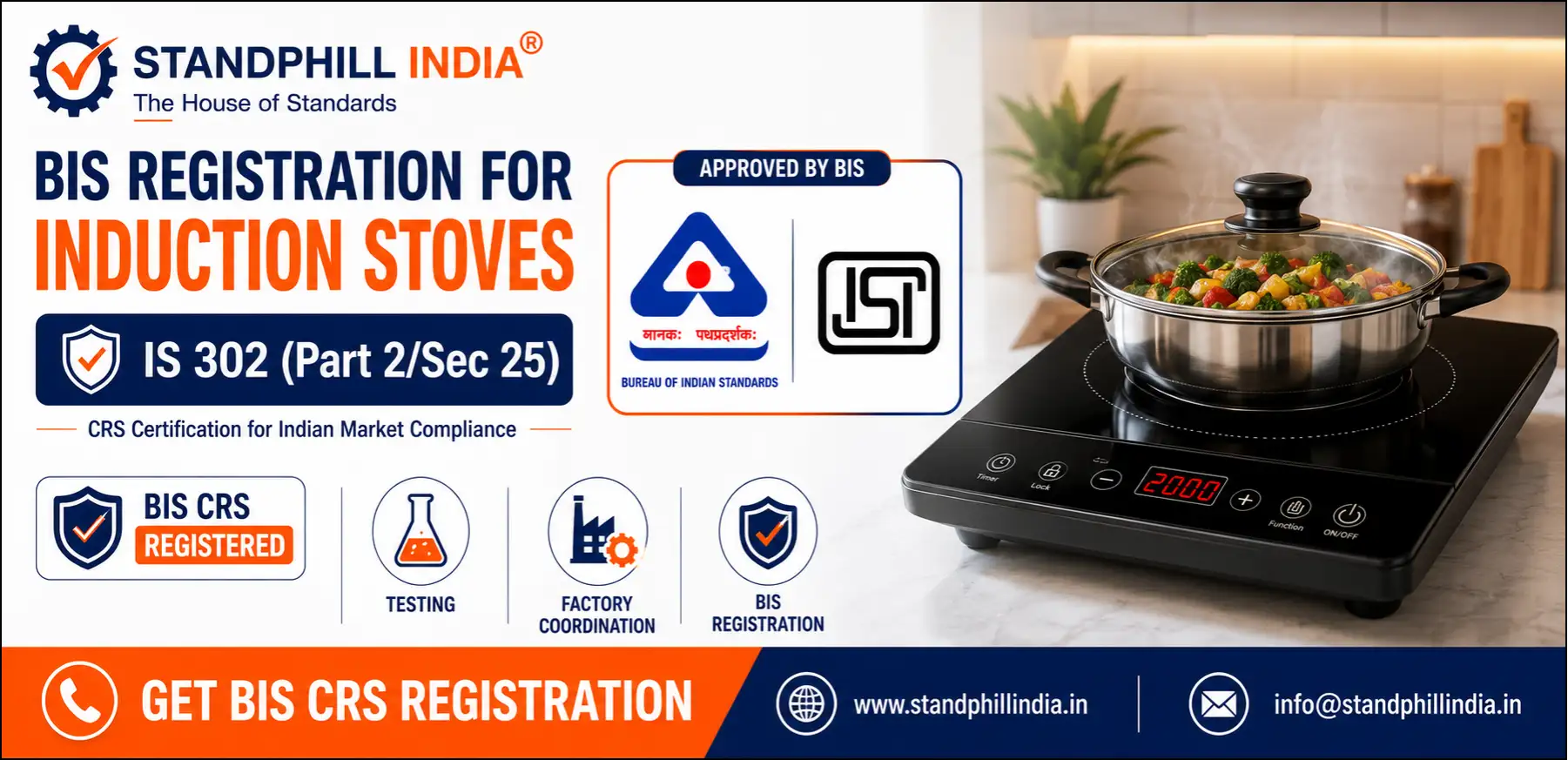
BIS Registration for Induction Stoves - IS 302 (Part 2/Sec 25)
BIS ISI Mark Certification for Induction Stoves & Induction Cooktops - Simple Process, Cost, Documents & Expert BIS Consultant Support
Selling Induction Stoves Without BIS? Here Is What Will Happen
Induction stoves are high-wattage appliances - up to 2000W - used directly on kitchen countertops. BIS takes safety compliance for these products very seriously. If you sell, import, or distribute induction stoves in India without a valid ISI Mark licence - customs can reject your entire shipment at the port. Market enforcement officers can seize stock from warehouses and retail shelves. You face fines up to INR 2 lakh under the BIS Act 2016 - and repeat violations can mean criminal prosecution. E-commerce platforms actively block induction stove listings without a valid BIS CM/L Number. The risk is simply not worth it.
BIS Registration for Induction Stoves is not a choice - it is a legal requirement in India. Every induction stove or induction cooktop sold here - whether made in India or imported from abroad - must carry the ISI Mark issued by the Bureau of Indian Standards (BIS) under IS 302 (Part 2/Sec 25) - the Indian safety standard written specifically for portable cooking appliances including induction cooktops. Think of the ISI Mark as India's official promise to the buyer that this appliance will not shock you, burn your kitchen, or start a fire. No ISI Mark = illegal product in India. Full stop.
Quick Overview - BIS Certification for Induction Stoves at a Glance
Everything you need to know about induction stove BIS certification - summarised clearly in one table:
| What You Want to Know | The Answer |
|---|---|
| Which products need this? | All electric induction stoves, induction cooktops, portable induction hobs, built-in induction hobs, and multi-burner induction ranges |
| Which standard applies? | IS 302 (Part 2/Sec 25) - Safety of Household and Similar Electrical Appliances: Particular Requirements for Portable Cooking Ranges, Hobs, Hotplates and Similar Appliances |
| What kind of BIS mark is it? | ISI Mark - the round blue mark with "IS" inside - plus your BIS Licence Number, called the CM/L Number |
| Who gives this mark? | Bureau of Indian Standards (BIS) - India's national standards and certification authority under the Government of India |
| Is it truly mandatory? | Yes - notified under the Quality Control Order by the Government of India. No exemptions for small batches, personal import, or e-commerce sellers. |
| Who can apply? | Only the actual manufacturer of the induction stove. Importers and traders cannot apply on their own - they must go through the manufacturer. |
| How long is it valid? | 1 year - the licence must be renewed every year before it expires to continue selling legally |
| Does BIS inspect the factory? | Yes - a physical BIS factory inspection is mandatory before the licence is granted. This is a key difference from CRS (electronics). |
| How long does it take? | 8 to 14 weeks for Indian manufacturers; 12 to 18 weeks for foreign manufacturers (factory inspection travel adds time) |
| Where to apply? | BIS ManakOnline Portal - manakonline.in |
Why is this ISI Mark - not CRS? CRS (Compulsory Registration Scheme) is for electronics like phones, laptops, and TVs. Induction stoves are household electrical appliances that deal with high wattage, direct food contact, and kitchen safety - so they fall under the older and stricter ISI Mark scheme, which includes a mandatory factory inspection step that CRS does not have. Both are BIS certifications but the process and requirements are different.
Which Induction Stoves and Cooktops Need BIS Certification?
If your appliance uses electromagnetic induction to generate heat for cooking - it needs BIS. Here is a plain list of every type that falls under IS 302 (Part 2/Sec 25):
- Single-Burner Portable Induction Stoves - the most common type, used in homes, hostels, and small kitchens across India
- Double-Burner Induction Cooktops - two-zone induction cooktops for households that need multiple cooking zones simultaneously
- Built-in Induction Hobs - induction cooktops designed to be permanently installed into a kitchen countertop or modular kitchen platform
- Multi-Burner Induction Ranges - three, four, or five-zone induction stoves used in large households and professional kitchens
- Commercial Induction Stoves - high-wattage induction cookers (2000W-5000W) used in restaurants, hotels, cloud kitchens, and canteens
- Induction Cookers with Pressure Cooker Function - combination appliances that work as both an induction stove and a pressure cooker
- Portable Travel Induction Cookers - compact, lightweight induction stoves designed for travel, camping, or studio apartments
- Smart Induction Cooktops - Wi-Fi or Bluetooth-enabled induction stoves with app controls and auto-cooking presets
Is your product an induction stove or an infrared stove? Infrared/radiant cooking stoves and halogen cooktops are different from induction stoves - they use heat coils or halogen elements, not electromagnetic induction. They fall under a different BIS standard. Not sure which category your product falls in? Call Standphill India - we confirm the exact standard and scheme that applies to your specific appliance at no charge, before you spend anything.
What Does the Lab Actually Test in Your Induction Stove?
Before BIS issues your ISI Mark licence, a government-approved laboratory physically tests your induction stove. Induction stoves are high-power appliances - they draw up to 2000 watts from a standard home socket. The tests are therefore thorough. Here is what the lab checks - in plain terms:
Electric Shock Safety
The lab checks that the glass cooking surface, control panel, and body of the stove cannot transmit a dangerous electric current to the user - even when the stove is running at full power or if something shorts internally
Surface Temperature Safety
They measure how hot the control buttons, side panels, bottom surface, and cord entry point get during continuous cooking. These areas must stay within safe limits to prevent accidental burns when cooking
Liquid Spill Safety
Liquids spill on induction stoves all the time in real kitchens. The lab deliberately spills water onto the running stove to verify that no short circuit, electric leakage, or shock hazard occurs from common kitchen splashes and boil-overs
Fire and Flame Resistance
The plastic casing, internal wiring insulation, and circuit board materials must not easily catch fire or continue burning if something overheats inside. Flame retardance of key materials is tested directly
Power Cord and Plug Safety
Induction stoves draw very high current - a thin or poorly insulated cord is a serious fire risk. The lab checks cord thickness (cross-section area), insulation quality, strain relief at entry point, and maximum current-carrying capacity
Overload and Fault Protection
The stove is tested under fault scenarios - running empty, running with a blocked cooling fan, and running with abnormal input voltage. The stove must shut down safely without fire, explosion, or dangerous heating of any surface
All testing must be done at a BIS-recognized NABL-accredited laboratory. Test reports from unrecognized labs are rejected by BIS outright. Standphill India only coordinates with BIS-approved labs that have specific experience testing induction stoves - so your test report is accepted the first time, every time.
4 Rules BIS Never Bends On - Read Before You Apply
These four rules apply to every BIS application. Getting even one of them wrong is the most common reason manufacturers lose weeks waiting for a rejection letter instead of their licence.
Manufacturer Only - No Traders
BIS issues the ISI Mark licence only to the factory that actually makes the induction stove. If you are an importer or a dealer - you cannot apply yourself. You must go through the manufacturer.
One Factory = One Licence
Running two factories in different cities? Each one needs its own separate BIS licence - even if both produce the identical induction stove model. Factory address defines the licence.
Factory Inspection is Compulsory
A BIS officer will physically visit and inspect your factory before the licence is granted. You cannot skip this step. The factory must have basic quality testing instruments ready on inspection day.
One Brand = One Licence
Selling the same induction stove under two different brand names? You need two separate BIS licences - one per brand. No exceptions.
Here is the good news though: One BIS licence can cover multiple induction stove models from the same factory under the same brand - as long as they share the same basic circuit design, IGBT module, and power range. Standphill India analyses your full product range and plans the smartest grouping strategy to get maximum model coverage at minimum registration cost.
Step-by-Step BIS Process for Foreign Induction Stove Manufacturers
If your factory is in China, South Korea, Vietnam, or anywhere outside India - here is exactly what happens from day one to the day you receive your BIS ISI Mark licence:
| Step | What Happens |
|---|---|
| STEP 1 | Appoint an Authorized Indian Representative (AIR) - an Indian company or registered individual who legally represents you before BIS. This is not optional - BIS will not deal directly with a foreign factory. Standphill India serves as AIR for induction stove manufacturers from China, South Korea, Vietnam, and Thailand. |
| STEP 2 | Register your factory on BIS ManakOnline portal - your AIR creates your manufacturer account on manakonline.in using your factory business licence, company KYC documents, and the notarized AIR authorization letter |
| STEP 3 | Ship induction stove samples to India for testing - typically 3 to 5 units of each model are sent to a BIS-recognized NABL-accredited laboratory in India for safety testing under IS 302 (Part 2/Sec 25). Testing usually takes 3 to 6 weeks depending on the lab schedule and model complexity. |
| STEP 4 | Prepare the complete document package - your AIR prepares the BIS application form, critical component list, product specification sheets, trademark certificates, and ISI marking label artwork in the exact BIS-prescribed format |
| STEP 5 | Submit application on BIS ManakOnline portal - the complete application with the test report and full document package is filed online. Government application and licence fees are paid at this stage. |
| STEP 6 | BIS factory inspection at your overseas plant - a BIS inspector travels to your factory to physically verify your production line, IGBT component sourcing, quality control systems, and in-house testing setup. Your AIR coordinates all logistics, visa support, and factory visit scheduling for this. |
| STEP 7 | BIS scrutiny and query response - BIS reviews the application, test report, and factory inspection findings. If BIS raises any queries or asks for additional information, your AIR responds promptly within the BIS-specified response window |
| STEP 8 | ISI Mark Licence (CM/L Number) granted - you receive your BIS licence number. Print the ISI Mark and CM/L Number on every induction stove body and outer box before shipping to India. Licence is valid for 1 year - renew before expiry. |
Why can't a foreign factory apply directly without an AIR? BIS requires a legal point of contact within India for ongoing compliance - surveillance visits, renewal, licence amendments, and market complaints all need someone physically present in India to respond. The AIR is legally accountable for post-registration compliance too, not just the application. This is why choosing an experienced AIR like Standphill India - not just any random agent - makes a real difference.
Step-by-Step BIS Process for Indian Induction Stove Manufacturers
Making induction stoves in India? Here is your complete, jargon-free guide to getting your BIS ISI Mark licence:
| Step | What You Do |
|---|---|
| STEP 1 | Create your account on BIS ManakOnline portal - register at manakonline.in as a manufacturer. You will need your company GST number, factory address, and KYC documents of the person signing the application. |
| STEP 2 | Send induction stove samples for laboratory testing - dispatch 3 to 5 units to a BIS-recognized NABL lab for testing under IS 302 (Part 2/Sec 25). The lab tests all electrical safety, temperature, and overload parameters. Testing typically takes 3 to 6 weeks. |
| STEP 3 | Get all your documents ready - complete the BIS application form, prepare the product specification sheet listing wattage, voltage, IGBT specs, and other details. Design your ISI marking label and gather your trademark certificate. |
| STEP 4 | File the application on BIS portal - upload all documents and the test report together. Select IS 302 (Part 2/Sec 25) as the applicable standard and pay the government fees online. Incomplete submissions are rejected - make sure everything is ready before filing. |
| STEP 5 | Prepare your factory for BIS inspection - a BIS officer will visit your production unit. They will check your manufacturing setup, IGBT and component sourcing records, production capacity, and in-house testing instruments. Have your voltmeter, insulation tester, and temperature measuring equipment ready and working on inspection day. |
| STEP 6 | Respond to any BIS queries - after reviewing your application and inspection report, BIS may ask for additional documents or clarifications. Respond within the given timeline - missing the deadline can cause your application to lapse. |
| STEP 7 | Receive your ISI Mark Licence (CM/L Number) - start printing the ISI Mark and your CM/L Number on every induction stove and its packaging. Remember to renew your licence every year - production cannot continue under an expired licence. |
Factory Inspection Tip for Induction Stove Makers: BIS inspectors specifically look for an IGBT component testing setup and a dielectric strength tester in induction stove factories. They also verify that the production line has a process for checking each unit's power draw and safety before it leaves the factory floor. Many first-time applicants fail the inspection because their factory is not prepared for this level of scrutiny. Standphill India provides a detailed factory-readiness checklist specific to induction stove manufacturing before the inspection date is even scheduled.
Documents You Will Need for BIS Induction Stove Registration
Gather these documents before you start the application - not during. Missing documents mid-application is the single biggest cause of delays. Here is the complete plain-language checklist:
- Filled and signed BIS application form - downloaded from BIS ManakOnline portal and signed by the authorized signatory of your company
- Factory / business registration certificate - legal proof that your company is registered and permitted to manufacture electrical appliances. Foreign manufacturers must provide an English translation.
- Factory address proof - utility bill, lease agreement, or property document confirming the manufacturing location address
- Trademark registration certificate - for the brand name printed on your induction stove. If trademark registration is pending, include the official TM application acknowledgment from the Trademark Registry.
- Trademark authorization letter - required only if the trademark is owned by a different company than the manufacturer
- Product technical specification sheet - document showing input voltage (220-240V), frequency (50Hz), rated wattage (e.g. 1800W or 2000W), IGBT module specifications, glass ceramic surface type, control panel type, and dimensions
- Critical component list - details of the IGBT module, main control board, glass ceramic plate, power cord, thermostat or temperature sensor, and cooling fan - with supplier names and part numbers
- ISI marking label design / artwork - showing exactly how the ISI Mark, CM/L number, wattage, voltage, standard number IS 302 (Part 2/Sec 25), and manufacturer details will appear on the product body and box
- BIS-recognized laboratory test report - the safety test report under IS 302 (Part 2/Sec 25) issued by a BIS-recognized NABL-accredited lab, valid and submitted to BIS within the allowed window from the date of issue
- Photo ID and address proof of the authorized signatory of the BIS application
- AIR authorization letter + Indian company registration - required only for foreign manufacturers appointing an Authorized Indian Representative in India
- ISO certificate - not mandatory but strengthens your application during BIS scrutiny. Include it if you have one.
Watch the Test Report Expiry Date: Once your laboratory issues the induction stove test report, you must submit your complete BIS application within the validity window. If your application is not fully ready by the time the report expires - you must retest. That means fresh samples, fresh fees, and fresh weeks of waiting. Standphill India monitors this window actively for every client so this never happens.
BIS Registration Cost, Timeline & Validity for Induction Stoves
Here is a straightforward breakdown of what you will spend and how long it will take. Every number is realistic - no surprises:
| What You Are Paying For | Approximate Amount / Timeline |
|---|---|
| BIS Application Fee | INR 1,000/- (one-time at the time of filing) |
| BIS Annual Licence Fee | INR 1,000/- to INR 15,000/- per year - calculated on a slab basis by BIS depending on your annual production or import value |
| Laboratory Testing Charges | INR 20,000/- to INR 60,000/- depending on the induction stove wattage, number of models being tested, and specific tests needed under IS 302 (Part 2/Sec 25) |
| BIS Factory Inspection Fee | Charged by BIS - domestic factory inspections approx INR 5,000-20,000. Overseas factory inspections significantly higher as international travel costs are billed separately. |
| BIS Marking Fee | Nominal per-unit fee paid to BIS based on the actual quantity of induction stoves produced or imported under the licence during the year |
| Timeline - Indian Manufacturers | 8 to 14 weeks from application start to licence grant |
| Timeline - Foreign Manufacturers | 12 to 18 weeks - factory inspection travel scheduling adds time on top of the standard process |
| Licence Validity | 1 year - renew every year before expiry. Renewal is much faster than the first application. |
| Annual BIS Surveillance | BIS may conduct surprise market or factory inspections after licence grant to verify ongoing product compliance. Keep your production quality consistent. |
What Does It Actually Cost - In Simple Terms? For a typical Indian induction stove manufacturer registering one or two models from a single factory, the total first-year investment - covering testing, government fees, and factory inspection - is usually between INR 50,000 and INR 1,20,000. For foreign manufacturers with overseas inspection, expect higher costs due to BIS inspector international travel. Call Standphill India for a free written estimate specific to your factory and product range before you budget anything.
Also Read
BIS CRS Registration - Complete Guide for Electronic Products Authorized Indian Representative (AIR) for BIS Certification BIS Registration for Rice Cookers - IS 302 (Part 2/Sec 15) BIS FMCS Certification for Foreign ManufacturersWhy Induction Stove Manufacturers Choose Standphill India for BIS Registration
We are not a general documentation agency. We are BIS specialists - and household electrical appliances like induction stoves, rice cookers, and kitchen equipment are one of our strongest areas. Here is what working with us actually looks like for your business:
- We explain everything in plain language - you will never feel confused or left in the dark about where your application stands. We send you clear updates at every stage of the process.
- We prepare your factory for BIS inspection - before any inspection is scheduled, we walk you through exactly what BIS will check for induction stove manufacturing specifically. No surprises on inspection day.
- Right lab, right tests, first time - we have working relationships with BIS-recognized labs that regularly test induction stoves. Your samples go to the right lab, get tested correctly, and the report comes back accepted by BIS without revision requests.
- Full AIR service for importers and overseas factories - if you are an Indian importer or a foreign manufacturer, we handle everything on your behalf as your Authorized Indian Representative, including factory inspection coordination, travel logistics, and ongoing compliance.
- Smart multi-model coverage planning - we review your full induction stove product range and design the most cost-efficient grouping strategy so you cover as many models as possible under each registration.
- Test report expiry tracking - we monitor the validity window of your lab report and ensure your application is always submitted before the report expires. No costly retesting ever happens on our watch.
- BIS surveillance and renewal handled for you - we track your annual renewal date and initiate the process 60 days before expiry. Surveillance visits are coordinated professionally to ensure zero disruption to your production.
- Transparent, upfront pricing - you get a clear written cost estimate before any work begins. No surprise bills midway through the process.
Ready to Get BIS ISI Mark for Your Induction Stove?
Tell us your factory location, product wattage, and number of models - we will send you a clear cost and timeline estimate within 24 hours. No jargon. No obligation. Just straightforward expert guidance from people who have done this hundreds of times.
Contact Us Today +91-9667674225Your Questions About BIS Registration for Induction Stoves - Answered
Ask Us Anything About BIS for Induction Stoves
Not sure about something? Our team replies within a few hours - clear answers, no jargon.
★ Why Standphill India?
- 20+ Years of BIS Certification Experience
- 10,000+ Certifications Delivered Globally
- Dedicated Teams for CRS, FMCS & ISI Mark
- End-to-End Documentation & Filing Support
- Fast Response & Practical Compliance Guidance
- Support for Indian & Foreign Manufacturers
Get Free Call Back
Our Services
- BIS (ISI Mark) for Foreign Manufacturers
- Domestic BIS (ISI Mark) Certification
- BIS Certificate of Conformity (CoC)
- BIS Hallmarking
- BIS Licence for Toys
- ECO Mark Certification
- TAC Approval for Automobile
- Drug Licence
- Peso Certification
- BIS (CRS) Registration
- WPC-ETA Approval
- BEE Certification
- E-Waste Management (EPR)
- EPR for Plastic Waste
- EPR for Battery Waste
- CE Certification
- UL Certification
- ROHS Licence
- Standardization Division
- Import / Export Licence
- FSSAI Certification
- ISO Registration
- Trademark Registration
- Make in India Support
- AG-Mark Licence
- Third Party Monitoring
Client Testimonials
Their team was very knowledgeable and helped us every step of the way. Standphill India is the best BIS certification consultants for any type of BIS certification.

Chintan Shah (AGM)
Sudeep Nutrition P.Ltd



Featured Guide
Complete BIS CRS certification guide for electronic products in India — free to read.
Read CRS Certification Guide📞 Contact Standphill India
+91-9667674225 info@standphillindia.in WhatsApp Now Greater Noida West, UPGet Expert BIS Certification Support for Your Business
Connect with Standphill India for complete support with BIS certification, CRS registration, WPC approval, FMCS compliance, and related regulatory services. Our team helps businesses with documentation, testing coordination, application support, and end-to-end compliance guidance.
Request Free Consultation
Share your requirement and our team will contact you shortly.