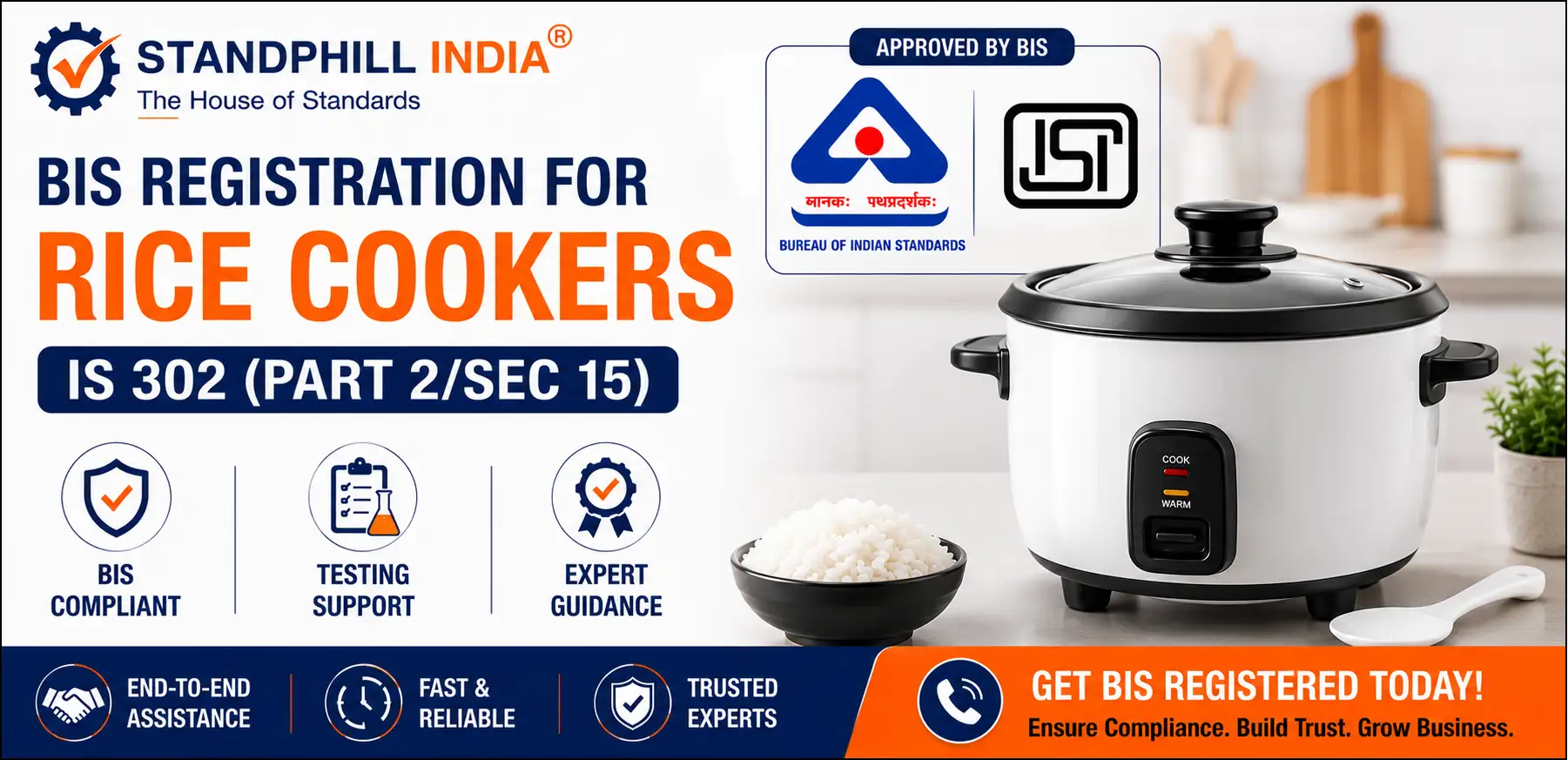
BIS Registration for Rice Cookers - IS 302 (Part 2/Sec 15)
BIS ISI Mark Certification for Rice Cookers - Simple Process, Cost, Documents & Expert BIS Consultant Support
Selling Rice Cookers Without BIS? Here Is What Can Happen
If you sell, import, or distribute rice cookers in India without a valid BIS ISI Mark licence - your entire stock can be seized at customs or in the market. You can face fines up to INR 2 lakh or more under the BIS Act 2016. Your products will be rejected at Indian ports. Online marketplaces like Amazon and Flipkart also block listings without valid BIS numbers. Don't risk it - get BIS before you sell.
BIS Certification for Rice Cookers is not optional - it is the law in India. Every rice cooker sold in India - whether made here or imported from abroad - must carry the ISI Mark issued by the Bureau of Indian Standards (BIS) under IS 302 (Part 2/Sec 15) - the Indian safety standard specifically written for electric rice cookers. Think of it as India's official safety stamp of approval. No ISI Mark = No sale in India. It is that simple.
Quick Overview - BIS Certification for Rice Cookers at a Glance
Not sure where to begin? This table gives you the full picture in under 60 seconds:
| What You Want to Know | The Answer |
|---|---|
| Which products need this? | All electric rice cookers - small, large, commercial, automatic, digital, and multi-cooker types |
| Which standard applies? | IS 302 (Part 2/Sec 15) - Safety of Household and Similar Electrical Appliances: Particular Requirements for Rice Cookers |
| What kind of BIS mark is it? | ISI Mark - the round blue mark with "IS" inside, plus your BIS Licence Number (CM/L Number) |
| Who gives this mark? | Bureau of Indian Standards (BIS) - India's national standards body |
| Is it mandatory? | Yes - under the Quality Control Order notified by the Government of India |
| Who can apply? | Only the manufacturer of the rice cooker - not importers or traders. Foreign manufacturers need an AIR in India. |
| How long is it valid? | 1 year - you renew it every year to keep selling legally |
| Does BIS inspect the factory? | Yes - unlike CRS (electronics), ISI Mark requires a physical BIS factory inspection before the licence is granted |
| How long does it take? | 8 to 14 weeks from start to licence grant |
| Where to apply? | BIS ManakOnline Portal - manakonline.in |
ISI Mark vs CRS - What is the difference? CRS (Compulsory Registration Scheme) is for electronics and IT products like phones and laptops. Rice cookers are household electrical appliances, so they follow the ISI Mark scheme - which is older, stricter, and includes a factory inspection step that CRS does not have. Both are BIS certifications but they work differently.
Which Rice Cookers Need BIS Certification?
If your product uses electricity to cook rice - it almost certainly needs BIS. Here is a plain list of all types that fall under IS 302 (Part 2/Sec 15):
- Standard Electric Rice Cookers - the everyday pot-style rice cookers used in homes across India
- Automatic Rice Cookers - models that switch from cook mode to warm mode automatically
- Digital / Microcomputer Rice Cookers - smart rice cookers with LED panels and programmable settings
- Multi-Function Cookers - appliances that cook rice, steam vegetables, and make soups using one pot
- Pressure Rice Cookers (Electric) - electric models that use pressure to cook rice faster
- Induction Rice Cookers - models using induction heating technology for uniform cooking
- Commercial Rice Cookers - large-capacity models used in hotels, restaurants, and canteens
- Mini / Travel Rice Cookers - compact 0.3 litre to 1 litre models for single-person use or travel
Not sure if your product needs BIS? If your appliance cooks rice using electricity - regardless of size, capacity, or extra features - it most likely needs BIS ISI Mark certification. Call Standphill India at +91-9667674225 for a free scope confirmation before you spend a rupee on testing.
What Does the Lab Test in Your Rice Cooker?
Before BIS issues your ISI Mark licence, a government-approved laboratory physically tests your rice cooker. Here is what they check - explained simply:
Electric Shock Safety
The lab checks that no dangerous electric current can reach the user's hands when touching the cooker's outer body, lid, or handles - even if something goes wrong inside
Heat and Temperature
They measure how hot the outside of the cooker gets while it is running. The handles, body, and base must stay within safe touch temperatures to prevent burns
Moisture and Leakage
Steam and water spill are common with rice cookers. The lab tests that even with steam and water around, no electrical leakage or short circuit occurs
Fire Resistance
The plastic parts, inner lid gaskets, and cord materials must not easily catch fire - tested by checking flame retardance of key materials
Power Cord Safety
The power cord thickness, insulation quality, and how it connects to the cooker body are all checked - a weak cord is a common cause of kitchen fires
Overload and Fault Test
The cooker is deliberately run under abnormal conditions - like blocking the steam vent or running dry - to verify it shuts off safely without catching fire or exploding
All testing must be done at a BIS-recognized and NABL-accredited laboratory. Test reports from non-recognized labs are rejected. Standphill India only works with BIS-approved labs - so your report will be accepted the first time.
4 Things Every Rice Cooker Manufacturer Must Know Before Applying
These are the four rules BIS never bends on. Getting any one of these wrong will delay your licence by weeks - or get your application rejected outright.
Manufacturers Only
Only the factory that makes the rice cooker can apply. If you are an importer or a trader - you cannot apply directly. You must go through the manufacturer.
One Factory = One Licence
Got two factories? You need two separate BIS licences - even if both make the exact same rice cooker model. Each factory address gets its own licence.
Factory Inspection is Mandatory
A BIS officer will visit your factory before the licence is granted. This is not optional. The factory must have basic quality control and testing equipment ready.
One Brand = One Licence
If you sell the same rice cooker under two different brand names - you need two separate BIS licences. One for each brand or trademark.
Good news: One BIS licence can cover multiple rice cooker models from the same factory under the same brand - if they share the same basic design and critical components. Standphill India helps you plan this smartly to get maximum model coverage with minimum cost and effort.
Step-by-Step BIS Process for Foreign Rice Cooker Manufacturers
If your factory is outside India - in China, South Korea, Thailand, or anywhere else - here is exactly how you get your BIS ISI Mark licence:
| Step | What You Do |
|---|---|
| STEP 1 | Appoint an Authorized Indian Representative (AIR) - this is an Indian company or individual who will be your official representative before BIS. You cannot apply without one. Standphill India can serve as your AIR. |
| STEP 2 | Register as a manufacturer on BIS ManakOnline portal - your AIR creates the manufacturer account on manakonline.in using your factory documents, KYC, and authorization letter |
| STEP 3 | Send rice cooker samples to India for testing - samples are tested at a BIS-recognized NABL-accredited lab in India under IS 302 (Part 2/Sec 15). Typically 3 to 5 samples are required. |
| STEP 4 | Prepare all documents - your AIR prepares the complete document package including the application form, factory licence, trademark certificate, and product specifications in BIS-prescribed format |
| STEP 5 | Submit online application on BIS portal - the complete application with test report and all documents is filed on BIS ManakOnline. Government fees are paid online at this stage. |
| STEP 6 | BIS factory inspection - a BIS officer visits your manufacturing plant overseas to verify production setup, quality control systems, and that everything matches what you declared. Your AIR coordinates all logistics for this visit. |
| STEP 7 | BIS scrutiny and queries - BIS reviews all documents and the factory inspection report. If they have questions, your AIR responds promptly on your behalf |
| STEP 8 | ISI Mark Licence (CM/L Number) granted - you receive your BIS licence number. Print the ISI Mark and CM/L Number on every rice cooker and its box before shipping to India. Licence valid for 1 year. |
What is an AIR and why is it not optional? BIS does not communicate directly with foreign factories - all correspondence goes through the Authorized Indian Representative. The AIR is legally responsible for compliance after the licence is granted too. Without an AIR, a foreign factory simply cannot get a BIS licence. Standphill India has been serving as AIR for rice cooker manufacturers from China, Thailand, South Korea, and Vietnam for over two decades.
Step-by-Step BIS Process for Indian Rice Cooker Manufacturers
If your factory is in India - here is your simple step-by-step guide to getting the BIS ISI Mark for your rice cooker:
| Step | What You Do |
|---|---|
| STEP 1 | Register on BIS ManakOnline portal - create your manufacturer account at manakonline.in with your company GST number, factory address, and authorized signatory KYC documents |
| STEP 2 | Get your rice cooker samples tested - send 3 to 5 rice cooker samples to a BIS-recognized laboratory for safety testing under IS 302 (Part 2/Sec 15). Testing usually takes 3 to 5 weeks. |
| STEP 3 | Prepare your documents - fill the BIS application form, prepare the product specification sheet, get your trademark certificate ready, and design the ISI marking label for your rice cooker |
| STEP 4 | Submit application on BIS portal - upload all documents and the test report, select the correct standard (IS 302 Part 2/Sec 15), and pay the government application and licence fees online |
| STEP 5 | BIS factory inspection - a BIS officer visits your factory. They check your production line, in-house testing instruments, and quality records. Make sure your factory is inspection-ready before applying. |
| STEP 6 | Respond to BIS queries (if any) - BIS may ask for additional information or clarifications. Respond within the given deadline to keep your application moving forward. |
| STEP 7 | Get your ISI Mark Licence (CM/L Number) - start marking all your rice cookers with the ISI Mark and your BIS licence number. Renew every year before expiry. |
Factory Inspection Tip: Many applications get stuck at the inspection stage because the factory does not have the minimum required testing instruments - like a voltmeter, insulation tester, and thermometer for product quality checks. BIS expects basic in-house testing capability. Standphill India prepares a factory-readiness checklist for every client before the inspection date is scheduled.
Documents You Will Need for BIS Rice Cooker Registration
Keep these documents ready before you start. Missing or incorrect documents is the number one reason BIS applications get delayed or returned. Here is the complete, plain-language checklist:
- Filled BIS application form - available on BIS ManakOnline portal, must be signed by the authorized signatory
- Factory / business registration certificate - proof that your company is legally registered and permitted to manufacture rice cookers (for foreign manufacturers: English translation required)
- Factory address proof - utility bill, lease agreement, or property document for the manufacturing location
- Trademark registration certificate - for the brand name printed on your rice cooker. If trademark is pending, provide application acknowledgment.
- Trademark authorization letter - only needed if the brand owner is a different company from the manufacturer
- Product specification sheet - technical details of your rice cooker: voltage, wattage, capacity (litres), weight, dimensions, materials used
- ISI marking label design - artwork showing where and how the ISI mark, CM/L number, voltage, wattage, and standard number will appear on the product and box
- BIS test report - the safety test report issued by a BIS-recognized laboratory under IS 302 (Part 2/Sec 15), valid and submitted within the BIS window
- List of critical components - details of the heating element, thermostat, inner pot, power cord, and other key parts with supplier names and specifications
- Photo ID and address proof of the authorized signatory of the application
- AIR authorization letter + Indian company proof - only for foreign manufacturers appointing an Authorized Indian Representative
- ISO certificate (if available) - not mandatory but helps build credibility during BIS scrutiny
Test Report Validity: Once your lab issues the test report, you must submit your full BIS application within the valid window. If you delay and the report expires - you need to test fresh samples all over again, which means extra weeks and extra cost. Standphill India tracks this deadline for every client.
BIS Registration Cost, Timeline & Validity for Rice Cookers
Here is a straightforward breakdown of the money and time involved. No hidden surprises:
| What You Are Paying For | Approximate Amount |
|---|---|
| BIS Application Fee | INR 1,000/- (one-time at application stage) |
| BIS Annual Licence Fee | INR 1,000/- to INR 10,000/- per year (based on annual production or import value - BIS calculates this on a slab basis) |
| Laboratory Testing Charges | INR 15,000/- to INR 50,000/- (depends on the rice cooker model, number of models, and tests required) |
| BIS Factory Inspection Fee | Charged by BIS - includes inspector travel and visit cost (domestic inspections: approx INR 5,000-15,000; foreign factory inspections: higher, billed separately) |
| Marking Fee | Paid to BIS per unit produced under the ISI licence - very nominal, calculated on production quantity |
| Total Timeline | 8 to 14 weeks from start to licence grant (domestic); 12 to 18 weeks (foreign, including factory inspection travel coordination) |
| Licence Validity | 1 year - must be renewed every year. Renewal is simpler than the first application but must not be missed. |
| Surveillance | BIS may conduct surprise visits to check product quality even after the licence is granted - this is called BIS surveillance |
Total Investment in Simple Terms: For a typical Indian rice cooker manufacturer, the full first-year BIS registration investment - including testing, government fees, and inspection - is usually between INR 40,000 and INR 1,00,000. For foreign manufacturers with overseas factory inspection, it is higher. Standphill India gives you a precise cost estimate for your exact situation - for free - before you commit.
Also Read
BIS CRS Registration - Complete Guide for Electronic Products Authorized Indian Representative (AIR) for BIS Certification BIS FMCS Certification for Foreign Manufacturers BIS Registration for LCD / LED / Plasma TV up to 32 InchWhy Rice Cooker Manufacturers Trust Standphill India for BIS Registration?
We are not a general compliance company that handles every product under the sun. We are BIS specialists - and rice cookers, kitchen appliances, and household electrical products are one of our core areas. Here is what that means for you in practice:
- We speak plain language - no confusing technical jargon. We explain every step to you so you always know where your application stands and what is happening next
- Factory inspection prep - we tell you exactly what BIS looks for during the factory visit and help you get ready so there are no surprises on inspection day
- Right lab, right tests - we send your samples to the best-fit BIS-recognized lab for rice cooker testing, cutting down unnecessary delays in the test report turnaround
- AIR services for importers - if you are an Indian importer bringing in rice cookers from China or anywhere else, we work directly with the foreign manufacturer on your behalf as the Authorized Indian Representative
- Multi-model coverage strategy - we review all your rice cooker models and plan the smartest grouping so you get maximum coverage under minimum registrations, saving you money
- Deadline management - we track your test report validity, licence renewal dates, and BIS response deadlines so nothing slips through the cracks
- Post-registration support - BIS surveillance visits, model additions, licence amendments when components change - we handle it all after your licence is granted too
- Transparent pricing - we tell you the full cost upfront. No hidden charges, no surprise fees midway through the process
Ready to Get BIS for Your Rice Cooker? Let's Talk.
Tell us your product and factory location - we will give you a clear cost estimate, timeline, and step-by-step plan within 24 hours. No obligation. No confusing forms. Just straightforward expert help.
Contact Us Today +91-9667674225Common Questions About BIS Registration for Rice Cookers - Answered Simply
Ask Us Anything About BIS for Rice Cookers
Not sure about something? Our team responds within a few hours - no jargon, just clear answers.
★ Why Standphill India?
- 20+ Years of BIS Certification Experience
- 10,000+ Certifications Delivered Globally
- Dedicated Teams for CRS, FMCS & ISI Mark
- End-to-End Documentation & Filing Support
- Fast Response & Practical Compliance Guidance
- Support for Indian & Foreign Manufacturers
Get Free Call Back
Our Services
- BIS (ISI Mark) for Foreign Manufacturers
- Domestic BIS (ISI Mark) Certification
- BIS Certificate of Conformity (CoC)
- BIS Hallmarking
- BIS Licence for Toys
- ECO Mark Certification
- TAC Approval for Automobile
- Drug Licence
- Peso Certification
- BIS (CRS) Registration
- WPC-ETA Approval
- BEE Certification
- E-Waste Management (EPR)
- EPR for Plastic Waste
- EPR for Battery Waste
- CE Certification
- UL Certification
- ROHS Licence
- Standardization Division
- Import / Export Licence
- FSSAI Certification
- ISO Registration
- Trademark Registration
- Make in India Support
- AG-Mark Licence
- Third Party Monitoring
Client Testimonials
Their team was very knowledgeable and helped us every step of the way. Standphill India is the best BIS certification consultants for any type of BIS certification.

Chintan Shah (AGM)
Sudeep Nutrition P.Ltd



Featured Guide
Complete BIS CRS certification guide for electronic products in India — free to read.
Read CRS Certification Guide📞 Contact Standphill India
+91-9667674225 info@standphillindia.in WhatsApp Now Greater Noida West, UPGet Expert BIS Certification Support for Your Business
Connect with Standphill India for complete support with BIS certification, CRS registration, WPC approval, FMCS compliance, and related regulatory services. Our team helps businesses with documentation, testing coordination, application support, and end-to-end compliance guidance.
Request Free Consultation
Share your requirement and our team will contact you shortly.