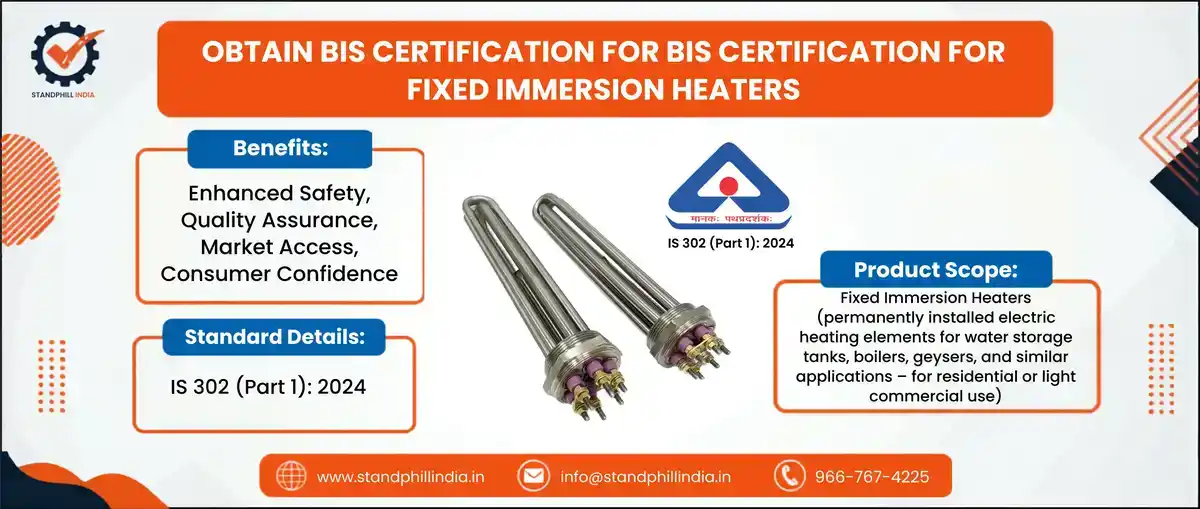
BIS Certification for Fixed Immersion Heaters — IS 302 (Part 1): 2024
By Standphill India | BIS Certification Consultants | Updated: 2026 Category: BIS Certification | IS 302 Part 1 | QCO 2026 | Electrical Appliances | Sr. No. 75
What Are Fixed Immersion Heaters?
Think of a fixed immersion heater as the "heart" inside your home's water geyser. It is a permanently installed electric heating element that sits inside a water storage tank and heats the water from within. You will find these in almost every Indian household's bathroom – the metal rod-like part inside the geyser that actually does the heating job. But here is the important news: from 19 March 2026, the Government of India has made BIS certification mandatory for all fixed immersion heaters under the new Quality Control Order (QCO) 2026, Sr. No. 75[reference:0]. The standard they must follow is IS 302 (Part 1): 2024, which is all about electrical safety[reference:1]. This means if you manufacture or export fixed immersion heaters to India, you cannot sell a single unit without the ISI Mark after the deadline. This page explains everything in simple, easy-to-understand language – no confusing legal terms.
Which Products Fall Under Fixed Immersion Heaters?
The term "fixed immersion heaters" covers all permanently installed electric heating elements used for heating water or other liquids in a storage tank. Here are common examples you will recognise:
• Storage water heater elements – the heating rod inside your home's geyser (also called "geyser element" in common language).
• Industrial immersion heaters – used in boilers, hot water storage tanks in hotels, hospitals, and factories.
• Flange-type immersion heaters – bolted onto tanks for heating water, oils, or chemicals.
• Screw-plug immersion heaters – screwed directly into a threaded opening in a tank.
• Over-the-side immersion heaters – used for heating liquids in open tanks or drums (when permanently fixed, not portable).
Important note: The keyword here is "fixed" – meaning permanently installed, not portable. Portable immersion heaters (the ones you dip into a bucket) fall under different rules. Also, if you are manufacturing the complete water heater (the geyser with the tank and outer body), that is covered under IS 2082:2018 – more on that below.
Fixed Immersion Heater vs Electric Water Heater – What is the Difference?
This is a common confusion, so let me explain clearly. A fixed immersion heater is just one component – the heating element inside a water storage tank. An electric water heater (geyser) is the complete appliance: the tank, the insulation, the outer body, the thermostat, and the immersion heater inside it[reference:2].
In simple words: The immersion heater is the part that gets hot. The water heater is the whole machine that keeps the hot water ready for your bath.
Now, the important part – different standards apply:
• Fixed Immersion Heater (component) – certified under IS 302 (Part 1): 2024 (Safety of Household and Similar Electrical Appliances – General Requirements). This standard focuses on the electrical safety of the heating element itself – things like insulation, earthing, thermal protection, and moisture resistance[reference:3].
• Complete Electric Water Heater (finished product) – certified under IS 2082:2018 (Stationary Storage Type Electric Water Heaters – Specification)[reference:4]. This standard covers the entire appliance – tank strength, insulation efficiency, thermostat accuracy, energy consumption, and overall safety[reference:5].
So if you are a manufacturer making only the heating element (the rod) for geysers, you need BIS certification under IS 302 (Part 1): 2024. But if you are manufacturing the complete water heater (geyser) and selling it as a finished product, you need certification under IS 2082:2018. Many manufacturers make both – and they need both certifications.
👉 Want to learn more about water heater certification? Read our detailed guide: BIS Certification for Electric Water Heaters (IS 2082:2018).
Why Is BIS Certification So Important? (Real Safety Risks)
You might be thinking – it is just a metal rod that heats water. What could go wrong? Actually, quite a lot. Fixed immersion heaters work with electricity and water together. If not made safely, they can cause serious accidents. Here are the real risks that BIS testing prevents:
⚡ Electric shock through water. If the heating element's insulation fails, the water in the tank can become electrified. The next person who opens the tap could get a fatal shock. IS 302 tests insulation resistance and electric strength to prevent this.
🔥 Fire from overheating. If the immersion heater runs without water (dry run) or if the thermostat fails, the element can overheat, melt the tank fittings, and cause a fire. The standard requires thermal cut-off protection.
💧 Moisture ingress and corrosion. Poorly sealed immersion heaters allow water to enter the electrical connections, leading to short circuits and shock hazards. BIS testing checks for water resistance.
⚡ Poor earthing. If the heater is not properly earthed, a fault current has no safe path to ground, increasing shock risk. IS 302 mandates earthing continuity testing.
Getting BIS certification is not just a legal formality – it is proof that your product will not hurt anyone. It protects your customers and your business from liability disasters.
Why Should Global Manufacturers Get BIS Certification?
If you manufacture fixed immersion heaters anywhere in the world and export to India, here is why certification is non-negotiable for your business:
1. Legal market access – the only way to sell in India. After 19 March 2026, Indian customs will reject any shipment of fixed immersion heaters without a valid BIS ISI Mark. Your containers will be detained, returned, or destroyed. Certification is your entry ticket[reference:6].
2. Avoid devastating liability lawsuits. If a non-certified immersion heater causes electrocution or a house fire, you could face millions in damages. BIS certification proves your product meets national safety standards – strong legal protection.
3. Build trust with Indian geyser manufacturers. Major water heater brands in India buy immersion heater elements from suppliers. They will only purchase BIS-certified components after the deadline. The ISI Mark is your sales advantage.
4. Faster customs clearance. BIS-certified products are cleared faster. Without certification, every shipment is at risk of detention and expensive demurrage charges.
5. Gain a competitive advantage. Many smaller manufacturers will delay certification. By certifying early, you can market your products as "BIS certified – safe for Indian homes."
When Is the Deadline? (Important Dates)
The government has set different deadlines based on business size. For foreign manufacturers (exporters), you generally fall under the "general manufacturers" category. Here is the table:
| Business Category | Compliance Deadline |
|---|---|
| General Manufacturers (including all foreign manufacturers) | 19 March 2026 |
| Small Enterprises (MSME) | 19 June 2026 |
| Micro Enterprises (MSME) | 19 September 2026 |
If you are a foreign manufacturer, you need to apply under the Foreign Manufacturers Certification Scheme (FMCS). The practical deadline to start the process is no later than December 2025 – because the overseas factory inspection takes 8 to 12 weeks to coordinate, and BIS testing laboratories get heavily backlogged as the deadline approaches. Starting early is essential.
How to Get BIS Certification – Simple Steps
The certification process follows Scheme‑I of Schedule‑II of the BIS Conformity Assessment Regulations. Here is a simple summary:
Step 1 – Confirm your product scope. We verify that your fixed immersion heater falls under Sr. No. 75 and that IS 302 (Part 1): 2024 is the correct standard. We also check if your product is just the element or a complete water heater.
Step 2 – Testing at a BIS-approved laboratory. You send 3 to 5 samples to a NABL-accredited lab in India. The lab tests earth continuity, electric strength, insulation resistance, thermal cut-off operation, moisture resistance, and heating performance. Testing typically takes 3 to 5 weeks[reference:7].
Step 3 – Documentation preparation. We help you prepare all required documents: factory layout, quality manual, circuit diagrams, material specifications, and label artwork.
Step 4 – Submit application on BIS ManakOnline portal. We file the complete application and handle all queries from BIS officers.
Step 5 – BIS factory inspection. BIS officials visit your factory (overseas for FMCS) to verify production quality, in-house testing, and safety measures – especially for thermal cut-off assembly, insulation testing, and earthing checks.
Step 6 – Grant of ISI Mark licence. Once approved, you can put the ISI Mark on your fixed immersion heaters and legally export to India.
Documents You Will Need – A Simple List
Here are the documents required for BIS certification. We help you prepare every single one:
✓ Company registration certificate (or factory licence for foreign manufacturers)
✓ Product technical specification – including wattage, voltage, tube material (copper, stainless steel, Incoloy), sheath material, flange/screw thread details, and IP rating
✓ Electrical circuit diagram – showing the heating element wiring, thermal cut-off, and terminal connections
✓ Factory layout drawing – showing assembly lines, winding machines, filling stations, and testing areas
✓ Machinery and equipment list – including tube bending machines, powder filling machines, swaging machines, and testing instruments
✓ Quality management plan – describing how you check insulation resistance, earth continuity, dielectric strength, and thermal cut-off function during production
✓ Calibration certificates for all testing equipment
✓ Component supplier details – for heating wire (NiCr), insulating powder (MgO), terminal pins, thermal cut-offs, and seals
✓ Material test certificates for sheath tube (copper/stainless steel/Incoloy)
✓ Test reports from a BIS-approved, NABL-accredited laboratory
✓ Label artwork – showing the ISI Mark, licence number, voltage, wattage, and warnings (e.g., "Do not operate without water", "Professional installation only")
✓ Product photographs – all sides, showing the element, terminals, flange/screw, and marking
✓ Undertakings and declarations – as per BIS forms
✓ For foreign manufacturers: Authorized Indian Representative (AIR) appointment letter and apostilled power of attorney
Common Mistakes to Avoid
Based on our experience, here are the mistakes we see most often – and how to avoid them:
Mistake 1: No thermal cut-off or incorrect placement. Many immersion heaters fail because the thermal cut-off is missing or placed too far from the heating zone. Always include a bimetallic thermal protector or thermal fuse directly on the heating tube, and test its operation.
Mistake 2: Poor MgO powder insulation. The magnesium oxide powder inside the sheath tube must be completely dry and properly compacted. Moisture in the MgO causes insulation failure. Ensure your manufacturing process includes baking and vacuum filling.
Mistake 3: Insufficient earth continuity. The earth terminal must be permanently connected to the sheath tube with low resistance. Use a dedicated earth screw and test continuity before packing.
Mistake 4: Wrong sheath material for application. Copper elements corrode in hard water areas. For the Indian market, stainless steel or Incoloy sheaths are preferred. Know your customer's water quality.
Mistake 5: Submitting international test reports (CE, UL, RoHS) directly to BIS. BIS does not accept foreign test reports. You must retest in a BIS-approved Indian laboratory. However, we can use your existing reports to guide testing and reduce surprises.
Helpful Resources for Your BIS Certification Journey
• Complete QCO 2026 Guide – 90 Electrical Appliances – full details on the order, exemptions, enforcement, and the complete list of covered products.
• BIS FMCS Certification for Foreign Manufacturers – detailed process for overseas factories, including documentation, overseas inspection, and Authorized Indian Representative (AIR) appointment.
• BIS ISI Mark Certification for Indian Manufacturers – for domestic producers of fixed immersion heaters.
• BIS Certification for Electric Water Heaters (IS 2082:2018) – if you manufacture complete geysers, this is your guide.
Do You Need Help Getting BIS Certification for Your Fixed Immersion Heaters?
Are you a manufacturer of geyser elements, boiler heaters, or industrial immersion heaters? Do you want to export to India but are confused about the new QCO 2026 rules? Would you like a free, no‑obligation assessment of your product's compliance requirements, estimated timeline, and cost?
If you answered yes to any of these questions, then Standphill India is here to help. With over 20 years of exclusive BIS certification experience and more than 10,000 successful certification projects, we have the expertise to guide you through every step – from product testing to licence approval. We work with manufacturers and exporters from over 40 countries.
You can reach us by phone or email. Our team is ready to answer your questions and provide a customized compliance plan for your product.
📞 +91 96676 74225
✉️ info@standphillindia.in
🌐 www.standphillindia.in
Standphill India – Your trusted partner for BIS certification, serving manufacturers and exporters from over 40 countries worldwide.
★ Why Standphill India?
- 20+ Years of BIS Certification Experience
- 10,000+ Certifications Delivered Globally
- Dedicated Teams for CRS, FMCS & ISI Mark
- End-to-End Documentation & Filing Support
- Fast Response & Practical Compliance Guidance
- Support for Indian & Foreign Manufacturers
Get Free Call Back
Our Services
- BIS (ISI Mark) for Foreign Manufacturers
- Domestic BIS (ISI Mark) Certification
- BIS Certificate of Conformity (CoC)
- BIS Hallmarking
- BIS Licence for Toys
- ECO Mark Certification
- TAC Approval for Automobile
- Drug Licence
- Peso Certification
- BIS (CRS) Registration
- WPC-ETA Approval
- BEE Certification
- E-Waste Management (EPR)
- EPR for Plastic Waste
- EPR for Battery Waste
- CE Certification
- UL Certification
- ROHS Licence
- Standardization Division
- Import / Export Licence
- FSSAI Certification
- ISO Registration
- Trademark Registration
- Make in India Support
- AG-Mark Licence
- Third Party Monitoring
Client Testimonials
Their team was very knowledgeable and helped us every step of the way. Standphill India is the best BIS certification consultants for any type of BIS certification.

Chintan Shah (AGM)
Sudeep Nutrition P.Ltd




Featured Guide
Complete BIS CRS certification guide for electronic products in India — free to read.
Read CRS Certification Guide📞 Contact Standphill India
+91-9667674225 info@standphillindia.in WhatsApp Now Greater Noida West, UPGet Expert BIS Certification Support for Your Business
Connect with Standphill India for complete support with BIS certification, CRS registration, WPC approval, FMCS compliance, and related regulatory services. Our team helps businesses with documentation, testing coordination, application support, and end-to-end compliance guidance.
Request Free Consultation
Share your requirement and our team will contact you shortly.