BIS Certification for Safety Glass under IS 2553 (Part 1):2018
ISI Mark Licence for Architectural, Building and General Use Safety Glass
AI Overview – BIS Certification for Safety Glass
BIS Certification for Safety Glass under IS 2553 (Part 1):2018 is mandatory in India for manufacturers and importers supplying safety glass for architectural, building and general applications. The certification is governed by the Safety Glass (Quality Control) Order, 2020 and implemented by the Bureau of Indian Standards (BIS) under Scheme I (ISI Mark Certification Scheme).
Under this regulatory framework, safety glass products must comply with IS 2553 (Part 1):2018 and carry the ISI Mark before they can be manufactured, imported, stored or sold in the Indian market. The enforcement became effective from 1 April 2023 after the relevant amendment timeline.
The standard helps ensure that safety glass used in buildings, railways, furniture, display applications, lighting fixtures and machinery-related uses meets required safety, durability and impact-related requirements.
Standphill India provides complete BIS certification consultancy for safety glass and supports both domestic and foreign manufacturers through documentation, product testing coordination, factory inspection preparation and licence approval support.
Safety Glass Quality Control Order in India
The Safety Glass (Quality Control) Order, 2020 made BIS certification compulsory for notified safety glass products in India. Under this Quality Control Order, the product must conform to the specified Indian Standard and must bear the Standard Mark (ISI Mark) under a valid BIS licence.
The notified product categories include:
| Product Category | Applicable Indian Standard |
|---|---|
| Safety Glass for Architectural, Building and General Uses | IS 2553 (Part 1):2018 |
| Safety Glass for Road Transport | IS 2553 (Part 2):2019 |
This page focuses on IS 2553 (Part 1):2018, which applies to safety glass used in buildings and general-use applications.
Introduction to BIS Certification for Safety Glass
Safety glass plays an important role in modern construction, infrastructure and equipment-based applications. It is widely used in architectural glazing, commercial buildings, railway coaches, furniture, display systems, lighting fixtures, machinery components and certain industrial applications.
Because glass failure can create serious safety risks, the Indian regulatory framework requires compliance for covered products. BIS certification confirms that the product meets the relevant Indian Standard and that the manufacturer is following acceptable production and quality control practices.
Manufacturers who obtain a BIS ISI Mark Licence for safety glass demonstrate compliance with Indian safety regulations, improve buyer confidence and can lawfully supply the product in the Indian market.
Regulatory Framework for Safety Glass Certification in India
The regulatory basis for safety glass certification in India comes mainly from the following framework:
1. Safety Glass (Quality Control) Order, 2020
This QCO mandates compliance with the notified Indian Standards and prohibits manufacturing, import or sale without BIS certification for covered products.
2. Safety Glass (Quality Control) Amendment Order, 2022
This updated the implementation timeline and made practical compliance effective from 1 April 2023.
3. BIS Scheme I (ISI Mark Scheme)
Certification for safety glass is granted under the BIS product certification system commonly known as the ISI Mark Scheme.
4. BIS Product Manual / Licensing Framework
BIS product-specific guidance for IS 2553 (Part 1):2018 supports the certification process, grouping logic and optional requirement structure for licensing.
Which Authorities Are Involved?
Bureau of Indian Standards (BIS)
BIS is the certification authority that grants the ISI Mark licence, scrutinizes applications, conducts inspections and monitors compliance.
Ministry of Commerce and Industry / DPIIT
The Quality Control Order framework is notified through the Government of India under the relevant ministry and department mechanism.
BIS Recognized Laboratories
Testing of samples for certification is carried out through the relevant laboratory system as applicable under BIS requirements.
Scope of IS 2553 (Part 1):2018
IS 2553 (Part 1):2018 is titled:
Safety Glass — Specification — Part 1 Architectural, Building and General Uses
The standard applies to safety glass used in various sectors including:
• architectural glazing
• furniture and display boards
• railway coaches
• earth-moving equipment
• lighting fixtures
• appliances and machinery components
For certain appliance-related uses, an additional thermal shock requirement may also apply depending on the application context.
Types of Safety Glass Covered
The BIS product manual for IS 2553 (Part 1):2018 classifies safety glass into two main categories:
1. Toughened (Tempered) Safety Glass
This is glass processed through thermal treatment to improve strength and impact resistance.
2. Laminated Safety Glass
This is glass made by bonding glass layers with interlayers so that the fragments remain attached when broken.
Safety glass under this standard may be:
• flat or curved
• clear, tinted or coated
• manufactured with coloured interlayers
Related Standards Referenced in the Standard
IS 2553 (Part 1):2018 works along with related standards and testing references. Commonly discussed linked references include:
| Standard | Description |
|---|---|
| IS 14900:2018 | Transparent float glass specification |
| IS 17004:2018 | Testing methods for processed glass |
| ISO 12540 | Tempered glass performance guidelines |
| ISO 12543 series | Laminated glass testing methods |
Key Technical Requirements under IS 2553 (Part 1):2018
The standard includes both general quality requirements and type-specific performance requirements.
General Requirements
The base glass used for manufacturing safety glass must comply with the relevant defect limits and quality controls. These checks are intended to maintain optical clarity and structural quality.
Common defect controls may include:
• spot faults
• linear faults
• strings
• optical distortions
• reams and surface imperfections
Testing Requirements for Toughened Safety Glass
Toughened safety glass generally requires performance checks such as:
• fragmentation test
• resistance to shock / impact related testing
• human impact resistance
• surface compression, where applicable
• mechanical strength, where applicable
Testing Requirements for Laminated Safety Glass
Laminated safety glass generally requires checks such as:
• light stability
• boil test
• bake test
• fracture and adhesion test
• humidity resistance, where applicable
• human impact resistance
Packing and Marking Requirements
IS 2553 (Part 1):2018 includes product identification and marking requirements.
Packaging Requirements
Each packet should generally display:
• source of manufacture
• nominal thickness
• batch or code number
• month and year of manufacture
• type of safety glass
Product Marking Requirements
Each piece of glass should be appropriately marked, such as:
• Toughened Safety Glass → “Toughened”
• Laminated Safety Glass → “Laminated Safety”
The marking should also include:
• manufacturer identification
• year of manufacture
Only certified products can carry the ISI Mark.
BIS ISI Certification Process for Safety Glass
Safety glass certification is granted under BIS Scheme I (ISI Mark Scheme).
Step 1 – Documentation Preparation
The manufacturer prepares technical documents, factory details, quality control records and product-related information.
Step 2 – Product Testing
Samples are tested as per the applicable standard and BIS certification requirements.
Step 3 – Application Filing
The BIS application is submitted through the prescribed process and relevant application format.
Step 4 – Factory Inspection
BIS officials inspect the production unit, testing facilities, manufacturing process and quality controls.
Step 5 – Grant of Licence
After successful evaluation, BIS grants the ISI Mark Licence for the applicable product scope.
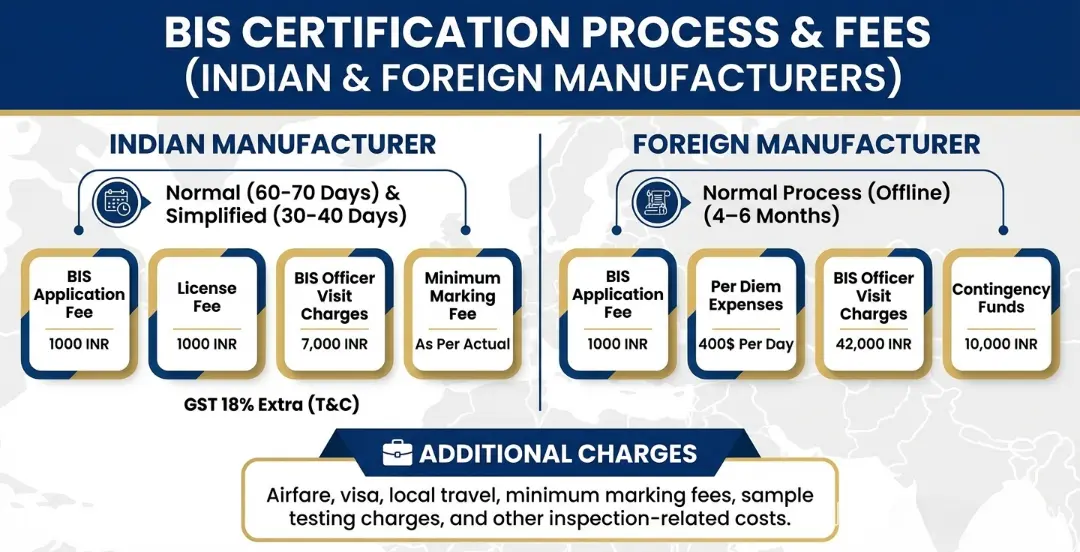
BIS Certification Process for Safety Glass
Documents Required for BIS Certification for Safety Glass
Manufacturers normally need to prepare several technical and compliance documents.
Typical documents may include:
• factory registration certificate
• manufacturing licence
• factory layout and process flow chart
• list of manufacturing machinery
• list of testing equipment
• calibration certificates
• quality control records
• raw material details
• product test reports
• declarations and undertakings
Standphill India assists in complete documentation support, document review and application structuring to reduce delays.
BIS Certification for Foreign Manufacturers
Foreign manufacturers supplying safety glass to India must normally apply through the Foreign Manufacturers Certification Scheme (FMCS).
Important requirements may include:
• appointment of an Authorized Indian Representative (AIR)
• submission of technical documents and test information
• BIS factory audit at the manufacturing location outside India
Once approved, foreign manufacturers can legally export certified safety glass to India subject to the granted licence scope.
BIS Certification Fees and Timeline
Typical government fee components commonly discussed for Scheme I certification include:
| S. No. | Particulars | Amount |
|---|---|---|
| 1 | Application Fee | ₹1,000/- |
| 2 | Inspection Fee | ₹7,000/- per man-day |
| 3 | Annual Licence Fee | ₹1,000/- |
| 4 | Marking Fee | As Applicable |
| 5 | Sample Testing Fee | As Applicable |
Testing charges depend on the laboratory, product type and actual scope of testing.
Average timelines:
• Option 1 Certification: around 3 to 4 months
• Option 2 Certification: around 30 to 45 days, subject to eligibility and case suitability
Validity and Surveillance of BIS Licence
BIS licences are generally valid for an initial period and can be renewed further depending on compliance and renewal eligibility.
During the licence period:
• BIS may conduct surveillance inspections
• market or factory samples may be tested
• non-compliance may lead to suspension or cancellation
Penalties for Non-Compliance
Manufacturing, importing or selling safety glass without required certification can lead to serious consequences under the BIS compliance framework.
Possible consequences may include:
• product seizure
• licence cancellation
• financial penalties
• prosecution in serious cases
Also Read
BIS Certification for Indian Manufacturers
Recent Safety Glass Clients Supported by Standphill India
Standphill India has supported multiple safety glass manufacturers with documentation guidance, BIS process support, inspection preparation and compliance coordination. Some recent names in the safety glass segment include:
| S. No. | Client Name |
|---|---|
| 1 | Amogh Industries |
| 2 | Saraf Safety Glass |
| 3 | Radhika Glass |
| 4 | Jaipur Tuff |
| 5 | Auto Tuff |
| 6 | Nice Tuff |
| 7 | Parihar Glass |
Why Choose Standphill India for BIS Certification
Standphill India is a trusted BIS certification consultancy with support capabilities across India and for global manufacturers targeting the Indian market.
Our BIS certification services include:
• complete documentation support
• coordination with BIS recognized laboratories
• factory inspection preparation
• application filing and compliance support
• FMCS support for foreign manufacturers
We have completed 10000+ domestic projects, 1000+ FMCS projects, and support manufacturers across all States and Union Territories of India as well as global businesses exporting to India.
We also maintain separate expert teams for domestic BIS certification and foreign manufacturer / FMCS cases for better project handling and faster coordination.
Conclusion
BIS Certification for Safety Glass under IS 2553 (Part 1):2018 is an important regulatory requirement for manufacturers and importers dealing with architectural, building and general-use safety glass in India.
The certification framework connects the applicable Quality Control Order, the Indian Standard, the product testing process and the BIS licensing system under Scheme I.
With the right technical preparation, documentation strategy and compliance guidance, manufacturers can complete the process more smoothly and enter the Indian market with stronger regulatory confidence.
Get expert support from Standphill India for BIS certification of safety glass and complete your compliance journey with confidence.
Frequently Asked Questions (FAQ)
Q1. Is BIS certification mandatory for safety glass?
Yes. Safety glass regulated under the Safety Glass Quality Control Order must obtain BIS certification before being sold in India.
Q2. Which standard applies to building safety glass?
Safety glass for architectural and general uses must comply with IS 2553 (Part 1):2018.
Q3. What types of safety glass are covered?
The standard covers toughened safety glass and laminated safety glass.
Q4. Can foreign manufacturers obtain BIS certification?
Yes. They must apply under the Foreign Manufacturers Certification Scheme and appoint an Authorized Indian Representative where applicable.
Q5. How long does BIS certification take?
The process may take around 30 days to 4 months depending on documentation, testing, inspection and BIS scrutiny.
Q6. What is the difference between IS 2553 Part 1 and Part 2?
Part 1 applies to architectural, building and general-use safety glass, while Part 2 applies to safety glass for road transport.
★ Why Standphill India?
- 20+ Years of BIS Certification Experience
- 10,000+ Certifications Delivered Globally
- Dedicated Teams for CRS, FMCS & ISI Mark
- End-to-End Documentation & Filing Support
- Fast Response & Practical Compliance Guidance
- Support for Indian & Foreign Manufacturers
Get Free Call Back
Our Services
- BIS (ISI Mark) for Foreign Manufacturers
- Domestic BIS (ISI Mark) Certification
- BIS Certificate of Conformity (CoC)
- BIS Hallmarking
- BIS Licence for Toys
- ECO Mark Certification
- TAC Approval for Automobile
- Drug Licence
- Peso Certification
- BIS (CRS) Registration
- WPC-ETA Approval
- BEE Certification
- E-Waste Management (EPR)
- EPR for Plastic Waste
- EPR for Battery Waste
- CE Certification
- UL Certification
- ROHS Licence
- Standardization Division
- Import / Export Licence
- FSSAI Certification
- ISO Registration
- Trademark Registration
- Make in India Support
- AG-Mark Licence
- Third Party Monitoring
Client Testimonials
Their team was very knowledgeable and helped us every step of the way. Standphill India is the best BIS certification consultants for any type of BIS certification.

Chintan Shah (AGM)
Sudeep Nutrition P.Ltd




Featured Guide
Complete BIS CRS certification guide for electronic products in India — free to read.
Read CRS Certification Guide📞 Contact Standphill India
+91-9667674225 info@standphillindia.in WhatsApp Now Greater Noida West, UPGet Expert BIS Certification Support for Your Business
Connect with Standphill India for complete support with BIS certification, CRS registration, WPC approval, FMCS compliance, and related regulatory services. Our team helps businesses with documentation, testing coordination, application support, and end-to-end compliance guidance.
Request Free Consultation
Share your requirement and our team will contact you shortly.