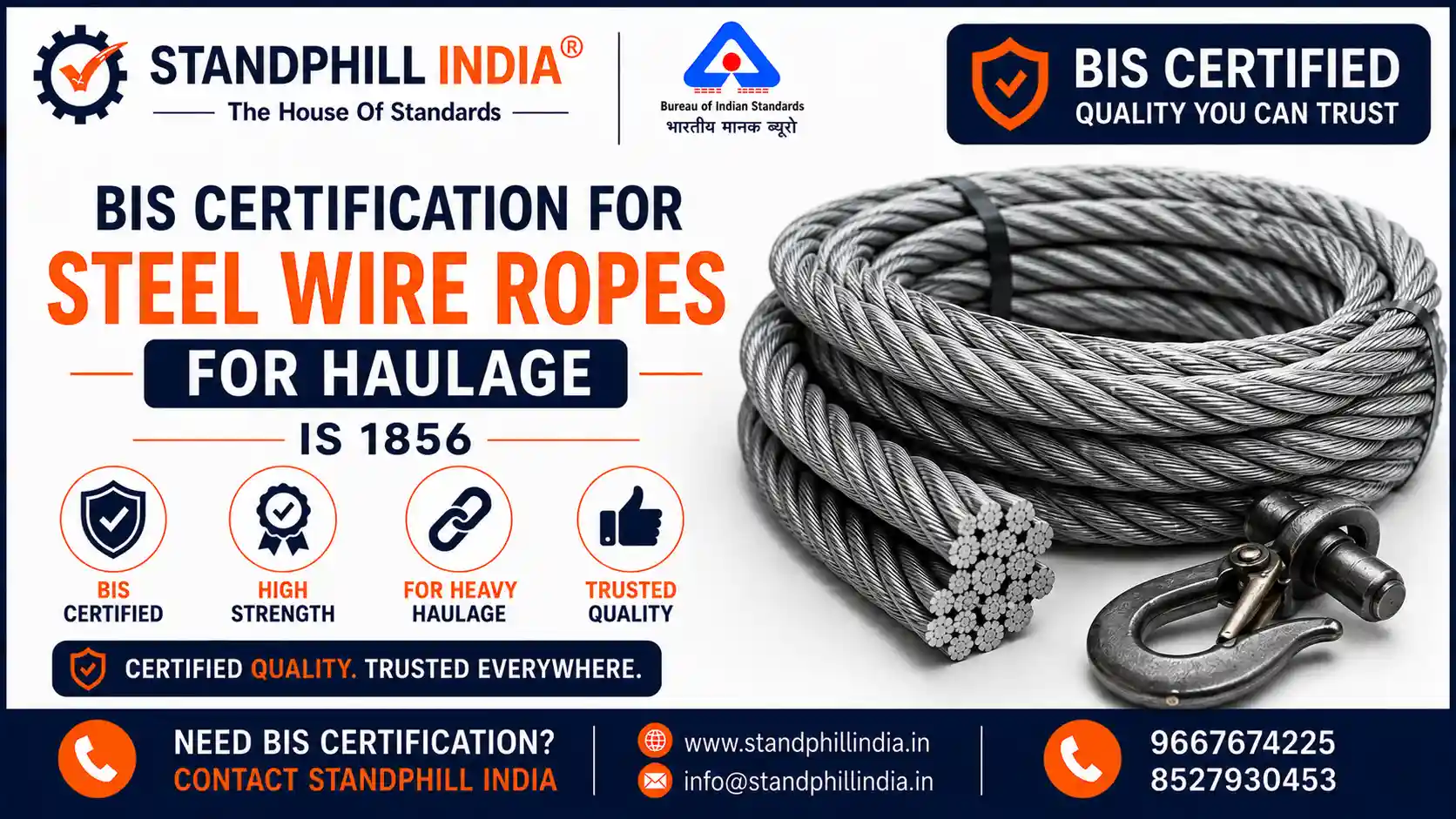
BIS Certification for Steel Wire Ropes for Haulage Purposes
IS 1856:2005 · ISI Mark - Mandatory Since 1 December 2024 - The Workhorse of Material Movement
Mandatory for Haulage Wire Ropes
Steel wire ropes for haulage purposes are notified under IS 1856:2005 by the 2024 Quality Control Order (S.O. 2581(E)). Compliance became mandatory on 1 December 2024 (Small Enterprises: 1 March 2025; Micro Enterprises: 1 June 2025) - all three windows have closed, so certification is a live legal requirement today.
What This Certification Covers - in Plain Terms
Haulage rope is the rope that pulls rather than lifts. Along mine inclines, across surface haulage tracks, on tub and trolley systems, the haulage rope drags loaded material continuously over rollers and around return wheels - a life of abrasion, surface wear and cyclic tension rather than the single vertical loads of a hoisting rope. IS 1856:2005 is the standard built around that duty, and it now sits under compulsory BIS certification.
The commercial reality: haulage rope is consumed in volume. It wears, it gets replaced on schedule, and mining and industrial buyers purchase it on rate contracts year after year. For a rope mill, the ISI Mark on this product is the ticket to steady, repeat institutional business - and since the compliance dates passed, the uncertified competition is legally out of the game.
This is one of 9 products notified under the Steel Wires or Strands, Nylon or Wire Ropes and Wire Mesh (Quality Control) Order, 2024 - S.O. 2581(E), dated 3 July 2024, which superseded the original 2023 order (S.O. 5022(E), 21 November 2023). Mandatory since 1 December 2024 for manufacturers in general; 1 March 2025 for Small Enterprises; 1 June 2025 for Micro Enterprises - all three dates have passed, so the requirement is fully in force for every manufacturer and importer today.
Product Scope & Key Specifications
Knowing exactly where your product sits within the standard saves time and money at the testing stage. The practical scope:
| Specification | Detail |
|---|---|
| Product | Steel wire ropes for haulage purposes |
| Indian Standard | IS 1856:2005 - latest version including amendments applies |
| Duty | Pulling and hauling material - mine haulages, tub and trolley systems, incline and surface haulage |
| Wear profile | Abrasion and cyclic tension over rollers and return wheels - a consumable, replaced on schedule |
| Distinct from | Winding and man-riding ropes (IS 1855) - human transport is a separate, stricter product |
Where Haulage Rope Earns Its Keep
Continuous pulling duty across mining and industry:
Mine Haulages
Direct and endless haulage systems on underground and surface inclines.
Tubs & Trolleys
Pulling loaded tubs and trolleys in mines and plants.
Industrial Pulling
Winching and pulling duty across heavy industry.
Replacement Market
Scheduled rope replacement on installed haulage systems.
What the Standard Tests
Testing verifies the rope can take sustained pulling duty - strength plus wear-relevant properties:
Breaking Force
Finished rope minimum breaking force verified to destruction.
Wire Tests
Tensile, torsion and wrap tests on individual wires.
Construction & Lay
Strand construction and lay verified against the standard.
Dimensions
Diameter and tolerance for roller and wheel compatibility.
Finish
Bright or galvanized finish quality as specified.
Lubrication
Lubrication appropriate to abrasive haulage duty.
Certification Snapshot - Including the Exact Mandatory Dates
| Item | Detail |
|---|---|
| Product | Steel Wire Ropes for Haulage Purposes |
| Indian Standard | IS 1856:2005 - latest version including amendments applies |
| Certification mark | ISI Mark (Standard Mark) with CM/L licence number |
| Scheme | Scheme-I, Product Certification (Schedule-II) |
| Governing order | Steel Wires or Strands, Nylon or Wire Ropes and Wire Mesh (Quality Control) Order, 2024 - S.O. 2581(E), 3 July 2024 (supersedes the 2023 order S.O. 5022(E), 21 November 2023) |
| Mandatory since | 1 December 2024 (general) · 1 March 2025 (Small Enterprises) · 1 June 2025 (Micro Enterprises) - all dates passed; in force for everyone today |
| Certifying authority | Bureau of Indian Standards (BIS) |
| Who can apply | Manufacturer only; foreign makers via AIR / FMCS |
| Validity | Typically 2 years, renewable |
Who Needs the Licence - and Who is Exempt
Apply directly to BIS through the domestic ISI Mark (Scheme-I) route - sample testing, documentation and a factory assessment before the licence is granted. See our Indian manufacturers guide.
Apply through the Foreign Manufacturers Certification Scheme (FMCS) with an Authorized Indian Representative and an overseas factory audit.
This order is strict on exemptions. There is essentially one exemption: goods manufactured domestically purely for export. There is no exemption for goods imported as a component of a finished product, and no small-unit turnover exemption - Micro and Small Enterprises were only given later compliance dates (1 June 2025 and 1 March 2025 respectively), and both of those dates have now passed. Today the order applies with full force to every manufacturer, of every size, selling into India.
The licence always sits with the actual manufacturer, never a trader or reseller. And unlike several other QCOs, this order gives no shelter to small units on turnover grounds - confirm your position with us free of charge.
Documents Required
BIS expects documentation in three broad groups. Getting the format right is the single biggest cause of delay for first-time applicants, which is exactly the part we take off your plate:
- Administrative: company registration, factory licence, trademark proof, and - for foreign makers - the Authorized Indian Representative appointment.
- Technical: product drawings and construction details, raw-material details (rope cores and wires are themselves checked against their own standards), machinery list, in-house test equipment list, and the recognised-lab test report.
- Quality control: the quality manual, competent QC personnel details, and the process and quality-control flow for the product.
How to Get Certified
The route depends on where your factory is. Indian manufacturers follow the domestic Scheme-I process - sample testing, documentation and a factory assessment before the licence is granted (official standard timeframe is about 30 days for a fully-prepared file; realistically plan for a few weeks to a few months). The step-by-step is on our BIS Certification for Indian Manufacturers page. Manufacturers outside India go through FMCS with an Authorized Indian Representative and typically an overseas factory audit (standard timeframe about 180 days) - see our FMCS guide.
Most haulage-rope mills also make general engineering rope - IS 1856 and IS 2266 are separate licences, but we routinely prepare both together around a single factory assessment. Combine yours.
Marking Requirements
Once the licence is granted, BIS issues a unique licence number (the CM/L number). The ISI Mark together with that CM/L number must be applied to the product and its packaging in the manner the standard prescribes - for ropes this typically travels with the reel/coil tag and test certificate that buyers and inspectors check. Selling a notified product that carries no mark, or a mark without a valid licence behind it, is treated as non-compliance.
Penalties for Non-Compliance
The Bureau of Indian Standards is the certifying and enforcing authority for this product, and non-compliance is dealt with under the BIS Act, 2016:
- Seizure of stock from the factory, warehouse or distribution chain.
- Customs detention of imported consignments that arrive without a valid licence and marking.
- Fines and imprisonment as provided under the BIS Act, 2016 - for a first offence, imprisonment up to two years or a fine of at least two lakh rupees, rising steeply for repeat offences.
- Loss of tenders and contracts - mining houses, elevator OEMs, oil companies, utilities and infrastructure EPCs require the ISI Mark as a precondition.
Related Guides
BIS Certification for Steel Wires, Wire Ropes & Wire Mesh - All 9 Products & the 2024 Order Stranded Steel Wire Ropes for Mines (Winding & Man-Riding) Steel Wire Ropes for General Engineering BIS Certification for Indian Manufacturers BIS Certification for Foreign Manufacturers (FMCS)Why Choose Standphill India for Wire Rope & Mesh Certification
This order spans nine very different products - crane ropes, elevator ropes, mine ropes, oil-well lines, stay strand, a nylon life-safety rope, barbed wire and gabion mesh - each under its own Indian Standard with its own test regime, and several tied to safety-critical, regulator-watched industries. We work across the entire order as specialists, prepare every document to exact BIS format, and coordinate lab testing and the factory assessment so your file keeps moving - whether your plant is in India or overseas.
Certify Your Haulage Ropes
Free scope check, lab-test coordination, documentation, factory-audit preparation and the final ISI licence - for Indian and overseas rope mills.
Free Consultation +91-9667674225Frequently Asked Questions
Ask About Your Wire Rope / Mesh Certification
Tell us what you make - we will confirm your standard, scope and a quote. Clients in India and worldwide.
★ Why Standphill India?
- 20+ Years of BIS Certification Experience
- 10,000+ Certifications Delivered Globally
- Dedicated Teams for CRS, FMCS & ISI Mark
- End-to-End Documentation & Filing Support
- Fast Response & Practical Compliance Guidance
- Support for Indian & Foreign Manufacturers
Get Free Call Back
Our Services
- BIS (ISI Mark) for Foreign Manufacturers
- Domestic BIS (ISI Mark) Certification
- BIS Certificate of Conformity (CoC)
- BIS Hallmarking
- BIS Licence for Toys
- ECO Mark Certification
- TAC Approval for Automobile
- Drug Licence
- Peso Certification
- BIS (CRS) Registration
- WPC-ETA Approval
- BEE Certification
- E-Waste Management (EPR)
- EPR for Plastic Waste
- EPR for Battery Waste
- CE Certification
- UL Certification
- ROHS Licence
- Standardization Division
- Import / Export Licence
- FSSAI Certification
- ISO Registration
- Trademark Registration
- Make in India Support
- AG-Mark Licence
- Third Party Monitoring
Client Testimonials
Their team was very knowledgeable and helped us every step of the way. Standphill India is the best BIS certification consultants for any type of BIS certification.

Chintan Shah (AGM)
Sudeep Nutrition P.Ltd



Featured Guide
Complete BIS CRS certification guide for electronic products in India — free to read.
Read CRS Certification Guide📞 Contact Standphill India
+91-9667674225 info@standphillindia.in WhatsApp Now Greater Noida West, UPGet Expert BIS Certification Support for Your Business
Connect with Standphill India for complete support with BIS certification, CRS registration, WPC approval, FMCS compliance, and related regulatory services. Our team helps businesses with documentation, testing coordination, application support, and end-to-end compliance guidance.
Request Free Consultation
Share your requirement and our team will contact you shortly.