
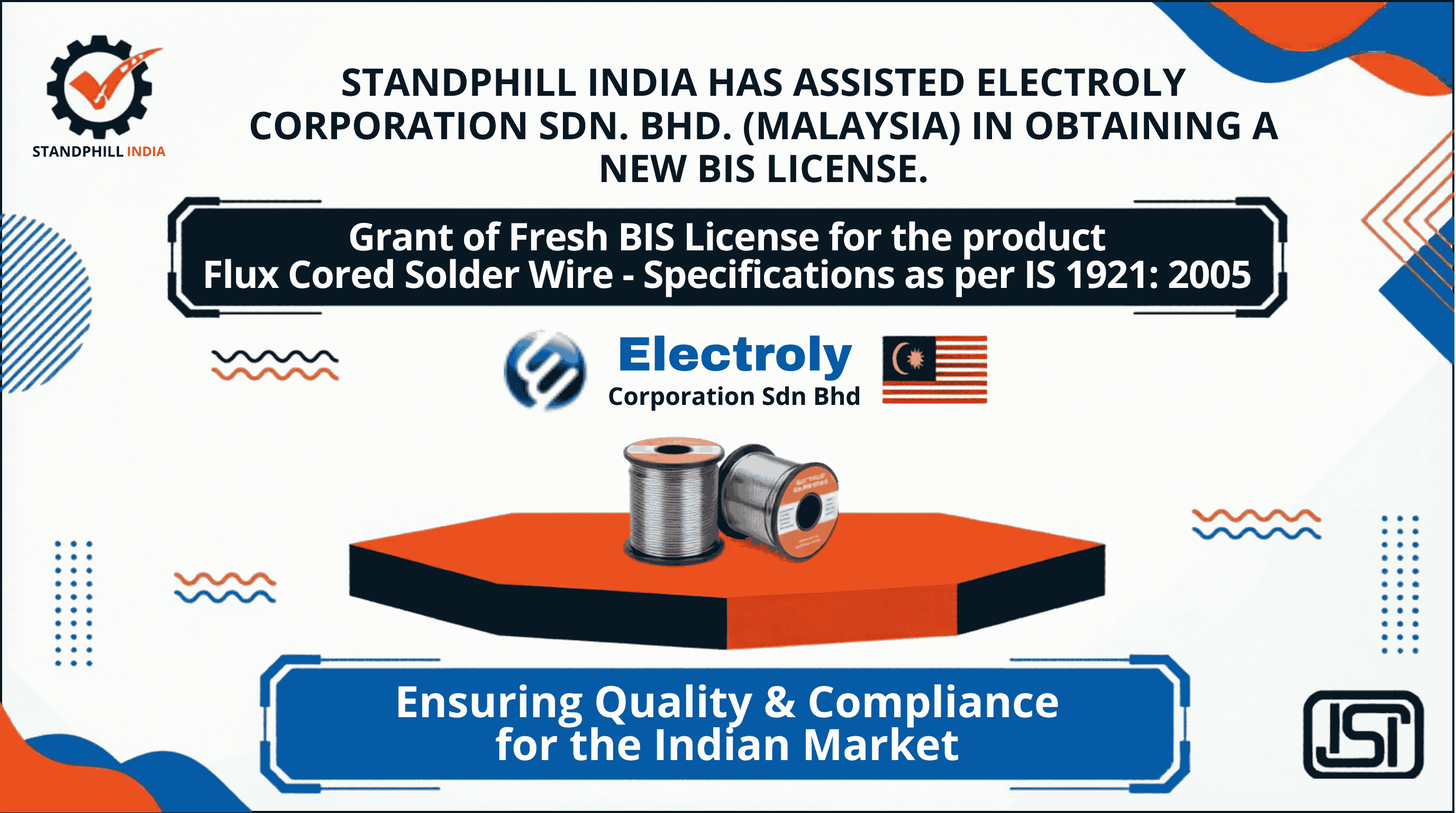
BIS Certification for Flux Cored Solder Wire IS 1921:2005 — Electroloy Malaysia
By Standphill India | BIS Certification Consultants | Updated: 2026 Category: BIS Certification | FMCS | Flux Cored Solder Wire | Success Story
Flux cored solder wire sold in India must meet BIS certification requirements under IS 1921 : 2005. In this article, we explain the complete BIS certification process for flux cored solder wire — what this standard covers, which grades and types are included, what documents you need, and how the FMCS process works for foreign manufacturers. We also share how Standphill India successfully helped Electroloy Corporation Sdn Bhd — a Malaysia-based solder manufacturer — obtain a fresh BIS ISI Mark Licence for Flux Cored Solder Wire in India.
Why the Indian Solder Wire Market Cannot Be Ignored
India's electronics manufacturing industry is no longer a secondary market. It is a global priority.
Following the government's Production Linked Incentive (PLI) schemes, the National Electronics Policy, and India's stated ambition to become a $300 billion electronics manufacturing economy, the country's consumption of soldering materials — including flux cored solder wire — has grown sharply and is set to grow further. PCB assembly units, contract manufacturers, EMS companies, automotive electronics suppliers, telecom equipment makers, and defence electronics producers — all of them consume flux cored solder wire at industrial scale.
For any serious solder wire manufacturer outside India — whether based in Malaysia, Singapore, China, Japan, South Korea, Germany, or the United States — this market is too large and too fast-growing to ignore. But entering it legally requires one non-negotiable step: BIS certification under IS 1921 : 2005.
Standphill India helped Electroloy Corporation Sdn Bhd do exactly that.
The Mandatory Compliance Trigger — DPIIT Quality Control Order, 2023
This is a critical compliance fact that every manufacturer, importer, and distributor of solder wire must understand.
On 18 September 2023, the Department for Promotion of Industry and Internal Trade (DPIIT), Ministry of Commerce & Industry, Government of India, issued the Flux Cored Solder Wire (Quality Control) Order, 2023. This order mandates that all flux cored solder wire manufactured in India or imported into India must:
• Conform to IS 1921 : 2005
• Bear the Standard Mark (ISI Mark) under a valid BIS licence
• Comply under Scheme-I of Schedule-II of the BIS (Conformity Assessment) Regulations, 2018
The enforcement timelines under this QCO are:
• Large Scale Industry / Foreign Manufacturers / Importers — 6 months from notification (enforceable from March 2024)
• Small Enterprises — 9 months from notification
• Micro Enterprises — 12 months from notification
As of March 2024, it is illegal to import or sell flux cored solder wire in India without a valid BIS licence. Any shipment without ISI Mark certification is subject to seizure, rejection at customs, and penalties under the BIS Act, 2016.
For foreign manufacturers like Electroloy Corporation Sdn Bhd, this QCO made BIS FMCS certification not just commercially important but a legal prerequisite for market entry.
What is IS 1921 : 2005?
IS 1921 : 2005 is India's official standard for Flux Cored Solder Wire — Specification (Second Revision), governed by the Bureau of Indian Standards under the Metallurgical Engineering Division. It is the definitive Indian technical document that specifies what a flux cored solder wire must be, how it must be made, and how it must perform.
What the Standard Covers
IS 1921 : 2005 covers requirements for rosin/no-clean flux cored solder wire — either activated or non-activated (non-corrosive) — of circular cross-section, having a single or multiple continuous core of flux.
The standard defines technical requirements across the following key parameters:
• Alloy Composition — Precise tin-lead alloy grades and permissible elemental compositions, including tolerances for impurities
• Solder Grades — Grade 60, 50, 40, 35, and 20 (referring to percentage tin content)
• Flux Type — Activated and Non-Activated flux cores
• Wire Diameter — Multiple standard wire diameters from fine-gauge precision wire to heavier industrial gauges
• Flux Content — Minimum and maximum flux core content as a percentage of total wire weight
• Melting Characteristics — Solidus and liquidus temperature requirements for each grade
• Wetting Ability — Solder spread and flow behaviour on a standard test substrate
• Spatter Resistance — Control of flux-induced spattering during soldering
• Workmanship — Surface finish, core continuity, and coil uniformity
• Chemical Testing — Verification of alloy composition via spectrometry
Why IS 1921 : 2005 Is More Demanding Than It Appears
Many manufacturers assume that because they already comply with international standards like IPC J-STD-006, JIS Z 3282, or EN ISO 9453, the BIS certification process will be straightforward. In practice, IS 1921 : 2005 has its own specific test methods, laboratory requirements, and documentary compliance structure that does not automatically map to other international standards. BIS will not accept test reports from laboratories that are not on their approved list — regardless of how reputable those laboratories may be internationally. The grading nomenclature (Grade 60, 50, 40, 35, 20) is India-specific and must be clearly reflected in the licence scope.
This is precisely why working with an experienced BIS certification consultant — rather than attempting the process independently — saves foreign manufacturers time, cost, and rejection risk.
What Happens Without BIS Certification?
The consequences of non-compliance are serious and enforceable:
• Customs Detention — Indian customs authorities are empowered to hold or reject consignments of notified products that do not carry the ISI Mark
• Market Seizure — BIS enforcement officers can seize non-certified products from warehouses, distribution channels, and retail points
• Financial Penalties — Violations are punishable under the BIS Act, 2016, which provides for fines and in serious cases, imprisonment
• Reputational Damage — Rejection at the border or market withdrawal damages the manufacturer's brand credibility with Indian buyers irreparably
• Contract Ineligibility — Government procurement, public sector tenders, and large enterprise supply chains will not accept non-BIS-certified solder materials under any circumstances
No legitimate distribution partnership in India — whether with a national electronics components distributor, an EMS company, or a government-linked procurement body — will onboard a foreign supplier without BIS certification for notified products.
Who is Electroloy Corporation Sdn Bhd?
Electroloy Corporation Sdn Bhd is a Malaysia-based solder manufacturer headquartered in Masai, Johor. Part of the Electroloy Group — originally established in Singapore in 1977 — the company has grown into one of Asia's recognised manufacturers and suppliers of soldering solutions for the electronics, semiconductor, and plating industries. The group has manufacturing facilities across Malaysia, China, and India, and holds ISO 9001 and ISO 14001 certifications, reflecting its commitment to quality management and environmental standards.
Electroloy's product portfolio spans solder bars, flux cored solder wire, solder paste, and other soldering consumables — all manufactured to international specifications for demanding industrial and electronics applications.
When Electroloy Corporation Sdn Bhd decided to formally enter the Indian market with their flux cored solder wire, they reached out to Standphill India for end-to-end BIS FMCS certification support. The result: a fresh grant of BIS ISI Mark Licence for Flux Cored Solder Wire as per IS 1921 : 2005.
What is BIS FMCS? — The Certification Path for Foreign Manufacturers
Since Electroloy Corporation Sdn Bhd is based in Malaysia, they were not eligible for standard BIS ISI Mark certification — that route is only available to manufacturers with production facilities in India. Instead, they applied through FMCS — the Foreign Manufacturers Certification Scheme.
FMCS is BIS's official pathway that allows manufacturers based outside India to obtain BIS certification for products they want to export and sell in the Indian market. It is the most internationally relevant of all BIS schemes, and it is the route that every serious foreign manufacturer must go through if they want legal access to India's market.
Authorized Indian Representative (AIR)
Every FMCS applicant must appoint an Authorized Indian Representative (AIR). This is a legally registered Indian entity who acts as the official point of contact between the foreign manufacturer and BIS. The AIR accepts legal responsibility for the certified products in the Indian market, communicates with BIS on behalf of the manufacturer, and ensures ongoing compliance after certification is granted.
This is not a formality. BIS requires the AIR relationship to be formally documented through an appointment letter and a notarised or apostilled power of attorney. Standphill India works with clients to ensure AIR appointment is correctly structured — avoiding the delays that arise from improperly formatted documentation.
Overseas Factory Audit
This is the aspect of FMCS that most foreign manufacturers find most challenging. Unlike CRS registration (which is lab-report based), FMCS requires a physical factory audit at the overseas manufacturing facility by BIS officials.
BIS inspectors travel to your factory — in Electroloy's case, to Johor, Malaysia — and conduct a detailed inspection of your manufacturing infrastructure, quality control systems, equipment, personnel competence, and production records. They verify that your factory is genuinely capable of consistently producing products to the quality levels claimed in your application.
The cost of the BIS officials' travel and stay during this audit is borne entirely by the applicant. Thorough preparation for this audit is critical — an unprepared factory risks non-conformity findings that delay or derail the entire certification.
Product Testing
Products must be tested at a BIS-approved, NABL-accredited laboratory. For flux cored solder wire under IS 1921 : 2005, the test parameters include alloy composition analysis, flux content determination, melting characteristics, wetting ability, spatter resistance, and dimensional checks. Test reports from laboratories not on BIS's approved list are not accepted — regardless of the laboratory's international reputation or accreditation.
The Complete BIS FMCS Certification Process — Step by Step
Step 1 — Standard Mapping and Scope Definition
Identify the exact Indian Standard that applies to your product — IS 1921 : 2005 for flux cored solder wire. Confirm that your product grades, wire diameters, and flux types fall within the standard's scope and define the exact licence scope to be declared in the application.
Step 2 — Appoint an Authorized Indian Representative (AIR)
Formally appoint an AIR in India before any application can be submitted. This appointment must be documented through an official letter and an apostilled or notarised power of attorney.
Step 3 — Product Testing at a BIS-Approved Laboratory
Dispatch representative product samples to a BIS-approved, NABL-accredited laboratory for testing against all applicable parameters of IS 1921 : 2005. Ensure test reports are comprehensive, correctly formatted, and valid.
Step 4 — Prepare and Compile Application Documents
Gather and prepare all required documentation — company registration, factory layout, machinery list, product specifications, manufacturing process details, quality system documents, and personnel records. Every document must be accurate, complete, and consistent with what BIS will verify during the factory audit.
Step 5 — Submit Application on the BIS Portal
Submit the complete FMCS application online through the official BIS portal (manakonline.in) along with all documents and the prescribed application fees.
Step 6 — BIS Document Scrutiny and Query Response
BIS officers review the application in detail. They may raise queries for clarification or additional information. All queries must be responded to promptly and accurately to keep the application moving forward.
Step 7 — Overseas Factory Audit by BIS Officials
BIS inspectors travel to your manufacturing facility for a physical audit. They verify your factory infrastructure, machinery, quality systems, and production capabilities. Thorough preparation for this audit is critical.
Step 8 — Grant of BIS FMCS Licence
After successful document scrutiny and factory audit, BIS grants the FMCS licence. Your products are now officially authorised for sale in India under the ISI Mark.
Step 9 — Ongoing Compliance — Surveillance and Renewal
FMCS certification requires ongoing compliance. BIS conducts periodic surveillance checks, and the licence must be renewed at the appropriate time. Staying on top of these obligations is essential to maintaining your market access.
How Standphill India Managed the Electroloy Corporation Certification
This is not a theoretical case study. This is what Standphill India actually did.
Standard Mapping and Scope Definition
We reviewed Electroloy Corporation's existing product grades, wire diameters, flux types (activated and non-activated), and solder compositions against the IS 1921 : 2005 scope. We defined the exact licence scope — the specific grades, sizes, and flux types — that would be declared in the BIS application and reflected in the final licence.
AIR Appointment and Legal Documentation
We facilitated the formal appointment of the Authorized Indian Representative, prepared the appointment letter and power of attorney in the format required by BIS, and ensured all legal documents were properly executed and apostilled as required for Malaysian documents to be legally valid in India.
Laboratory Coordination and Test Report Management
We identified the appropriate BIS-approved, NABL-accredited testing laboratory for flux cored solder wire, coordinated sample dispatch from Electroloy's Malaysia facility, monitored test progress, and reviewed all test reports before submission to confirm they covered every required parameter of IS 1921 : 2005 without gaps.
Complete Document Compilation for BIS Portal Submission
We compiled the full FMCS application package — company registration documents, factory layout, machinery list, quality system procedures, personnel records, raw material traceability documentation, and test reports — ensuring consistency across every document before submission through the BIS online portal (manakonline.in).
Factory Audit Preparation for Malaysia
This was one of the most critical stages. Before BIS officials arrived in Johor for the physical factory audit, Standphill India briefed the Electroloy team comprehensively. We prepared a detailed audit readiness checklist, reviewed their QC documentation, advised on the physical organisation of the factory and testing area, and ensured that all records BIS inspectors would want to examine were ready, organised, and accessible.
BIS Portal Submission and Query Management
We handled the complete online application submission through the BIS portal and managed all BIS communications, including responding accurately and promptly to all queries raised during document scrutiny.
Result
Electroloy Corporation Sdn Bhd received a fresh grant of BIS ISI Mark Licence for Flux Cored Solder Wire as per IS 1921 : 2005. They are now fully authorised to export and sell their solder wire products in the Indian market under the ISI Mark — legally compliant, fully audit-verified, and market-ready.
Why This Certification Opens Big Doors for Electroloy in India
Beyond the compliance box it ticks, this certification opens doors that were previously closed.
Government and PSU Procurement
India's public sector and government-linked electronics manufacturers — including defence electronics, railway signalling systems, and public sector telecom entities — mandate BIS-certified consumables in their procurement specifications. Electroloy is now eligible to supply these channels.
EMS and Tier-1 Electronics Manufacturers
India's growing contract electronics manufacturing sector — which serves global OEMs including Apple supply chain partners, Samsung, and automotive electronics Tier-1 suppliers — requires certified inputs. BIS certification is a vendor qualification prerequisite.
E-Commerce and National Distribution
Platforms like Amazon India, Flipkart B2B, and IndiaMART enforce BIS compliance for notified products. With ISI Mark certification, Electroloy can now be listed and distributed through these channels nationally.
Brand Credibility with Indian Buyers
Indian procurement professionals, quality managers, and sourcing engineers treat the ISI Mark as a quality signal. A foreign supplier with BIS certification stands in a fundamentally different position than an uncertified competitor.
ASEAN-India Trade Alignment
As ASEAN-India trade relations deepen under the ASEAN-India Free Trade Agreement (AIFTA) and subsequent frameworks, Malaysian manufacturers with Indian compliance certifications are well-positioned to become preferred supply partners for Indian industrial buyers sourcing from Southeast Asia.
Documents Required for BIS FMCS Certification (Flux Cored Solder Wire)
Here is a comprehensive list of the documents required for an FMCS application under IS 1921 : 2005:
Company and Legal Documents
Certificate of Incorporation (with apostille or notarisation as required), business registration and company profile, and bank account details of the overseas company.
AIR Documents
AIR Appointment Letter, Power of Attorney (apostilled, authorising AIR to act before BIS), and AIR's Indian identity and address proof.
Factory and Infrastructure Documents
Factory address proof, complete factory layout plan showing production, storage, QC lab, and dispatch areas, and full machinery and equipment list with specifications and capacity details.
Product and Technical Documents
Detailed product specifications for all grades, sizes, and flux types in scope, manufacturing process flow chart, raw material specifications and supplier details, and raw material incoming inspection procedures and records.
Quality System Documents
Written quality management system procedures, in-process inspection records and checkpoints, final product inspection and release records, and calibration records for all measurement and testing instruments.
Test Reports
Valid test reports from BIS-approved, NABL-accredited laboratories covering all parameters of IS 1921 : 2005.
Personnel Records
List of key technical, production, and quality control personnel with their qualifications, designations, and relevant experience details.
About Standphill India — Why Global Manufacturers Choose Us
Standphill India is India's leading BIS certification consultancy, headquartered in New Delhi, with over 20 years of exclusive expertise in BIS Registration, ISI Mark, FMCS, CRS Scheme, PESO, WPC, and EPR compliance. We are trusted by 1,000+ brands — Indian and international — to make their products market-ready in India.
BIS certification is not something we do on the side. It is everything we do. That singular focus — built and sharpened over more than two decades — is what makes us the partner of choice for businesses that are serious about getting certified correctly, quickly, and without unnecessary complications.
Verified Track Record Across Product Categories and Countries. From stainless steel pipes certified for South Korean manufacturers (HYG CO., LTD) to flux cored solder wire for Malaysian manufacturers (Electroloy Corporation Sdn Bhd) — our portfolio of verified FMCS certifications spans diverse product categories and multiple ASEAN, East Asian, and European countries. Every case on our website is a real certification, not a claim.
Deep Technical Reading of Indian Standards. We read and interpret Indian Standards — not just summarise them. When Standphill India assesses your product against IS 1921 : 2005, we identify scope boundaries, test parameter gaps, and documentation inconsistencies before they become BIS queries or audit non-conformities.
BIS-Approved Laboratory Network. Two decades of operation have given us established working relationships with BIS-approved, NABL-accredited laboratories across India. That translates to faster test turnarounds, accurate test report formats, and zero rework.
Factory Audit Preparation as a Core Service. For many foreign manufacturers, the overseas factory audit is the most anxiety-inducing part of FMCS. Standphill India converts that uncertainty into confidence — through structured pre-audit briefings, documentation reviews, and factory readiness guidance specific to what BIS inspectors actually check.
Post-Certification Compliance Management. BIS certification is not a one-time event. FMCS licences require ongoing surveillance compliance, marking obligations, and eventual renewal. Standphill India manages these obligations for our clients so that their market access remains uninterrupted.
End-to-End Accountability. From the day you engage Standphill India to the day your licence is granted — and beyond — you have one accountable partner managing the entire process. No fragmented handoffs, no hidden steps, no surprise costs.
Are You a Solder Wire Manufacturer or Importer Looking for BIS Certification?
Whether you are an Indian manufacturer, an importer of flux cored solder wire, or a foreign manufacturer like Electroloy Corporation Sdn Bhd looking to enter the Indian market — Standphill India is ready to help you navigate the BIS FMCS certification process from start to finish.
We have successfully certified solder materials, stainless steel products, electronics, construction materials, safety equipment, and dozens of other product categories across multiple BIS schemes. Whatever your product, whatever your country — we have the expertise to get you certified.
Get in touch with us today for a free consultation.
📞 +91 96676 74225
✉️ info@standphillindia.in
🌐 standphillindia.in
Standphill India — India's Leading BIS Certification Consultant. Your trusted partner in global compliance.
Congratulations to the entire team at Electroloy Corporation Sdn Bhd on this significant milestone. Standphill India is proud to have been your BIS FMCS certification partner and looks forward to supporting your continued growth in one of the world's most dynamic electronics markets.
Other Certification Services Offered by Standphill India
1. BIS ISI Mark Certification – Scheme I (Indian Manufacturers)
The ISI Mark certification under Scheme I is the primary BIS product certification for Indian manufacturers. It confirms that the product complies with the applicable Indian Standard and allows the manufacturer to use the ISI Mark. Standphill India provides end-to-end support for ISI Mark certification across all regulated product categories.
Read More: BIS Certification for Indian Manufacturers
2. BIS FMCS Certification – Foreign Manufacturers Certification Scheme
The FMCS scheme allows foreign manufacturers to obtain the ISI Mark licence for products they export to India. BIS conducts factory inspections overseas, and product samples are tested against Indian Standards. Standphill India provides complete FMCS support including AIR appointment, documentation, inspection preparation, and application management.
Read More: BIS FMCS Certification for Foreign Manufacturers
3. BIS CRS Registration – Compulsory Registration Scheme
The CRS scheme is the mandatory BIS registration system for notified electronic and IT products in India. It requires product testing in a BIS recognized laboratory, application submission, and BIS registration approval before the product can be sold in India. Standphill India handles complete CRS registration for electronic and IT product manufacturers.
Read More: BIS CRS Registration for Electronic Products
4. BIS Certification for Stainless Steel Products
Standphill India provides specialised BIS certification consultancy for stainless steel pipes, tubes, and other stainless steel products under relevant Indian Standards including IS 17875 and IS 17876.
Read More: BIS Certification for Stainless Steel Pipes & Tubes — HYG CO., LTD Case Study