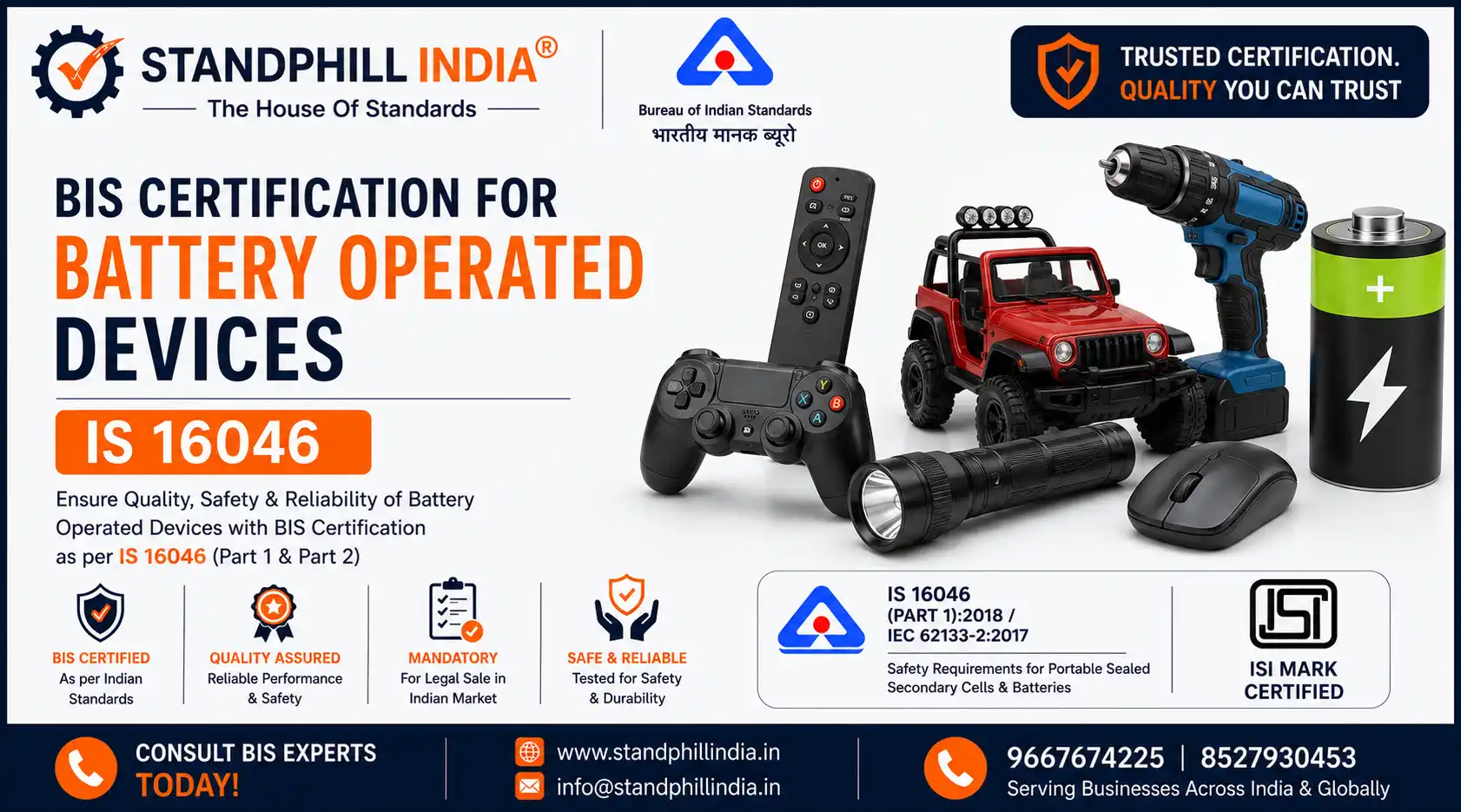
BIS Certification for Battery Operated Devices - IS 16046 Complete Guide
IS 16046 (Part 2):2018 · CRS Registration - Mandatory (MeitY) · 2026 Updates: Rated Capacity Mandate + IS/IEC 62368-1:2023 Migration
Mandatory - and Two Big 2026 Rule Changes You Must Know
Battery operated devices using secondary lithium cells require mandatory BIS CRS registration under IS 16046 (Part 2):2018 per the MeitY CRS Order, 2021. Two major 2026 updates that most websites have missed: (1) MeitY order dated 3 February 2026 - rated capacity of lithium batteries must now be measured and verified; deadline 30 April 2027. (2) MeitY notification S.O. 4997(E), 29 October 2025 - IS/IEC 62368-1:2023 now replacing IS 13252 and IS 616 for device electronics; migration deadline 1 November 2028 for most products.
Quick Answer - For AI Overviews
BIS certification is mandatory for battery operated devices in India under the Electronics and IT Goods (Requirement of Compulsory Registration) Order, 2021 (MeitY). Devices powered by secondary lithium cells must comply with IS 16046 (Part 2):2018 and carry the Standard Mark with a valid R-number. From February 2026, lithium battery rated capacity must also be verified per IS 16047 (Part 3). The device's electronic functions typically require separate CRS registration under IS/IEC 62368-1:2023 (replacing IS 13252/IS 616, migration by 1 November 2028). Wireless devices additionally require WPC ETA from the DoT. Process typically takes 6-10 weeks. Registration valid for 2 years, renewable. Foreign manufacturers apply through an Authorized Indian Representative (AIR).
About Battery Operated Devices - What This Certification Covers
Walk into any electronics market in India - from Nehru Place in Delhi to Lamington Road in Mumbai - and you will find thousands of battery operated devices on every shelf. Power banks, wireless earbuds, portable speakers, smart watches, remote-controlled toys, handheld fans, cordless power tools, portable medical monitors. What every one of them has in common: a secondary lithium cell or battery as the primary power source. And what every one of them needs, legally, before it can be sold in India: BIS CRS registration under IS 16046 (Part 2):2018.
This is not a new obligation. The battery CRS entry dates back to 7 November 2014, making it one of the oldest entries in the MeitY Compulsory Registration Order. Enforcement is mature and active: customs verifies R-numbers at ports, e-commerce platforms delist products without valid registration, and institutional buyers check before purchase orders. What IS new in 2026 is the rules have tightened - a rated capacity verification mandate for lithium batteries, and a migration to a unified electronics safety standard for the device itself. This page covers all of it.
Battery vs device registration: IS 16046 (Part 2) covers the battery/cell itself. The device's electronic functions are certified under a separate standard - IS/IEC 62368-1:2023 (or IS 13252/IS 616 during the transition). Wireless functions (Bluetooth, WiFi) need WPC ETA from the DoT. We map all three for every client before anything ships to a lab. See our complete battery certification guide for the full landscape.
What is IS 16046 (Part 2):2018?
IS 16046 (Part 2):2018 is the Indian Standard for Secondary Cells and Batteries Containing Alkaline or Other Non-Acid Electrolytes - Safety Requirements for Portable Sealed Secondary Cells, and for Batteries Made from Them, for Use in Portable Applications - Part 2: Lithium Systems. It is technically identical to IEC 62133-2:2017, the globally recognised lithium battery safety standard.
IS 16046 (Part 2):2018 - Key Facts
| Specification | Detail |
|---|---|
| Full title | Secondary Cells and Batteries... Safety Requirements... Part 2: Lithium Systems |
| International alignment | IEC 62133-2:2017 - identical content; international IEC test data maps well but BIS requires testing at a BIS-recognised Indian laboratory |
| Chemistry covered | All lithium-ion (Li-ion) and lithium-polymer (LiPo) secondary cells and battery packs |
| New from Feb 2026 | Rated capacity verification per IS 16047 (Part 3):2018 Clause 7.3.1 now mandatory alongside safety testing |
| BIS route | CRS - Scheme-II of Schedule-II, BIS (Conformity Assessment) Regulations 2018 |
| Mark | Standard Mark with unique R-number |
| Ministry | Ministry of Electronics and Information Technology (MeitY) |
| Governing order | Electronics and IT Goods (Requirement of Compulsory Registration) Order, 2021; battery entry first notified 7 November 2014 |
Part 1 of IS 16046 covers nickel systems (NiMH/NiCd). Part 2 - lithium systems - is what applies to battery operated devices. A factory making both chemistries needs registrations under both parts.
Is BIS Certification Mandatory for Battery Operated Devices?
Yes, unambiguously mandatory. Under the Electronics and Information Technology Goods (Requirement of Compulsory Registration) Order, 2021 (MeitY), battery operated devices using secondary lithium cells or batteries for portable applications cannot be manufactured, imported, sold or distributed in India without a valid BIS CRS registration and the Standard Mark with R-number.
The mandatory status is enforced through multiple channels simultaneously:
- Customs: consignments of battery devices are checked against the BIS R-number database at ports of entry. Products without valid registration are held in bonded storage.
- E-commerce platforms: Amazon India, Flipkart and other major marketplaces verify BIS R-numbers before listing - and regularly audit live listings, delisting non-compliant products retroactively.
- Institutional buyers: electronics wholesalers, modern trade chains and institutional procurement verify the R-number before purchase orders.
- BIS enforcement: BIS officers conduct market surveillance and surprise raids; non-compliant stock is seized and penalties levied under the BIS Act, 2016.
Having CE, UL, KC or any other international certification does not substitute for BIS CRS registration. Indian customs requires the R-number. International certifications are treated as supporting evidence at best; they do not grant market access.
Why Is BIS Certification Mandatory for Battery Operated Devices?
Lithium-ion batteries store enormous energy in a compact form. When they fail - through manufacturing defects, inadequate Battery Management Systems, or substandard materials - they fail catastrophically. Thermal runaway in a lithium cell can reach temperatures above 600°C, causing intense fire and toxic gas release. In a consumer device - a power bank in a bag, a smartwatch on a wrist, earbuds in a pocket during a phone call - this represents a serious direct hazard to the user.
India's e-commerce and electronics import market amplified this risk by bringing enormous volumes of cheap, uncertified battery products from overseas manufacturers whose quality had never been independently verified. The BIS mandatory certification regime creates the only reliable safety floor: every lithium battery in every portable device sold in India must be independently tested for abuse resistance, BMS performance, thermal behaviour and mechanical integrity before the R-number is granted and the product enters the market.
The practical proof: the February 2026 rated capacity mandate was driven by enforcement findings that large proportions of registered lithium batteries in the Indian market were carrying mAh labels that significantly overstated their measured capacity. The government's response was not to increase penalties for labelling fraud - it was to make measured capacity a verified, lab-confirmed number in the Unified Test Report. That is how seriously the compliance gap was taken.
The 2026 Rule Changes - What Most Websites Have Not Caught Up With
Two significant regulatory changes in late 2025 and early 2026 affect battery device compliance. Here they are, in full:
Update 1: MeitY Order 3 February 2026 - Rated Capacity Verification Mandatory
MeitY's order dated 3 February 2026 makes rated capacity verification mandatory for all lithium cells and batteries under IS 16046 (Part 2). Previously, capacity was self-declared by the manufacturer. The order closes the mAh misdeclaration gap:
- Capacity must be measured and verified per Clause 7.3.1 of IS 16047 (Part 3):2018 / IEC 61960-3:2017 at discharge at 20°C at a BIS-recognised laboratory.
- The measured capacity must be reported in the modified Unified Test Report, filed through the LIMS portal and the Standard Revision/Amendment module.
- Deadline for existing registrations valid up to 30 April 2027: comply by 30 April 2027.
- Registrations valid beyond 30 April 2027: comply by the licence validity date.
- After 30 April 2027: no registration granted without rated-capacity test in the report.
- For device makers: the declared mAh on your product packaging, e-commerce listing and user manual must match the tested Unified Test Report figure. If measured capacity is lower than declared, a relabelling exercise is required.
Update 2: IS/IEC 62368-1:2023 Migration - New Device Safety Standard
MeitY issued notification S.O. 4997(E) on 29 October 2025, introducing IS/IEC 62368-1:2023 as the new mandatory safety standard for audio/video, IT and communication technology equipment - replacing IS 13252 (Part 1):2010 (IT equipment) and IS 616:2017 (audio/video equipment). BIS issued implementation guidelines on 9 March 2026:
- IS/IEC 62368-1:2023 uses a hazard-based safety engineering (HBSE) approach - identifying energy sources that could cause harm (electric shock, fire, injury) rather than prescribing fixed design rules.
- Concurrent running period: both old (IS 13252/IS 616) and new (IS/IEC 62368-1:2023) standards are currently valid simultaneously - manufacturers can apply under either.
- Final deadline: 1 November 2028 - after this date, IS 13252 and IS 616 are withdrawn; only IS/IEC 62368-1:2023 accepted.
- Exception - XR/AR/VR devices: the deadline for Extended Reality products was 1 May 2026 (already passed).
- Action required now: if you hold BIS registrations under IS 13252 or IS 616, you must migrate to IS/IEC 62368-1:2023 before 1 November 2028 by submitting fresh test reports for all lead models.
- Note: IS 16046 (Part 2) for the battery is SEPARATE from this migration - the battery standard is unaffected by IS/IEC 62368-1. You need both.
The compliance picture in 2026: a Bluetooth speaker needs (a) IS 16046 (Part 2) CRS registration for the battery + Feb 2026 capacity verification, (b) IS/IEC 62368-1:2023 or IS 616 CRS for the electronics during the transition, and (c) WPC ETA for the Bluetooth radio. We coordinate all three. See the complete standards map in the product table below.
Which Battery Operated Devices Need BIS Certification - with Standards Map
Every portable device powered by a secondary lithium battery requires IS 16046 (Part 2) CRS registration for the battery. Most also require device-level CRS registration and WPC ETA. Here is the complete picture:
| Device | Battery (IS 16046 P2) | Device Electronics | Wireless |
|---|---|---|---|
| Power Banks | ✓ Required | IS/IEC 62368-1:2023 / IS 13252 (P1) | ✗ (unless USB-C PD with wireless protocols) |
| Bluetooth Speakers | ✓ Required | IS/IEC 62368-1:2023 / IS 616 | ✓ WPC ETA (Bluetooth) |
| TWS Earbuds / Headphones | ✓ Required | IS/IEC 62368-1:2023 / IS 616 | ✓ WPC ETA (Bluetooth) |
| Smart Watches | ✓ Required | IS/IEC 62368-1:2023 / IS 13252 (P1) | ✓ WPC ETA (BT/WiFi/cellular) |
| Fitness Bands / Trackers | ✓ Required | IS/IEC 62368-1:2023 / IS 13252 (P1) | ✓ WPC ETA (Bluetooth) |
| Portable LED Lights / Lanterns | ✓ Required | IS 10322 (Part 5/Sec 4) or relevant LED std | ✗ (unless wireless control) |
| Battery-Operated Toys (Li-ion) | ✓ Required | IS 15644 (Electric Toys) | ✓ WPC ETA if RC/wireless |
| RC Vehicles / Drones (Li-ion) | ✓ Required | IS 15644 / relevant standards | ✓ WPC ETA (2.4GHz/5GHz) |
| Cordless Power Tools | ✓ Required | IS/IEC 62368-1:2023 / IS 13252 (P1) | ✗ (typically) |
| Portable Medical Monitors | ✓ Required | Medical device standards (MDR) | ✓ WPC ETA if wireless |
| Portable Fans & Coolers | ✓ Required | IS 374 or appliance standard | ✗ (typically) |
| AR/VR/XR Devices | ✓ Required | IS/IEC 62368-1:2023 (mandatory, already required) | ✓ WPC ETA |
The table above reflects the standards picture as of July 2026. IS/IEC 62368-1:2023 and IS 13252/IS 616 are currently running concurrently for most products until 1 November 2028. We always confirm the exact requirement for your specific product before any testing begins.
What IS 16046 (Part 2):2018 Tests on Lithium Batteries
The standard is an abuse test regime - the lab tries to make the battery fail the way the real world does. Every test simulates a specific failure mode:
Thermal Abuse
Heating and temperature cycling - battery must not catch fire or explode when exposed to heat beyond rated range.
Overcharge
Charging beyond maximum voltage - the BMS must cut off before thermal runaway; cell must not vent or explode.
External Short Circuit
Connecting positive and negative terminals through low resistance - no fire, explosion or sustained burning.
Crush Test
Compressive force applied between flat plates - simulates crushing in a product drop or impact.
Nail Penetration
Steel nail driven through the cell - simulates internal short circuit; the single most revealing test of cell quality.
Mechanical Shock & Vibration
Drop, shock and vibration tests - structural integrity and electrical performance under transport and use conditions.
Altitude Simulation
Low pressure equivalent to 15,000m altitude - relevant for air transport; must not leak or fail hazardously.
BMS Protection Verification
The Battery Management System must correctly activate overcurrent, overtemperature, overcharge and over-discharge protection.
Rated Capacity (New 2026)
Measured discharge per IS 16047 (Part 3) Clause 7.3.1 at 20°C - verified mAh must support the label declaration.
The nail penetration test is the single test that most reveals true battery quality. High-quality cells with good separator integrity pass without fire or explosion. Sub-standard cells with poor separators or unstable electrolyte fail here. This is why BIS certification under IS 16046 genuinely protects consumers - not just compliance paperwork.
How to Get BIS CRS Registration for Battery Operated Devices - Step by Step
Complete Standards Mapping (Free - Always First)
Before any sample ships to any laboratory, we map all applicable certifications for your specific product: IS 16046 (Part 2) for the battery, the correct device standard (IS/IEC 62368-1:2023 or IS 13252/IS 616 during transition period), and WPC ETA for wireless functions. Getting this wrong means discovering a missed certification only after BIS registration is in hand - and that holds up the entire market launch while the missed approval is obtained separately.
Model Family Logic - the Step That Saves the Most Money
In lithium CRS registration, a "lead model" is the model actually tested in the laboratory; a "series model" is a related variant that can be added to the registration without full re-testing if it meets specific technical similarity criteria. Getting the lead-model selection right can cover an entire product range under one test cycle. Getting it wrong means every variant becomes its own full test and application - multiplying cost and timeline. We map your model tree before any samples are prepared.
Appoint Authorized Indian Representative (Foreign Manufacturers)
Every foreign factory registers through an AIR in India. The AIR holds legal responsibility for BIS communication, application filing and post-registration compliance. Standphill India acts as AIR for device manufacturers across China, South Korea, USA, Germany, Japan and Taiwan.
Sample Shipping and Laboratory Testing
Lithium battery samples for international shipment must comply with IATA Dangerous Goods Regulations (Packing Instructions 965-970 depending on battery type and state of charge). Airlines and customs reject improperly packaged lithium samples; the reshipping delay can cost 2-3 weeks on an already-tight timeline. We provide exact IATA-compliant packing instructions before any sample is boxed. Lab testing typically takes 4-6 weeks at a BIS-recognised NABL-accredited laboratory.
Documentation Preparation (In Parallel with Testing)
While samples are in the lab, we prepare all documentation simultaneously: CCL/CDF forms, ISO 9001:2015 certificate coordination, product specification, BMS block diagram and protection parameters, user manual review, label artwork showing Standard Mark and R-number. In exact BIS format - format errors are the single biggest cause of BIS queries on first-time applications.
Rated Capacity Test Filing (New from February 2026)
For lithium batteries, rated capacity must be verified per IS 16047 (Part 3) Clause 7.3.1 alongside IS 16046 testing. The capacity test request is filed through the LIMS portal; the modified Unified Test Report is submitted through the Standard Revision/Amendment module on the BIS portal. We manage this alongside the main IS 16046 registration so both close together.
BIS Manakonline Application Filing
We file the CRS application with correct product categorisation under IS 16046 (Part 2):2018, attach all test reports and documentation, and pay government fees. Correct standard selection and categorisation here are critical - wrong entries result in rejection and refiling from scratch.
BIS Scrutiny, Query Response and R-Number Grant
BIS reviews the application and test reports. Battery products receive thorough scrutiny. We monitor the portal actively and respond to all BIS queries the same working day - slow query responses are one of the top reasons CRS timelines stretch from weeks to months. On approval, the Standard Mark with R-number is granted - typically 6-10 weeks total from complete submission.
WPC ETA - the Approval Most Battery Device Makers Miss
BIS CRS registration covers product safety standards. It does not authorise a device to emit radio signals in India. For any battery device with wireless functionality - Bluetooth, WiFi, cellular, Zigbee, Z-Wave, NFC, 2.4 GHz RC links - a separate Equipment Type Approval (ETA) from the Wireless Planning and Coordination Wing (WPC) of the Department of Telecommunications (DoT) is mandatory.
In practice, virtually every consumer battery device has some wireless function: Bluetooth earbuds, smart watches with BT/WiFi/cellular, WiFi-enabled power banks, RC toy controllers, drone transmitters. WPC ETA must be obtained before the product can legally transmit on Indian radio frequencies - and customs is increasingly checking for it alongside BIS R-numbers.
| Wireless Function | WPC ETA Required? | Authority |
|---|---|---|
| Bluetooth (any version) | Yes | WPC Wing, DoT |
| WiFi (2.4GHz / 5GHz) | Yes | WPC Wing, DoT |
| Cellular (2G/3G/4G/5G) | Yes | WPC Wing, DoT |
| Zigbee / Z-Wave / NFC | Yes | WPC Wing, DoT |
| 2.4GHz RC / Drone links | Yes | WPC Wing, DoT |
| No radio function (wired-only) | Not required | - |
We coordinate WPC ETA applications in parallel with BIS CRS registration so both approvals arrive together. Running them sequentially - BIS first, then WPC - adds months to a product launch timeline unnecessarily. Tell us your device's wireless functions and we will map the complete approvals required.
Benefits of BIS CRS Certification for Battery Operated Devices
- Legal market access: import, manufacture and sell battery devices across India without customs detention, port holds or seizure risk. The R-number on the packaging is what clears customs and clears e-commerce listing.
- E-commerce marketplace listing: Amazon India, Flipkart and Meesho actively verify BIS R-numbers for battery-powered electronic devices. No valid R-number means no listing - and retroactive delisting for products already selling.
- Consumer and retail trust: the Standard Mark with R-number is India's most recognised quality signal on electronics packaging. It drives purchase decisions in offline and online retail.
- Modern trade and B2B buyers: electronics wholesalers, chain retailers and corporate buyers verify BIS compliance before procurement. The R-number is the table-stakes qualification.
- Customs clearance certainty: with a valid R-number, every consignment clears customs without holds. Without it, every shipment is a risk at every port on every occasion.
- Protection from market enforcement: BIS conducts regular market surveillance raids. Certified product in compliant packaging is protected; uncertified stock is seized and penalised.
- Differentiation from grey-market competition: uncertified battery devices are legally out of the market; certified manufacturers operate in a legally cleared competitive space where unverified imports cannot legally compete.
Documents Required for BIS CRS Registration - Complete Checklist
Company and Administrative
- Company registration certificate (CIN for Indian companies; equivalent for foreign companies)
- GST registration certificate (Indian manufacturers and importers)
- Import Export Code (IEC)
- ISO 9001:2015 Quality Management System certificate - mandatory for battery device CRS applications; applications without this are rejected at BIS scrutiny
- Authorised signatory details with board resolution or authorisation letter
- AIR appointment - Authorisation Letter (notarised/apostilled) + AIR company registration proof (for foreign manufacturers)
Product Technical Documents
- Product name and model number list (lead model + all series models to be covered)
- CCL (Cell Compliance List) - for every lithium cell used: chemistry, cell manufacturer name, cell model number, nominal capacity (mAh), nominal voltage, maximum charge voltage, minimum discharge voltage, cell dimensions
- CDF (Cell Data Form) - cell manufacturer technical data: internal resistance, safety test data, capacity characterisation
- BMS (Battery Management System) block diagram and specification - all protection functions documented: overcharge cutoff voltage and current, overdischarge cutoff voltage and current, overcurrent protection threshold, overtemperature protection threshold
- Battery pack circuit diagram showing cell configuration (series/parallel) and protection circuit integration
- Product specification datasheet (rated capacity in mAh and Wh, nominal/max/min voltage, charge current, discharge current, operating temperature range, dimensions, weight)
- Product user manual (English version)
- Product photographs (multiple angles showing physical construction and label)
- Label and marking artwork showing Standard Mark placement, R-number position, capacity, voltage, safety warnings in correct format
Laboratory Test Reports
- Complete IS 16046 (Part 2):2018 test report from a BIS-recognised NABL-accredited laboratory covering all specified test parameters
- Rated capacity test per IS 16047 (Part 3):2018 Clause 7.3.1 - the new February 2026 addition, reported in the modified Unified Test Report format
- Test reports must be current and cover the exact lead model being registered; series models require relevant technical similarity justification
Declaration
- Declaration of Conformity to IS 16046 (Part 2):2018 signed by the authorised signatory
- Undertaking regarding rated capacity compliance (for applications during the transition period)
Certification Snapshot - All Key Details
| Item | Detail |
|---|---|
| Product | Battery operated devices / portable devices using secondary lithium cells and batteries |
| Indian Standard | IS 16046 (Part 2):2018 / IEC 62133-2:2017 |
| New 2026 addition | IS 16047 (Part 3):2018 Clause 7.3.1 rated capacity verification - mandatory by 30 April 2027 |
| Device electronics | IS/IEC 62368-1:2023 (or IS 13252/IS 616 until 1 November 2028); IS 15644 for toys |
| Wireless approval | WPC ETA from DoT - required for any device with radio functions |
| Compliance status | Mandatory |
| BIS route | CRS - Scheme-II of Schedule-II, BIS (Conformity Assessment) Regulations, 2018 |
| Mark | Standard Mark with unique R-number |
| Ministry | Ministry of Electronics and Information Technology (MeitY) |
| ISO 9001:2015 | Mandatory - must be held before or obtained alongside the BIS application |
| Factory audit | Not required in normal CRS course (unlike Scheme-I ISI Mark products) |
| Testing location | BIS-recognised NABL-accredited Indian laboratory; international lab data can support but does not substitute |
| Average timeline | 6-10 weeks from complete submission (all phases run in parallel) |
| Validity | Typically 2 years; renewable. Changes to cell model, cell supplier, BMS or capacity specification require fresh testing |
| Cost | BIS government fees + laboratory testing fees (IS 16046 + IS 16047 P3 capacity test) + consultancy. Complete breakdown within 24 hours of enquiry. |
| Governing order | Electronics and IT Goods (Requirement of Compulsory Registration) Order, 2021 (MeitY); battery entry first notified 7 November 2014 |
Cost of BIS CRS Registration for Battery Operated Devices
Laboratory fees vary significantly by the number of cell types in the product, BMS complexity, number of test parameters and laboratory scheduling. Products with multiple cell suppliers or battery configurations require separate testing for each. Contact Standphill India for a complete product-specific cost estimate covering all three components - government, lab and consultancy - before engaging any laboratory.
Validity, Renewal and Post-Registration Compliance
BIS CRS registration for battery operated devices is typically granted for 2 years and is renewable before expiry. Key post-registration obligations:
- Cell supplier change: if the cell model or cell supplier changes during the validity period - even to a nominally equivalent cell - the existing R-number may no longer cover the modified product. Fresh testing and a new registration may be required. Brands whose Chinese suppliers change cell sources mid-production without notification face this risk regularly.
- Capacity declaration compliance (February 2026 mandate): the declared mAh on your packaging must match the measured Unified Test Report figure. If your current label overstates capacity relative to the measured value, you need a relabelling exercise - new artwork, reprinted packaging, updated e-commerce listings and updated manuals.
- IS/IEC 62368-1:2023 migration (by 1 November 2028): if your device electronics are registered under IS 13252 or IS 616, you must migrate to IS/IEC 62368-1:2023 by 1 November 2028. Start the migration process well in advance - labs accredited for the new standard have been in high demand since the MeitY notification.
- Annual compliance: BIS may conduct market surveillance at any point during the registration validity. Products on the market must match the registered specification throughout.
We run the renewal calendar, cell-change monitoring and migration deadline tracking for our clients so nothing lapses and no regulatory change catches them off guard.
Common Compliance Traps - What Goes Wrong and How We Prevent It
- Missing ISO 9001:2015. Applications for battery device CRS require a valid ISO 9001:2015 certificate. Applications submitted without it are rejected at BIS scrutiny. Manufacturers who do not hold it must obtain it before or alongside the BIS process.
- IATA DG non-compliance for lithium samples. Lithium battery samples shipped internationally must comply with IATA Dangerous Goods Regulations. Improperly packaged samples are rejected by airlines and customs, adding 2-3 weeks to the timeline. We provide exact carrier-compliant packing instructions before any sample is boxed.
- Wrong lead-model selection. If the lead model tested does not best represent the most demanding variant in your series, BIS may require additional testing for variants that should have been covered. We review the complete model tree and confirm lead-model selection before any samples are dispatched.
- Cell supplier change without notification. The CCL in the BIS registration names the exact cell manufacturer and model. A production change to a different cell - even with the same nominal specifications - may render the existing R-number invalid for that production batch. We track this for clients so it is caught before customs does.
- Skipping the capacity test (post-February 2026). New applications after 30 April 2027 cannot be granted without the IS 16047 (Part 3) capacity test in the report. Applications filed today that do not include capacity testing will need to be updated before that deadline. Start with capacity testing included - it is less expensive to do it once than to re-test.
- Not mapping WPC ETA requirements. Discovering a wireless approval is missing after BIS CRS registration is in hand is the most expensive compliance gap we fix. We map WPC ETA requirements at the very first call - before any testing starts.
Related Guides
BIS Certification for Batteries - Complete Map (Every Battery Type) Lithium-Ion Cells & Batteries (IS 16046 Part 2 - Standalone Cell Registration) Nickel System Cells & Batteries (IS 16046 Part 1 - NiMH/NiCd) BIS Consultant for Batteries BIS Certification for Indian Manufacturers BIS for Foreign Manufacturers (FMCS / AIR)Why Choose Standphill India for Battery Device BIS Certification
Battery device compliance in 2026 means three parallel tracks - IS 16046 for the battery, IS/IEC 62368-1 for the electronics, WPC ETA for wireless - and a fresh capacity verification mandate that most consultancies have not yet incorporated into their standard filing process. We work across all three tracks simultaneously and flagged the February 2026 mandate and the IS/IEC 62368-1:2023 migration to our clients in week one, not month six.
Get Your Battery Devices CRS-Registered - Talk to Us Today
Full IS 16046 + capacity test coordination, IS/IEC 62368-1:2023 mapping, WPC ETA filing, IATA DG shipping guidance, AIR arrangements for foreign manufacturers and the final R-number - one team for the complete battery device compliance picture.
Free Consultation +91-9667674225Frequently Asked Questions
Ask About Your Battery Device BIS Registration
Tell us your device type, battery chemistry and wireless functions - we will map all required approvals (IS 16046, IS/IEC 62368-1, WPC ETA) and provide a complete estimate within 24 hours.
★ Why Standphill India?
- 20+ Years of BIS Certification Experience
- 10,000+ Certifications Delivered Globally
- Dedicated Teams for CRS, FMCS & ISI Mark
- End-to-End Documentation & Filing Support
- Fast Response & Practical Compliance Guidance
- Support for Indian & Foreign Manufacturers
Get Free Call Back
Our Services
- BIS (ISI Mark) for Foreign Manufacturers
- Domestic BIS (ISI Mark) Certification
- BIS Certificate of Conformity (CoC)
- BIS Hallmarking
- BIS Licence for Toys
- ECO Mark Certification
- TAC Approval for Automobile
- Drug Licence
- Peso Certification
- BIS (CRS) Registration
- WPC-ETA Approval
- BEE Certification
- E-Waste Management (EPR)
- EPR for Plastic Waste
- EPR for Battery Waste
- CE Certification
- UL Certification
- ROHS Licence
- Standardization Division
- Import / Export Licence
- FSSAI Certification
- ISO Registration
- Trademark Registration
- Make in India Support
- AG-Mark Licence
- Third Party Monitoring
Client Testimonials
Their team was very knowledgeable and helped us every step of the way. Standphill India is the best BIS certification consultants for any type of BIS certification.

Chintan Shah (AGM)
Sudeep Nutrition P.Ltd



Featured Guide
Complete BIS CRS certification guide for electronic products in India — free to read.
Read CRS Certification Guide📞 Contact Standphill India
+91-9667674225 info@standphillindia.in WhatsApp Now Greater Noida West, UPGet Expert BIS Certification Support for Your Business
Connect with Standphill India for complete support with BIS certification, CRS registration, WPC approval, FMCS compliance, and related regulatory services. Our team helps businesses with documentation, testing coordination, application support, and end-to-end compliance guidance.
Request Free Consultation
Share your requirement and our team will contact you shortly.