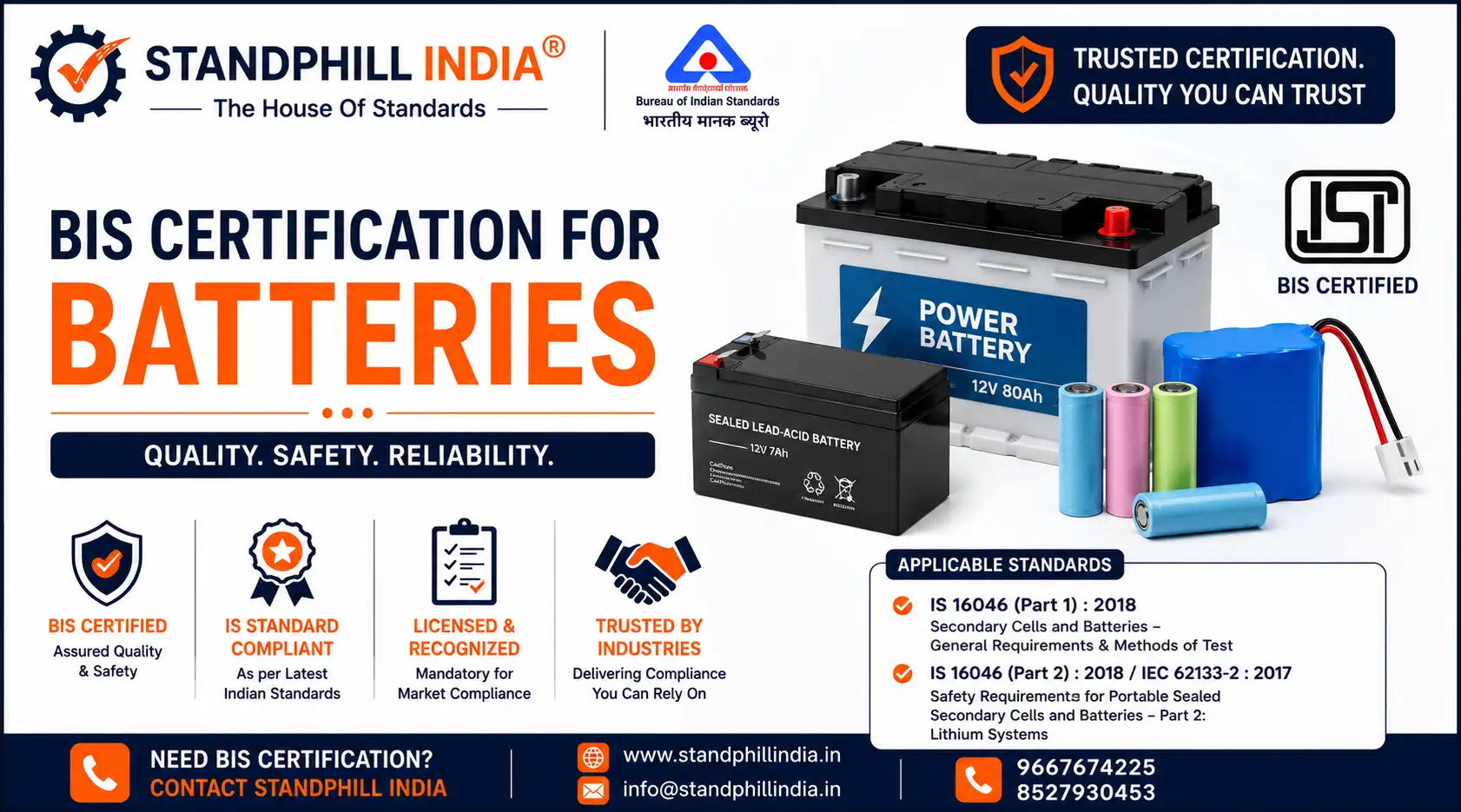
BIS Certification for Batteries - the Complete Map, Every Battery Type
CRS (IS 16046) · ISI (IS 8144) · Voluntary (Lead-Acid, Solar, BESS) · EV (AIS-156) - Mandatory vs Voluntary, Settled in One Page
Batteries Are Not One Product in Indian Law - They Are Four
Lithium and nickel rechargeables: mandatory CRS registration (IS 16046, MeitY). Zinc-carbon dry cells: mandatory ISI Mark (IS 8144, Scheme-I with factory audit). Lead-acid, solar and BESS: voluntary BIS today (plus mandatory BWMR EPR). EV traction packs: mandatory under AIS-156 - not BIS. Getting the route wrong means detained consignments or paying for certification you never needed. This page settles it - including the fresh 3 February 2026 rated-capacity mandate for lithium.
Which Batteries Need BIS - the One Table That Settles It
Ask "is BIS certification mandatory for batteries?" and you will get five confident, contradictory answers - because the honest answer is: it depends entirely on the battery. Indian law splits batteries across two BIS routes, one automotive regime and a voluntary layer, run by three different arms of government. Here is the entire map in one table - each row links to its dedicated deep-dive guide:
| Battery Type | Standard / Route | Status | Dedicated Guide |
|---|---|---|---|
| Lithium-ion / LiPo cells & batteries (portable applications) | IS 16046 (Part 2):2018 - CRS, MeitY | MANDATORY + Feb 2026 capacity mandate | Lithium-Ion Cells & Batteries |
| NiMH / NiCd cells & batteries (portable applications) | IS 16046 (Part 1):2018 - CRS, MeitY | MANDATORY | Nickel System Cells & Batteries |
| Zinc-carbon dry batteries (AA/AAA/C/D primary) | IS 8144 - ISI Mark, Scheme-I | MANDATORY (decades-old QCO) | Multipurpose Dry Batteries |
| Battery operated devices (power banks, TWS, wearables...) | IS 16046 (Part 2) + device standards - CRS | MANDATORY | Battery Operated Devices |
| Lead-acid batteries (auto, inverter, stationary, VRLA) | IS 14257 / IS 7372 / IS 1651 / IS 13369 / IS 15549 | VOLUNTARY + BWMR EPR mandatory | Lead-Acid Batteries |
| Solar PV batteries | IS 16270 - voluntary ISI | VOLUNTARY (tender-driven) | Solar & Storage Batteries |
| Stationary BESS | IS 17424:2020 - voluntary | VOLUNTARY (procurement reference) | Solar & Stationary BESS |
| EV traction battery packs | AIS-156 / AIS-038 Rev.2 - MoRTH regime; IS 16893 voluntary | MANDATORY - but NOT BIS | EV Clarity Section |
Bookmark rule of thumb: rechargeable + portable = CRS registration (MeitY). Single-use zinc-carbon = ISI Mark (Scheme-I). Lead-acid / solar / BESS = voluntary BIS today. EV pack = AIS-156, not BIS. Everything else on this page is the detail behind those four lines.
Route 1 - CRS Registration for Lithium & Nickel Batteries (Mandatory)
The biggest slice of the battery market - every rechargeable lithium and nickel cell and battery for portable applications - sits under the Electronics and Information Technology Goods (Requirement of Compulsory Registration) Order, 2021, issued by the Ministry of Electronics and Information Technology (MeitY). Batteries are one of the oldest CRS entries, first notified on 7 November 2014, so enforcement here is mature: customs checks R-numbers, marketplaces verify them against the BIS database, and unregistered stock gets delisted and seized as routine.
The mechanics: testing at a BIS-recognised laboratory against IS 16046 (Part 1) for nickel systems or IS 16046 (Part 2) for lithium systems, an online application, and grant of a Standard Mark with a unique R-number - per manufacturer, per factory location. Foreign factories register through an Authorized Indian Representative (AIR). No factory audit in the normal course - which is why CRS runs faster (typically 4-6 weeks) than the ISI route.
The February 2026 Rated Capacity Mandate - the Update Most Sites Missed
Fresh and consequential: by order dated 3 February 2026, MeitY made rated capacity verification mandatory for lithium cells and batteries under IS 16046 (Part 2). The trigger was rampant mAh misdeclaration; the fix is measurement - capacity must now be tested per Clause 7.3.1 of IS 16047 (Part 3):2018 / IEC 61960-3:2017 (discharge performance at 20°C) at a BIS-recognised lab and reported in the modified Unified Test Report.
- Registrations valid up to 30 April 2027: comply by 30 April 2027.
- Registrations valid beyond that: comply by the licence validity date.
- After 30 April 2027: no registration granted without rated-capacity testing in the report.
Full detail, filing route (LIMS + Standard Revision/Amendment module) and relabelling implications on our lithium-ion batteries guide. If you hold lithium registrations today, this is your 2026-27 compliance project.
Route 2 - the ISI Mark for Dry Batteries (Mandatory, and Older Than CRS)
The AA in your remote follows a different law entirely. Multipurpose dry batteries - zinc-carbon primary cells in R03/R6/R14/R20 sizes - have been under compulsory ISI certification for decades, via the Multipurpose Dry Batteries (Quality Control) Order issued in the BIS Act, 1986 era. The route is Scheme-I: factory assessment, sample testing at Indian BIS-recognised labs, and a licence with a CM/L number - the classic ISI Mark process, with the 2026 upgrade that licences now run up to 5 years.
Myth-buster, because even consultant websites get this wrong: IS 8144 dry batteries are NOT a CRS product. A CRS registration does not cover dry cells, and importers who assumed otherwise have watched AA consignments sit at Nhava Sheva. Rechargeable and single-use batteries of the same size follow different laws - chemistry decides the route, not shape.
The Voluntary Layer - Lead-Acid, Solar, BESS (and the EV Boundary)
Everything else in the battery world is - today - voluntary at BIS, with two big caveats: buyers often make it commercially mandatory, and the regulatory direction is one-way. The quick tour:
Lead-Acid (All Types)
No QCO as of July 2026 - voluntary ISI under IS 14257/7372/1651/13369/15549; BWMR 2022 EPR is the mandatory piece.
Solar PV Batteries
IS 16270 voluntary - but MNRE-linked schemes and tenders demand compliance in practice.
Stationary BESS
IS 17424:2020 voluntary - the reference standard in utility and C&I procurement.
EV Traction Packs
Mandatory under AIS-156/AIS-038 via ARAI/ICAT - the automotive regime, not BIS; IS 16893 available voluntarily.
Deep dives: lead-acid batteries (including the BWMR EPR obligations) and solar, storage & EV batteries (including the AIS-156 clarity most of the market lacks).
Who Needs Registration or Licence - India & Abroad
Apply for CRS registration directly to BIS - lab testing of your cells/batteries at a BIS-recognised laboratory, online application, and grant of the R-number. See our Indian manufacturers guide.
Foreign factories register through an Authorized Indian Representative (AIR) - each manufacturing location needs its own registration. See our foreign manufacturers guide.
One CRS detail that surprises people: the registration is granted per factory location, per Indian Standard, per brand/model series. A brand sourcing cells from two Chinese factories needs two registrations; a factory making both cells and packs may need the models covered appropriately. And traders or importers cannot hold the registration - it always belongs to the actual manufacturer, with the AIR carrying legal responsibility in India for foreign makers.
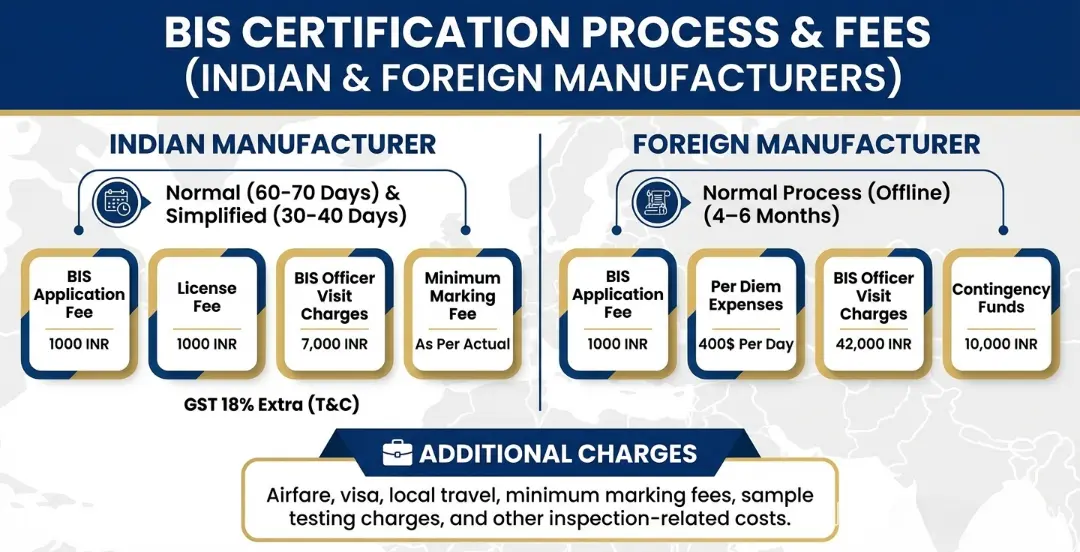
For the ISI-route products (dry batteries, voluntary lead-acid/solar licences), the process adds a factory assessment and runs through FMCS for foreign plants - our Indian and foreign manufacturer guides carry the step-by-step for both routes.
Documents Required
Documentation falls into three broad groups. Getting the format right is the single biggest cause of delay for first-time applicants, which is exactly the part we take off your plate:
- Administrative: company registration, factory licence/proof, trademark or brand proof, and - for foreign makers - the Authorized Indian Representative appointment and AIR company documents.
- Technical: product specification/datasheet, model list with series-family logic, critical component details (cells, protection circuit), and the BIS-recognised lab test report.
- Quality control: factory quality controls, test setup and marking/labelling artwork including the Standard Mark with registration number.
Process & Average Timelines - Both Routes, in Brief
CRS route (lithium/nickel): samples to a BIS-recognised lab (IATA dangerous-goods handling for lithium), testing to the applicable Part of IS 16046 - now plus the IS 16047 capacity test for lithium - online application, grant of R-number. Typically 4-6 weeks.
ISI route (dry batteries; voluntary lead-acid/solar): documentation, factory assessment, sample drawal, Indian lab testing, licence with CM/L. Typically 4-6 weeks for prepared Indian files; longer via FMCS for foreign factories (roughly 6-10 weeks and beyond).
Multi-chemistry makers - a factory running lithium packs, NiMH cells and a dry-cell line - need registrations/licences on each applicable route. We map the full matrix once and run the files in parallel. Send us your product list.
Validity & Renewal - Updated for 2026
CRS registrations are typically granted for 2 years and renewed for periods up to 5 years. Scheme-I ISI licences now run up to 5 years under the BIS (Conformity Assessment) Amendment Regulations, 2026 (25 February 2026), with fees payable annually in advance alongside a production statement - miss the date and suspension provisions bite. And for lithium specifically, remember the 2026 twist: renewals now interact with the rated-capacity deadline of 30 April 2027.
Marking - R-Number vs CM/L, and Why It Matters
CRS products carry the Standard Mark with the R-number; ISI products carry the ISI Mark with the CM/L number. They are not interchangeable, and buyers increasingly know the difference - e-commerce platforms verify R-numbers on battery listings against the BIS database, while tender scrutineers verify CM/L licences. Since the 2026 capacity mandate, lithium labels carry a further burden: the declared mAh must match the tested Unified Test Report figure.
Penalties for Non-Compliance
BIS is the certifying and enforcing authority, and non-compliance is dealt with under the BIS Act, 2016:
- Seizure of stock from the factory, warehouse or marketplace - including e-commerce delistings.
- Customs detention of imported consignments without valid registration and marking.
- Fines and imprisonment - for a first offence, imprisonment up to two years or a fine of at least two lakh rupees, rising steeply for repeat offences.
- Loss of buyers - device brands, EV/electronics OEMs and institutional buyers verify the registration number before the price.
Related Guides
The CRS Order for Batteries Explained - Notifications & the 2026 Capacity Mandate BIS Consultant for Batteries - Our Services BIS Certification for Indian Manufacturers BIS Certification for Foreign ManufacturersWhy Choose Standphill India for Battery Certification
Batteries are the one product family where two different BIS routes meet - MeitY's CRS registration for lithium and nickel systems, and the classic ISI Mark for dry batteries - plus a fast-moving layer of fresh rules like the February 2026 rated-capacity mandate. We work across the entire map as specialists, prepare every document to exact BIS format, and coordinate lab testing so your file keeps moving - whether your plant is in India or overseas.
Get Every Battery in Your Range Certified Right
One team across the whole map - CRS for lithium and nickel, ISI for dry cells, voluntary strategy for lead-acid and storage, AIS coordination for EV - for Indian and overseas factories.
Free Consultation +91-9667674225Frequently Asked Questions
Ask About Any Battery Certification
Tell us what you make - we will confirm your route (CRS or ISI), standard, scope and a quote. Clients in India and worldwide.
★ Why Standphill India?
- 20+ Years of BIS Certification Experience
- 10,000+ Certifications Delivered Globally
- Dedicated Teams for CRS, FMCS & ISI Mark
- End-to-End Documentation & Filing Support
- Fast Response & Practical Compliance Guidance
- Support for Indian & Foreign Manufacturers
Get Free Call Back
Our Services
- BIS (ISI Mark) for Foreign Manufacturers
- Domestic BIS (ISI Mark) Certification
- BIS Certificate of Conformity (CoC)
- BIS Hallmarking
- BIS Licence for Toys
- ECO Mark Certification
- TAC Approval for Automobile
- Drug Licence
- Peso Certification
- BIS (CRS) Registration
- WPC-ETA Approval
- BEE Certification
- E-Waste Management (EPR)
- EPR for Plastic Waste
- EPR for Battery Waste
- CE Certification
- UL Certification
- ROHS Licence
- Standardization Division
- Import / Export Licence
- FSSAI Certification
- ISO Registration
- Trademark Registration
- Make in India Support
- AG-Mark Licence
- Third Party Monitoring
Client Testimonials
Their team was very knowledgeable and helped us every step of the way. Standphill India is the best BIS certification consultants for any type of BIS certification.

Chintan Shah (AGM)
Sudeep Nutrition P.Ltd



Featured Guide
Complete BIS CRS certification guide for electronic products in India — free to read.
Read CRS Certification Guide📞 Contact Standphill India
+91-9667674225 info@standphillindia.in WhatsApp Now Greater Noida West, UPGet Expert BIS Certification Support for Your Business
Connect with Standphill India for complete support with BIS certification, CRS registration, WPC approval, FMCS compliance, and related regulatory services. Our team helps businesses with documentation, testing coordination, application support, and end-to-end compliance guidance.
Request Free Consultation
Share your requirement and our team will contact you shortly.