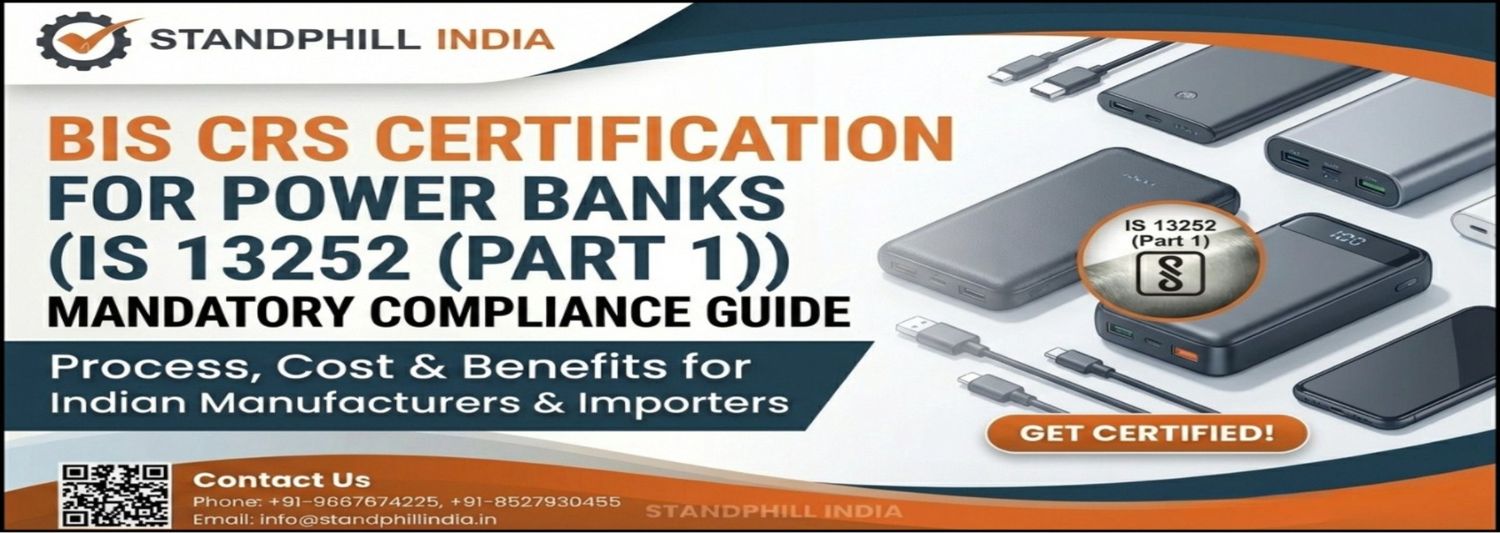
BIS Registration for Power Banks
IS 13252 (Part 1):2010 | Portable Applications | CRS Registration (R-Number) | Mandatory in India | Indian & Foreign Manufacturers
BIS certification for Power Banks is mandatory in India under IS 13252 (Part 1):2010 - Information Technology Equipment - Safety - Part 1: General Requirements. Regulated under the BIS Compulsory Registration Scheme (CRS), every manufacturer and importer must hold a valid BIS CRS R-Number before manufacturing, importing, or selling power banks - including at retail, e-commerce, or B2B channels - in the Indian market.
Power banks house high-energy-density lithium cells that can cause fire, explosion, or serious injury if they fail under overcharge, short-circuit, or thermal stress conditions. IS 13252 (Part 1):2010 - India's IT equipment safety standard based on IEC 60950-1:2005 - sets the mandatory safety floor that every power bank sold in India must meet. With hundreds of thousands of power banks imported monthly and rampant non-compliant products circulating online, BIS enforcement activity in this category is high and growing.
Selling Power Banks Without BIS CRS R-Number?
Amazon, Flipkart, and Meesho are actively delisting non-certified power banks. Customs is detaining non-CRS shipments. Act now - Standphill India delivers your R-Number in 6–10 weeks.
Key Facts - IS 13252 (Part 1):2010 for Power Banks at a Glance
| Product Name | Power Banks for Use in Portable Applications (Portable Battery Chargers, Mobile Power Packs) |
| Applicable Indian Standard | IS 13252 (Part 1):2010 - Information Technology Equipment - Safety - Part 1: General Requirements (based on IEC 60950-1:2005 + Amd 1:2009 + Amd 2:2013) |
| Certification Scheme | BIS Compulsory Registration Scheme (CRS) - Registration Certificate with R-Number |
| Compliance Requirement | Mandatory - BIS Act, 2016 / Electronics & IT Goods CRO |
| Certifying Authority | Bureau of Indian Standards (BIS) |
| Product Scope | Portable lithium-ion / lithium-polymer battery packs with USB output used to charge mobile devices - including power banks from 2,000 mAh to 50,000 mAh and above |
| CRS Certificate Validity | 2 Years - renewal required before expiry |
| Mark on Product | BIS CRS Standard Mark with R-Number (not ISI Mark) |
| Application Platform | BIS ManakOnline Portal - manakonline.in |
| Typical Timeline | 6 – 10 weeks (Indian) | 8 – 12 weeks (Foreign) - extended vs non-battery products due to mandatory battery cycle and thermal abuse testing |
Why Power Bank BIS Testing Takes Longer
Unlike passive electronic products, power banks require mandatory battery-specific safety tests - overcharge cycle tests, thermal abuse (nail penetration, crush, forced discharge), and multi-cycle charge/discharge endurance tests. These tests cannot be compressed below 3–5 weeks at any BIS-recognised battery testing lab. Planning your certification timeline around this is essential - Standphill India pre-books lab slots to minimise waiting time.
What Counts as a Power Bank Under IS 13252 (Part 1):2010
Any portable rechargeable battery pack with USB output designed to charge mobile phones, tablets, earbuds, smartwatches, or similar devices is classified as a power bank and requires BIS CRS certification. The standard applies regardless of capacity, brand, or whether the product is sold standalone or bundled.
- Standard power banks - 5,000 mAh, 10,000 mAh, 20,000 mAh, 26,800 mAh capacity variants
- Slimline / lipstick power banks - compact cylindrical form factor (2,000–5,000 mAh)
- High-capacity power banks - 30,000 mAh, 50,000 mAh and above
- Fast-charge power banks - supporting Qualcomm Quick Charge, PD 3.0, 65W / 100W USB-C PD output
- Wireless (Qi) charging power banks - with wireless output pad + USB output
- Solar charging power banks - with integrated solar panel and battery
- MagSafe-compatible power banks - magnetic attachment to iPhone (sold in India)
- Multi-port power banks - with 2–4 USB-A/USB-C output ports
- OEM / white-label power banks - private-label products for Indian brands need the Indian brand's own CRS registration
Capacity categories and airline limits: For BIS CRS purposes, all capacities require the same IS 13252 (Part 1):2010 certification. Note separately that DGCA (Indian aviation authority) limits carry-on power banks to 100 Wh (≈26,800 mAh at 3.7V nominal) - this is an aviation regulation, not a BIS requirement, but Standphill India advises manufacturers to clearly label Wh capacity on products to facilitate both BIS compliance and customer travel compliance.
Common Power Bank Capacity Segments - All Require IS 13252 CRS:
IS 13252 (Part 1):2010 - Critical Test Parameters for Power Banks
IS 13252 (Part 1):2010 tests for power banks cover two layers: standard IT equipment safety tests (electrical, mechanical, thermal) and battery-specific abuse and protection tests unique to lithium cell products. The battery-specific tests below are what make power bank certification more rigorous and time-consuming than other CRS products:
BATTERY-SPECIFIC SAFETY TESTS (Most Critical)
Overcharge Protection
Lithium cell charged to 130% rated capacity - the protection circuit must terminate charging before thermal runaway. Most commonly failed test for poor-quality power banks.
Overdischarge Protection
Cell discharged below minimum voltage threshold - protection circuit must prevent deep discharge which causes permanent cell damage and potential electrolyte degradation.
Short-Circuit Protection
Direct short circuit applied to output terminals - the power bank must not catch fire, explode, or leak electrolyte. Internal fusing and PCM response tested.
Thermal Abuse Test
Forced external heating to simulate hot-car / extreme ambient conditions - the cell must not rupture or catch fire. Particularly critical for Indian summer conditions (50°C+).
Nail Penetration Test
Steel nail driven through a fully charged cell - simulates internal short circuit from physical damage. The cell may vent but must not catch fire or explode.
Crush Test
Cell crushed between flat plates - simulates being run over or sat on. Cell may vent but must not catch fire. Critical safety test for flexible / pouch cells.
Charge / Discharge Cycles
Multiple full charge/discharge cycles to verify protection circuit stability over repeated use. Capacity retention and protection response checked at each cycle.
Abnormal Charge Rate
Charging at 2× rated current - tests whether the protection circuit prevents unsafe charging rates that generate excessive heat in the cell.
STANDARD IT EQUIPMENT SAFETY TESTS
| Test Category | Parameters Tested | Power Bank Relevance |
|---|---|---|
| Electrical Safety | Insulation resistance, dielectric strength (flash test), leakage current, touch current at output ports | USB output ports are user-accessible - touch current limits protect users from shock when connecting devices |
| Output Voltage Accuracy | USB output voltage (5V/9V/12V/15V/20V PD), current accuracy at rated output, voltage regulation under load | Overvoltage at USB output can damage connected devices - output accuracy is verified against declared specifications |
| Capacity Accuracy | Actual measured output capacity vs declared mAh at rated output voltage - tolerance limits apply | Overclaiming capacity is common in imported power banks. BIS tests verify actual usable output capacity matches the declared value on the label |
| Mechanical Safety | Drop test, enclosure strength, cable entry protection, USB port strain relief | Power banks are dropped frequently - housing integrity must prevent exposure of live components and battery cell damage after drop |
| Temperature Limits | External surface temperature during charging and discharging at rated current, at maximum Indian ambient temperature | Power banks charging in Indian summers (ambient 40–50°C) reach higher operating temperatures - surface temperature limits protect users |
| Marking & Labelling | Rated input voltage/current, rated output voltage/current, capacity (mAh and Wh), R-Number, BIS CRS mark, country of origin, model number, manufacturer details | Both mAh and Wh must be declared on labelling - mAh alone is insufficient under IS 13252 labelling requirements. Missing or mismatched labels are a BIS rejection ground |
Top 3 Failure Points for Imported Power Banks: (1) Overcharge protection failure - low-quality PCM boards from budget suppliers fail to cut off at 130% overcharge; (2) Capacity overclaim - labelled 20,000 mAh but tested output is 11,000–13,000 mAh (mAh of cells at 3.7V vs delivered output at 5V are different - many manufacturers label cell mAh rather than output mAh); (3) Nail penetration / crush failure - thin pouch cells used in slim power banks often rupture and ignite under IS 13252 nail penetration test. Standphill India pre-validates power bank safety design before lab submission to prevent these failures.
BIS CRS - Why It's Non-Negotiable for Power Bank Sellers in India
The power bank category is one of the highest-enforcement CRS categories in India. This is driven by e-commerce marketplace compliance requirements, customs scrutiny, and BIS market surveillance - which specifically targets this category due to the fire risk from non-compliant lithium battery products.
E-Commerce Platforms Requiring BIS CRS for Power Banks:
- Amazon / Flipkart listing block - power bank listings without BIS R-Number are blocked at listing creation; existing listings are delisted during compliance sweeps
- Customs detention - imported power banks without valid CRS R-Number are detained at Indian ports and cannot be cleared for sale
- BIS market surveillance - power banks are on BIS's active surveillance list due to fire risk; non-certified products are seized from distributors and retail stores
- Marketplace seller account suspension - repeated listing of non-certified products can result in permanent marketplace account suspension
Getting listed on Amazon / Flipkart for power banks?
Both platforms require the BIS CRS R-Number at the listing stage. Without it, your ASIN or listing will be blocked or delisted. Standphill India delivers your R-Number in 6–10 weeks.
BIS CRS Registration Process - Summary
The CRS process is documentation and testing-based - no factory audit required. Power banks require the same 6-step CRS process as other IT equipment, but with battery testing adding time at Step 3. Full step-by-step guide: CRS Process Guide →
IS Standard & Product Scope Confirmation
Confirm product falls under IS 13252 (Part 1):2010. Identify applicable capacity and output spec variants requiring registration
Technical File Preparation
Spec sheet, circuit diagram, PCM/BMS board details, cell datasheet, labelling artwork with mAh, Wh, input/output specs
Lab Testing (3–5 weeks)
Battery abuse tests + IT equipment safety tests at BIS-recognised lab. This step takes longer for power banks - Standphill India pre-books lab slots to avoid delays
ManakOnline Application
CRS application filed with test reports, CDF/CCL forms, and all supporting documents on BIS portal
BIS Scrutiny & Queries
All BIS technical queries responded to within 24–48 hours by Standphill India
R-Number Issued
CRS certificate granted - valid 2 years. Products can be legally manufactured, imported, sold, and listed on all Indian marketplaces
Duration Note: The 6–10 week (Indian) and 8–12 week (foreign) timelines are specific to power banks - they are longer than the 4–8 week timelines for passive electronic products. The extended duration is due to mandatory battery safety cycle tests (overcharge, overdischarge, thermal abuse) which cannot be compressed below 3–5 weeks. Plan your import or launch timeline accordingly. Standphill India pre-books lab slots to minimise waiting time at the testing stage.
Documents Required - Key List for Power Banks
Full document checklist at our CRS Process Guide. Power bank–specific documents to have ready before lab submission:
Standard Business Docs
- BIS application + CDF/CCL forms
- Manufacturing licence / GST / IEC
- Brand / trademark documents
- Authorised signatory ID proof
- ISO certificate (if available)
Power Bank–Specific Technical Docs
- Product spec sheet (mAh, Wh, input/output)
- Circuit diagram + PCM/BMS schematic
- Lithium cell datasheet (manufacturer, model, capacity, Wh)
- IS 13252 (Part 1):2010 lab test report
- Labelling artwork - mAh, Wh, V, A, R-Number, BIS mark, origin
- User manual with safety instructions
Foreign manufacturers additionally need: AIR appointment letter, company incorporation documents, authorised signatory ID. Full requirements →
BIS CRS Fees - Overview
For complete government fee details refer to our CRS Fees Guide. Note: power bank lab testing costs are higher than non-battery products due to the extended battery-specific test suite.
| Fee Component | Remarks |
|---|---|
| BIS Application Fee | As per current BIS CRS schedule - paid at ManakOnline portal |
| Lab Testing Fee | Higher than non-battery CRS products - includes battery abuse tests (nail penetration, crush, overcharge cycles, thermal abuse) in addition to standard IT safety tests |
| Annual Marking Fee | Based on quantity of certified products manufactured / imported annually in India - payable to BIS |
| Renewal Fee (2-year) | Fresh test reports required if cell model, PCM/BMS, or capacity changes since last registration |
| Standphill India Service Fee | End-to-end CRS management including pre-validation, lab coordination, documentation, portal filing, query responses - contact us for a quote |
Consequences of Selling Power Banks Without BIS CRS
- Amazon / Flipkart / Meesho listing blocked or delisted - all major Indian e-commerce platforms enforce BIS CRS compliance for power banks at listing stage
- Customs clearance refusal - imported power banks without valid R-Number are detained at Indian ports; entire consignments can be held
- BIS market seizure - power banks are on BIS's active surveillance list; non-certified stock seized from warehouses, distributors, and retail
- Financial penalties up to ₹5 lakh (first offence), ₹10 lakh + imprisonment for repeat offences under BIS Act, 2016
- Product liability exposure - a non-certified power bank causing fire or injury creates maximum legal liability for the brand / importer with no safety standard compliance defense
- Marketplace account suspension - repeated non-compliance listings can permanently suspend seller accounts on Amazon and Flipkart
Already importing or selling without BIS CRS? Stop immediately and begin the registration process. Standphill India can start your IS 13252 (Part 1):2010 CRS registration today - contact us for a same-day consultation.
Also Read - Related BIS Certification Pages
BIS Compulsory Registration Scheme (CRS) - Full Process, Documents & Fees Guide BIS CRS for Foreign Manufacturers - AIR Services India BIS ISI Mark Certification for Indian Manufacturers BIS CRS Licence Renewal - How to Renew Before ExpiryExplore Related BIS Certification Services
Why Choose Standphill India for Power Bank BIS CRS Registration
India's power bank market - driven by smartphone-heavy consumers, frequent power outages, and the rise of travel and work-from-anywhere culture - is one of the highest-volume imported electronics categories. BIS enforcement in this category is aggressive because non-compliant lithium battery products present genuine fire risk. Every power bank sold in India, from a 2,000 mAh lipstick charger to a 50,000 mAh travel bank, requires a valid IS 13252 (Part 1):2010 CRS R-Number. Standphill India has delivered 10,000+ BIS certifications including CRS registrations for power bank manufacturers and importers from India, China, South Korea, and beyond. We know the battery test failure points, the capacity labelling requirements, and the exact BIS documentation standard that gets R-Numbers granted first-time.
Battery Safety Pre-Validation
We review PCM/BMS design, cell datasheet, and overcharge protection before lab submission - preventing the most common power bank test failures.
Lab Slot Pre-Booking
Battery test labs have queues. We pre-book slots to minimise your waiting time - keeping the 6–10 week timeline on track.
Capacity Labelling Compliance
mAh and Wh must both be declared correctly. We review labelling artwork for IS 13252 marking compliance before submission.
AIR for Foreign Manufacturers
Full Authorised Indian Representative services for overseas power bank manufacturers - complete CRS managed from India.
BIS Query Resolution in 24–48 hrs
Every BIS technical query answered within one business day - maintaining fastest-possible approval momentum.
Renewal & Change Management
Cell model change? New capacity variant? We manage scope amendments and 2-year renewal filings - no lapse in your CRS status.
Get Your Power Bank BIS CRS R-Number - Fast, Complete, First Attempt
Amazon listing blocked? Customs shipment detained? Import clearance refused? Standphill India delivers your IS 13252 (Part 1):2010 CRS R-Number in 6–10 weeks - for Indian manufacturers and international suppliers. No failed lab tests. No rejected applications. No missed e-commerce deadlines.
Frequently Asked Questions - BIS CRS for Power Banks
India's Power Bank Market Requires BIS Certification - Don't Wait
Every power bank sold in India - on Amazon, Flipkart, in retail stores, or through distributors - requires a valid IS 13252 (Part 1):2010 BIS CRS R-Number. Standphill India delivers your certification in 6–10 weeks with pre-validated battery safety compliance - for Indian manufacturers and international suppliers alike.
Ask About Power Bank BIS CRS Registration
Indian manufacturer or overseas supplier - our BIS experts respond within one business day.
★ Why Standphill India?
- 20+ Years of BIS Certification Experience
- 10,000+ Certifications Delivered Globally
- Dedicated Teams for CRS, FMCS & ISI Mark
- End-to-End Documentation & Filing Support
- Fast Response & Practical Compliance Guidance
- Support for Indian & Foreign Manufacturers
Get Free Call Back
Our Services
- BIS (ISI Mark) for Foreign Manufacturers
- Domestic BIS (ISI Mark) Certification
- BIS Certificate of Conformity (CoC)
- BIS Hallmarking
- BIS Licence for Toys
- ECO Mark Certification
- TAC Approval for Automobile
- Drug Licence
- Peso Certification
- BIS (CRS) Registration
- WPC-ETA Approval
- BEE Certification
- E-Waste Management (EPR)
- EPR for Plastic Waste
- EPR for Battery Waste
- CE Certification
- UL Certification
- ROHS Licence
- Standardization Division
- Import / Export Licence
- FSSAI Certification
- ISO Registration
- Trademark Registration
- Make in India Support
- AG-Mark Licence
- Third Party Monitoring
Client Testimonials
Their team was very knowledgeable and helped us every step of the way. Standphill India is the best BIS certification consultants for any type of BIS certification.

Chintan Shah (AGM)
Sudeep Nutrition P.Ltd



Featured Guide
Complete BIS CRS certification guide for electronic products in India — free to read.
Read CRS Certification Guide📞 Contact Standphill India
+91-9667674225 info@standphillindia.in WhatsApp Now Greater Noida West, UPGet Expert BIS Certification Support for Your Business
Connect with Standphill India for complete support with BIS certification, CRS registration, WPC approval, FMCS compliance, and related regulatory services. Our team helps businesses with documentation, testing coordination, application support, and end-to-end compliance guidance.
Request Free Consultation
Share your requirement and our team will contact you shortly.