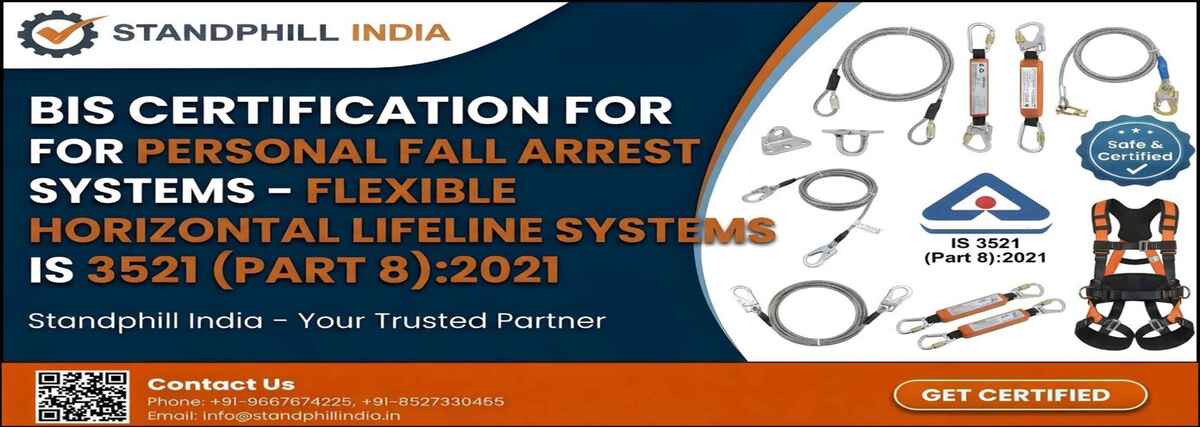
BIS Certification for Personal Fall Arrest Systems – Flexible Horizontal Lifeline Systems as per IS 3521 (Part 8):2021
BIS Certification for Flexible Horizontal Lifeline Systems under IS 3521 (Part 8):2021 is essential for manufacturers of personal fall arrest equipment in India. Although currently voluntary, BIS certification provides crucial quality assurance and is increasingly demanded in government tenders, EPC contracts, and safety-driven industries. The certification ensures compliance with national safety standards aligned with international practices for workplace fall protection.
Introduction
Work at height remains one of the most significant occupational safety risks across construction, industrial maintenance, infrastructure, and energy sectors. To mitigate the risk of fatal falls, Personal Fall Arrest Systems (PFAS) are essential safety solutions. Among these, Flexible Horizontal Lifeline Systems enable workers to move safely along elevated horizontal paths while remaining continuously protected.
To ensure safety, reliability, and uniform quality, the Bureau of Indian Standards (BIS) has introduced IS 3521 (Part 8):2021, which specifies requirements for Flexible Horizontal Lifeline Systems. BIS certification under this standard assures that such systems meet stringent design, performance, and testing benchmarks aligned with international safety practices.
Standphill India provides comprehensive BIS certification consultancy for manufacturers of fall protection equipment, ensuring compliance with IS 3521 (Part 8):2021 and enhancing workplace safety standards across India.
What Is IS 3521 (Part 8):2021?
IS 3521 (Part 8):2021 is an Indian Standard that defines the technical and performance specifications for flexible horizontal lifeline systems used as part of personal fall arrest systems.
This standard is aligned with ISO 16024:2005, ensuring that products manufactured and certified in India meet globally recognized safety and performance criteria. It addresses critical aspects such as system design, materials, strength, installation, testing methods, and user safety.
Scope of the Standard:
Applies to flexible horizontal lifeline systems
Systems intended for use with personal fall arrest equipment
Covers permanent and temporary horizontal lifelines used at height
Applications of Flexible Horizontal Lifeline Systems
BIS-certified flexible horizontal lifeline systems under IS 3521 (Part 8):2021 are deployed in:
1. Construction sites and building projects
2. Industrial plants and manufacturing facilities
3. Power plants and refineries
4. Warehouses and logistics facilities
5. Maintenance of bridges, rooftops, and large structures
6. Telecommunications and utility maintenance
7. Shipbuilding and offshore installations
Key Technical Requirements
Design and Construction Requirements:
Structural integrity of cables, connectors, and anchors
Compatibility with personal fall arrest equipment
Resistance to environmental and mechanical stress
Corrosion protection and durability
Performance and Strength Requirements:
Load-bearing capacity under fall arrest conditions
Energy absorption capability
Limitation of fall distance and arrest forces
Dynamic performance under impact loads
Installation and Use Requirements:
Clear installation instructions and guidelines
Defined system limits and user capacity
Proper anchorage and tensioning specifications
User training and maintenance requirements
Testing and Compliance Requirements
Products must undergo comprehensive testing at BIS-recognised laboratories:
| Test Category | Specific Tests |
| Static Load Testing | Ultimate strength test, anchor point strength, connector strength |
| Dynamic Performance Testing | Fall arrest simulation, energy absorption, impact force measurement |
| Durability Testing | Environmental exposure, corrosion resistance, fatigue testing |
| Material Testing | Cable strength, webbing strength, metal component analysis |
| System Performance Testing | Complete system testing under simulated working conditions |
BIS Certification Overview
| Particulars | Details |
| Product Name | Flexible Horizontal Lifeline Systems |
| Indian Standard | IS 3521 (Part 8):2021 |
| International Alignment | ISO 16024:2005 |
| Certification Status | Voluntary Certification |
| Certification Scheme | BIS Product Certification (ISI Mark Scheme) |
| Aspect Covered | Product Specification |
| Relevant Ministries | Ministry of Commerce and Industry, Ministry of Health and Family Welfare |
Note: Although classified as voluntary, BIS certification is increasingly demanded in government tenders, EPC contracts, and safety-driven industries.
Benefits of BIS Certification
For Manufacturers:
1. Government quality assurance and compliance validation
2. Enhanced market credibility and brand reputation
3. Eligibility for government and PSU tenders
4. Competitive advantage over uncertified products
5. Access to organized safety equipment markets
For End Users and Organizations:
1. Enhanced worker safety and reduced fatal fall risks
2. Compliance with occupational safety regulations
3. Reduced liability and insurance premiums
4. Quality assurance for critical safety equipment
5. Demonstration of commitment to workplace safety
BIS Certification Timeline
For Indian Manufacturers
Approximate Timeline: 30-45 working days
Testing Time: 15-20 days
Subject to complete documentation and successful testing
For Foreign Manufacturers (FMCS)
Approximate Timeline: 180 days
Includes FMCS registration, factory inspection, and Indian lab testing
License Validity: 1-2 years (renewable)
BIS Certification Process
Step 1: Application Submission
Submission of technical documents, product details, manufacturing information, and quality control procedures to BIS.
Step 2: Product Testing
Samples are tested at BIS-recognized laboratories as per IS 3521 (Part 8):2021 requirements. Testing includes static load tests, dynamic performance tests, and material analysis.
Step 3: Factory Inspection
BIS officers conduct factory inspection to verify manufacturing capability, quality control systems, testing infrastructure, and compliance with standard requirements.
Step 4: Grant of License
Upon successful compliance with all requirements, BIS issues the license allowing use of the ISI Mark on certified products.
Step 5: Surveillance and Renewal
Regular surveillance audits and license renewal as per BIS guidelines to maintain certification validity.
Client Success Story
AAKRUTI PROCESS TECHNOLOGIES PRIVATE LIMITED
Standphill India proudly supported AAKRUTI PROCESS TECHNOLOGIES PRIVATE LIMITED in obtaining BIS certification for Flexible Horizontal Lifeline Systems. From documentation and testing coordination to factory inspection readiness and final license grant, Standphill India ensured a seamless and timely certification process.
Certification Details:
Client Name: AAKRUTI PROCESS TECHNOLOGIES PRIVATE LIMITED
Product Standard: IS 3521 (Part 8):2021
Product: Flexible Horizontal Lifeline Systems
License Grant Date: 15 December 2025
BIS License / CML No.: 7100131987
This certification reinforces Aakruti Process Technologies' commitment to workplace safety and compliance with Indian and international standards for fall protection equipment.
Documents Required for BIS Certification
| Category | Documents Required |
| Business Documents | Company registration certificate, manufacturing license, organizational details |
| Technical Documents | Product specifications, design drawings, material specifications, technical data sheets |
| Manufacturing Documents | Factory layout, machinery list, manufacturing process flow, quality control procedures |
| Testing Documents | BIS lab test reports, in-house test records, quality certificates |
| Compliance Documents | ISO certifications (if any), previous approvals, user manuals, installation guidelines |
Who Should Obtain BIS Certification?
Manufacturers of fall protection and safety equipment
Suppliers of horizontal lifeline systems
Companies serving construction, infrastructure, and industrial safety markets
Manufacturers targeting government or PSU tenders
Importers of fall protection equipment for the Indian market
Safety equipment distributors and system integrators
Why Choose Standphill India?
Standphill India is a leading BIS certification consultancy with extensive experience in occupational safety and PPE standards. Our specialized expertise in fall protection equipment certification ensures manufacturers achieve compliance efficiently and effectively.
Our Services Include:
1. End-to-end BIS certification support and guidance
2. Technical documentation preparation as per IS 3521 requirements
3. Sample testing coordination with BIS-approved laboratories
4. Factory inspection readiness and compliance training
5. Objection handling and BIS liaison services
6. License grant and renewal support
7. Post-certification compliance monitoring
Our structured approach minimizes delays and ensures full compliance with BIS requirements for flexible horizontal lifeline systems.
Conclusion
IS 3521 (Part 8):2021 plays a vital role in enhancing occupational safety by regulating the quality and performance of flexible horizontal lifeline systems. BIS certification under this standard ensures that products deliver reliable fall protection and comply with nationally accepted safety benchmarks aligned with international practices.
With the growing emphasis on workplace safety and regulatory compliance in India, BIS certification provides manufacturers with a competitive edge while contributing to safer working environments. Although currently voluntary, the certification is increasingly becoming a de facto requirement for participation in major projects and tenders.
Partner with Standphill India for expert guidance and comprehensive support in achieving BIS certification for Flexible Horizontal Lifeline Systems. Our expertise ensures you navigate the certification process efficiently while maintaining the highest standards of product quality and workplace safety.
Frequently Asked Questions
Currently, BIS certification for flexible horizontal lifeline systems under IS 3521 (Part 8):2021 is classified as voluntary. However, it is increasingly demanded in government tenders, EPC contracts, and by safety-conscious industries as a quality assurance requirement.
IS 3521 (Part 8):2021 is the Indian Standard that specifies requirements for flexible horizontal lifeline systems used in personal fall arrest systems. The standard is aligned with ISO 16024:2005 and covers design, performance, testing, and safety requirements.
Key tests include: Static load testing (ultimate strength), dynamic performance testing (fall arrest simulation), durability testing (environmental exposure), material analysis, and complete system performance testing under simulated working conditions.
For Indian manufacturers: Approximately 30-45 working days. For foreign manufacturers: Approximately 180 days under the FMCS scheme. Testing typically takes 15-20 days at BIS-approved laboratories.
Benefits include: Government quality assurance, enhanced market credibility, eligibility for tenders, competitive advantage, improved worker safety assurance, compliance with safety regulations, and reduced liability for organizations.
Manufacturers of fall protection equipment, suppliers of horizontal lifeline systems, companies serving construction and industrial safety markets, and businesses targeting government or PSU tenders should obtain BIS certification.
Required documents include: Company registration, product specifications, technical drawings, manufacturing process details, quality control procedures, BIS lab test reports, and factory inspection documentation.
Yes. Foreign manufacturers can obtain BIS certification through the Foreign Manufacturers Certification Scheme (FMCS). They must appoint an Authorized Indian Representative (AIR) and comply with all testing and inspection requirements.
The BIS license is typically valid for 1-2 years and requires renewal before expiry. Renewal involves updated documentation, recent test reports, and compliance with any new regulatory requirements.
Standphill India offers: Expert guidance on IS 3521 compliance, complete documentation support, laboratory coordination, factory audit preparation, BIS liaison services, and dedicated support for both domestic and foreign manufacturers of safety equipment.
★ Why Standphill India?
- 20+ Years of BIS Certification Experience
- 10,000+ Certifications Delivered Globally
- Dedicated Teams for CRS, FMCS & ISI Mark
- End-to-End Documentation & Filing Support
- Fast Response & Practical Compliance Guidance
- Support for Indian & Foreign Manufacturers
Get Free Call Back
Our Services
- BIS (ISI Mark) for Foreign Manufacturers
- Domestic BIS (ISI Mark) Certification
- BIS Certificate of Conformity (CoC)
- BIS Hallmarking
- BIS Licence for Toys
- ECO Mark Certification
- TAC Approval for Automobile
- Drug Licence
- Peso Certification
- BIS (CRS) Registration
- WPC-ETA Approval
- BEE Certification
- E-Waste Management (EPR)
- EPR for Plastic Waste
- EPR for Battery Waste
- CE Certification
- UL Certification
- ROHS Licence
- Standardization Division
- Import / Export Licence
- FSSAI Certification
- ISO Registration
- Trademark Registration
- Make in India Support
- AG-Mark Licence
- Third Party Monitoring
Client Testimonials
Their team was very knowledgeable and helped us every step of the way. Standphill India is the best BIS certification consultants for any type of BIS certification.

Chintan Shah (AGM)
Sudeep Nutrition P.Ltd



Featured Guide
Complete BIS CRS certification guide for electronic products in India — free to read.
Read CRS Certification Guide📞 Contact Standphill India
+91-9667674225 info@standphillindia.in WhatsApp Now Greater Noida West, UPGet Expert BIS Certification Support for Your Business
Connect with Standphill India for complete support with BIS certification, CRS registration, WPC approval, FMCS compliance, and related regulatory services. Our team helps businesses with documentation, testing coordination, application support, and end-to-end compliance guidance.
Request Free Consultation
Share your requirement and our team will contact you shortly.