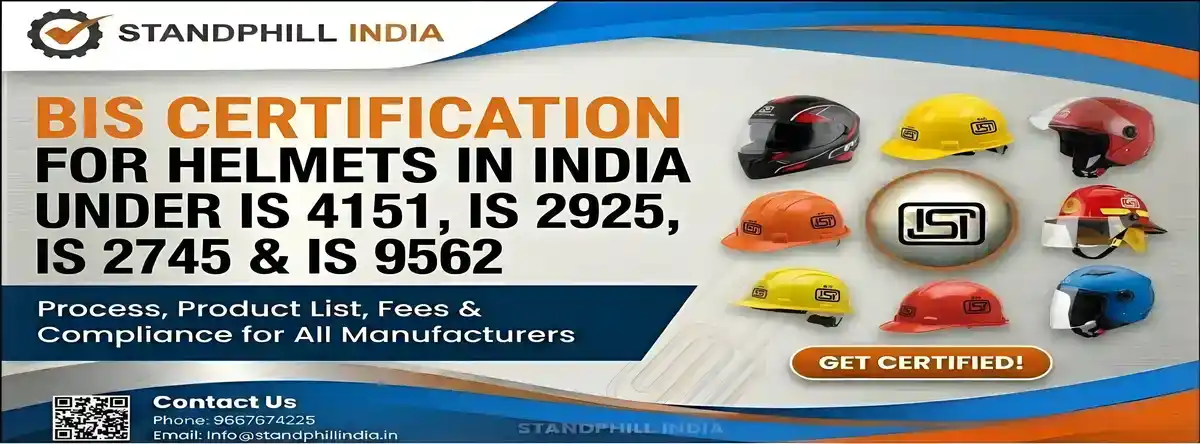
Learn how to obtain BIS certification for helmets in India under IS 4151, IS 2925, IS 2745 & IS 9562
Complete Regulatory & Compliance Guide (IS 4151:2015 | IS 2925:1984 | IS 2745:1983 | IS 9562:1980)
Safety helmets are not just protective accessories—they are life-saving devices. In India, helmet quality is strictly regulated to ensure public safety, workplace protection, and compliance with national standards. For manufacturers and importers, BIS certification is not optional—it is a legal obligation.
Legal Framework Governing Helmet Certification in India
Helmet certification in India operates under:
• Bureau of Indian Standards Act, 2016
• Notifications issued by the Ministry of Road Transport and Highways
• Quality Control Orders (QCOs) issued by DPIIT
Under these regulations, helmets covered by notified standards must bear the ISI Mark under a valid BIS license before they can be manufactured, sold, imported, or distributed in India.
Failure to comply may result in product seizure, financial penalties, or prosecution.
BIS Certification for Two-Wheeler Helmets – IS 4151:2015
Regulatory Mandate: The Helmet for Riders of Two-Wheeler Motor Vehicles (Quality Control) Order, 2020 mandates that all helmets intended for motorcycle and scooter riders must comply with IS 4151:2015.
From 1 June 2021 onward, it became illegal to manufacture or sell non-ISI helmets in India.
Key Safety & Performance Requirements:
• Impact absorption test
• Penetration resistance test
• Retention system (chin strap) strength test
• Shell rigidity test
• Visor quality and field-of-vision evaluation
• Conditioning tests under varied temperatures
• Maximum weight limit (generally 1.2 kg)
Marking Requirements: Helmets must be marked with ISI Mark, CM/L number, IS 4151 reference, and manufacturer details.
BIS Certification Process for Motorcycle Helmets
Step 1 – Application Submission: Submit online application through BIS portal with factory layout, process flow, machinery details, quality control plan, and product drawings.
Step 2 – Documentation Review: BIS verifies compliance with administrative and technical requirements.
Step 3 – Factory Inspection: BIS officer conducts on-site inspection of production infrastructure, in-house lab, calibration records, and quality systems.
Step 4 – Sample Testing: Samples tested in BIS-recognized laboratories for IS 4151 compliance.
Step 5 – Grant of BIS License: Upon successful inspection and test results, BIS issues CM/L number and authorizes ISI mark.
Step 6 – Ongoing Surveillance: Periodic audits, surprise inspections, and market surveillance.

⏱️ Timeline: 30-90 Working Days
BIS Certification for Industrial Safety Helmets – IS 2925:1984
Industrial helmets used in construction, mining, quarrying, shipbuilding, and other hazardous workplaces must comply with IS 2925:1984.
Performance Parameters: Shock absorption, penetration resistance, electrical resistance, water absorption, heat resistance, flammability resistance, and surface finish.
BIS Certification for Firemen Helmets – IS 2745:1983
This standard applies to non-metal helmets used by firefighters and civil defense personnel.
Key Requirements: Size tolerance ±3 mm, maximum mass 800 grams, electrical resistance, flammability resistance, shock absorption, and retention system strength.
BIS Certification for Police Helmets – IS 9562:1980
Police force helmets must comply with this standard covering shock absorption, penetration resistance, rigidity test, plumb-bob test, firing test, water absorption, and flammability resistance. Maximum mass limit: 950 grams.
International Helmet Certifications vs Indian Requirements
Certification - Valid Alone in India?
• ISI (BIS) - Yes
• DOT (USA) - No
• ECE (Europe) - No
• SNELL - No
• SHARP - No
Even helmets certified under international standards must carry the ISI mark to be legally sold or used on Indian roads.
Documents Required for BIS Helmet Certification
Administrative Documents:
• Business registration certificate
• GST registration
• Trademark certificate
Technical Documents:
• Product specifications
• Bill of materials
• Test reports
• Quality control manual
• In-house lab details
Commercial Documents:
• Machinery invoices
• Calibration certificates
• Marking fee payment proof
Estimated Cost & Timeline
Government Fees:
• Application Fee: ₹1,000
• Audit Fee: ₹7,000
• License Fee: ₹1,000
• Testing Charges: As applicable
• Marking Fee: Variable
• Renewal Fee: ₹1,000
Timeline: Typically 30–90 days depending on documentation completeness and testing clearance.
Penalties for Non-Compliance
Under the Bureau of Indian Standards Act, 2016:
• Heavy monetary penalties
• Product seizure
• Legal prosecution
• Suspension of license
Authorities actively monitor the market for counterfeit or non-certified helmets.
Importance of BIS Certification for Manufacturers
• Legal market access
• Increased consumer trust
• Protection against regulatory action
• Eligibility for government tenders
• Stronger brand credibility
Common Misconceptions
Myth 1: Imported helmets are automatically legal.
Reality: They must have ISI mark for Indian sale.
Myth 2: A sticker is enough.
Reality: Only genuine BIS license holders can legally use the ISI mark.
Myth 3: Certification is unnecessary for low-cost helmets.
Reality: All covered helmets require certification regardless of price.
Strategic Guidance for Manufacturers
• Invest in in-house testing facilities
• Maintain proper calibration records
• Implement structured quality control procedures
• Conduct internal pre-audits
• Ensure accurate labeling and marking
Frequently Asked Questions
Yes, as per Helmet Quality Control Order 2020, all two-wheeler helmets must have BIS certification under IS 4151:2015. Industrial, firemen, and police helmets also require certification under respective standards.
IS 4151:2015 is the Indian Standard for protective helmets for two-wheeler riders specifying safety requirements including impact absorption, penetration resistance, and retention system strength.
Typically 30–90 days depending on documentation completeness, testing clearance, and factory inspection scheduling.
No. Even helmets with DOT, ECE, or SNELL certifications must obtain BIS certification and carry the ISI mark to be legally sold in India.
Business registration, GST, trademark, product specifications, bill of materials, quality control manual, in-house lab details, machinery invoices, and calibration certificates.
Government fees include application fee ₹1,000, audit fee ₹7,000, license fee ₹1,000, plus testing charges and marking fees. Total cost varies based on product variants and testing requirements.
Yes, BIS conducts mandatory factory inspection to evaluate production infrastructure, in-house testing facilities, and quality control systems.
Penalties include product seizure, heavy monetary fines, legal prosecution, and license suspension under BIS Act, 2016.
Conclusion
BIS certification for helmets in India is a critical regulatory requirement designed to protect lives and ensure product reliability. Whether manufacturing motorcycle helmets under IS 4151:2015, industrial helmets under IS 2925:1984, firemen helmets under IS 2745:1983, or police helmets under IS 9562:1980, compliance is mandatory before entering the Indian market.
Beyond legal necessity, certification strengthens brand reputation and reinforces public trust. In an industry where safety is paramount, adherence to BIS standards reflects a manufacturer's commitment to quality, responsibility, and human life.
Your Safety. Our Compliance. Your Success.
★ Why Standphill India?
- 20+ Years of BIS Certification Experience
- 10,000+ Certifications Delivered Globally
- Dedicated Teams for CRS, FMCS & ISI Mark
- End-to-End Documentation & Filing Support
- Fast Response & Practical Compliance Guidance
- Support for Indian & Foreign Manufacturers
Get Free Call Back
Our Services
- BIS (ISI Mark) for Foreign Manufacturers
- Domestic BIS (ISI Mark) Certification
- BIS Certificate of Conformity (CoC)
- BIS Hallmarking
- BIS Licence for Toys
- ECO Mark Certification
- TAC Approval for Automobile
- Drug Licence
- Peso Certification
- BIS (CRS) Registration
- WPC-ETA Approval
- BEE Certification
- E-Waste Management (EPR)
- EPR for Plastic Waste
- EPR for Battery Waste
- CE Certification
- UL Certification
- ROHS Licence
- Standardization Division
- Import / Export Licence
- FSSAI Certification
- ISO Registration
- Trademark Registration
- Make in India Support
- AG-Mark Licence
- Third Party Monitoring
Client Testimonials
Their team was very knowledgeable and helped us every step of the way. Standphill India is the best BIS certification consultants for any type of BIS certification.

Chintan Shah (AGM)
Sudeep Nutrition P.Ltd




Featured Guide
Complete BIS CRS certification guide for electronic products in India — free to read.
Read CRS Certification Guide📞 Contact Standphill India
+91-9667674225 info@standphillindia.in WhatsApp Now Greater Noida West, UPGet Expert BIS Certification Support for Your Business
Connect with Standphill India for complete support with BIS certification, CRS registration, WPC approval, FMCS compliance, and related regulatory services. Our team helps businesses with documentation, testing coordination, application support, and end-to-end compliance guidance.
Request Free Consultation
Share your requirement and our team will contact you shortly.