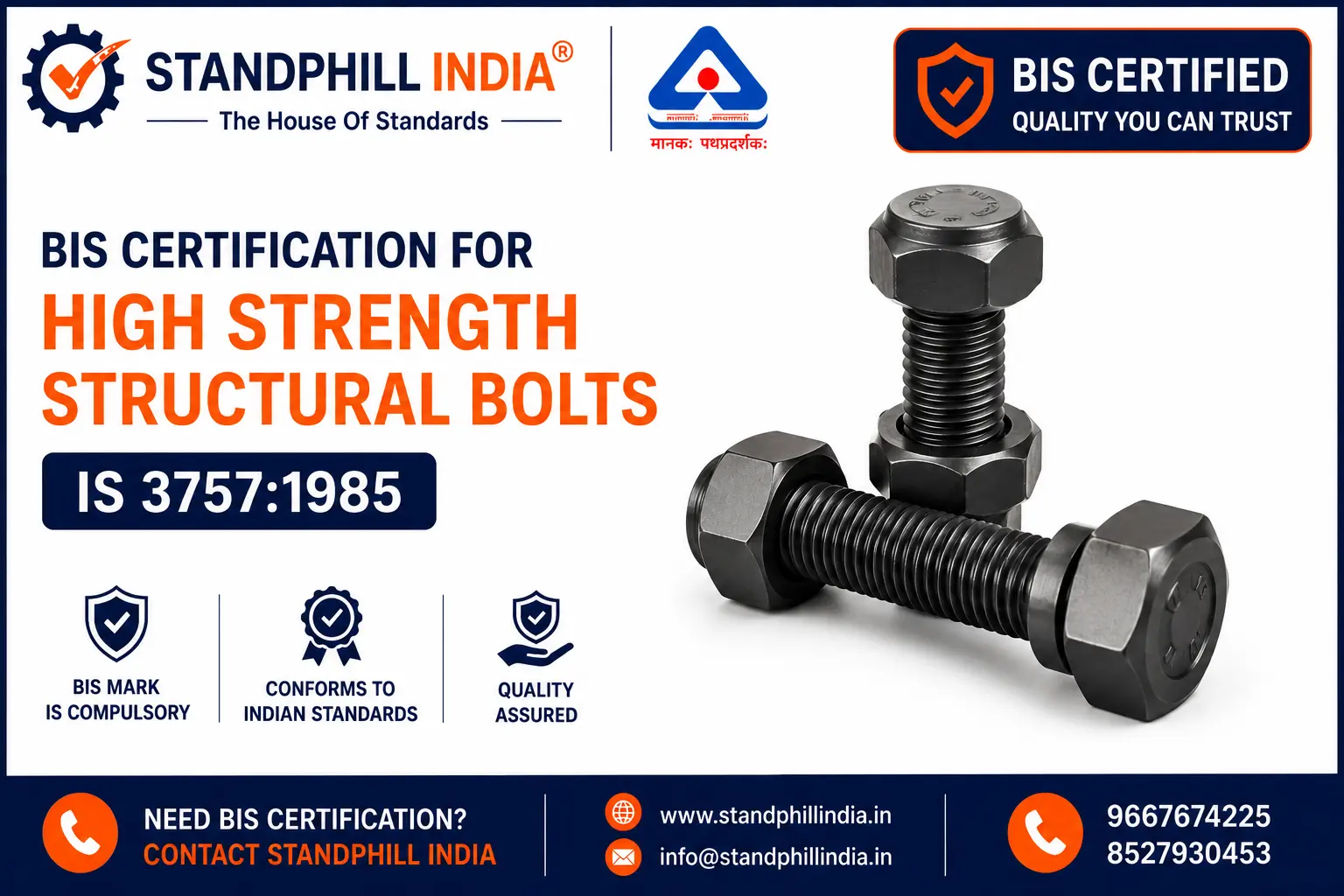
BIS Certification for High Strength Structural Bolts
ISI Mark Under the QCO 2024 - For Bridges, Steel Structures & EPC Projects
Mandatory for Structural-Grade Load-Bearing Bolts
High strength structural bolts are notified under the Bolts, Nuts and Fasteners (Quality Control) Order, 2024 and must carry the ISI Mark under a valid BIS licence before manufacture for sale, sale or import in India. Most EPC, bridge and government projects will only accept ISI-marked structural bolts.
Why This Category Carries Extra Weight
Most fasteners fail quietly - a loose bracket, a squeaky panel. High strength structural bolts are different. They sit in friction-grip joints that hold up bridges, multi-storey steel frames and transmission towers, and a failure here is rarely a minor inconvenience. That is the entire reason this category exists as its own certification: it is not just "a stronger bolt," it is a bolt whose job is to keep a structure standing under sustained load, vibration and weather, for decades.
Bolts in this family are typically manufactured in higher property classes, capable of carrying far greater tensile and shear loads than a general-purpose hexagon bolt. Engineers specify them precisely because the structural calculation depends on the bolt performing exactly as rated - which is exactly what BIS certification is meant to verify before that bolt ever reaches a job site.
Bridges & Flyovers
Friction-grip connections where joint integrity is safety-critical.
Steel-Framed Buildings
Multi-storey structures relying on bolted load-bearing joints.
Power & Transmission
Towers and heavy installations under constant load and weather.
Heavy Engineering
Industrial plant and machinery with high-stress structural joints.
What Certification Actually Verifies
Testing for this category goes well beyond a simple dimension check. A BIS-recognised laboratory verifies tensile strength and proof load - essentially, how much pulling force the bolt can sustain before it permanently deforms or breaks - along with hardness and the underlying chemical composition of the steel. Dimensional accuracy of the head, shank and thread is checked too, since a structural bolt that does not seat correctly in its joint defeats the purpose of using a high-strength fastener in the first place.
The licence is issued only to the manufacturer, never to a trader or stockist, and BIS continues periodic surveillance testing for as long as the licence is active.
Tensile & Proof Load
How much force the bolt sustains before yielding or fracture.
Hardness
Material hardness within the limits for high-strength performance.
Composition
Steel chemistry verified for strength and durability.
Dimensions
Head, shank and thread accuracy for correct seating in the joint.
For the full list of all 19 notified fastener products, see our complete BIS Certification for Bolts, Nuts & Fasteners guide.
Who This Applies To
You need a BIS licence directly from BIS through the standard domestic ISI Mark (Scheme-I) route before selling in the Indian market.
You need certification through the Foreign Manufacturers Certification Scheme (FMCS), via an Authorized Indian Representative in India.
If your factory manufactures high strength structural bolts for sale in India, this licence is not optional - it is what allows your product onto government, infrastructure and EPC project sites, most of which will not accept an unmarked fastener regardless of its actual quality. The same narrow exemptions that apply across the wider fastener order apply here too: goods manufactured purely for export, fasteners imported only as part of a finished assembly, and small Udyam-registered micro units under specific limits. We explain these in detail on our main fasteners page.
Getting Certified
The path you take depends entirely on where your factory is. If you manufacture in India, the process runs through BIS's standard product certification route - sample testing, factory documentation and a factory inspection before the licence is issued. We have laid out every step on our BIS Certification for Indian Manufacturers page.
If your factory sits outside India, you will go through the Foreign Manufacturers Certification Scheme, which adds an Authorized Indian Representative and typically an overseas factory audit. The full breakdown is on our FMCS guide for foreign manufacturers.
Bidding for an EPC or government tender that requires ISI-marked structural bolts? Tell us your timeline early - factory-audit slots for this category can take longer to schedule than for lighter fastener categories. Reach out.
Related Guides
BIS Certification for Bolts, Nuts and Fasteners - All 19 Products BIS QCO for Bolts, Nuts and Fasteners - the Order Explained BIS Certification for Indian Manufacturers BIS Certification for Foreign Manufacturers (FMCS) High Strength Structural NutsWhy Choose Standphill India for Fastener Certification
Fasteners are a deceptively tricky category - 19 products, overlapping standards, easy-to-miss exemptions and a demanding factory audit. We work across the entire fasteners QCO, not as a general firm dabbling, but as a team that knows this product family inside out and prepares every document to exact BIS specification so your file keeps moving - for manufacturers in India and around the world.
Certify Your High Strength Structural Bolts
Free scope check, accurate documentation, factory-audit preparation and the final ISI licence - for India and overseas manufacturers.
Free Consultation +91-9667674225Frequently Asked Questions
Ask About Your Fastener Certification
Tell us what you make - we will confirm if you are covered or exempt, the right standard, and a quote. Clients in India and worldwide.
★ Why Standphill India?
- 20+ Years of BIS Certification Experience
- 10,000+ Certifications Delivered Globally
- Dedicated Teams for CRS, FMCS & ISI Mark
- End-to-End Documentation & Filing Support
- Fast Response & Practical Compliance Guidance
- Support for Indian & Foreign Manufacturers
Get Free Call Back
Our Services
- BIS (ISI Mark) for Foreign Manufacturers
- Domestic BIS (ISI Mark) Certification
- BIS Certificate of Conformity (CoC)
- BIS Hallmarking
- BIS Licence for Toys
- ECO Mark Certification
- TAC Approval for Automobile
- Drug Licence
- Peso Certification
- BIS (CRS) Registration
- WPC-ETA Approval
- BEE Certification
- E-Waste Management (EPR)
- EPR for Plastic Waste
- EPR for Battery Waste
- CE Certification
- UL Certification
- ROHS Licence
- Standardization Division
- Import / Export Licence
- FSSAI Certification
- ISO Registration
- Trademark Registration
- Make in India Support
- AG-Mark Licence
- Third Party Monitoring
Client Testimonials
Their team was very knowledgeable and helped us every step of the way. Standphill India is the best BIS certification consultants for any type of BIS certification.

Chintan Shah (AGM)
Sudeep Nutrition P.Ltd



Featured Guide
Complete BIS CRS certification guide for electronic products in India — free to read.
Read CRS Certification Guide📞 Contact Standphill India
+91-9667674225 info@standphillindia.in WhatsApp Now Greater Noida West, UPGet Expert BIS Certification Support for Your Business
Connect with Standphill India for complete support with BIS certification, CRS registration, WPC approval, FMCS compliance, and related regulatory services. Our team helps businesses with documentation, testing coordination, application support, and end-to-end compliance guidance.
Request Free Consultation
Share your requirement and our team will contact you shortly.