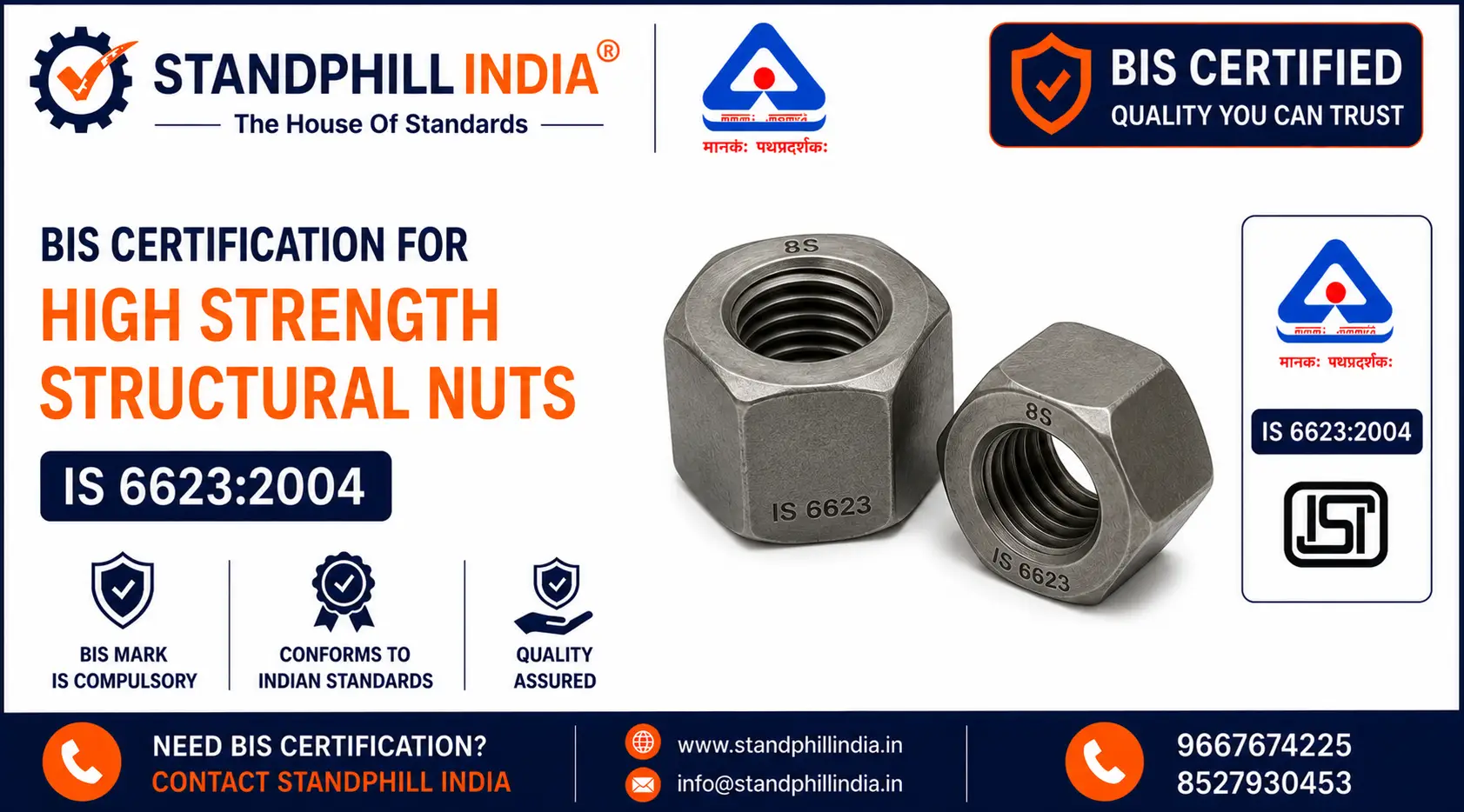
BIS Certification for High Strength Structural Nuts
ISI Mark Under the QCO 2023 - Class 8 & 10 Structural Nuts (M12 to M36) - Scope, Testing, Documents & Global Consultancy
Mandatory for High Strength Structural Nuts
High strength structural nuts are notified under the Bolts, Nuts and Fasteners (Quality Control) Order, 2023 and must carry the ISI Mark under a valid BIS licence before manufacture for sale, sale or import in India. This is a separate licence from the structural bolt - each needs its own ISI Mark.
What This Certification Covers - in Plain Terms
High strength structural nuts are the heavy-duty nuts used together with high-strength structural bolts in the load-bearing, bolted connections that hold up steel structures. They are not general-purpose nuts - they are engineered to carry very high clamping loads and, crucially, to work as a matched pair with the bolt so the joint does not fail by thread stripping when it is torqued up on site. That is why they are notified and certified in their own right rather than as an accessory to the bolt.
These are large-series hexagon nuts in higher property classes, made for both friction-grip (slip-critical) and bearing-type structural steel connections. When the right nut is paired with the right bolt and washer, the connection gives a high level of assurance against failure - which is exactly what a certification regime is meant to guarantee before that nut reaches a bridge or building site.
This is one of 19 fastener products notified under the Bolts, Nuts and Fasteners (Quality Control) Order, 2023. For the legal walkthrough, see our QCO explainer.
Product Scope & Key Specifications
Pinning down where your nut sits within the standard avoids wasted testing. The practical scope for this product:
| Specification | Detail |
|---|---|
| Product | Large-series hexagon high-strength structural nuts |
| Property classes | Higher structural classes (commonly class 8 and class 10, denoting strength grade) |
| Size range | Approximately M12 to M36 |
| Connection types | Suitable for both friction-type (slip-critical) and bearing-type structural steel connections |
| Finish | Plain (dull black) or hot-dip galvanized |
| Matched use | Designed to pair with high-strength structural bolts and hardened washers |
A structural nut is only as good as the bolt it is matched to. The property class of the nut must be compatible with the bolt so the assembly resists thread stripping on over-tightening - certification checks that the nut genuinely meets the class it claims.
Where These Nuts Are Used
High strength structural nuts appear wherever a bolted steel connection has to carry serious, sustained load safely over decades:
Bridges & Flyovers
Slip-critical and bearing connections where joint integrity is safety-critical.
Steel-Framed Buildings
Multi-storey structural steel frames relying on high-strength bolted joints.
Towers & Power
Transmission and communication towers under constant load and weather.
Railway & Heavy Engineering
Railway infrastructure and heavy machinery where load-carrying capacity is paramount.
What the Standard Tests
A BIS-recognised laboratory checks samples against the mechanical and dimensional requirements of the standard, with particular weight on proof load because that is what guarantees the nut can be torqued to the joint's design clamping force. BIS continues periodic surveillance testing while the licence is active:
Proof Load
Confirms the nut takes the required clamping force without stripping or deforming.
Hardness
Material hardness within the limits for the declared property class.
Dimensions & Thread
Dimensional accuracy, tolerances and thread fit checked with gauges.
Chemical Composition
Steel chemistry verified against the standard's requirements.
Coating / Mass of Coating
For galvanized nuts, coating quality and mass are assessed.
Appearance & Defects
Surface discontinuities and disqualifying defects checked.
Certification Snapshot
| Item | Detail |
|---|---|
| Certification mark | ISI Mark (Standard Mark) with CM/L licence number |
| Scheme | Scheme-I, Product Certification (Schedule-II) |
| Governing order | Bolts, Nuts and Fasteners (Quality Control) Order, 2023 |
| Certifying authority | Bureau of Indian Standards (BIS) |
| Who can apply | Manufacturer only; foreign makers via AIR / FMCS |
| Validity | Typically 2 years, renewable |
| Indicative timeline | A few months for a well-prepared Indian maker; longer for FMCS |
Who Needs the Licence - and Who is Exempt
Apply directly to BIS through the domestic ISI Mark (Scheme-I) route - sample testing, documentation and a factory assessment before the licence is granted. See our Indian manufacturers guide.
Apply through the Foreign Manufacturers Certification Scheme (FMCS) with an Authorized Indian Representative and an overseas factory audit.
The order carves out four specific exemptions. You may fall outside the requirement if you are: manufacturing purely for export; supplying nuts that are imported only as a part or component of a larger finished good or sub-assembly; a domestic maker importing to build products that are then exported; or a Udyam-registered micro unit whose plant & machinery investment (at original cost) does not exceed twenty-five lakh rupees and whose turnover did not exceed two crore rupees in the previous financial year, certified by a Chartered Accountant. These are narrow - crossing any threshold or selling one batch into the Indian market brings you back into scope.
The licence always sits with the actual manufacturer, never a trader or reseller. Supplying certified bolts with uncertified nuts does not satisfy the requirement for the nuts - each product needs its own valid ISI Mark. We will confirm your exact position.
Documents Required
BIS expects documentation in three broad groups, and getting the format right is the biggest cause of delay for first-time applicants:
- Administrative: company registration, factory licence, trademark proof, and - for foreign makers - the Authorized Indian Representative appointment.
- Technical: product drawings and specification, raw-material details (raw material should itself be of certified quality), machinery list, in-house test equipment list, and the recognised-lab test report.
- Quality control: the quality manual, competent QC personnel details, and the process and quality-control flow for the product.
How to Get Certified
The route depends on where your factory is. Indian manufacturers follow the domestic Scheme-I process, set out step by step on our BIS Certification for Indian Manufacturers page. Manufacturers outside India go through FMCS with an Authorized Indian Representative - see our FMCS guide.
Produce both high strength structural bolts and nuts? They are separate licences under separate standards, but we routinely certify both together and coordinate a single factory assessment to save time.
Marking Requirements
On grant, BIS issues a unique licence number (the CM/L number). The ISI Mark together with that CM/L number must appear on the nut and its packaging as the standard prescribes, and it is what lets a buyer, inspector or project authority confirm the licence is genuine. Structural nuts are also expected to be marked with their property class so they can be correctly matched with bolts on site.
Penalties for Non-Compliance
BIS is the certifying and enforcing authority, and non-compliance is dealt with under the BIS Act, 2016:
- Seizure of stock from the factory, warehouse or distribution chain.
- Customs detention of imported consignments without a valid licence and marking.
- Fines and imprisonment as provided under the BIS Act, 2016.
- Loss of tenders and contracts - structural projects almost always require the ISI Mark as a precondition.
Related Guides
BIS Certification for Bolts, Nuts and Fasteners - All 19 Products BIS QCO for Bolts, Nuts and Fasteners - the 2023 Order Explained High Strength Structural BoltsWhy Choose Standphill India for Fastener Certification
Fasteners are a deceptively broad category - 19 notified products, overlapping standards, easy-to-miss exemptions and a demanding factory assessment. We work across the entire order as fastener specialists, not a general firm dabbling, and prepare every document to exact BIS format so your file keeps moving - for manufacturers in India and around the world.
Certify Your High Strength Structural Nuts
Free scope check, property-class mapping, documentation, factory-audit preparation and the final ISI licence - for Indian and overseas manufacturers.
Free Consultation +91-9667674225Frequently Asked Questions
Ask About Your Fastener Certification
Tell us what you make - we will confirm if you are covered or exempt, the right standard, and a quote. Clients in India and worldwide.
★ Why Standphill India?
- 20+ Years of BIS Certification Experience
- 10,000+ Certifications Delivered Globally
- Dedicated Teams for CRS, FMCS & ISI Mark
- End-to-End Documentation & Filing Support
- Fast Response & Practical Compliance Guidance
- Support for Indian & Foreign Manufacturers
Get Free Call Back
Our Services
- BIS (ISI Mark) for Foreign Manufacturers
- Domestic BIS (ISI Mark) Certification
- BIS Certificate of Conformity (CoC)
- BIS Hallmarking
- BIS Licence for Toys
- ECO Mark Certification
- TAC Approval for Automobile
- Drug Licence
- Peso Certification
- BIS (CRS) Registration
- WPC-ETA Approval
- BEE Certification
- E-Waste Management (EPR)
- EPR for Plastic Waste
- EPR for Battery Waste
- CE Certification
- UL Certification
- ROHS Licence
- Standardization Division
- Import / Export Licence
- FSSAI Certification
- ISO Registration
- Trademark Registration
- Make in India Support
- AG-Mark Licence
- Third Party Monitoring
Client Testimonials
Their team was very knowledgeable and helped us every step of the way. Standphill India is the best BIS certification consultants for any type of BIS certification.

Chintan Shah (AGM)
Sudeep Nutrition P.Ltd



Featured Guide
Complete BIS CRS certification guide for electronic products in India — free to read.
Read CRS Certification Guide📞 Contact Standphill India
+91-9667674225 info@standphillindia.in WhatsApp Now Greater Noida West, UPGet Expert BIS Certification Support for Your Business
Connect with Standphill India for complete support with BIS certification, CRS registration, WPC approval, FMCS compliance, and related regulatory services. Our team helps businesses with documentation, testing coordination, application support, and end-to-end compliance guidance.
Request Free Consultation
Share your requirement and our team will contact you shortly.