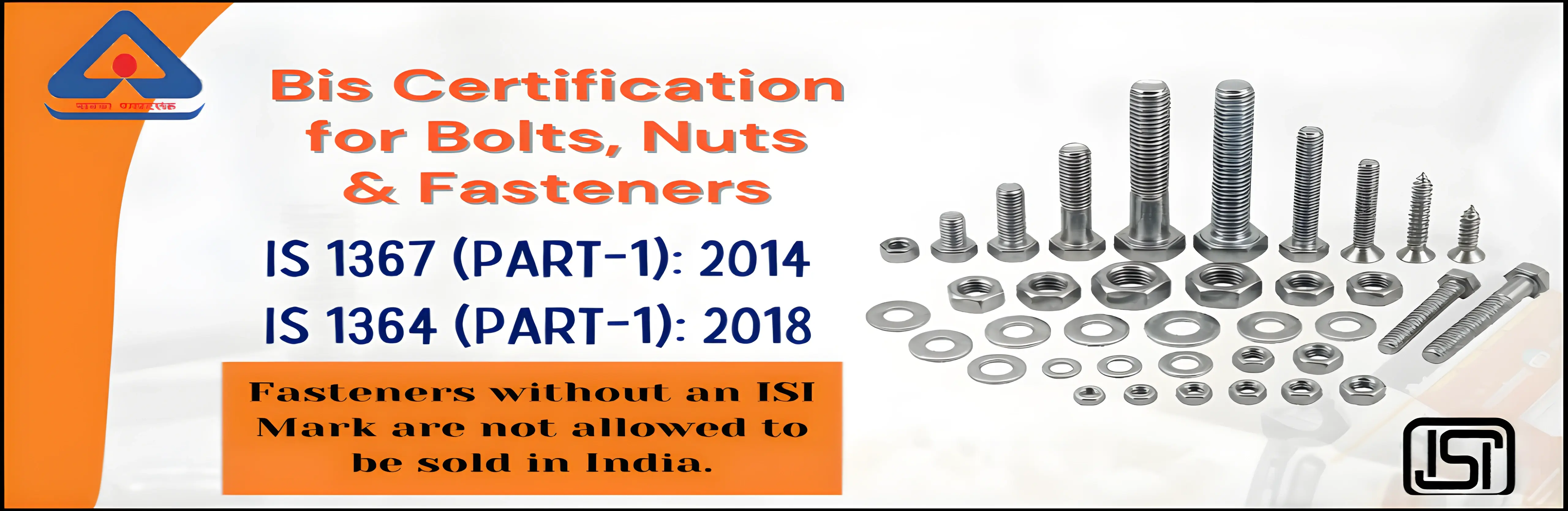
BIS Certification for Bolts, Nuts & Fasteners (ISI Mark)
All 19 Notified Products Under the Current QCO 2024 & Their Indian Standards - Are You Covered or Exempt, Which Standard Applies, and What You Actually Need
Looking for a trusted BIS consultant for bolts, nuts and fasteners? This guide doubles as your complete reference - read on for the products, standards and exemptions, or jump straight to why Standphill India is the right consultant for the job.
If you make or import notified bolts, nuts or fasteners for the Indian market, they must carry the ISI Mark under a BIS licence - mandatory under the Bolts, Nuts and Fasteners (Quality Control) Order, 2024 (which superseded the original 2023 order on 17 July 2024), covering 19 distinct products across standards like IS 1363, IS 1364, IS 3757, IS 6623 and IS 12427. A few are exempt (export-only goods, fasteners imported as a component, and tiny Udyam micro units). Standphill India is a trusted BIS consultant for fasteners, serving manufacturers and importers across India and internationally, and handles all 19 categories end-to-end. Call +91-9667674225.
The 2023 order has been superseded. The Ministry of Commerce and Industry notified the Bolts, Nuts and Fasteners (Quality Control) Order, 2024 on 15 July 2024, which came into force on 17 July 2024 and replaces the earlier Bolts, Nuts and Fasteners (Quality Control) Order, 2023. The 2024 order keeps the same Indian Standards and the same MSME relaxation structure (additional time for Small and Micro Enterprises), and is the version currently governing compliance. Wherever this page or its linked product pages mention "the QCO," it refers to the current 2024 order unless stated otherwise.
Need a BIS consultant for bolts, nuts and fasteners rather than a self-help guide? Standphill India handles scope checks, documentation, testing coordination, factory-audit prep and the final ISI licence end-to-end - for Indian and foreign manufacturers, anywhere in the world.
See Why Clients Choose Us →- What This Certification Actually Is
- Are You Covered? Who Needs It
- Who is Exempt
- All 19 Products - Find Yours
- Full IS Standards Reference Table
- Cost & Timeline
- Confusing Terms, Explained Simply
- What You Actually Need
- Your Route: Indian or Foreign Maker
- BIS Consultant for Fasteners - Why Standphill India
- The Official QCO Documents
- FAQs
Not Sure If Your Fastener Needs the ISI Mark?
Send us your product - we will tell you in one call whether you are covered or exempt, and exactly which of the 19 standards applies. Free scope check, for clients in India and abroad.
What This Certification Actually Is - in One Minute
Let us keep this simple. BIS certification for fasteners is the official approval from the Bureau of Indian Standards (BIS) that lets you put the ISI Mark on your bolts, nuts and screws. That little ISI symbol is the government's way of telling a buyer "this fastener has been tested and genuinely meets the Indian quality standard." Without it, a notified fastener cannot legally be sold in India.
Here is why it matters so much for fasteners specifically: these are tiny parts that hold up enormous things. A single weak bolt in a bridge, a tower or a machine can fail catastrophically. So the government brought 19 fastener products under compulsory certification through the current Bolts, Nuts and Fasteners (Quality Control) Order, 2024 - and for you as a manufacturer, the ISI Mark is now both a legal must-have and the thing that gets you into tenders and serious supply contracts.
This page is deliberately practical. Instead of repeating the legal text, it answers the questions fastener makers actually ask us: Am I covered? Am I exempt? Which of the 19 standards is mine? What does it cost and how long does it take? What do I actually need to get certified? Where you want the deeper detail on the order itself, we point you to the dedicated QCO explainer page.
Are You Covered? Who Needs BIS Certification
The simplest way to think about it: if your fastener is on the official notified list of 19 products and you are putting it into the Indian market, you need the ISI Mark. That applies to three groups:
Indian Manufacturers
You make notified fasteners and sell them in India
Importers
You import notified fasteners to sell in India
Foreign Manufacturers
You make fasteners abroad and supply Indian buyers
If you are in any of these three groups and your product is on the list, certification is not optional - it is the law, backed by the BIS Act, 2016. Selling a notified fastener without the ISI Mark can lead to fines, seized stock, blocked customs clearance and disqualification from government and infrastructure tenders.
Want the full legal background - the exact order, dates and enforcement timelines? We keep that on a dedicated page so this one stays practical: see BIS QCO for Bolts, Nuts and Fasteners.
Who is Exempt - the Part Most Pages Skip
This is the bit almost every other website forgets to tell you, and it can save you a lot of worry. The order itself carves out a few clear exemptions. If you fall into one of these, you may not need certification at all:
Export-Only Goods
Fasteners you manufacture in India purely for export are exempt. If it never enters the Indian market, the order does not apply.
Imported as a Component
Fasteners imported as part of a finished product, sub-assembly or component are exempt - they are not being sold as loose fasteners.
Import for Export Production
Fasteners a domestic maker imports specifically to build products that will be exported are exempt.
Tiny Udyam Micro Units
Units on the Udyam portal with plant & machinery investment up to Rs 25 lakh and turnover up to Rs 2 crore (CA-certified) are exempt.
Be careful - these exemptions are narrow and specific. The moment an "export-only" maker sells one batch in India, or a micro unit crosses the investment or turnover limit, certification kicks in. Do not assume - confirm your exact status with us first.
All 19 Fastener Products Covered - Find Yours
The current Bolts, Nuts and Fasteners (Quality Control) Order, 2024 covers 19 distinct fastener products, each mapped to its own Indian Standard. Whatever you manufacture - from a common hexagon bolt to a high-strength structural nut, a transmission tower bolt or a humble door aldrop - it is in this list. Find your product below and open its dedicated certification guide:
Make several types? Each product category needs certification against its own standard. We map your whole range to the right standards - and the fewest sensible licences - in one go. Send us your list.
Note: as per the order, the latest version of each Indian Standard, including amendments notified by BIS from time to time, applies from the date of such notification. The table above lists 18 product rows mapped to the 2023-originated standards; the 2024 order carries one additional product entry within the same overall scope, which we cover in detail on the dedicated QCO page.
Cost & Timeline - the Honest Numbers
Every manufacturer's first question is what this will actually cost and how long it will take. Here is a realistic, ballpark picture - your exact figure depends on how many products and standards you certify together, so treat this as a planning range, not a quote:
| Applicant Type | Typical Timeline | Approximate Cost Range (per standard) |
|---|---|---|
| Indian Manufacturer (well-prepared) | 3 - 6 months | ~INR 1.5 - 4 lakh |
| Indian Manufacturer (multiple standards) | 4 - 8 months | Lower per-standard cost when bundled |
| Foreign Manufacturer (FMCS route) | 6 - 9 months | ~INR 3 - 6 lakh (incl. AIR & overseas audit) |
Cost is generally made up of four parts: the BIS application and marking fee, lab testing charges at a BIS-recognised laboratory, the factory-audit fee, and professional consultancy support. Foreign applicants additionally factor in the Authorized Indian Representative (AIR) appointment and overseas factory inspection logistics. Standphill India gives every client a clear, itemised estimate before any work begins, so there are no surprise costs midway through the process.
Confusing Terms, Explained Simply
BIS paperwork is full of jargon. Here is what the most common terms actually mean, in plain words:
What You Actually Need to Get Certified
Without drowning you in the full process (that lives on our dedicated pages), here is the honest short version of what it takes. Three things have to line up:
- A fastener that passes the test. Your product is tested at a BIS-recognised lab for things like strength, hardness, chemical composition and dimensions - it has to meet its Indian Standard.
- A factory that can prove consistency. A BIS officer visits to check you have the right machinery, an in-house testing setup with calibrated instruments, and documented quality control - i.e. you can make a good fastener every time, not just once.
- Clean, BIS-format paperwork. Company documents, factory layout, machinery and testing lists, quality manual, raw-material details and test reports - all in the exact format BIS expects.
Honestly, the testing is rarely the hard part - it is the factory readiness and the paperwork formatting where first-timers lose weeks. That is precisely the bit we take off your plate.
Your Route Depends on Who You Are
The exact process differs slightly depending on whether you make your fasteners in India or abroad. Rather than repeat it all here, we keep the full step-by-step on dedicated pages - pick the one that fits you:
Make electronics or IT products too? Those follow a different scheme entirely - see BIS CRS Certification for Electronic Products. Fasteners themselves never go through CRS; they are always ISI Mark.
BIS Consultant for Bolts, Nuts & Fasteners - Why Standphill India
Choosing the right consultant is the difference between a smooth few-month certification and a year of back-and-forth. Fasteners are a deceptively tricky category - 19 products, overlapping standards, easy-to-miss exemptions and a demanding factory audit. Here is why manufacturers and importers across India and internationally trust Standphill India as their BIS consultant for bolts, nuts and fasteners:
Fastener QCO Specialists
We work across all 19 fastener products under the current order - not a general firm dabbling, but a team that knows IS 1363, 1364, 3757, 6623, 12427 and the rest inside out.
Honest Scope & Exemption Check
We tell you the truth first - whether you even need to certify, or whether you qualify for the export or Udyam exemption. No unnecessary work.
Deficiency-Free Documentation
The number-one cause of delay is badly formatted paperwork. We prepare every document to exact BIS specification so your file keeps moving.
Factory-Audit Ready
We prepare your production line, in-house lab and quality systems for the BIS inspection - where unprepared applicants lose the most time.
Indian & Foreign Makers, Worldwide
Domestic ISI Mark and full FMCS with AIR services for overseas fastener manufacturers and importers anywhere in the globe - one team for both.
Beyond the Licence
Surveillance management, renewals and adding new products later - we stay with you after the ISI Mark is granted.
With 20+ years of experience and 10,000+ certifications, we have guided everyone from single-product workshops to multi-standard manufacturers through fastener certification, both within India and for international clients. If you are searching for a dependable BIS certification consultant for fasteners, this is what that looks like. For more on our consultancy, see BIS Certification Consultants in India. For consultant assistance anywhere in the world, contact Standphill India directly.
This guide is maintained by the Standphill India BIS Certification Desk and reviewed periodically against the official Gazette notifications referenced below.
Get Your Fasteners ISI-Certified - Without the Guesswork
From confirming whether you are even covered, to documentation, testing, factory-audit prep and the final ISI licence - Standphill India runs the whole thing for Indian and foreign fastener makers, across all 19 products, for clients across India and around the world.
The Official QCO Documents - Read or Download
For complete transparency, here are the actual government notifications - the current Bolts, Nuts and Fasteners (Quality Control) Order, 2024 (in force from 17 July 2024, in supersession of the 2023 order) from the Gazette of India, listing every covered fastener and its Indian Standard. You can read it right here or download your own copy:
Bolts, Nuts & Fasteners (Quality Control) Order, 2023 / 2024
Download PDFRelated Guides
BIS QCO for Bolts, Nuts and Fasteners - the 2024 Order Explained BIS Certification for Indian Manufacturers (ISI Mark Process) BIS Certification for Foreign Manufacturers (FMCS) BIS Certification Consultants in India - Standphill India BIS CRS Certification for Electronic ProductsFrequently Asked Questions - Fastener BIS Certification
Ask About Your Fastener Certification
Tell us what you make - we will confirm if you are covered or exempt, the right standard, and a quote, within one business day. We work with clients across India and internationally.
★ Why Standphill India?
- 20+ Years of BIS Certification Experience
- 10,000+ Certifications Delivered Globally
- Dedicated Teams for CRS, FMCS & ISI Mark
- End-to-End Documentation & Filing Support
- Fast Response & Practical Compliance Guidance
- Support for Indian & Foreign Manufacturers
Get Free Call Back
Our Services
- BIS (ISI Mark) for Foreign Manufacturers
- Domestic BIS (ISI Mark) Certification
- BIS Certificate of Conformity (CoC)
- BIS Hallmarking
- BIS Licence for Toys
- ECO Mark Certification
- TAC Approval for Automobile
- Drug Licence
- Peso Certification
- BIS (CRS) Registration
- WPC-ETA Approval
- BEE Certification
- E-Waste Management (EPR)
- EPR for Plastic Waste
- EPR for Battery Waste
- CE Certification
- UL Certification
- ROHS Licence
- Standardization Division
- Import / Export Licence
- FSSAI Certification
- ISO Registration
- Trademark Registration
- Make in India Support
- AG-Mark Licence
- Third Party Monitoring
Client Testimonials
Their team was very knowledgeable and helped us every step of the way. Standphill India is the best BIS certification consultants for any type of BIS certification.

Chintan Shah (AGM)
Sudeep Nutrition P.Ltd



Featured Guide
Complete BIS CRS certification guide for electronic products in India — free to read.
Read CRS Certification Guide📞 Contact Standphill India
+91-9667674225 info@standphillindia.in WhatsApp Now Greater Noida West, UPGet Expert BIS Certification Support for Your Business
Connect with Standphill India for complete support with BIS certification, CRS registration, WPC approval, FMCS compliance, and related regulatory services. Our team helps businesses with documentation, testing coordination, application support, and end-to-end compliance guidance.
Request Free Consultation
Share your requirement and our team will contact you shortly.