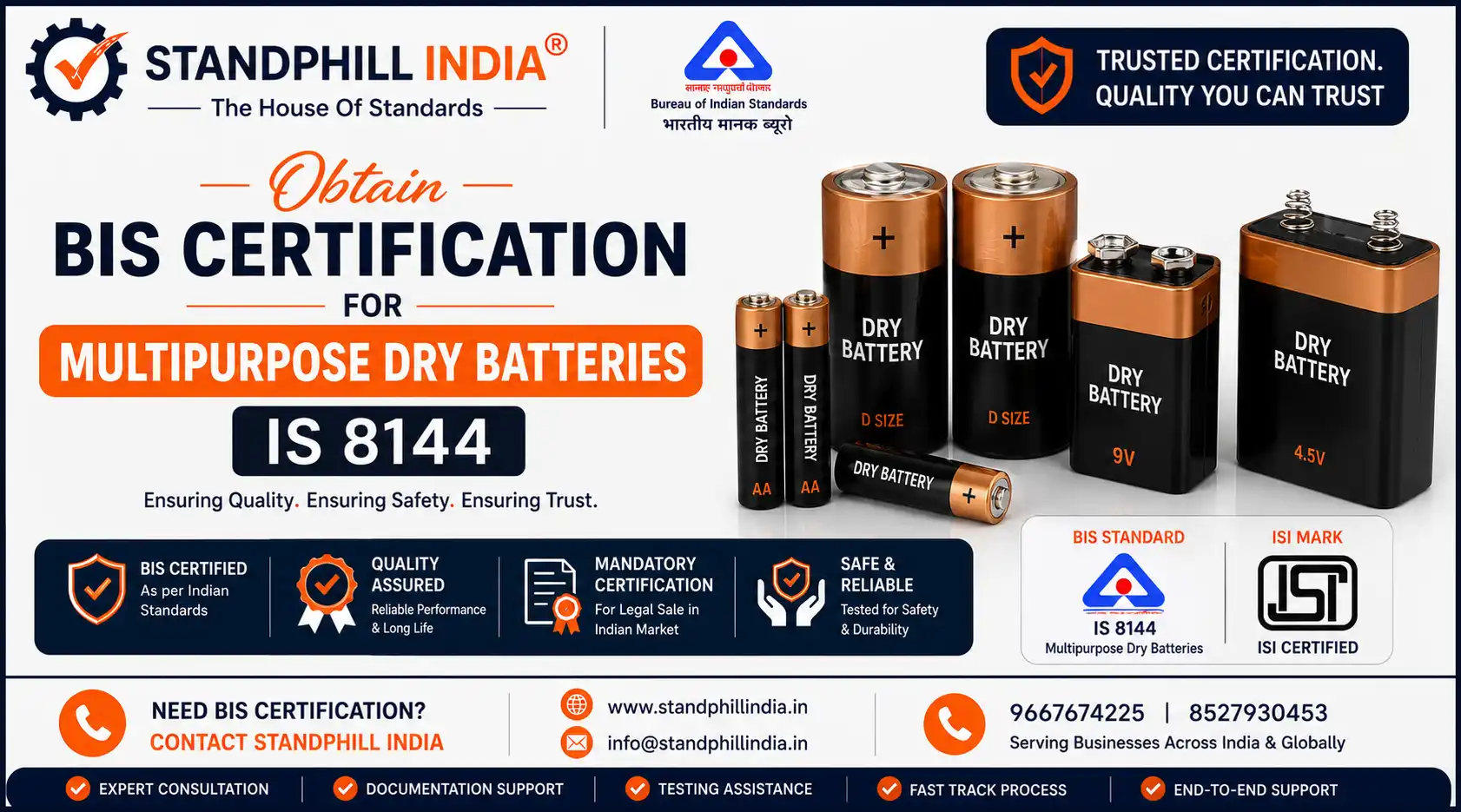
Obtain BIS Certification for Multipurpose Dry Batteries - IS 8144
IS 8144 · AA / AAA / C / D Zinc-Carbon Cells · Mandatory Under Scheme-I (NOT CRS) · ISI Mark with CM/L Number
Mandatory ISI Mark - Not CRS
Multipurpose dry batteries (AA/AAA/C/D zinc-carbon primary cells) must carry the ISI Mark under a BIS Scheme-I licence (CM/L number) as per the long-standing Multipurpose Dry Batteries (Quality Control) Order. This is NOT a CRS registration - it requires a factory audit and testing at BIS-recognised Indian laboratories. A CRS registration does not cover dry batteries - this confusion has stranded imported consignments at Indian ports.
About Multipurpose Dry Batteries - What This Certification Covers
The AA cell in your TV remote, the AAA in your wall clock, the D-cell in the torch - multipurpose dry batteries are the most distributed electrical product in India, sold in crores through every kirana store and supermarket. They are zinc-carbon (Leclanche-type) primary (single-use) batteries, standardised in four familiar sizes. And they have been under mandatory ISI certification for decades - one of India's oldest compulsory-certification products.
The governing instrument is the Multipurpose Dry Batteries (Quality Control) Order, issued under Section 14 of the BIS Act, 1986 by the then Ministry of Food and Civil Supplies. BIS is the certifying and enforcing authority. Every dry battery sold in India must conform to the applicable Indian Standard and carry the ISI Mark with a valid CM/L licence number - whether made in India or imported.
Route check: Dry batteries follow the ISI Mark (Scheme-I) route with a factory audit - completely different from the CRS registration (R-number) route that covers lithium and nickel rechargeables. If you are looking for lithium battery certification, see our lithium-ion cells and batteries page.
What is IS 8144 - The Indian Standard for Dry Batteries?
IS 8144 is the Indian Standard for Multipurpose Dry Batteries - the zinc-carbon (Leclanche-type) primary batteries used in remote controls, clocks, torches, toys, hearing aids and countless everyday devices. A significant revision in 2018 merged the old heavy-duty standard IS 9128:1999 into IS 8144, so one standard now covers all categories. The latest notified version, including amendments by BIS, always applies.
| Specification | Detail |
|---|---|
| Indian Standard | IS 8144 (latest version including amendments) - merged IS 9128:1999 in 2018 revision |
| Battery chemistry | Zinc-carbon (Leclanche-type) - primary / single-use cells |
| Sizes covered | R03 (AAA) · R6 (AA) · R14 (C) · R20 (D) |
| Categories | Standard and high-power (heavy duty) within each size |
| NOT covered | Rechargeable NiMH/NiCd (IS 16046 Part 1), lithium (IS 16046 Part 2), alkaline primary, lead-acid |
| Compliance status | Mandatory - under QCO for decades |
| BIS route | Scheme-I ISI Mark with CM/L licence number (NOT CRS) |
Why Is BIS Certification Mandatory for Dry Batteries?
Dry batteries are bought overwhelmingly on price, by everyone, from every channel - from organised retail to open bazaars. Without mandatory certification, the market races to the bottom: under-gauge wire, less zinc and manganese dioxide inside, thinner separators, and fake brand names on cells that deliver a fraction of their declared service life. Worse, sub-standard dry cells leak electrolyte into the devices they power, causing corrosion damage that costs far more than the battery.
The QCO puts a verified floor under all of it: proven dimensions (a fat AA jams the battery compartment), proven discharge output (service life actually delivered), proven leakage resistance, and the ISI Mark that lets a buyer and a customs officer tell real from counterfeit. This certification requirement is one of India's oldest - and it exists because the need never went away.
Myth-buster: IS 8144 dry batteries are NOT covered by CRS registration. They are a Scheme-I ISI product. A brand that files CRS for its AA batteries is filing under the wrong scheme - and importers who believed online advice saying "CRS covers dry batteries" have watched shipments sit at Nhava Sheva.
How to Get BIS Certification for Dry Batteries - Step by Step
The Scheme-I route has six clear steps. Unlike CRS (which is lab-test + portal only), Scheme-I includes a factory assessment by BIS:
- Map your sizes and categories - confirm which of the four sizes and two categories your product covers under IS 8144. We do this mapping free before any testing begins.
- Prepare factory and in-house test setup - BIS requires your manufacturing facility and in-house testing capability to meet IS 8144 requirements. We assess and guide this before the BIS audit, so the real visit gets a clean report.
- Laboratory sample testing - samples are tested at a BIS-recognised Indian laboratory against IS 8144. Note: testing must be done in India at BIS-recognised labs - foreign lab reports are not a substitute.
- Prepare documentation in BIS format - application forms, quality manual, process flow charts, equipment lists, technical specification, and marking/labelling artwork. Format errors are the most common cause of BIS objections.
- BIS factory assessment - a BIS officer visits your facility to verify manufacturing and testing capability. We prepare your team for the audit in advance.
- Licence grant with CM/L number - on satisfactory review, BIS issues the ISI Mark licence with your unique CM/L number. This is what goes on every battery and pack.
For foreign manufacturers the route is FMCS (Foreign Manufacturers Certification Scheme) with an Authorized Indian Representative - same steps, with the factory audit happening at your overseas facility. Full detail on our FMCS guide.
Testing for dry batteries is done at BIS-recognised Indian laboratories - we manage sample logistics and lab coordination so your samples arrive correctly packaged and the report comes back in BIS-accepted format. Ask us before you ship any samples.
Benefits of BIS Certification for Dry Batteries
- Legal market access: manufacture, import, stock and sell freely across India without customs detention or seizure risk.
- Institutional and government tenders: railway, defence and public procurement routinely specifies ISI-marked batteries - the CM/L is your tender qualification.
- Brand protection: the ISI Mark on your battery, traceable to your CM/L, is the visible signal separating genuine product from the counterfeit copies that flood the bazaar category.
- Consumer trust: the ISI Mark is India's most recognised quality mark in electrical retail - visible on packaging, it moves product at the point of sale.
- E-commerce and modern trade: leading platforms and modern retailers increasingly verify ISI certification as a listing and stocking requirement.
- Competitive moat: uncertified product is legally out of the market; certified factories capture the compliance-verified buyer base their uncertified competition can no longer legally serve.
Documents Required for BIS Certification of Dry Batteries
BIS expects documentation in three broad groups:
- Administrative: company registration certificate, factory licence, GST registration (Indian manufacturers), trademark certificate and authorisation, Import Export Code (where applicable), and - for foreign manufacturers - the Authorized Indian Representative appointment documents.
- Technical: product specification to IS 8144 (sizes, categories, construction details), machinery and equipment list, in-house test equipment list with calibration certificates, process flow chart, and the BIS-recognised laboratory test report covering all IS 8144 test parameters.
- Quality control: quality manual, competent QC personnel details, batch-testing and inspection procedures, and marking/labelling artwork showing the ISI Mark with CM/L placement per IS 8144.
We prepare every document from scratch to exact BIS format - not a template from three years ago. Format errors are the single biggest cause of BIS objections and delays; correct preparation at the start is the single biggest time-saver.
Certification Snapshot - All Key Details
| Item | Detail |
|---|---|
| Product | Multipurpose dry batteries - zinc-carbon (Leclanche-type) primary cells, R03/R6/R14/R20 |
| Indian Standard | IS 8144 (latest notified version including amendments) |
| Compliance status | Mandatory - under QCO for decades |
| BIS route | Scheme-I ISI Mark with CM/L number (not a CRS R-number) |
| Ministry / QCO | Multipurpose Dry Batteries (Quality Control) Order - Ministry of Food and Civil Supplies era (BIS Act, 1986, Section 14); BIS is the certifying and enforcing authority |
| Who can apply | Manufacturer only; foreign makers via FMCS with an Authorized Indian Representative |
| Factory audit | Yes - Scheme-I includes a BIS factory assessment before licence grant |
| Testing location | BIS-recognised Indian laboratories (foreign lab reports are not accepted) |
| Average timeline | 4-6 weeks for prepared Indian files; 6-10+ weeks via FMCS for foreign manufacturers |
| Validity | Up to 5 years per the BIS (Conformity Assessment) Amendment Regulations, 2026 (25 Feb 2026); fee payable annually in advance with production statement |
| Renewal | Renewable for further periods of up to 5 years; renewal application through BIS Manakonline portal before expiry |
| Cost | Government fees (BIS) + laboratory testing fees (BIS-recognised Indian lab) + consultancy fees - complete estimate provided within 24 hours of enquiry |
Licence Validity and Renewal - Updated for 2026
This changed recently, and most websites have not caught up. Under the BIS (Conformity Assessment) Amendment Regulations, 2026 (notified 25 February 2026), Scheme-I licences are now granted for periods of up to 5 years - previously the initial grant was typically up to 2 years. On expiry, the licence is renewable for further periods of up to 5 years.
The trade-off: the applicable licence fee is payable annually in advance along with a production statement. Miss the due date and the licence can be suspended for up to 90 days (with a late fee to restore it); continued default triggers cancellation. In practice: renewals are less frequent, but the annual fee deadline is now a hard compliance event.
Renewal process: apply through the BIS Manakonline portal before expiry with production details and the fee for the renewal period opted. We run the annual-fee and renewal calendar for our clients so nothing lapses.
Marking Requirements After Certification
The ISI Mark with the CM/L number must appear on each battery and its packaging per IS 8144's marking clauses - along with size designation, polarity marking, date coding and manufacturer/brand details. On a product this widely counterfeited, correct marking is also your brand-protection tool: buyers, enforcement officers and e-commerce platforms verify CM/L numbers against the BIS database.
Penalties for Non-Compliance
BIS is the certifying and enforcing authority. Non-compliance is punishable under the BIS Act, 2016: seizure of stock, customs detention of imports, and for a first offence imprisonment up to two years or a fine of at least two lakh rupees - rising steeply for repeat offences. Beyond legal penalties: institutional buyers verify CM/L numbers, e-commerce platforms delist unmarked batteries, and the customs hold on an uncertified imported shipment typically costs more than the entire certification would have.
Related Guides
BIS Certification for Batteries - Complete Map (Every Battery Type) Lithium-Ion Cells & Batteries (CRS - IS 16046 Part 2) Nickel System Cells & Batteries (CRS - IS 16046 Part 1) BIS Consultant for Batteries BIS Certification for Indian Manufacturers BIS Certification for Foreign Manufacturers (FMCS)Why Choose Standphill India for Dry Battery Certification
With 20+ years and 10,000+ certifications, we work across the entire battery compliance map - ISI Mark for dry batteries and voluntary lead-acid products, CRS for lithium and nickel rechargeables, FMCS for overseas factories. For dry batteries specifically, we prepare the factory for the BIS audit, manage Indian laboratory testing, build the documentation in exact BIS format, and run the annual-fee compliance calendar so your CM/L never lapses.
Get Your Dry Battery ISI Licence - Talk to Us Today
Size and category mapping, Indian lab coordination, factory-audit preparation, documentation and the final CM/L licence - for Indian manufacturers and overseas factories via FMCS.
Free Consultation +91-9667674225Frequently Asked Questions
Ask About Your Dry Battery ISI Licence
Tell us your battery sizes and categories - we will confirm the route, timeline and cost within 24 hours.
★ Why Standphill India?
- 20+ Years of BIS Certification Experience
- 10,000+ Certifications Delivered Globally
- Dedicated Teams for CRS, FMCS & ISI Mark
- End-to-End Documentation & Filing Support
- Fast Response & Practical Compliance Guidance
- Support for Indian & Foreign Manufacturers
Get Free Call Back
Our Services
- BIS (ISI Mark) for Foreign Manufacturers
- Domestic BIS (ISI Mark) Certification
- BIS Certificate of Conformity (CoC)
- BIS Hallmarking
- BIS Licence for Toys
- ECO Mark Certification
- TAC Approval for Automobile
- Drug Licence
- Peso Certification
- BIS (CRS) Registration
- WPC-ETA Approval
- BEE Certification
- E-Waste Management (EPR)
- EPR for Plastic Waste
- EPR for Battery Waste
- CE Certification
- UL Certification
- ROHS Licence
- Standardization Division
- Import / Export Licence
- FSSAI Certification
- ISO Registration
- Trademark Registration
- Make in India Support
- AG-Mark Licence
- Third Party Monitoring
Client Testimonials
Their team was very knowledgeable and helped us every step of the way. Standphill India is the best BIS certification consultants for any type of BIS certification.

Chintan Shah (AGM)
Sudeep Nutrition P.Ltd



Featured Guide
Complete BIS CRS certification guide for electronic products in India — free to read.
Read CRS Certification Guide📞 Contact Standphill India
+91-9667674225 info@standphillindia.in WhatsApp Now Greater Noida West, UPGet Expert BIS Certification Support for Your Business
Connect with Standphill India for complete support with BIS certification, CRS registration, WPC approval, FMCS compliance, and related regulatory services. Our team helps businesses with documentation, testing coordination, application support, and end-to-end compliance guidance.
Request Free Consultation
Share your requirement and our team will contact you shortly.