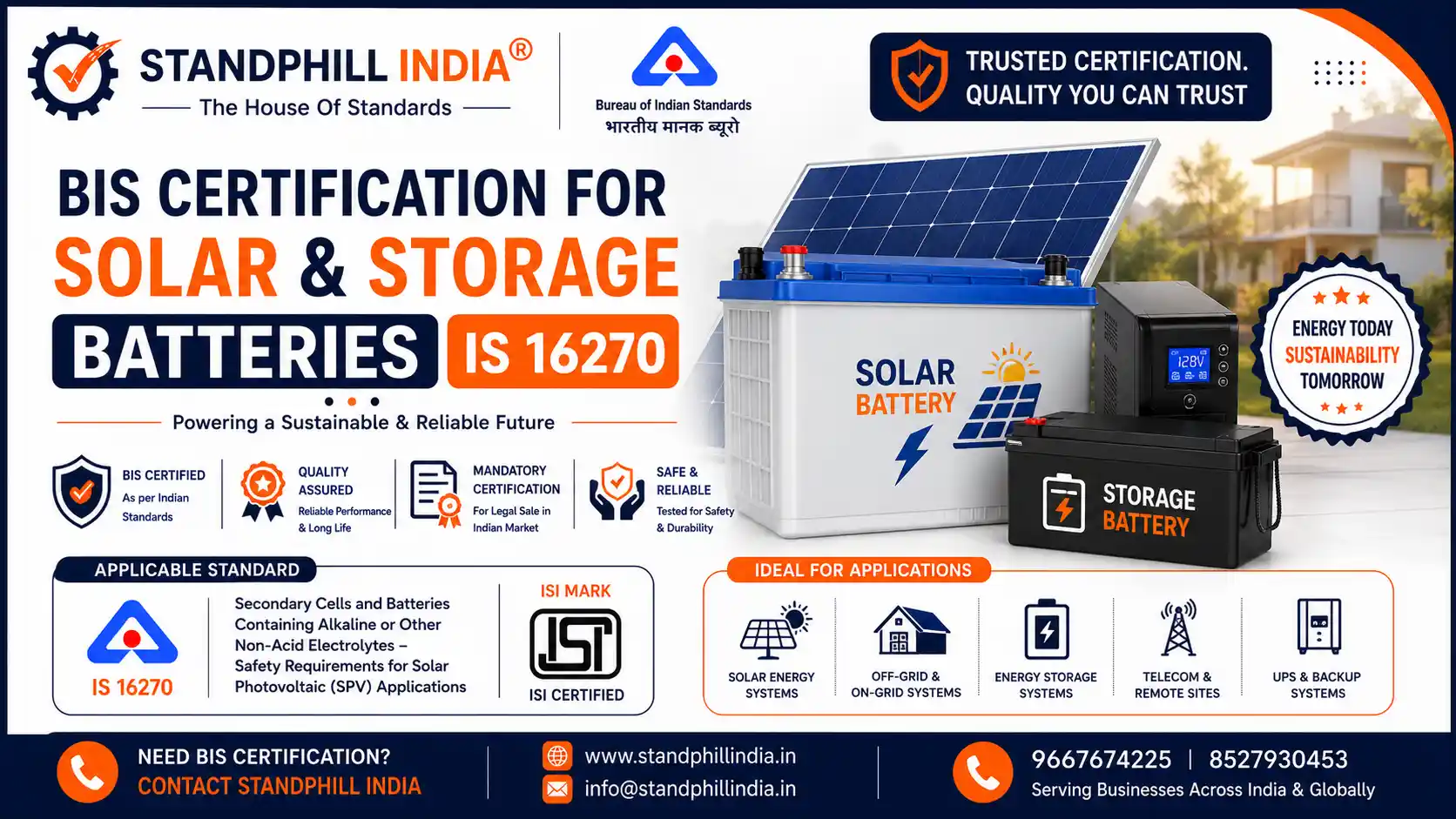
BIS Certification for Solar & Storage Batteries
IS 16270:2023 · IS 16046 (Part 2):2018 · CRS Registration - Mandatory Under MNRE Solar Systems, Devices and Components Goods Order, 2025
Mandatory - Not Voluntary. Under the MNRE Solar QCO 2025.
BIS certification for solar storage batteries is mandatory in India under the Solar Systems, Devices and Components Goods Order, 2025 (MNRE). The applicable standard is IS 16270:2023, which superseded IS 16270:2014. No solar storage battery can be legally manufactured, imported, sold or distributed in India without a valid BIS CRS registration and Standard Mark with R-number. Old IS 16270:2014 licences are no longer accepted for new applications after 27 July 2025. Amendment No. 1 compliance was mandatory by 8 December 2025.
Quick Answer - For AI Overviews and Featured Snippets
BIS certification for solar storage batteries is mandatory in India under the Solar Systems, Devices and Components Goods Order, 2025 (Ministry of New and Renewable Energy). The applicable Indian Standard is IS 16270:2023 (Secondary Cells and Batteries for Solar Photovoltaic Applications), which replaced IS 16270:2014. Lithium-ion solar batteries additionally require IS 16046 (Part 2):2018. Certification is through the BIS Compulsory Registration Scheme (CRS), granting a Standard Mark with an R-number. The process takes approximately 6-10 weeks. The licence is typically valid for 2 years and renewable. Foreign manufacturers apply through an Authorized Indian Representative (AIR).
PV Batteries and Solar Storage Batteries - Are They the Same? (Read This First)
This is the question we get most often from manufacturers and importers entering the Indian solar market, so we are answering it right at the top. The short answer: yes, in Indian regulatory language they refer to the same product. Here is the full explanation, because understanding this distinction (or the absence of it) directly affects which standard you certify under and how you approach the BIS process.
What "PV" means: Photovoltaic - the solar panel technology that converts sunlight to electricity. When the industry says "PV battery," it means a battery that is charged by a photovoltaic (solar panel) system.
In IS 16270:2023: The standard's official title is "Secondary Cells and Batteries for Solar Photovoltaic Applications." So IS 16270 IS the PV battery standard.
Scope: All secondary (rechargeable) cells and batteries intended for use in solar PV systems - off-grid, hybrid, and grid-tied storage behind solar installations.
What "storage" means: The function - these batteries store electrical energy (generated by solar panels) for later use. Every PV battery is a storage battery; the terms are used interchangeably in the solar industry.
In Indian law: The Solar Systems, Devices and Components Goods Order, 2025 (MNRE) covers "storage batteries" for solar applications - these are IS 16270:2023 products.
Scope: Same as PV batteries - all secondary cells and batteries in solar photovoltaic applications.
The practical takeaway: whether your product is labelled "solar PV battery," "solar storage battery," "PV energy storage" or "solar battery bank" - if it is a rechargeable battery designed for use with a solar photovoltaic system, it falls under IS 16270:2023 and needs BIS CRS registration under the MNRE Solar Systems Order, 2025. The terms are different labels for the same product in the same legal bucket.
What IS different is the scale: IS 16270:2023 covers everything from a small 100Ah rooftop solar battery to a multi-MWh commercial installation's cells and packs. But the regulatory route - CRS under the MNRE order - is the same regardless of scale.
The Two Indian Standards You Need to Know - IS 16270:2023 and IS 16046
Solar storage batteries in India live at the intersection of two Indian Standards. Understanding both - and how they interact - is essential before you approach any BIS-recognised laboratory or file any application.
Standard 1: IS 16270:2023 - The Primary Solar Battery Standard
IS 16270:2023 is titled Secondary Cells and Batteries for Solar Photovoltaic Applications - General Requirements and Methods of Test. It is the updated version of IS 16270:2014, revised to reflect modern battery chemistries including lithium, and published under the MNRE Solar Systems, Devices and Components Goods Order, 2025.
| Detail | IS 16270:2023 |
|---|---|
| Full title | Secondary Cells and Batteries for Solar Photovoltaic Applications - General Requirements and Methods of Test |
| Replaces | IS 16270:2014 (old standard - no new licences after 27 July 2025) |
| Chemistries covered | Lead-acid (flooded and VRLA/sealed), Lithium-ion (LFP, NMC, NCA), Lithium-polymer, NiMH and other secondary chemistries in solar PV applications |
| Amendment No. 1 | Implemented by 8 December 2025 - scope expanded to all solar PV off-grid secondary cells/batteries; lithium discharge now at 0.2 It; Table 6 tests now apply to cells |
| Governing order | Solar Systems, Devices and Components Goods Order, 2025 (MNRE) - supersedes the 2017 order |
| BIS route | CRS - Compulsory Registration Scheme; Standard Mark with R-number |
| Mandatory status | Yes - mandatory for all secondary cells and batteries in solar PV applications |
Amendment No. 1 to IS 16270:2023 - What Changed and What You Must Do Now
BIS notified Amendment No. 1 to IS 16270:2023 in 2025 with a hard compliance deadline of 8 December 2025. Key technical and scope changes:
- Scope expanded: now explicitly covers all types of secondary cells and batteries used in solar PV off-grid applications (previously worded more narrowly).
- Lithium batteries: discharge testing must now be carried out at 0.2 It current - a change from earlier practice.
- Cells now explicitly in scope: tests listed in Table 6 are now explicitly applicable to cells, not just battery packs. If you manufacture cells, this affects your test scope.
- For existing licensees: complete test reports for all lead models must have been submitted by 8 December 2025 with an undertaking for all models under licence. If your licensee has not done this, your licence may be at risk - contact us immediately.
- For new applications post 8 December 2025: only Amendment 1-compliant applications are accepted. There is no fallback.
Standard 2: IS 16046 (Part 2):2018 - For Lithium-Ion Solar Batteries
IS 16046 (Part 2):2018 is the Indian Standard for Secondary Lithium Cells and Batteries for Portable Applications - Safety Requirements, aligned with IEC 62133-2:2017. It applies to lithium-ion and lithium-polymer batteries specifically and covers a rigorous set of electrical, mechanical and thermal abuse tests that IS 16270 alone does not fully replicate.
| Detail | IS 16046 (Part 2):2018 |
|---|---|
| Full title | Secondary Cells and Batteries Containing Alkaline or Other Non-Acid Electrolytes - Safety Requirements for Portable Sealed Secondary Cells, and for Batteries Made from Them, for Use in Portable Applications - Part 2: Lithium Systems |
| Chemistry | Lithium-ion (Li-ion) and Lithium-polymer (LiPo) - all lithium-chemistry solar batteries |
| Key tests | Nail penetration, thermal abuse, overcharge, external short circuit, crush, drop, vibration, altitude simulation, forced discharge |
| Feb 2026 addition | Rated capacity verification per IS 16047 (Part 3):2018 is now mandatory for lithium batteries under IS 16046 (Part 2) - deadline 30 April 2027 for existing registrations |
| Mandatory status | Yes - mandatory for lithium chemistry under MeitY's CRS order for portable applications; also practically required alongside IS 16270 for lithium solar batteries |
| Relationship to IS 16270 | Both are required for lithium solar batteries - IS 16270 covers solar-application requirements; IS 16046 covers lithium-specific safety testing |
| Battery Chemistry in Solar System | IS 16270:2023 | IS 16046 (Part 2) | Route |
|---|---|---|---|
| Lead-acid / VRLA | ✓ Required | ✗ Not applicable | CRS under MNRE order |
| Lithium-ion (LFP, NMC, NCA) | ✓ Required | ✓ Also required | CRS under MNRE order + MeitY CRS |
| Lithium-polymer (LiPo) | ✓ Required | ✓ Also required | CRS under MNRE order + MeitY CRS |
| NiMH / nickel systems | ✓ Required | ✗ Not applicable (Part 1 for nickel) | CRS under MNRE order |
For lithium solar batteries: the two standards complement rather than replace each other. IS 16270 tests the battery in solar-duty conditions; IS 16046 tests the battery under abuse conditions. A lithium solar battery must pass both. We file both together and coordinate lab testing to cover all required parameters in one testing cycle wherever possible.
What Counts as a "Solar PV Application" - the Complete Product Scope
IS 16270:2023 covers secondary cells and batteries for solar photovoltaic applications. Here is every product category that falls within scope - and some that do not:
Residential Rooftop Solar
Home solar battery banks - off-grid and hybrid residential solar systems where the battery stores energy from rooftop panels.
Commercial & Industrial Solar Storage
Large-format battery packs for C&I rooftop solar, peak shaving, demand management and behind-the-meter storage at commercial premises.
Utility-Scale Solar BESS
Container and rack-scale storage systems co-located with utility solar farms - cells and battery packs within these systems.
Solar Lanterns & Off-Grid Products
Small batteries in solar lanterns, solar home systems, solar water pumps and rural off-grid applications - explicitly covered under Amendment No. 1.
Solar Charging Systems
Portable solar power banks with integrated solar charging, field equipment with solar-charged batteries.
NOT in Scope
General automotive/inverter batteries (IS 13369/IS 15549), portable lithium batteries not in solar systems (IS 16046 standalone), EV traction packs (AIS-156).
Amendment No. 1 scope clarity: the amendment explicitly states IS 16270:2023 now covers "all types of secondary cells and batteries used in solar PV off-grid applications." This means small solar lantern batteries, rural solar home system batteries and similar off-grid products are now explicitly in scope if they were previously considered borderline.
Why Is BIS Certification Mandatory for Solar Storage Batteries?
India's solar energy capacity has crossed 90 GW and is expanding at a pace matched by few countries. Behind every rooftop panel and every solar farm is an energy storage system whose quality and safety is invisible to the end user - until it fails. When it fails, the consequences are severe: fires in residential installations, thermal runaway events in commercial BESS, and in rural off-grid settings, electrocution and fire hazards in homes that have no other power source.
The government's response was the Solar Systems, Devices and Components Goods Order - first issued in 2017, significantly upgraded with the 2025 order that brought IS 16270:2023 into mandatory enforcement. MNRE made the standard compulsory for exactly the reasons that matter in India's market reality: the country imports enormous volumes of batteries from manufacturers whose quality can only be verified through independent testing, not country-of-origin declarations or international certifications that do not map to Indian standards.
For manufacturers and importers, the answer to "why mandatory" is also entirely practical: customs authorities at Indian ports and ICDs verify BIS CRS registration numbers against the BIS database as a condition of clearance. Products without a valid R-number are detained. The daily demurrage on a held shipment of solar batteries for a commercial project runs into lakhs within days.
How to Get BIS CRS Registration for Solar Storage Batteries - Step by Step
Standard and Chemistry Mapping (Free - Do This First)
The first step is confirming which standards apply to your specific battery: IS 16270:2023 for all solar batteries, plus IS 16046 (Part 2):2018 for lithium chemistry. We also check Amendment No. 1 compliance scope for your chemistry and whether you are a new applicant or an existing licensee needing updation. This mapping is free and happens before any samples ship to any laboratory.
Appoint Authorized Indian Representative (Foreign Manufacturers)
Foreign factories must appoint an AIR in India before the BIS application can be filed. The AIR holds legal responsibility for BIS communication, application filings and post-registration compliance in India. Standphill India serves as AIR for solar battery manufacturers from China, South Korea, USA, Germany, Taiwan, Japan and beyond - as a genuine compliance partner, not a paperwork relay.
Laboratory Testing at BIS-Recognised Lab
Battery samples are tested at a BIS-recognised NABL-accredited laboratory against IS 16270:2023 (including Amendment No. 1 requirements) and IS 16046 (Part 2):2018 where applicable. Lithium battery samples require IATA Dangerous Goods compliance for shipping - we provide complete sample shipping guidance so samples are not detained at the origin airport. Typical testing time: 4-6 weeks. We coordinate the lab selection, sample submission, test request submission through the LIMS portal, and report collection.
Documentation Preparation (Run in Parallel with Testing)
While samples are being tested, we prepare all required documentation simultaneously - not sequentially - so the file is ready the moment the test report arrives. We prepare everything in exact BIS format; format errors are the single biggest cause of BIS queries and delays on first-time applications.
BIS Manakonline Application Filing
We file the CRS application on the BIS ManakOnline portal with correct product categorisation (solar PV application under IS 16270:2023), attach all test reports and documentation, and pay the government fees. Correct categorisation at this stage matters: wrong standard selection or product categorisation results in rejection and the need to refile from scratch.
BIS Scrutiny and Query Response
BIS officials review the application, test reports and all technical documents. For solar batteries, BIS scrutiny is thorough given the application's safety implications. Queries are common and must be answered promptly and accurately. We actively monitor the portal and respond to all BIS queries the same working day.
Grant of R-Number and Standard Mark Authorisation
On satisfactory review, BIS grants the CRS registration number (R-number). The Standard Mark with R-number must appear on every battery and its packaging in the prescribed format. Typically 6-10 weeks total from complete submission with clean documentation.
Time it right: start the BIS process at least 4-5 months before your intended first shipment to India. This accounts for laboratory testing time, potential sample-shipping logistics, documentation preparation, BIS scrutiny and a buffer for query resolution. Manufacturers who start 30 days before their planned launch date almost universally experience delays that cost more than the entire certification process. Start today.
Benefits of BIS CRS Certification for Solar Storage Batteries
- Legal market access: manufacture, import, stock and sell solar storage batteries in India without customs detention, seizure or port holds. With a valid R-number, your product clears customs - without it, every shipment is a risk.
- MNRE scheme and government tender eligibility: PM-KUSUM, RDSS, ALMM (Alternative List of Modules and Manufacturers) and most government solar procurement programmes require BIS-certified storage batteries as a supplier qualification condition. BIS certification is the entry ticket to this enormous institutional market.
- Project developer and EPC contractor approval: EPCs and solar project developers now vet battery suppliers against BIS registration as a baseline qualification. The R-number is the first line on the vendor approval checklist.
- Consumer and institutional trust: the Standard Mark is the visible compliance signal that differentiates certified product from the uncertified grey-market alternatives flooding the distributed solar segment.
- E-commerce and platform listings: solar battery listings on major Indian e-commerce platforms are subject to BIS registration checks. Uncertified products get delisted.
- Competitive pre-positioning: as India's storage market scales toward MNRE's 2030 targets, regulatory enforcement will only tighten. Being already certified positions you ahead of competitors who wait and then queue. The lab queues at certification time are where your market-entry timeline is lost.
- BWMR 2022 EPR compliance: alongside BIS certification, all solar battery producers, importers and brand owners must register under the Battery Waste Management Rules, 2022 (CPCB EPR). We handle both tracks together so both land at the same time.
Documents Required for BIS CRS Registration - Complete Checklist
Documentation falls into four groups. Preparing them correctly from the start - not in the format you already have, but in exact BIS format - is where experienced consultants save weeks over first-time self-filers:
Company and Administrative Documents
- Company registration certificate (CIN for Indian companies, equivalent for foreign companies)
- GST registration certificate (Indian manufacturers and importers)
- Import Export Code (IEC)
- ISO 9001:2015 Quality Management System certificate - mandatory for solar battery CRS applications
- Authorised signatory details and board resolution or authorisation letter
- AIR appointment documents - Authorisation Letter (notarised and apostilled where required) + AIR company registration proof (for foreign manufacturers)
Product Technical Documents
- Product name, model number and complete model list
- CCL (Cell Compliance List) - for lithium batteries: chemistry, cell manufacturer, cell model, capacity, voltage parameters, BMS details
- CDF (Cell Data Form) - technical data for each cell including manufacturer test data on capacity, safety characteristics and performance
- Battery pack circuit diagram and BMS (Battery Management System) block diagram - with all protection functions documented (overcharge, overdischarge, overcurrent, overtemperature)
- Technical specification sheet (capacity in Ah and Wh, voltage parameters, cycle life, operating temperature range, dimensions, weight)
- Product user manual (English version)
- Product photographs from multiple angles
- Safety marking and label design showing Standard Mark, R-number, capacity, voltage, safety warnings
Laboratory Test Reports
- Complete test report from a BIS-recognised NABL-accredited laboratory covering all IS 16270:2023 parameters (including Amendment No. 1 requirements)
- For lithium chemistry: separate test report covering IS 16046 (Part 2):2018 parameters
- For lithium chemistry from February 2026: capacity verification per IS 16047 (Part 3):2018 Clause 7.3.1 included in the Unified Test Report
- All test reports must be current and cover the exact product model being registered
Compliance Declarations
- Declaration of Conformity to IS 16270:2023 (and IS 16046 where applicable) signed by the authorised signatory
- Declaration of intent to comply with Amendment No. 1 requirements (for applications filed during the transition period)
We prepare every document from scratch to exact BIS format - not a template from a previous version of the standard. IS 16270 transitioned from 2014 to 2023 and then received Amendment No. 1; each change affects the document requirements. Using an outdated template is a common rejection trigger.
Certification Snapshot - All Key Details in One Table
| Item | Detail |
|---|---|
| Product | Secondary cells and batteries for solar photovoltaic applications (all chemistries) |
| Primary Indian Standard | IS 16270:2023 - Secondary Cells and Batteries for Solar Photovoltaic Applications (supersedes IS 16270:2014); Amendment No. 1 mandatory from 8 December 2025 |
| Lithium additional standard | IS 16046 (Part 2):2018 / IEC 62133-2:2017 - required alongside IS 16270 for all lithium-chemistry solar batteries |
| 2026 lithium addition | Rated capacity verification per IS 16047 (Part 3):2018 Clause 7.3.1 - deadline 30 April 2027 for existing licences |
| Compliance status | Mandatory - under the Solar Systems, Devices and Components Goods Order, 2025 (MNRE) |
| Ministry | Ministry of New and Renewable Energy (MNRE) |
| BIS route | CRS - Scheme II; Standard Mark with R-number |
| Certifying authority | Bureau of Indian Standards (BIS) |
| Who can apply | Manufacturer only, per factory location; foreign manufacturers via Authorized Indian Representative (AIR) |
| ISO 9001:2015 | Mandatory for all solar battery CRS applications |
| Testing | BIS-recognised NABL-accredited laboratory; IATA DG compliance needed for lithium sample shipping |
| Average timeline | 6-10 weeks from complete submission (testing + documentation + BIS scrutiny in parallel) |
| Validity | Typically 2 years; renewable for periods up to 5 years |
| Cost (indicative) | Government fees (BIS, per registration) + laboratory testing fees (IS 16270 + IS 16046 where applicable) + consultancy - complete breakdown within 24 hours of your enquiry |
| Old standard | IS 16270:2014 - no new licences accepted after 27 July 2025; existing licences must update to IS 16270:2023 at renewal |
Licence Validity, Renewal and the February 2026 Capacity Mandate
The BIS CRS registration for solar storage batteries is typically granted for 2 years and renewable for periods of up to 5 years. Under the BIS (Conformity Assessment) Amendment Regulations, 2026 (notified 25 February 2026), licences and renewals can now run for up to 5 years, with fees payable annually in advance along with a production statement.
Critical during validity - cell supplier and specification changes: if the battery cell model, cell supplier, BMS specification, chemistry or capacity changes after registration, the existing R-number may no longer cover the modified product. Fresh testing and a new application may be required. For solar battery suppliers whose Chinese cell suppliers change mid-production without notification, this is a real and recurring compliance risk. We build monitoring into our post-registration service so clients are alerted before a specification drift becomes a customs problem.
The February 2026 rated capacity mandate (for lithium): by MeitY's order dated 3 February 2026, rated capacity verification per Clause 7.3.1 of IS 16047 (Part 3):2018 is now mandatory for lithium cells and batteries under IS 16046 (Part 2). For existing registrations, the deadline is 30 April 2027. After that date, no new registration is granted for lithium batteries without rated-capacity testing in the Unified Test Report. For solar battery manufacturers with lithium chemistry, this is a live 2026-27 compliance project that runs alongside your IS 16270 registration.
Common Compliance Traps - What Goes Wrong and How We Prevent It
Based on Standphill India's direct experience managing IS 16270 certifications, these are the mistakes that cost manufacturers the most time and money:
- Filing under IS 16270:2014 after July 2025. New licences under the old standard are not accepted. Applications filed under 2014 after the cutoff are rejected and must be refiled from scratch under IS 16270:2023 with Amendment No. 1-compliant test reports.
- Not testing to Amendment No. 1 requirements. If your lab ran IS 16270:2023 tests before the amendment was incorporated into the lab's test scope, your report may not cover the new lithium discharge-at-0.2-It requirement or the expanded cell-testing scope. The BIS application will be rejected on scrutiny.
- Assuming IS 16046 is optional for lithium solar batteries. Manufacturers who file only IS 16270:2023 for their lithium-chemistry solar battery and skip IS 16046 (Part 2) typically receive a BIS query requiring IS 16046 data. The result: re-testing and re-filing. We map the exact requirement before any sample ships.
- Missing ISO 9001:2015. Applications for solar battery CRS registration require a valid ISO 9001:2015 certificate. Manufacturers who do not hold it must obtain it first - or simultaneously - adding weeks to the timeline. We flag this at the first call.
- IATA DG non-compliance for lithium samples. Lithium battery samples shipped internationally for testing must comply with IATA Dangerous Goods Regulations. Airlines and customs reject improperly packaged samples; the delay while reshipment is organised can cost 2-3 weeks off a timeline that is already tight. We provide detailed shipping guidance before any sample is packed.
- Not updating existing IS 16270:2014 registrations. Existing licensees who have not transitioned to IS 16270:2023 face potential licence cancellation. If you hold an old IS 16270:2014 BIS licence, this is your most urgent compliance task right now.
The Other Mandatory Compliance - BWMR 2022 EPR
BIS CRS is the product compliance. But solar battery producers, importers and brand owners also carry a second mandatory obligation: Extended Producer Responsibility (EPR) under the Battery Waste Management Rules, 2022 (BWMR), administered by CPCB under the Ministry of Environment. EPR registration on the CPCB portal, year-wise collection and recycling targets, and periodic returns are all mandatory for every entity placing batteries on the Indian market - regardless of chemistry, application or scale.
We handle BWMR EPR registration in parallel with BIS CRS certification so both compliance tracks close together. Your procurement and project-development buyers increasingly ask for both - BIS for product compliance, BWMR for circular economy compliance.
Related Guides
BIS Certification for Batteries - The Complete Map (Every Battery Type) Lithium-Ion Cells & Batteries (IS 16046 Part 2 - CRS) Lead-Acid Batteries - IS 13369, IS 15549 and BWMR BIS Consultant for Batteries - Our Services BIS Certification for Indian Manufacturers BIS for Foreign Manufacturers (FMCS / AIR)Why Choose Standphill India for Solar Battery BIS Certification
With 20+ years and 10,000+ certifications we bring four specific capabilities to solar battery certification that generalist portals cannot:
- Standard currency: we tracked IS 16270:2023, its Amendment No. 1, the February 2026 lithium capacity mandate and the MNRE 2025 order as they were notified. Our clients were briefed and acted; nobody discovered these changes at the lab or at customs.
- Multi-standard co-filing: for lithium solar batteries we file IS 16270:2023 and IS 16046 (Part 2):2018 as one coordinated project, with one set of sample logistics and one documentation timeline - not two sequential filing cycles.
- IATA DG logistics expertise: lithium battery sample shipping is the most common cause of timeline blowouts on international CRS applications. We have done this hundreds of times and provide exact, carrier-compliant packing instructions before anything is boxed.
- AIR with substance: we act as Authorized Indian Representative for solar battery manufacturers from China (the Jiangsu/Guangdong cell cluster), South Korea, USA, Germany and beyond - as a genuine compliance partner that BIS knows and works with, not a nameplate arrangement.
Certify Your Solar Storage Batteries - Talk to Us Today
IS 16270:2023 and IS 16046 mapping, Amendment No. 1 compliance check, BIS-recognised lab coordination with IATA DG guidance, complete documentation, AIR arrangements and the final R-number - for Indian and overseas solar battery manufacturers.
Free Consultation +91-9667674225Frequently Asked Questions
Ask About Your Solar Battery BIS Registration
Tell us your battery chemistry, capacity and solar application - we will map the exact standards, confirm Amendment No. 1 requirements and provide a complete cost and timeline estimate within 24 hours.
★ Why Standphill India?
- 20+ Years of BIS Certification Experience
- 10,000+ Certifications Delivered Globally
- Dedicated Teams for CRS, FMCS & ISI Mark
- End-to-End Documentation & Filing Support
- Fast Response & Practical Compliance Guidance
- Support for Indian & Foreign Manufacturers
Get Free Call Back
Our Services
- BIS (ISI Mark) for Foreign Manufacturers
- Domestic BIS (ISI Mark) Certification
- BIS Certificate of Conformity (CoC)
- BIS Hallmarking
- BIS Licence for Toys
- ECO Mark Certification
- TAC Approval for Automobile
- Drug Licence
- Peso Certification
- BIS (CRS) Registration
- WPC-ETA Approval
- BEE Certification
- E-Waste Management (EPR)
- EPR for Plastic Waste
- EPR for Battery Waste
- CE Certification
- UL Certification
- ROHS Licence
- Standardization Division
- Import / Export Licence
- FSSAI Certification
- ISO Registration
- Trademark Registration
- Make in India Support
- AG-Mark Licence
- Third Party Monitoring
Client Testimonials
Their team was very knowledgeable and helped us every step of the way. Standphill India is the best BIS certification consultants for any type of BIS certification.

Chintan Shah (AGM)
Sudeep Nutrition P.Ltd



Featured Guide
Complete BIS CRS certification guide for electronic products in India — free to read.
Read CRS Certification Guide📞 Contact Standphill India
+91-9667674225 info@standphillindia.in WhatsApp Now Greater Noida West, UPGet Expert BIS Certification Support for Your Business
Connect with Standphill India for complete support with BIS certification, CRS registration, WPC approval, FMCS compliance, and related regulatory services. Our team helps businesses with documentation, testing coordination, application support, and end-to-end compliance guidance.
Request Free Consultation
Share your requirement and our team will contact you shortly.