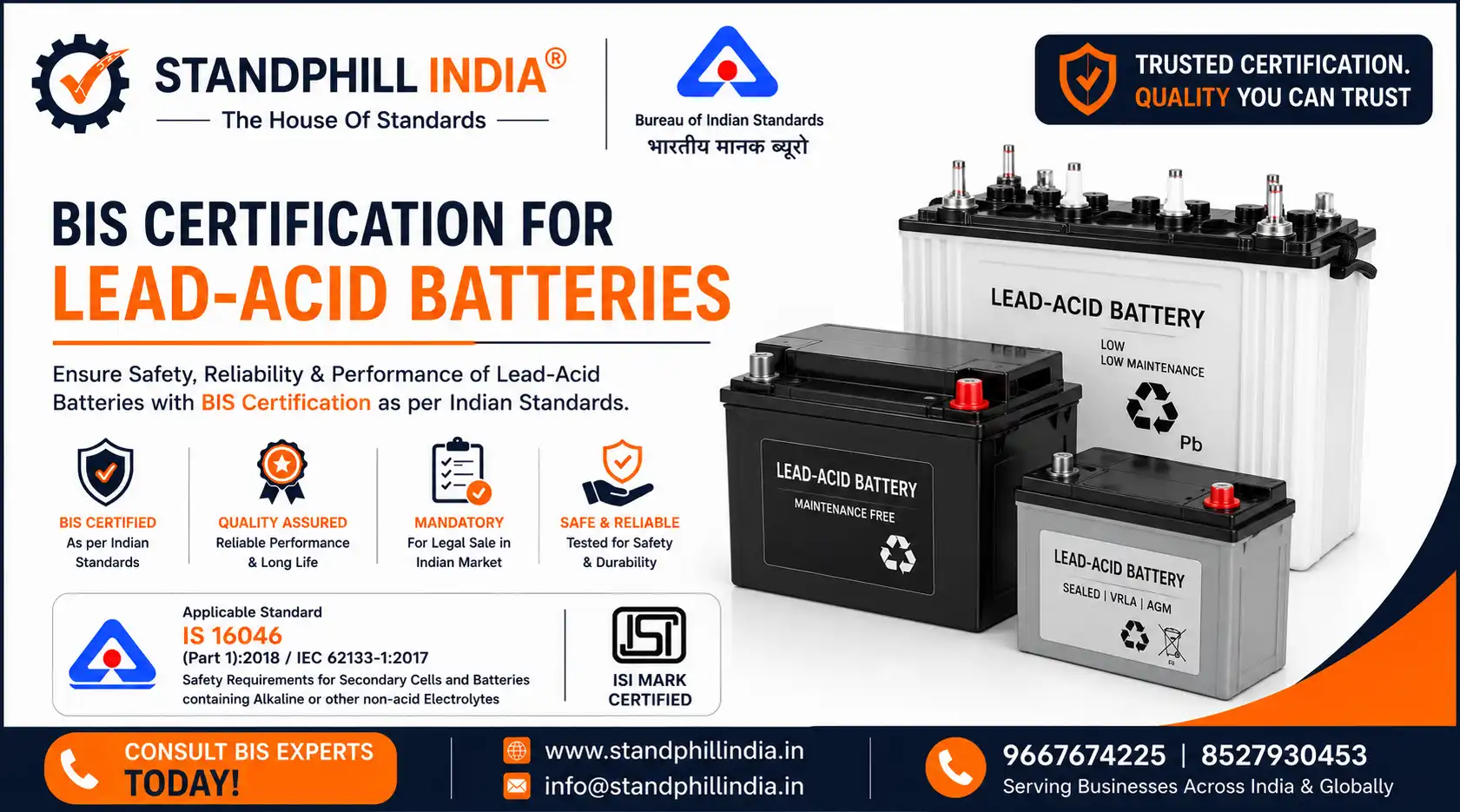
BIS Certification for Lead-Acid Batteries - the Honest Compliance Map
Automotive · Inverter · Stationary · Traction - Voluntary ISI Today (No QCO Yet) + Mandatory EPR Under BWMR 2022
Read This Before Anyone Sells You a Mandatory Lead-Acid BIS Certificate
As of July 2026, there is no Quality Control Order making BIS certification mandatory for lead-acid batteries - not for automotive, inverter, stationary or traction types. What IS available is voluntary ISI certification under the relevant Indian Standards, and what IS mandatory is EPR registration under the Battery Waste Management Rules, 2022 (CPCB). Battery QCOs are an active policy area, so this page is kept current - verify before you commit either way.
The Straight Answer - Mandatory or Voluntary?
Let us answer the question everyone actually types into Google: is BIS certification mandatory for lead-acid batteries in India? No - not today. Unlike lithium and nickel rechargeables (compulsory CRS registration) and zinc-carbon dry cells (compulsory ISI), lead-acid batteries have no Quality Control Order behind them as of July 2026. A battery plant can legally manufacture and sell automotive, inverter or stationary lead-acid batteries in India without any BIS mark.
So why does this page exist? Three reasons. First, because voluntary ISI certification under the lead-acid standards is real, available, and increasingly demanded by the buyers who matter - railways, defence, telecom, discoms and OEMs routinely specify ISI-marked batteries in tenders even where the law does not. Second, because lead-acid makers DO have a mandatory compliance burden - just not a BIS one: the Battery Waste Management Rules, 2022. And third, because half the internet will happily sell you a "mandatory BIS certificate" for a product that does not need one - and the other half will tell you nothing applies, which is equally wrong.
Battery regulation is moving fast in India - lithium got its rated-capacity mandate in February 2026, and standards work on storage batteries continues across ministries. If a lead-acid QCO is notified, this page will be updated within days - or ask us and we will confirm the position on the day you call.
The Voluntary ISI Standards for Lead-Acid Batteries
BIS maintains a full family of lead-acid standards, and a Scheme-I ISI licence can be obtained against the one matching your product:
| Indian Standard | What It Covers |
|---|---|
| IS 14257 | Lead-acid starter batteries for motorcycles and mopeds - the two-wheeler market |
| IS 7372 | Lead-acid storage batteries for motor vehicles - the automotive starter (SLI) category |
| IS 1651 | Stationary cells and batteries, lead-acid (Plante positive plates) - substations, telecom, standby power |
| IS 13369 | Stationary lead-acid batteries (tubular positive plates) - the inverter/UPS and standby workhorse |
| IS 15549 | Stationary valve-regulated (VRLA/SMF) lead-acid batteries - sealed maintenance-free standby duty |
Voluntary does not mean pointless. An ISI licence on a lead-acid battery is a tender key: government and institutional procurement - railways, defence establishments, telecom infrastructure, power utilities - regularly names these IS standards and treats the CM/L licence as the qualification line between bidders. For the branded inverter-battery market, the ISI Mark is also the visible answer to a category drowning in refurbished and reconditioned product sold as new.
Strategic timing note: every recent QCO handed early ISI holders a windfall - certified plants kept selling while competitors queued for audits. Getting the voluntary licence now is cheap insurance against the day lead-acid gets its own order.
What IS Mandatory - Battery Waste Management Rules, 2022
Here is the compliance lead-acid makers cannot skip, and it comes from the environment ministry, not BIS. The Battery Waste Management Rules, 2022 put every producer, importer and brand owner of batteries - lead-acid very much included - under Extended Producer Responsibility (EPR):
- EPR registration on the CPCB centralized portal before placing batteries on the market.
- Collection and recycling obligations - meeting year-wise targets for waste battery collection and channelling to registered recyclers, evidenced through EPR certificates.
- Labelling and reporting - prescribed marking and periodic returns on quantities placed and recovered.
So the accurate 2026 picture for a lead-acid manufacturer: BIS - voluntary but commercially valuable; BWMR EPR - mandatory, enforced, and increasingly audited. We handle both tracks together, because your buyers will ask for both.
Where Certified Lead-Acid Batteries Win Business
The markets where the voluntary ISI Mark behaves like a mandatory one:
Automotive & Two-Wheeler
SLI batteries into OEM and organised aftermarket channels.
Inverter & UPS
The branded home-backup market where trust is the product.
Telecom & Substations
Stationary and VRLA banks bought on tender against IS specs.
Railways & Defence
Institutional buyers who specify ISI-marked cells by default.
What ISI Certification Tests on a Lead-Acid Battery
Testing follows the specific standard, but the pillars are consistent:
Capacity
Rated ampere-hour capacity verified on standard discharge.
High-Rate Discharge
Cold-cranking / high-rate performance for starter duty.
Cycle Endurance
Charge-discharge life for the duty class.
Charge Retention
Self-discharge within limits over storage.
Electrolyte & Sealing
Leakage, vent and (for VRLA) valve behaviour.
Dimensions & Terminals
Fit, polarity and terminal integrity per the standard.
Certification Snapshot
| Item | Detail |
|---|---|
| Product | Lead-acid batteries - automotive, two-wheeler, inverter/UPS, stationary, VRLA |
| BIS status | Voluntary ISI certification (Scheme-I) - no QCO as of July 2026 |
| Standards | IS 14257, IS 7372, IS 1651, IS 13369, IS 15549 - per product type; latest versions apply |
| Mandatory instead | EPR registration and obligations under the Battery Waste Management Rules, 2022 (CPCB/MoEFCC) |
| Mark | ISI Mark with CM/L number (where voluntarily certified) |
| Who can apply | Manufacturer; foreign makers via FMCS with an AIR |
| Validity | Up to 5 years per the BIS (Conformity Assessment) Amendment Regulations, 2026; fee annually in advance |
Documents & Process - in Brief
Documentation falls into three broad groups. Getting the format right is the single biggest cause of delay for first-time applicants, which is exactly the part we take off your plate:
- Administrative: company registration, factory licence/proof, trademark or brand proof, and - for foreign makers - the Authorized Indian Representative appointment and AIR company documents.
- Technical: product specification/datasheet, model list with series-family logic, critical component details (cells, protection circuit), and the BIS-recognised lab test report.
- Quality control: factory quality controls, test setup and marking/labelling artwork including the Standard Mark with registration number.
The voluntary Scheme-I process mirrors the mandatory one - documentation, factory assessment, sample testing, licence with CM/L - typically a few weeks to a couple of months for a prepared Indian file. Details on our Indian manufacturers and FMCS guides. We run the BWMR EPR registration in parallel so both compliances land together.
Penalties & Risks
With no QCO, there is no BIS penalty for selling unmarked lead-acid batteries - the risks sit elsewhere: BWMR non-compliance attracts environmental compensation and enforcement through CPCB; tender disqualification quietly costs more than any fine; and misusing an ISI Mark you do not hold is an offence under the BIS Act, 2016 regardless of whether the product itself is notified.
Related Guides
BIS Certification for Batteries - The Complete Map (Every Battery Type) Stationary BESS Certification (IS 17424 + CEA 2026 Framework) EV Traction Battery Packs – AIS-156 / AIS-038 Compliance Guide Solar Storage Batteries (IS 16270:2023) Lithium-Ion Cells & Batteries (CRS) BIS Consultant for Batteries - Our ServicesWhy Choose Standphill India for Battery Certification
Batteries are the one product family where two different BIS routes meet - MeitY's CRS registration for lithium and nickel systems, and the classic ISI Mark for dry batteries - plus a fast-moving layer of fresh rules like the February 2026 rated-capacity mandate. We work across the entire map as specialists, prepare every document to exact BIS format, and coordinate lab testing so your file keeps moving - whether your plant is in India or overseas.
Get the Lead-Acid Compliance Map Right
Voluntary ISI licensing against the correct IS standard, BWMR 2022 EPR registration, tender-readiness and QCO watch - one team for the full lead-acid picture.
Free Consultation +91-9667674225Frequently Asked Questions
Ask About Your Lead-Acid Compliance
Tell us what you make - we will confirm your route (CRS or ISI), standard, scope and a quote. Clients in India and worldwide.
★ Why Standphill India?
- 20+ Years of BIS Certification Experience
- 10,000+ Certifications Delivered Globally
- Dedicated Teams for CRS, FMCS & ISI Mark
- End-to-End Documentation & Filing Support
- Fast Response & Practical Compliance Guidance
- Support for Indian & Foreign Manufacturers
Get Free Call Back
Our Services
- BIS (ISI Mark) for Foreign Manufacturers
- Domestic BIS (ISI Mark) Certification
- BIS Certificate of Conformity (CoC)
- BIS Hallmarking
- BIS Licence for Toys
- ECO Mark Certification
- TAC Approval for Automobile
- Drug Licence
- Peso Certification
- BIS (CRS) Registration
- WPC-ETA Approval
- BEE Certification
- E-Waste Management (EPR)
- EPR for Plastic Waste
- EPR for Battery Waste
- CE Certification
- UL Certification
- ROHS Licence
- Standardization Division
- Import / Export Licence
- FSSAI Certification
- ISO Registration
- Trademark Registration
- Make in India Support
- AG-Mark Licence
- Third Party Monitoring
Client Testimonials
Their team was very knowledgeable and helped us every step of the way. Standphill India is the best BIS certification consultants for any type of BIS certification.

Chintan Shah (AGM)
Sudeep Nutrition P.Ltd



Featured Guide
Complete BIS CRS certification guide for electronic products in India — free to read.
Read CRS Certification Guide📞 Contact Standphill India
+91-9667674225 info@standphillindia.in WhatsApp Now Greater Noida West, UPGet Expert BIS Certification Support for Your Business
Connect with Standphill India for complete support with BIS certification, CRS registration, WPC approval, FMCS compliance, and related regulatory services. Our team helps businesses with documentation, testing coordination, application support, and end-to-end compliance guidance.
Request Free Consultation
Share your requirement and our team will contact you shortly.