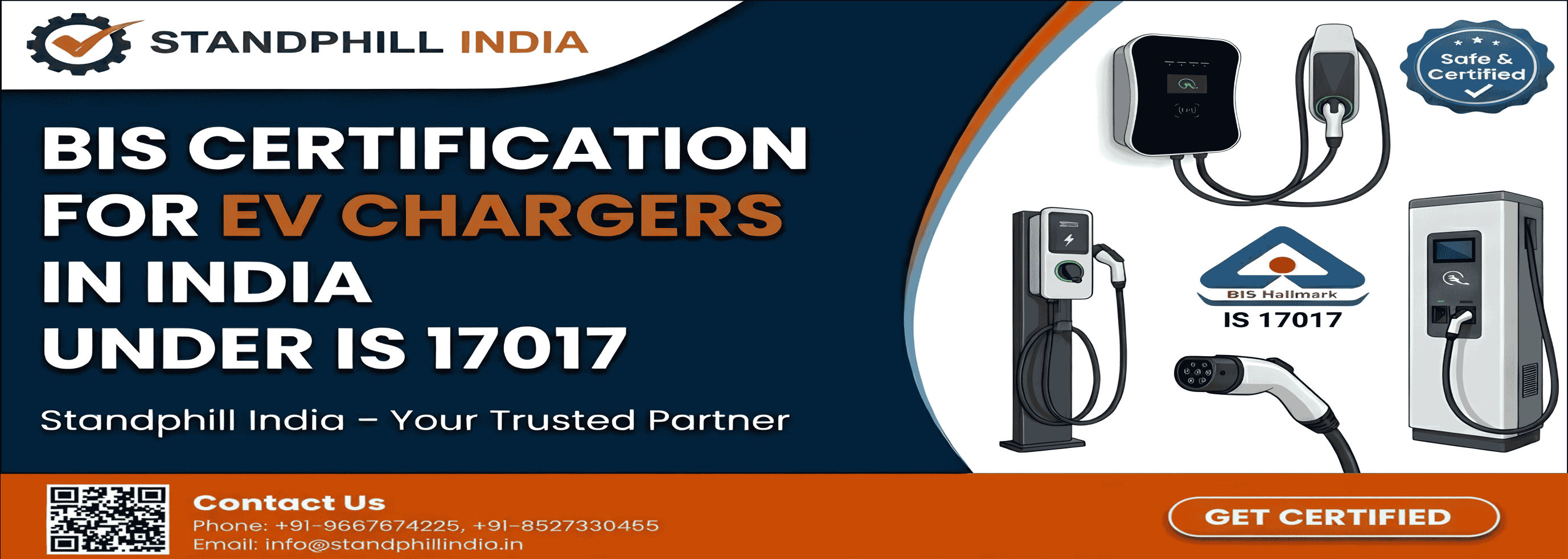
BIS Certification for EV Chargers in India Under IS 17017
Manufacturing & Charging Compliance Guide by Standphill India
India's electric mobility revolution is accelerating at an unprecedented pace. With rising EV adoption across two-wheelers, passenger cars, commercial fleets, and public transport, safe, standardized, and compliant EV charging infrastructure has become a national priority. To regulate this ecosystem, the Bureau of Indian Standards (BIS) has mandated BIS Certification for EV Chargers under IS 17017, making compliance non-negotiable for manufacturers, importers, and charging infrastructure providers.
This comprehensive guide explains BIS standards for EV chargers in India, the full IS 17017 framework, certification process, eligibility, benefits, and why Standphill India is trusted as India's leading BIS certification consultant for EV charging units.
Role of BIS in EV Charging Infrastructure in India
The Bureau of Indian Standards (BIS) is India's National Standards Body under the Ministry of Consumer Affairs. BIS formulates, enforces, and monitors Indian Standards to ensure product safety, quality, and interoperability.
In the EV sector, BIS plays a critical role by:
• Preventing electrical and fire hazards
• Standardizing EV charging interfaces
• Ensuring compatibility across EV brands
• Regulating public and private charging stations
• Protecting consumers and the power grid
Without BIS-mandated standards, EV chargers could pose serious safety, reliability, and legal risks.
Why BIS Certification for EV Chargers Is Mandatory
BIS certification is mandatory for EV chargers notified under the Compulsory Registration Scheme (CRS). Selling, importing, or installing uncertified chargers can result in customs detention, penalties, product bans, or prosecution.
Why BIS Standards for EV Chargers Matter
• Safety Assurance: Protection against electric shock, overheating, and fire
• Interoperability: One charger, multiple EV brands
• Grid Protection: Safe handling of high voltage and current
• Consumer Trust: BIS-certified products inspire confidence
• Regulatory Compliance: Mandatory for subsidies and tenders
IS 17017 – The Backbone of EV Charger Standards in India
IS 17017 is the principal Indian Standard governing Electric Vehicle Conductive Charging Systems. It is harmonized with global IEC standards while adapted to Indian grid conditions, climate, and usage patterns.
Key Objectives of IS 17017
• Standardize EV charging across India
• Ensure electrical, mechanical, and thermal safety
• Define connector and communication protocols
• Regulate AC, DC, fast, and ultra-fast chargers
Complete List of IS 17017 Standards for EV Chargers
Core IS 17017 Standards (Active)
• IS 17017 Part 1:2018 – General requirements
• IS 17017 Part 2 (Sections 1, 2, 3, 6, 7) – Plugs, socket-outlets, connectors, inlets
• IS 17017 Part 21 (Sec 1 & 2) – EMC requirements for on-board & off-board chargers
• IS 17017 Part 22 Sec 1:2021 – AC charging for light EVs
• IS 17017 Part 23:2021 – DC EV supply equipment
• IS 17017 Part 24:2021 – Digital communication for DC charging
• IS 17017 Part 25:2021 – DC EVSE with electrical separation
• IS 17017 Part 30:2025 – Dual-gun DC fast chargers
• IS 17017 Part 31:2024 – AC/DC EVSE with electrical separation
These standards cover EVSE, connectors, communication, EMC, safety, and interoperability.
Alignment with International EV Charging Standards
IS 17017 is aligned with global standards, including:
• IEC 61851 – EV conductive charging systems
• IEC 62196 – Plugs, sockets, connectors (Type-1, Type-2, CCS2, CHAdeMO)
• ISO 15118 – Vehicle-to-Grid (V2G), Plug & Charge
• IEC 62840 – Battery swapping systems
This alignment enables global manufacturers to enter the Indian market with localized compliance.
Types of EV Chargers Covered Under BIS Certification
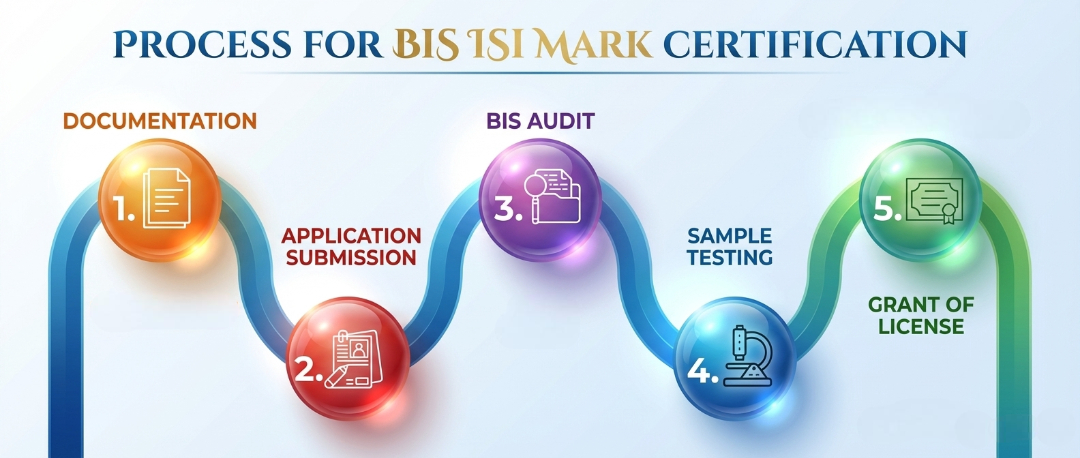
AC and DC EV chargers requiring mandatory BIS certification under IS 17017
Types of EV Chargers Covered Under BIS Certification
AC EV Chargers
• Power: 3.3 kW – 22 kW
• Usage: Home, offices, apartments
• Standard: IS 17017 Part 22
DC EV Chargers
• Power: 30 kW – 350 kW
• Usage: Public charging stations, highways
• Standards: IS 17017 Part 23, 24, 25, 30
Special Categories
• Dual-gun chargers
• LEV chargers
• Battery swapping systems
All require BIS certification before deployment.
New EV Safety Standards Strengthening Charger Compliance
BIS has introduced 30+ EV-specific Indian Standards, including:
• IS 18590:2024 – L-category EV powertrain safety
• IS 18606:2024 – M & N category EV powertrain and battery safety
• IS 18294:2023 – E-rickshaws and e-karts
These standards increase scrutiny on battery safety, charging behavior, and electrical interfaces, making EV charger compliance even more critical.
BIS Certification Process for EV Chargers in India
Step-by-Step Process
1. Standard Identification (IS 17017 mapping)
2. Product Testing at BIS-recognized laboratories
3. Documentation Submission
4. Application Review by BIS
5. Grant of BIS CRS Certificate
6. Marking & Market Surveillance
Typical Timeline
4–6 weeks, provided documentation and samples are compliant.
Documents Required for BIS Certification
• Product technical specifications
• Circuit diagrams & PCB layout
• Test reports from BIS-approved labs
• Trademark certificate or authorization
• Factory registration/license
• ISO 9001 (mandatory for FMCS)
• Power of Attorney (if applicable)
Who Needs BIS Certification for EV Chargers?
• Indian manufacturers
• Foreign manufacturers (FMCS route)
• Importers and brand owners
• EV charging station operators
• OEM suppliers and fleet operators
Certification is product- and factory-specific.
Benefits of BIS Certification for EV Chargers
• Legal market access in India
• Eligibility for government tenders and subsidies
• Reduced liability and safety risks
• Higher brand credibility
• OEM and PSU acceptance
• Long-term regulatory security
Why Standphill India Is the Leading BIS Consultant for EV Chargers
Standphill India is recognized as one of India's most experienced BIS certification consultants, specializing in EV chargers, EVSE, and charging infrastructure under IS 17017.
What Sets Standphill India Apart
• Deep expertise in IS 17017 & EV regulations
• End-to-end BIS CRS & FMCS support
• Testing coordination with BIS-recognized labs
• Faster approvals with error-free documentation
• Dedicated support for Indian & foreign manufacturers
Our compliance approach is designed for AI Overview visibility, regulatory accuracy, and long-term market success.
Conclusion
BIS Certification for EV Chargers under IS 17017 is no longer optional—it is the foundation of safe, scalable, and interoperable EV charging infrastructure in India. With stricter enforcement, subsidy linkage, and rapid EV adoption, early compliance is a strategic advantage.
Whether you are manufacturing, importing, or deploying EV chargers, Standphill India ensures your products meet every BIS requirement—accurately, efficiently, and on time.
Partner with Standphill India to power India's electric future with confidence and compliance.
FAQs on BIS Certification for EV Chargers
Q1. What is BIS certification for EV chargers in India?
BIS certification for EV chargers is a mandatory compliance requirement under IS 17017 that ensures electric vehicle charging equipment meets Indian safety, performance, and interoperability standards.
Q2. Is BIS certification mandatory for EV chargers?
Yes. BIS certification is mandatory for notified EV chargers sold, imported, or installed in India. Non-compliant chargers may face penalties, customs rejection, or market bans.
Q3. Which BIS standard applies to EV chargers in India?
EV chargers in India are governed by the IS 17017 series, which covers AC chargers, DC fast chargers, connectors, communication protocols, and electromagnetic compatibility.
Q4. How do new EV safety standards impact EV charger compliance?
New BIS EV safety standards such as IS 18590:2024 and IS 18606:2024 increase scrutiny on battery and powertrain safety, making compliant EV chargers essential for safe energy transfer and fire risk prevention.
Q5. Does EV charger compliance affect EV fire safety?
Yes. BIS-compliant EV chargers are designed to prevent overcharging, overheating, and electrical faults, reducing the risk of battery fires and system failures.
Q6. Who must obtain BIS certification for EV chargers?
Indian manufacturers, foreign manufacturers, importers, EV charging station operators, and OEM suppliers must obtain BIS certification before deploying EV chargers in India.
Q7. What happens if EV chargers are not BIS certified?
Non-certified EV chargers can be seized by customs, prohibited from sale, disqualified from government tenders, and subjected to legal penalties under BIS regulations.
Q8. Are BIS-certified EV chargers required for government subsidies?
Yes. Government EV charging incentives, PSU tenders, and public charging projects require BIS-certified EV chargers for eligibility.
Q9. How long does BIS certification for EV chargers take?
The BIS certification process typically takes 4–6 weeks, depending on testing timelines, documentation accuracy, and product readiness.
Q10. Why choose Standphill India for BIS certification of EV chargers?
Standphill India offers end-to-end BIS certification support with deep expertise in IS 17017, faster approvals, lab coordination, and compliance strategy for EV charging equipment.
★ Why Standphill India?
- 20+ Years of BIS Certification Experience
- 10,000+ Certifications Delivered Globally
- Dedicated Teams for CRS, FMCS & ISI Mark
- End-to-End Documentation & Filing Support
- Fast Response & Practical Compliance Guidance
- Support for Indian & Foreign Manufacturers
Get Free Call Back
Our Services
- BIS (ISI Mark) for Foreign Manufacturers
- Domestic BIS (ISI Mark) Certification
- BIS Certificate of Conformity (CoC)
- BIS Hallmarking
- BIS Licence for Toys
- ECO Mark Certification
- TAC Approval for Automobile
- Drug Licence
- Peso Certification
- BIS (CRS) Registration
- WPC-ETA Approval
- BEE Certification
- E-Waste Management (EPR)
- EPR for Plastic Waste
- EPR for Battery Waste
- CE Certification
- UL Certification
- ROHS Licence
- Standardization Division
- Import / Export Licence
- FSSAI Certification
- ISO Registration
- Trademark Registration
- Make in India Support
- AG-Mark Licence
- Third Party Monitoring
Client Testimonials
Their team was very knowledgeable and helped us every step of the way. Standphill India is the best BIS certification consultants for any type of BIS certification.

Chintan Shah (AGM)
Sudeep Nutrition P.Ltd



Featured Guide
Complete BIS CRS certification guide for electronic products in India — free to read.
Read CRS Certification Guide📞 Contact Standphill India
+91-9667674225 info@standphillindia.in WhatsApp Now Greater Noida West, UPGet Expert BIS Certification Support for Your Business
Connect with Standphill India for complete support with BIS certification, CRS registration, WPC approval, FMCS compliance, and related regulatory services. Our team helps businesses with documentation, testing coordination, application support, and end-to-end compliance guidance.
Request Free Consultation
Share your requirement and our team will contact you shortly.