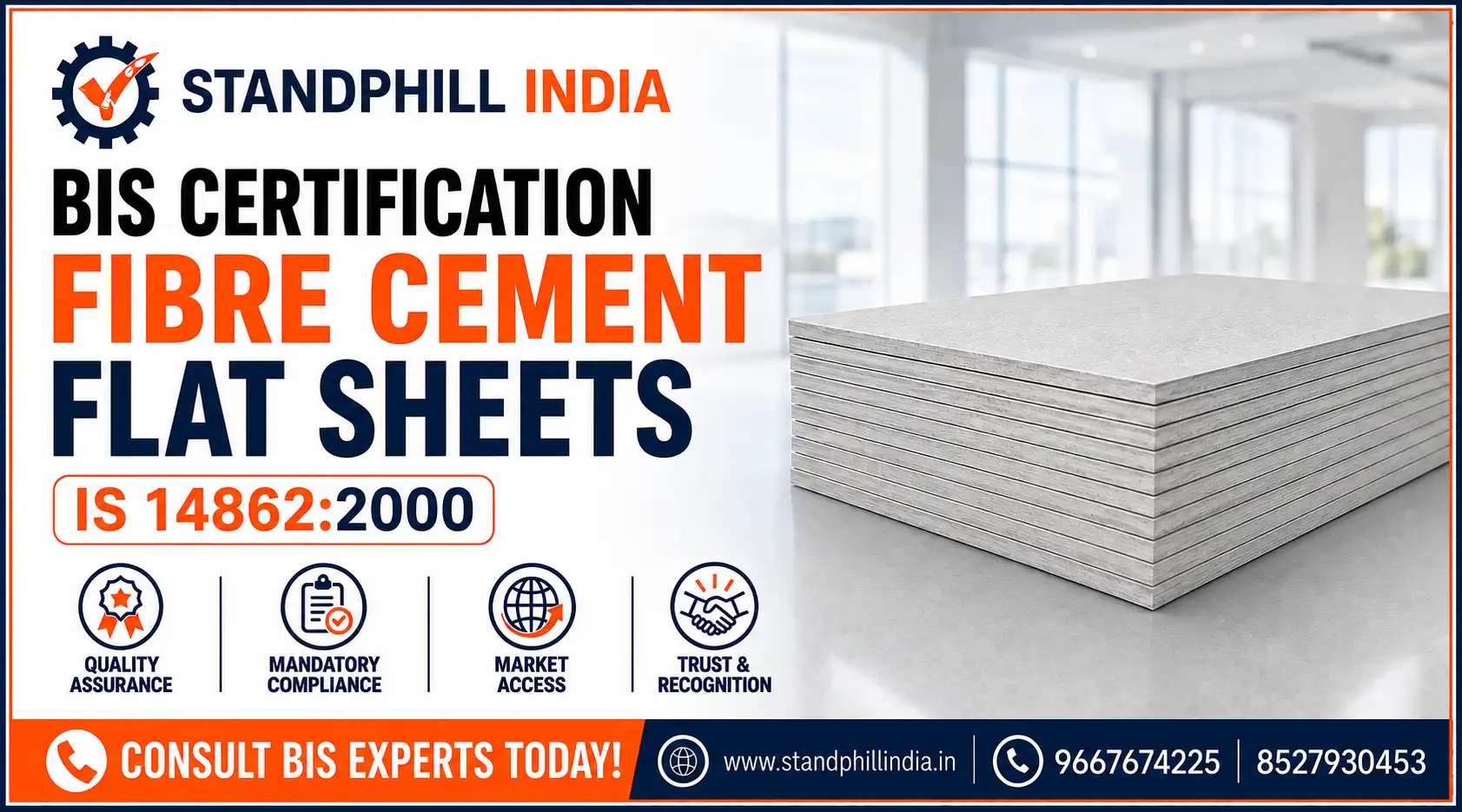
BIS Certification for Fibre Cement Flat Sheets in India
IS 14862:2000 - Mandatory ISI Mark under the Asbestos or Fibre Cement based Products (Quality Control) Order, 2024
Certification Is Mandatory and the QCO Is Fully in Force
Fibre cement flat sheets are covered by the Asbestos or Fibre Cement based Products (Quality Control) Order, 2024 — notified as S.O. 1152(E) on 6 March 2024 by DPIIT. The grace periods for large and medium enterprises (6 months), small enterprises (9 months) and micro enterprises (12 months) have all now passed, so the order applies to every manufacturer regardless of size. Manufacturing, importing, storing for sale or selling fibre cement flat sheets in India without a valid BIS ISI Mark licence is now prohibited, except for goods made solely for export.
BIS certification for fibre cement flat sheets is the mandatory ISI Mark approval issued by the Bureau of Indian Standards, confirming that a manufacturer's sheets conform to IS 14862:2000. It is granted under Scheme-I after a factory inspection and independent testing, and the ISI Mark with the CM/L number must appear on every certified sheet before it can be sold. This guide, written for manufacturers and importers, explains exactly what the standard covers, which sheets need certification, what is tested, and how Standphill India delivers the licence end to end for both Indian and foreign manufacturers.
Quick Answer
Is BIS certification mandatory for fibre cement flat sheets in India? Yes. Fibre cement flat sheets under IS 14862:2000 are covered by the Asbestos or Fibre Cement based Products (Quality Control) Order, 2024 (S.O. 1152(E), 6 March 2024, issued by DPIIT). The order is fully in force, so a valid BIS ISI Mark licence is legally required to make, import or sell these sheets in India — only export-only production is exempt.
Standard: IS 14862:2000 (Fibre Cement Flat Sheets), BIS Committee CED 53. Scheme: Scheme-I ISI Mark (factory inspection + testing, CM/L number). Timeline: about 4–6 months. Validity: up to 5 years. Foreign makers: FMCS route with an Authorized Indian Representative (AIR).
- Is BIS Certification Mandatory? The QCO 2024
- What is BIS Certification for Fibre Cement Flat Sheets?
- IS 14862:2000 - Standard Overview
- Types, Categories & Product Scope
- Where Fibre Cement Flat Sheets Are Used
- What is Tested Under IS 14862:2000?
- Certification Process - Step by Step
- BIS Certification for Foreign Manufacturers (FMCS)
- Documents Required
- Benefits of BIS Certification
- Penalties for Non-Compliance
- Why Choose Standphill India?
- Frequently Asked Questions
Is BIS Certification Mandatory for Fibre Cement Flat Sheets?
Yes — and this is the first thing every manufacturer needs to be clear about. BIS certification for fibre cement flat sheets is mandatory, not voluntary. The product is one of eleven asbestos and fibre-cement standards brought under compulsory certification by the Asbestos or Fibre Cement based Products (Quality Control) Order, 2024, which the Department for Promotion of Industry and Internal Trade (DPIIT) notified as S.O. 1152(E) on 6 March 2024 under the BIS Act, 2016.
The order was implemented in phases, and every phase has now passed. Large and medium enterprises had to comply within six months (around September 2024), small enterprises within nine months (around December 2024), and micro enterprises within twelve months (around March 2025). Because all three deadlines are behind us, the requirement now applies to manufacturers of every size, as well as to importers and foreign manufacturers supplying the Indian market. Only goods manufactured solely for export fall outside the order.
Governing order: Asbestos or Fibre Cement based Products (Quality Control) Order, 2024 — S.O. 1152(E), dated 6 March 2024, issued by DPIIT, Ministry of Commerce and Industry. IS 14862:2000 (Fibre Cement Flat Sheets) is named in the schedule of standards. You can read the full order on this page below.
The same QCO also covers ten related products, including corrugated asbestos cement sheets (IS 459), asbestos cement flat sheets (IS 2096), asbestos cement building boards (IS 2098), silica-asbestos cement flat sheets (IS 13000) and fibre cement long corrugated sheets (IS 14871). If you make more than one of these, all of them now need the ISI Mark — and we can register them together.
What is BIS Certification for Fibre Cement Flat Sheets?
BIS certification for fibre cement flat sheets is the conformity-assessment process through which the Bureau of Indian Standards verifies that a manufacturer's sheets meet every requirement of IS 14862:2000, and then licenses the manufacturer to apply the ISI Mark. It is granted under Scheme-I of Schedule-II of the BIS (Conformity Assessment) Regulations, 2018 — the classic product-certification route that involves a factory inspection and independent testing, and issues a CM/L licence number.
- Applies to domestic manufacturers and to foreign manufacturers through the FMCS route
- The manufacturing facility must pass a BIS factory inspection
- Samples are drawn from production and tested at a BIS-recognized laboratory against IS 14862:2000
- On grant, the ISI Mark with the CM/L number must appear on every certified sheet
- The licence is now granted with a validity of up to five years under the 2026 Conformity Assessment amendment
Fibre cement is a composite of cement, fine mineral fillers and reinforcing fibres, valued in construction because it is fire-resistant, water-resistant, dimensionally stable and durable. Because these sheets are used in cladding, partitions and ceilings where safety and durability matter, the government has made independent BIS certification compulsory to keep sub-standard sheets out of the market. If you would like the wider picture of how cement-based product certification works, see our overview of BIS certification for cement and cement products.
IS 14862:2000 - Standard Overview
| Detail | Information |
|---|---|
| Standard Number | IS 14862:2000 |
| Standard Title | Fibre Cement Flat Sheets - Specification |
| Year / Status | Published 2000, reaffirmed 2010; Amendment 1 (2002) and Amendment 2 (2003) |
| Technical Committee | CED 53 - Cement Matrix Products Sectional Committee |
| Regulatory Status | Mandatory - Asbestos or Fibre Cement based Products QCO 2024 (S.O. 1152(E)) |
| Certification Scheme | Scheme-I of Schedule-II, BIS (Conformity Assessment) Regulations, 2018 |
| Licence Validity | Up to 5 years (per the 2026 Conformity Assessment amendment) |
| Aligned With | ISO 8336 and ISO 390 |
IS 14862:2000 specifies the classification, material characteristics, dimensional tolerances, mechanical strength and durability requirements, along with the test methods and acceptance conditions, that fibre cement flat sheets must satisfy for BIS to grant the ISI Mark licence.
Types, Categories and Product Scope
IS 14862:2000 covers fibre cement flat sheets with smooth or textured surfaces, and it classifies them in two ways that a manufacturer must get right on the application, because they determine the testing.
By Type (based on where the sheet is used):
- Type A — sheets for external applications that are directly exposed to sun, rain and, in some regions, frost. Type A sheets undergo the full durability type-testing regime.
- Type B — sheets for internal use or for protected external areas. Type B sheets are not subjected to the weather-exposure type tests.
By Category (based on bending strength / modulus of rupture, in MPa):
| Category | Minimum Bending Strength - Type A (MPa) | Minimum Bending Strength - Type B (MPa) |
|---|---|---|
| Category 1 | 4 | 7 |
| Category 2 | 7 | 13 |
| Category 3 | 10 | 18 |
| Category 4 | 16 | — |
| Category 5 | 22 | — |
Sheets are typically produced in nominal lengths up to about 3,000 mm and widths up to about 1,240 mm, in preferred thicknesses of 3, 4, 4.5, 5, 6 and 9 mm (and, by mutual agreement, up to 30 mm). Both the visible and the non-visible faces of the sheet are covered by the standard's requirements.
Getting the Type and Category right matters: declaring the wrong Type or Category is one of the most common causes of testing rework in fibre-cement certification, because it changes which durability tests apply and which strength limit the sheet must meet. We confirm the correct Type and Category for every product before your samples go to the laboratory.
Where Fibre Cement Flat Sheets Are Used
Fibre cement flat sheets are one of the most versatile boards in modern construction, valued for being fire-resistant, moisture-resistant and durable. IS 14862:2000 certification applies to sheets intended for uses such as:
External Cladding & Facades
Internal Partition Walls
False Ceilings
Flooring Underlays & Soffits
Prefab & Modular Panels
Roofing Underlays
Because Type A sheets are used on the outside of buildings and must survive years of sun, rain and thermal movement, they face a much tougher durability test regime than the internal Type B sheets — which is exactly what the certification is designed to verify.
The QCO Is in Force - Uncertified Sheets Cannot Be Sold Legally
Get your fibre cement flat sheets ISI Mark certified quickly. Free, honest assessment of your product and timeline.
What is Tested Under IS 14862:2000?
A BIS-recognized laboratory tests fibre cement flat sheets across the following parameters, and every result must meet the limits in IS 14862:2000 before a licence is granted. Type A external sheets undergo the full durability regime, while Type B internal sheets are tested against the mechanical and dimensional requirements.
Bending Strength (Modulus of Rupture)
The sheet must meet the minimum bending strength for its declared Category, and for Type A the wet strength must remain at least half of the equilibrium strength
Apparent Density
The measured density must meet the manufacturer's declared minimum, confirming the sheet is properly compacted and consistent
Water Impermeability
Under a standing head of water, the underside of the sheet may show moisture traces but must not form drops of water — proving it keeps water out
Warm Water Test
After a prolonged period in warm water at about 60°C, the sheet must retain the required proportion of its strength, confirming long-term stability
Soak-Dry Cycles
Repeated wet-and-dry cycling must not reduce the sheet's strength below the specified retained-strength ratio
Heat-Rain Cycles (Type A)
External sheets are cycled between heat and simulated rain and must show no cracking, delamination or other visible defects afterwards
Frost Resistance
Where the sheet will face freezing conditions, repeated freeze-thaw cycles must not reduce its average strength below the specified ratio
Dimensional Tolerances
Length, width, thickness, squareness and straightness of edges are all measured against the standard's tolerances
BIS Certification Process for Fibre Cement Flat Sheets - Step by Step
The process follows Scheme-I, which combines a factory inspection with sample testing. For fibre cement sheets the critical path is correct Type and Category mapping, a well-prepared factory inspection, and clean durability test results.
We confirm your product falls under IS 14862:2000 and fix the correct Type (A or B) and Category (1 to 5), because this decides the entire test schedule.
We compile the GST and company documents, factory layout, machinery and process flow, raw material and fibre specifications, the quality control manual and the in-house test equipment list with calibration certificates.
The Scheme-I application is filed with the product and factory details and the IS 14862:2000 reference, and the application fee is paid. Indian manufacturers follow the domestic ISI Mark route.
A BIS officer inspects the plant, verifies the production process, raw material controls, the in-house laboratory and the quality system, and draws samples from the production line.
The drawn samples are tested against IS 14862:2000 - bending strength, density, water impermeability, warm-water, soak-dry and heat-rain durability, and dimensional checks.
On a satisfactory report and conforming results, BIS grants the ISI Mark licence (CM/L number) under Scheme-I, now valid for up to five years. The ISI Mark must then appear on every certified sheet.
BIS Certification for Foreign Manufacturers (FMCS)
A manufacturer located outside India can hold a BIS ISI Mark licence for fibre cement flat sheets, but must apply through the Foreign Manufacturers Certification Scheme (FMCS) and appoint an Authorized Indian Representative (AIR) who is resident in India and legally responsible for compliance and market surveillance. Under FMCS, two BIS officials inspect the overseas factory, samples are tested against IS 14862:2000 in India, and a performance bank guarantee is furnished before the licence is granted.
Because the QCO covers importers and foreign manufacturers as well, an overseas producer supplying fibre cement sheets to India now needs this licence to clear customs and sell. Standphill India acts as AIR and manages the entire India-side process — you can read more about the FMCS route for foreign manufacturers, which we run end to end.
Documents Required for BIS Certification
For Indian manufacturers (ISI Mark route):
- GST registration and company incorporation documents
- Factory layout plan and location plan of the works
- List of manufacturing machinery with installed capacity
- Manufacturing process flow chart
- Raw material and reinforcing-fibre specifications
- Product details with declared Type, Category and thicknesses
- Quality control manual and in-process inspection records
- In-house test equipment list with calibration certificates
- Test reports from a BIS-recognized laboratory (IS 14862:2000)
- Authorization letters and BIS-prescribed undertakings
Additional for foreign manufacturers (FMCS route):
- Appointment of an Authorized Indian Representative (AIR)
- AIR company registration and KYC documents
- Foreign manufacturer's authorization letter to the AIR
- Performance bank guarantee and overseas inspection readiness
Pro tip: the two most common causes of delay in fibre-cement certification are an under-equipped in-house laboratory (for routine bending-strength and density checks) and an incorrect Type or Category declaration. Standphill India audits both before the BIS visit, so your inspection is cleared in the first attempt.
Benefits of BIS Certification for Fibre Cement Flat Sheet Manufacturers
Because certification is now mandatory, its first benefit is simply the legal right to trade — but the ISI Mark also delivers real commercial value.
Legal Right to Manufacture and Sell
A valid ISI Mark licence is what allows you to legally manufacture, import and sell fibre cement flat sheets in India now that the QCO is in force.
Protection From Seizure and Penalties
Certified stock is safe from the seizure, penalties and prosecution that the BIS Act, 2016 provides for uncertified goods.
Customs Clearance for Importers
Imported fibre cement sheets clear customs without BIS holds only when the overseas factory holds a valid FMCS licence.
Eligibility for Tenders and Projects
Government, infrastructure and institutional projects specify BIS-certified building boards, so the ISI Mark opens that business.
Buyer and Builder Confidence
The ISI Mark is independent proof of strength, water resistance and durability, which reassures builders, architects and distributors.
A Level Playing Field
With every manufacturer now required to certify, the mark removes the price advantage that sub-standard, uncertified sheets used to enjoy.
Penalties for Selling Uncertified Fibre Cement Flat Sheets
Now that the QCO is in force, manufacturing, importing, storing for sale or selling fibre cement flat sheets without a valid BIS ISI Mark licence is an offence under the BIS Act, 2016. The consequences are serious and are actively enforced: monetary penalties and possible imprisonment for the responsible persons, seizure of uncertified stock from factories, warehouses and retail points, detention or rejection of imported consignments at customs (with demurrage and re-export costs falling on the importer), and disqualification from government and institutional procurement. In practice, the cost of certification is a small fraction of the cost of enforcement, which is why compliant manufacturers treat the ISI Mark as a routine cost of doing business.
Why Choose Standphill India for Fibre Cement Flat Sheet BIS Certification?
Standphill India is a specialist BIS certification consultancy with over twenty years of experience and more than 10,000 certifications completed across every major scheme, rated 4.9 out of 5 by over 200 clients. For fibre cement flat sheet manufacturers, we run the entire Scheme-I project end to end and keep you fully compliant with the 2024 QCO.
Correct Type & Category Mapping
We fix the right Type and Category before testing, so you never pay to test against the wrong strength or durability requirements.
Factory Inspection Readiness
We audit your plant, in-house laboratory and quality records before the BIS visit, so the inspection is cleared in one attempt.
BIS-Recognized Lab Coordination
We schedule and manage the durability testing at the right laboratory and brief them on your product, shortening the timeline.
FMCS & AIR for Foreign Makers
We act as your Authorized Indian Representative and manage the complete FMCS process for overseas factories.
Whole-QCO Coverage
If you make several products under the 2024 QCO, we register the full range together rather than one licence at a time.
Renewals & Ongoing Compliance
We track your licence, annual fees and renewals so your ISI Mark never lapses and your production is never left uncovered.
Get Your Fibre Cement Flat Sheets ISI Mark Certified - Fast & Compliant
Trusted BIS consultant for fibre cement and cement-based products. Complete IS 14862:2000 certification support for Indian and foreign manufacturers.
Contact Us Today +91-9667674225Also Read
BIS Certification for Cement and Cement-Based Products BIS Certification for Indian Manufacturers - Scheme I ISI Mark Process BIS FMCS Certification for Foreign Manufacturers BIS Certificate Renewal ProcessFrequently Asked Questions
Ask a Question
Have a query about BIS Certification for Fibre Cement Flat Sheets? Our expert team responds within 24 hours.
★ Why Standphill India?
- 20+ Years of BIS Certification Experience
- 10,000+ Certifications Delivered Globally
- Dedicated Teams for CRS, FMCS & ISI Mark
- End-to-End Documentation & Filing Support
- Fast Response & Practical Compliance Guidance
- Support for Indian & Foreign Manufacturers
Get Free Call Back
Our Services
- BIS (ISI Mark) for Foreign Manufacturers
- Domestic BIS (ISI Mark) Certification
- BIS Certificate of Conformity (CoC)
- BIS Hallmarking
- BIS Licence for Toys
- ECO Mark Certification
- TAC Approval for Automobile
- Drug Licence
- Peso Certification
- BIS (CRS) Registration
- WPC-ETA Approval
- BEE Certification
- E-Waste Management (EPR)
- EPR for Plastic Waste
- EPR for Battery Waste
- CE Certification
- UL Certification
- ROHS Licence
- Standardization Division
- Import / Export Licence
- FSSAI Certification
- ISO Registration
- Trademark Registration
- Make in India Support
- AG-Mark Licence
- Third Party Monitoring
Client Testimonials
Their team was very knowledgeable and helped us every step of the way. Standphill India is the best BIS certification consultants for any type of BIS certification.

Chintan Shah (AGM)
Sudeep Nutrition P.Ltd



Featured Guide
Complete BIS CRS certification guide for electronic products in India — free to read.
Read CRS Certification Guide📞 Contact Standphill India
+91-9667674225 info@standphillindia.in WhatsApp Now Greater Noida West, UPGet Expert BIS Certification Support for Your Business
Connect with Standphill India for complete support with BIS certification, CRS registration, WPC approval, FMCS compliance, and related regulatory services. Our team helps businesses with documentation, testing coordination, application support, and end-to-end compliance guidance.
Request Free Consultation
Share your requirement and our team will contact you shortly.