ISI vs ISO Certification: Key Differences Every Business Must Know (2026)
Complete Guide to ISI Mark, ISO Certification, Key Differences, Validity, Scope and Expert Consultancy in India
What is the Difference Between ISI and ISO Certification?
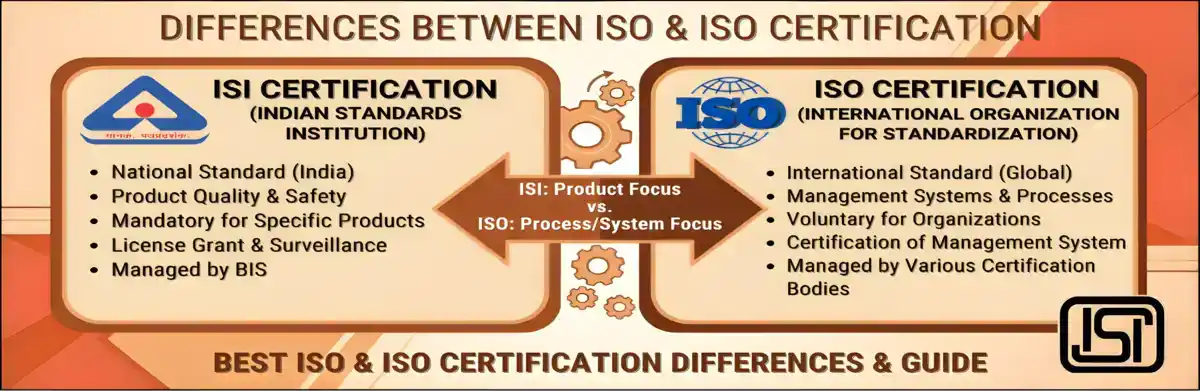
The ISI mark is a product quality certification issued by the Bureau of Indian Standards (BIS) under the BIS Act, 2016 — mandatory for specific products sold in India. ISO certification is issued by the International Organization for Standardization, a global body recognized in 167+ countries, covering quality management systems across all industries and services. ISI certification is domestic, product-centric, valid for 1 year, and mandatory for listed goods in India. ISO certification is global, process-centric, valid for 3 years, and applicable to manufacturers, service providers, and government bodies worldwide. Standphill India provides expert consultancy for both ISI and ISO certifications across India with 20+ years of experience and 10,000+ projects completed.
Table of Contents
3. ISI vs ISO: Side-by-Side Comparison Table
4. Key Difference 1: Territorial Coverage
5. Key Difference 2: Validity Period
6. Key Difference 3: Governing Bodies
7. Key Difference 4: Organizational Requirements
8. Key Difference 5: Approval Time
9. Key Difference 6: Business Formation Opportunities
10. Key Difference 7: Product and Industry Coverage
11. Benefits of ISI Certification
12. Benefits of ISO Certification
13. Can a Business Hold Both ISI and ISO?
14. Which Certification Is Right for Your Business?
What Is ISI Certification?
ISI certification is a product quality mark issued by the Bureau of Indian Standards (BIS), operating under India's Ministry of Consumer Affairs, Food and Public Distribution. The ISI mark certifies that a product meets the quality and safety standards set by BIS specifically for the Indian market.
The Indian Standardization Institute was established in 2016 under the BIS Act, and ISI certification came into effect on October 12, 2017. Since then, it has played a vital role in ensuring product quality in India aligns with BIS standards — protecting consumers and supporting the Make in India initiative.
Who Issues the ISI Mark?
The ISI mark is issued exclusively by the Bureau of Indian Standards (BIS) through a BIS ISI Licence. No other body in India has the authority to grant this certification. The ISI mark contains the Indian Standard number and the manufacturer's unique CM/L licence number.
Which Products Require ISI Certification?
ISI certification is mandatory for products covered under Quality Control Orders (QCOs). Key categories include:
• Electrical goods — switches, wires, cables, fans, circuit breakers
• Food products — milk powder, packaged drinking water
• Steel, cement, and construction materials
• LPG cylinders and pressure regulators
• Helmets and personal safety equipment
• Toys (IS 9873 and IS 15644 series)
• Medical textiles and household consumer goods
Critical Rule: If your product falls under the BIS mandatory certification list, you cannot legally manufacture, import, or sell it in India without the ISI mark. Violations attract fines, product seizure, and prosecution under the BIS Act, 2016.
What Is ISO Certification?
The International Organization for Standardization (ISO) is a Geneva-based, non-governmental global body comprising national standardization bodies from 167 member countries. ISO develops international standards for business, manufacturing, technology, and services — promoting practices that prioritize customer satisfaction, product quality, and operational efficiency.
ISO certification signals that a company's processes, products, or services consistently meet globally recognized quality benchmarks. It applies to manufacturers, service providers, IT companies, healthcare organizations, and government bodies of all sizes.
Popular ISO Certifications for Businesses in India
• ISO 9001 — Quality Management Systems (most widely sought)
• ISO 14001 — Environmental Management Systems
• ISO 27001 — Information Security Management
• ISO 45001 — Occupational Health and Safety
• ISO 22000 — Food Safety Management
ISI vs ISO Certification: A Side-by-Side Comparison
| Feature | ISI Certification | ISO Certification |
|---|---|---|
| Issuing Body | Bureau of Indian Standards (BIS) | Various accredited external bodies |
| Scope | India (domestic market only) | Global (167+ countries) |
| Validity Period | ~1 year (annual renewal) | ~3 years (with surveillance audits) |
| Applicability | Specific manufactured products only | All industries and service sectors |
| Mandatory? | Yes, for BIS QCO-listed products | Voluntary (but industry-expected) |
| Factory Inspection | Yes — conducted by BIS officers | Yes — by accredited certifying body |
| Application Route | Directly through BIS / MANAK portal | Through accredited certification bodies |
| Purpose | Domestic product quality compliance | Global quality management systems |
Key Differences Between ISI and ISO Certification (Detailed)
Understanding the nuances between ISI and ISO certification helps you make smarter compliance and business strategy decisions. Here are the seven most important distinctions every manufacturer and business owner must know:
1. Territorial Coverage
ISI certification applies strictly within India. It ensures that products sold in the Indian market meet BIS-defined quality standards — protecting Indian consumers from substandard and unsafe goods. The ISI mark has no formal recognition outside India.
ISO certification is globally recognized across 167+ member countries. Businesses with ISO certification demonstrate their quality commitment to customers, partners, regulators, and institutional buyers in any country worldwide.
2. Validity Period
One of the most practical differences is the certification duration:
• ISI Certification — Typically valid for one year. Must be renewed annually with BIS and is subject to ongoing market surveillance and periodic factory inspections throughout.
• ISO Certification — Valid for three years. Surveillance audits are conducted annually in between renewal cycles.
The shorter renewal cycle for ISI means more frequent compliance checks. ISO's longer cycle offers businesses greater administrative stability and planning horizon.
3. Governing Bodies
ISI certification follows a centralized model — issued solely by the Bureau of Indian Standards (BIS). There is one authority, one standard framework, and one unified process for the entire country. Applications go directly through BIS via the MANAK Online portal.
ISO certification is decentralized. Businesses apply through accredited third-party certification bodies recognized by national accreditation bodies (such as NABCB in India). There is no single global entity that directly grants ISO certificates — and the choice of certifying body can affect the credibility and market recognition of your certificate.
4. Organizational Requirements
ISI certification is primarily designed for manufacturing companies producing specific goods listed under BIS Quality Control Orders. It is product-centric — each product, each manufacturing unit, and each applicable IS standard requires a separate BIS licence.
ISO certification is far more inclusive — applicable to:
• Manufacturing companies of all sizes and sectors
• Service providers — IT, healthcare, consulting, logistics, finance
• Government organizations and public sector undertakings
• Non-profits, NGOs, and educational institutions
• Startups and MSMEs across any industry
5. Approval Time
Obtaining a BIS ISI licence is generally faster and more streamlined for Indian manufacturers familiar with BIS documentation and process requirements.
ISO certification takes longer because it requires a thorough organizational audit, documentation systems review, and compliance with comprehensive international standards. Typical timelines:
• ISI Certification (Domestic Manufacturer): 30–60 days
• ISO Certification (Small/Medium Organization): 3–6 months
• ISO Certification (Large Enterprise): 6–12 months or more
• BIS FMCS (Foreign Manufacturer): 4–6 months
6. Business Formation Opportunities
ISI certification establishes credibility and legal compliance within the Indian domestic market — essential for product retail, distribution, government tenders, and e-commerce platform listings in India. Without it for regulated products, you simply cannot sell legally.
ISO certification opens doors to international trade and global business partnerships. It is often a prerequisite for export contracts, multinational supply chain qualification, and foreign government procurement programs.
7. Product and Industry Coverage
ISI certification covers a specific and defined range of product categories as listed by BIS and notified under Quality Control Orders — electrical appliances, steel, cement, toys, medical textiles, food products, footwear, and more. If your product is not on the BIS mandatory list, ISI certification may not apply.
ISO certification spans a much broader range of industries and functions — from quality management (ISO 9001) to environmental responsibility (ISO 14001), food safety (ISO 22000), and information security (ISO 27001) — covering every business type from manufacturing to software development.
Benefits of ISI Certification
• Legal market access — mandatory for regulated products; without ISI you cannot manufacture or sell legally in India
• Consumer trust — the ISI mark is one of India's most recognized quality symbols, trusted since 1955
• Government and institutional procurement — tenders and institutional buyers mandate ISI-marked products
• E-commerce platform access — Amazon India, Flipkart, and others require BIS/ISI certification for regulated product listings
• Protection from enforcement action — avoids fines, product seizure, import rejection, and criminal liability under BIS Act, 2016
• Forced quality improvement — BIS inspection and surveillance compels consistent quality across manufacturing operations
Benefits of ISO Certification
• Global recognition — recognized in 167+ countries as internationally accepted proof of quality management systems
• International trade facilitation — often a prerequisite for export contracts and global supply chain qualification
• Operational efficiency — ISO frameworks improve internal processes, reduce waste, and minimize rework
• Customer satisfaction — demonstrates commitment to consistent quality, improving retention and referrals
• Competitive advantage — boosts credibility in domestic and international tenders, RFPs, and procurement
• International standards alignment — ISO standards align with globally accepted benchmarks including IEC, helping India-to-global growth
Can a Business Hold Both ISI and ISO Certifications?
Absolutely — and many of India's leading manufacturers do. Holding both ISI and ISO certifications demonstrates a dual commitment to quality: one at the national compliance level and one at the international quality management level.
For manufacturers scaling from India to global markets, holding both ISI and ISO certifications is a clear strategic advantage — signaling compliance, credibility, and quality commitment at every level of business.
Which Certification Is Right for Your Business?
Choosing between ISI and ISO certification depends on your business type, target market, and compliance obligations. Here is a practical decision guide:
| Your Situation | Recommended | Reason |
|---|---|---|
| Manufacturer of BIS QCO-listed products in India | ISI Certification | Legal mandatory requirement |
| Service provider, IT company, or healthcare firm | ISO Certification | ISI does not cover services |
| Exporter targeting international markets | ISO Certification | Internationally recognized quality proof |
| Indian manufacturer scaling to global markets | Both ISI + ISO | Maximum domestic and global credibility |
| Foreign manufacturer exporting to India | ISI via BIS FMCS | Mandatory for regulated product categories |
Need Expert Help Choosing the Right Certification?
Our compliance experts will assess your product and business to guide you to the right certification — clear timelines, no hidden charges
Get Free Certification ConsultationHow Standphill India Helps with ISI and ISO Certification
Standphill India is a trusted BIS certification consultant with 20+ years of experience, 10,000+ domestic certification projects, and 400+ foreign product certifications completed across India and internationally. We provide complete end-to-end consultancy for both ISI and ISO certifications.
Our ISI and ISO Certification Services Include:
• Standard identification and BIS scheme selection for your specific product
• BIS ISI Licence application and complete documentation preparation
• Factory inspection readiness review and audit preparation
• BIS-recognized laboratory coordination and sample submission management
• ISO standard gap analysis and audit preparation
• BIS MANAK portal filing and query resolution
• FMCS — foreign manufacturer certification with Authorized Indian Representative (AIR) services
• CRS registration for electronic and IT products
• Licence renewal, new model additions, and ongoing compliance support
Explore Our BIS and Certification Services
→ BIS FMCS Certification for Foreign Manufacturers
→ BIS CRS Registration for Electronic and IT Products
→ Bureau of Indian Standards BIS Certification – Complete Guide
Conclusion
Both ISI and ISO certifications play essential roles in quality assurance and standardization — but they serve very different purposes and markets. ISI certification ensures your product meets India's mandatory safety and quality standards under BIS, making it indispensable for domestic manufacturers and importers of regulated goods. ISO certification, recognized in 167+ countries, elevates your business to global quality benchmarks and opens doors to international trade.
The smartest businesses do not see this as an either/or decision. By pursuing both ISI and ISO certifications, you signal an unwavering commitment to quality at every level — and build the trust that both Indian consumers and global partners expect.
Contact Standphill India today — and let us guide your business to the right certification, on time and without complications. Call us at +91-9667674225 or email info@standphillindia.in.
Frequently Asked Questions (FAQ)
Q1. Is ISI certification mandatory in India?
Yes, ISI certification is mandatory for specific product categories listed under Quality Control Orders (QCOs) by the Bureau of Indian Standards. Products like electrical goods, LPG cylinders, toys, and packaged drinking water must carry the ISI mark to be legally manufactured, imported, or sold in India. Selling without it attracts fines, seizure, and prosecution under the BIS Act, 2016.
Q2. What is the difference between ISI and ISO certification validity?
ISI certification is typically valid for one year and requires annual renewal through BIS, with ongoing market surveillance throughout. ISO certification is valid for three years, with annual surveillance audits conducted between renewal cycles. ISO's longer validity cycle offers greater administrative stability for organizations.
Q3. Can a service company get ISI certification?
No. ISI certification is specifically designed for manufactured goods covered under BIS standards. Service organizations — including IT, healthcare, and consulting firms — should pursue ISO certifications such as ISO 9001 for quality management or ISO 27001 for information security management systems.
Q4. Is ISO certification recognized in India?
Yes. ISO certifications are recognized globally, including in India. Many Indian government tenders and corporate procurement policies require ISO 9001 certification as a minimum quality benchmark. Indian companies with ISO certification are also better positioned to win international export contracts and supply chain partnerships.
Q5. How can consumers identify a genuine ISI mark?
A genuine ISI mark contains the BIS logo along with a CM/L licence number (e.g., CM/L-XXXXXXXXXX). Consumers can verify this number on the official BIS website (bis.gov.in) or through the BIS Care app to confirm certification authenticity and check whether the licence is current and valid.
Q6. When was ISI certification introduced in India?
The Indian Standardization Institute was established in 2016 under the BIS Act, and ISI certification formally came into effect on October 12, 2017. The ISI Mark itself dates back to 1955 under the original Indian Standards Institution — making it one of India's oldest and most recognized quality symbols.
Q7. What is the product differentiation between ISI and ISO certification?
ISI certification applies to specific manufactured goods regulated by BIS — electrical items, food products, steel, toys, medical textiles, and more. ISO certification covers quality management systems across all types of industries and services, not limited to physical products. A software company can obtain ISO 9001; it cannot obtain ISI certification.
Q8. Can Standphill India handle end-to-end ISI and ISO certification?
Yes. Standphill India provides complete certification services — from standard and scheme identification to documentation preparation, laboratory coordination, factory audit preparation, BIS MANAK portal filing, query resolution, and post-licence renewal support. With 20+ years of experience and 10,000+ completed domestic and 400+ foreign certification projects, we are one of India's most trusted BIS certification consultants. Contact us at +91-9667674225 or info@standphillindia.in.
Q9. Where is ISO headquartered?
ISO (International Organization for Standardization) is headquartered in Geneva, Switzerland. It comprises national standardization bodies from 167 member countries worldwide. India is represented in ISO by the Bureau of Indian Standards (BIS) itself.
Q10. Which organizations require both ISI and ISO certifications?
Manufacturing companies that produce BIS-listed products for the Indian market while also exporting internationally — or those supplying multinational corporations — typically benefit most from holding both certifications. ISI satisfies domestic legal compliance; ISO satisfies global quality expectations. Together, they provide the broadest possible market access and the strongest credibility signal to buyers and partners.
★ Why Standphill India?
- 20+ Years of BIS Certification Experience
- 10,000+ Certifications Delivered Globally
- Dedicated Teams for CRS, FMCS & ISI Mark
- End-to-End Documentation & Filing Support
- Fast Response & Practical Compliance Guidance
- Support for Indian & Foreign Manufacturers
Get Free Call Back
Our Services
- BIS (ISI Mark) for Foreign Manufacturers
- Domestic BIS (ISI Mark) Certification
- BIS Certificate of Conformity (CoC)
- BIS Hallmarking
- BIS Licence for Toys
- ECO Mark Certification
- TAC Approval for Automobile
- Drug Licence
- Peso Certification
- BIS (CRS) Registration
- WPC-ETA Approval
- BEE Certification
- E-Waste Management (EPR)
- EPR for Plastic Waste
- EPR for Battery Waste
- CE Certification
- UL Certification
- ROHS Licence
- Standardization Division
- Import / Export Licence
- FSSAI Certification
- ISO Registration
- Trademark Registration
- Make in India Support
- AG-Mark Licence
- Third Party Monitoring
Client Testimonials
Their team was very knowledgeable and helped us every step of the way. Standphill India is the best BIS certification consultants for any type of BIS certification.

Chintan Shah (AGM)
Sudeep Nutrition P.Ltd




Featured Guide
Complete BIS CRS certification guide for electronic products in India — free to read.
Read CRS Certification Guide📞 Contact Standphill India
+91-9667674225 info@standphillindia.in WhatsApp Now Greater Noida West, UPNeed ISI or ISO Certification?
Get expert guidance for ISI mark and ISO certification from Standphill India.
Contact Certification ExpertGet Expert BIS Certification Support for Your Business
Connect with Standphill India for complete support with BIS certification, CRS registration, WPC approval, FMCS compliance, and related regulatory services. Our team helps businesses with documentation, testing coordination, application support, and end-to-end compliance guidance.
Request Free Consultation
Share your requirement and our team will contact you shortly.