BIS Certification for Aluminium Composite Panels – IS 17682:2021
BIS Certification for Aluminium Composite Panels
BIS ISI Mark certification for aluminium composite panels (ACPs) in India is mandatory under the Aluminium Composite Panels Quality Control Order. All ACPs must comply with IS 17682:2021 — the Indian Standard for Aluminium Composite Panels: Specification — covering aluminium skin thickness, total panel thickness, peel strength, tensile strength, flexural strength, fire performance (for FR-grade panels), coating adhesion, flatness, and weather resistance requirements. The standard classifies ACPs by core type (FR and non-FR) and specifies distinct fire performance requirements for each. Manufacturers must obtain an ISI Mark licence under Product Certification Scheme (Scheme I). Standphill India provides complete BIS ACP certification consultancy with over 20 years of experience and 10,000+ domestic and 400+ foreign certification projects completed.
ISI Mark Licence under IS 17682:2021 – Aluminium Composite Panels: Specification | ACP Quality Control Order India
Key Highlights
| Product Name | Aluminium Composite Panels (ACP) – Specification |
| Applicable Indian Standard | IS 17682:2021 |
| Applicable Certification Scheme | Product Certification Scheme (ISI Mark Scheme) Scheme I |
| Compliance Requirement | Mandatory |
| Product Scope | Aluminium composite panels used in building facades, external cladding, interior cladding, signage, and general construction applications |
| Core Types Covered | Fire-Retardant (FR) core and standard (non-FR) core |
| Relevant Ministries | Ministry of Commerce and Industry; Ministry of Housing and Urban Affairs |
| Timeline – Indian Manufacturers | Approximately 30 to 60 days |
| Timeline – Foreign Manufacturers | Approximately 180 days (FMCS) |
Overview
BIS Certification for Aluminium Composite Panels is a mandatory ISI Mark product certification issued by the Bureau of Indian Standards (BIS) for all aluminium composite panels (ACPs) manufactured, imported, or sold in India. Without a valid ISI Mark licence under IS 17682:2021, ACPs cannot be legally placed in the Indian market.
Aluminium composite panels are among the most widely used construction and cladding materials in India — installed across commercial towers, residential complexes, retail malls, airports, metro stations, hospitals, hotels, and signage systems. India's rapid urbanisation and the ambitious infrastructure build-out under programmes such as Smart Cities Mission, RERA-regulated housing development, and public infrastructure projects have made ACP one of the highest-volume building material categories in the country.
The quality and fire safety performance of ACPs has come under sharp scrutiny following several high-profile facade fire incidents globally — most notably the 2017 Grenfell Tower fire in London — and in India itself, where investigations into building fires have repeatedly identified substandard or non-fire-retardant ACP cladding as a contributing factor. IS 17682:2021 was introduced specifically to establish mandatory quality and fire safety standards for ACPs sold in India, ensuring that buildings clad with ISI-marked ACPs meet minimum safety thresholds for structural integrity, fire performance, and material durability.
Standphill India provides end-to-end BIS certification consultancy for ACP manufacturers and importers across India, covering IS 17682:2021 compliance assessment, documentation preparation, BIS recognized laboratory coordination, factory inspection preparation, and ISI Mark licence approval support.
What is IS 17682:2021 – Indian Standard for Aluminium Composite Panels?
IS 17682:2021 is the Indian Standard titled Aluminium Composite Panels – Specification, published by the Bureau of Indian Standards. It is India's first dedicated national standard specifically for ACPs and covers the complete product specification — material composition, dimensional requirements, mechanical performance, fire behaviour, coating quality, flatness tolerance, and weather resistance.
The standard classifies ACPs by their core composition — primarily distinguishing between fire-retardant (FR) core panels and standard (non-FR) core panels — and sets distinct performance requirements for each classification. This classification is critically important for specifiers, architects, and fire safety officers in India's building construction sector.
IS 17682:2021 – Key Technical Parameters:
IS Number: IS 17682:2021
Title: Aluminium Composite Panels – Specification
Certification Type: Mandatory (ISI Mark Scheme I)
Core Classification: Fire-Retardant (FR) and Non-FR (Standard)
Aluminium Skin: Thickness, alloy grade, temper, and coating system requirements
Mechanical Properties: Peel strength, tensile strength, flexural strength, and impact resistance
Fire Performance: Flame spread index, smoke density, and combustibility classification (for FR panels)
Coating: PVDF or polyester coating — adhesion, hardness, gloss, chalk resistance, and colour fastness
Flatness: Maximum bow and waviness tolerances per unit length
Weather Resistance: Accelerated weathering performance for exterior-grade panels
Dimensions: Width, length, and total thickness tolerances
Classification of Aluminium Composite Panels Under IS 17682:2021
IS 17682:2021 classifies ACPs based on core type and intended application. Understanding this classification is essential for manufacturers determining which product variants require separate BIS licence declarations and testing.
| Panel Type | Core Composition | Fire Performance Requirement | Typical Application |
|---|---|---|---|
| FR Grade ACP | Mineral-filled core (high ATH or similar content ≥ 70%) | Must meet flame spread and smoke density limits under IS 17682:2021 fire tests | High-rise facades, airports, malls, hospitals, metro stations |
| Non-FR (Standard) Grade ACP | Polyethylene (PE) core, standard composition | Fire performance requirements as per IS 17682:2021 for non-FR category | Low-rise interiors, signage, display, non-fire-critical applications |
| PVDF Coated ACP | FR or non-FR core with PVDF surface coating | As per core type; PVDF coating tested for adhesion, chalk resistance, UV stability | Exterior facades, harsh environment applications |
| Polyester Coated ACP | FR or non-FR core with polyester surface coating | As per core type; polyester coating tested for adhesion and durability | Interior cladding, signage, lower-exposure applications |
Why BIS Certification is Critical for ACP Manufacturers and Importers
1. Legal Compliance – No ISI Mark, No Sale
ACPs without a valid ISI Mark licence under IS 17682:2021 cannot be legally manufactured, imported, or sold in India. Non-compliance leads to product seizure, heavy fines, and legal action under the BIS Act, 2016. With BIS actively enforcing the ACP QCO through market surveillance operations and import checks, the legal risk of operating without certification is immediate and serious.
2. Building Fire Safety — The Most Critical Driver
The fire risk of substandard ACP cladding is not theoretical. In 2018, a fire at a commercial complex in Karol Bagh, Delhi spread rapidly through the building's ACP facade, trapping occupants and causing multiple fatalities. Investigation revealed that the ACP used was non-FR grade installed in a high-rise context. IS 17682:2021 certification — particularly for FR-grade panels — directly addresses this fire risk by mandating verified flame spread and smoke density performance before panels reach building sites.
For every architect, builder, and contractor specifying ACP for facade applications in India, the ISI Mark under IS 17682:2021 is the one piece of documentation that confirms the panel meets India's mandatory fire safety and quality standards.
3. RERA and Building Code Compliance
The National Building Code of India (NBC 2016) and various state building bye-laws specify requirements for cladding materials in high-rise and public buildings. BIS-certified FR-grade ACPs under IS 17682:2021 provide developers, contractors, and architects with the documented product compliance needed for building approvals, RERA project registrations, and occupancy certificate applications — particularly for projects where fire safety compliance documentation is mandated.
4. Government and Institutional Project Procurement
Government infrastructure projects — including CPWD buildings, metro station construction, airport terminal expansion, hospital construction, and smart city development projects — specifically require ISI-marked building materials. ACP manufacturers without IS 17682:2021 certification are effectively excluded from the largest and most reliable procurement channel in India's construction market.
For example, Delhi Metro Rail Corporation (DMRC) and Mumbai Metro Rail Corporation (MMRC) specifications for station cladding material explicitly require BIS-certified ACPs from ISI-licensed manufacturers — a requirement that has become standard across major infrastructure projects.
5. Quality Differentiation Against Low-Cost Imports
India's ACP market has been significantly impacted by low-cost imported panels — primarily from China — that do not meet IS 17682:2021 specifications. These panels are often sold with misleading FR claims, inadequate aluminium skin thickness, poor coating adhesion, and substandard core mineral content. BIS certification under IS 17682:2021 provides domestic and compliant foreign manufacturers with a verified quality credential that exposes and differentiates their products from substandard alternatives.
A premium ACP manufacturer in Gujarat who obtained IS 17682:2021 certification reported that the ISI Mark became a mandatory qualification criterion for 8 out of 10 high-value commercial projects they bid on — directly attributing certification to their ability to compete for and win these contracts against uncertified importers.
6. Import Market Access and Customs Clearance
For foreign manufacturers, BIS certification under IS 17682:2021 via the FMCS route is the only legal pathway to the Indian ACP market. Imported ACPs without ISI Mark are held at customs and face rejection. With India being one of the fastest-growing ACP markets in Asia, FMCS certification is a commercially essential investment for international ACP manufacturers targeting Indian architects, developers, and contractors.
Who Needs BIS Certification for Aluminium Composite Panels?
BIS ISI Mark certification under IS 17682:2021 is required for:
• Indian manufacturers producing aluminium composite panels at factories in India
• Foreign manufacturers exporting ACPs to the Indian market (under the FMCS scheme)
• Importers sourcing ACPs from overseas manufacturers for sale in India
• Manufacturers supplying to government infrastructure projects, CPWD, metro rail, airports, and public institutions
• Manufacturers targeting premium commercial, hospitality, and high-rise residential cladding markets
The ISI Mark licence is issued to the manufacturer. Foreign manufacturers must appoint an Authorized Indian Representative (AIR). A separate BIS licence is required for each manufacturing location. FR and non-FR grade panels may need to be declared as separate product variants within the licence scope.
Eligibility for BIS ISI Mark Certification – Aluminium Composite Panels
To obtain BIS certification under IS 17682:2021, ACP manufacturers must meet the following requirements.
1. Manufacturing Unit Must Be Operational
The factory must have an active ACP production facility with equipment for aluminium coil uncoiling, core material feeding, lamination/bonding, cutting, slitting, and quality inspection — and must be ready for BIS factory inspection.
2. Product Must Comply with IS 17682:2021
All ACP products must meet the technical requirements of IS 17682:2021 including aluminium skin thickness, core composition declaration, peel strength, mechanical properties, fire performance (for FR grade), coating adhesion, flatness, and dimensional tolerances.
3. In-House Testing Facilities Must Be Available
Manufacturers must maintain testing equipment as specified under the BIS Scheme of Inspection and Testing (SIT) for IS 17682:2021 including thickness gauges, peel strength testing apparatus, flatness measurement tools, and coating adhesion testing equipment.
4. Quality Control System Must Be in Place
The manufacturer must demonstrate documented quality control processes covering incoming aluminium coil inspection, core material specification verification, in-process bonding quality checks, dimensional verification, and finished panel quality inspection and sampling.
5. Factory Inspection Must Be Accepted
The manufacturer must agree to BIS factory audits during certification and ongoing BIS surveillance inspections after the licence is granted.
Key Tests Under IS 17682:2021 for BIS ACP Certification
IS 17682:2021 specifies a comprehensive test matrix covering material, mechanical, fire, coating, and dimensional properties of ACPs.
1. Aluminium Skin Thickness Measurement
The thickness of the aluminium face and back skins is measured using calibrated instruments at multiple points across the panel. Minimum aluminium skin thickness is a critical quality parameter — panels with undersized aluminium skin have reduced structural performance and are a common characteristic of substandard imported ACPs. IS 17682:2021 specifies minimum skin thickness requirements that manufacturers must consistently meet.
2. Total Panel Thickness
Verification that the total nominal panel thickness (typically 3mm, 4mm, or 6mm) is within the permissible tolerance of the declared specification.
3. Peel Strength Test
The peel strength test measures the force required to separate the aluminium skin from the core material — the most critical bonding quality test for ACPs. Low peel strength means the aluminium skins can delaminate from the core under thermal stress, mechanical loading, or during facade installation and use. IS 17682:2021 specifies minimum peel strength values that ACPs must achieve.
Delamination failure in installed ACP panels is a significant field problem that has caused entire building facades to shed skin panels — a safety hazard for pedestrians below and a major cost liability for builders and developers. The IS 17682:2021 peel strength requirement directly addresses this failure mode.
4. Tensile Strength Test
Measurement of the tensile strength of the composite panel assembly — verifying that the panel can withstand the tensile forces experienced during facade installation, wind loading, and thermal expansion and contraction cycles over its service life.
5. Flexural Strength and Stiffness Test
The panel's resistance to bending under applied load is measured to verify that the ACP provides adequate structural performance as a cladding element under wind pressure and self-weight loads.
6. Fire Performance Tests (FR Grade Panels)
For fire-retardant (FR) grade ACPs — the category required for high-rise facades, public buildings, and fire-sensitive applications — IS 17682:2021 specifies fire performance tests including:
• Flame Spread Test — measures how rapidly flame propagates along the panel surface under standard test conditions
• Smoke Density Test — measures the optical density of smoke generated during combustion, which directly impacts occupant evacuation safety in building fire scenarios
• Combustibility Classification — assessment of the panel's overall contribution to fire load when used as a building cladding element
These fire performance tests are the most technically demanding tests under IS 17682:2021 and require specialized fire testing equipment available at BIS recognized testing laboratories with fire test capabilities.
7. Coating Adhesion Test (Cross-Cut Test)
The adhesion of the PVDF or polyester coating to the aluminium skin is evaluated using the cross-cut adhesion test method. Poor coating adhesion leads to coating delamination, chalking, and colour fade — common field failure modes in ACPs exposed to weathering conditions in India's tropical climate.
8. Coating Pencil Hardness Test
The surface hardness of the coating is measured using the pencil hardness method to verify resistance to surface scratching during transport, installation, and service use.
9. Flatness Test
The maximum bow and waviness of the panel surface are measured against IS 17682:2021 flatness tolerances. Poor flatness causes visible undulation in installed facade panels — a common aesthetic problem in low-quality ACPs that compromises the visual quality of completed building facades.
10. Accelerated Weathering Test
For exterior-grade panels, accelerated weathering testing using UV exposure simulates the effect of long-term outdoor weathering on coating colour, gloss, chalking resistance, and substrate integrity. This test is particularly important for ACPs specified in coastal regions, high-UV locations, and industrial environments across India.
11. Dimensional Verification
Verification of panel width, length, and square-cut accuracy against declared dimensions and IS 17682:2021 tolerances.
BIS Certification Process for Aluminium Composite Panels – IS 17682:2021
Step 1 – Standard Compliance Assessment and Product Classification
Review IS 17682:2021 to confirm compliance requirements for your specific ACP products. Classify each product variant as FR or non-FR grade, declare aluminium skin thickness, coating type (PVDF or polyester), core composition, and nominal panel thickness for each model being certified.
Step 2 – Raw Material Specification Review
Verify that incoming aluminium coil alloy, temper, and thickness meet IS 17682:2021 skin requirements. Review core material mineral filler content for FR-grade panels to confirm compliance with the FR classification threshold. Collect and organize mill test certificates and supplier specifications.
Step 3 – Documentation Preparation
Compile all required documents including factory registration, manufacturing process flowchart, list of production machinery, testing equipment list with calibration certificates, quality control records, product technical datasheets, and raw material specifications.
Step 4 – Product Testing in BIS Recognized Laboratory
ACP samples are tested in a BIS recognized laboratory against all IS 17682:2021 parameters — including fire performance tests for FR-grade panels. Select a laboratory with fire testing capability for FR-grade ACP certification. The complete test report covering all mandatory parameters is the core technical basis of the BIS application.
Step 5 – Application Submission on BIS ManakOnline Portal
Domestic manufacturers apply through the BIS ManakOnline portal selecting IS 17682:2021. Foreign manufacturers submit a physical application to the BIS Foreign Manufacturers division. The application fee of INR 1,000 and applicable advance marking fee are paid at this stage.
Step 6 – BIS Scrutiny
BIS reviews the application, test reports, and documentation. Respond promptly to any BIS queries to avoid processing delays — fire performance test queries are particularly common for FR-grade ACP applications and require accurate technical responses.
Step 7 – Factory Audit by BIS
A BIS auditor inspects the manufacturing premises covering:
• ACP production line — uncoiling, core feeding, bonding, cutting, and slitting equipment
• in-house testing equipment — thickness gauges, peel strength tester, flatness measurement tools
• quality control systems, production records, and in-process inspection documentation
• raw material controls — aluminium coil incoming inspection records, mill certificates, and core material specifications
Step 8 – Sample Draw and Laboratory Testing
BIS auditor draws representative ACP samples during the factory visit, sealed and sent to a BIS recognized laboratory for independent IS 17682:2021 verification testing.
Step 9 – Evaluation and Grant of ISI Mark Licence
BIS evaluates the factory audit and laboratory test results. If compliant, the ISI Mark licence is granted for the declared ACP products under IS 17682:2021 — authorizing the manufacturer to apply the ISI Mark on certified panels.
BIS Certification Process for Aluminium Composite Panels – IS 17682:2021
Documents Required for BIS Certification of Aluminium Composite Panels
Manufacturers must prepare and submit the following documents. Incomplete documentation is the most common cause of BIS certification delays for ACP manufacturers.
• factory registration certificate or manufacturing licence
• company registration documents (GST certificate, incorporation certificate)
• identity proof and authorization letter of authorized signatory
• board resolution authorizing BIS application
• factory layout plan
• manufacturing process flow chart (uncoiling / core feeding / lamination / cutting / quality inspection)
• list of manufacturing machinery with specifications
• list of in-house testing equipment with calibration certificates
• quality control plan and finished goods inspection sampling procedures
• BIS recognized laboratory test report (IS 17682:2021 — all mandatory parameters including fire performance for FR grade)
• product technical datasheet for each ACP variant (skin thickness, total thickness, core type, coating type, dimensions)
• aluminium coil mill test certificates confirming alloy, temper, and thickness
• core material composition declaration and supplier specification for FR-grade panels
• coating system technical datasheet (PVDF or polyester)
• trademark registration certificate (if applicable)
• AIR appointment documents (mandatory for foreign manufacturers)
Standphill India assists in documentation preparation, raw material specification review, fire test coordination, and BIS filing support to improve approval efficiency and reduce delays.
Timeline for BIS ISI Mark Certification – Aluminium Composite Panels
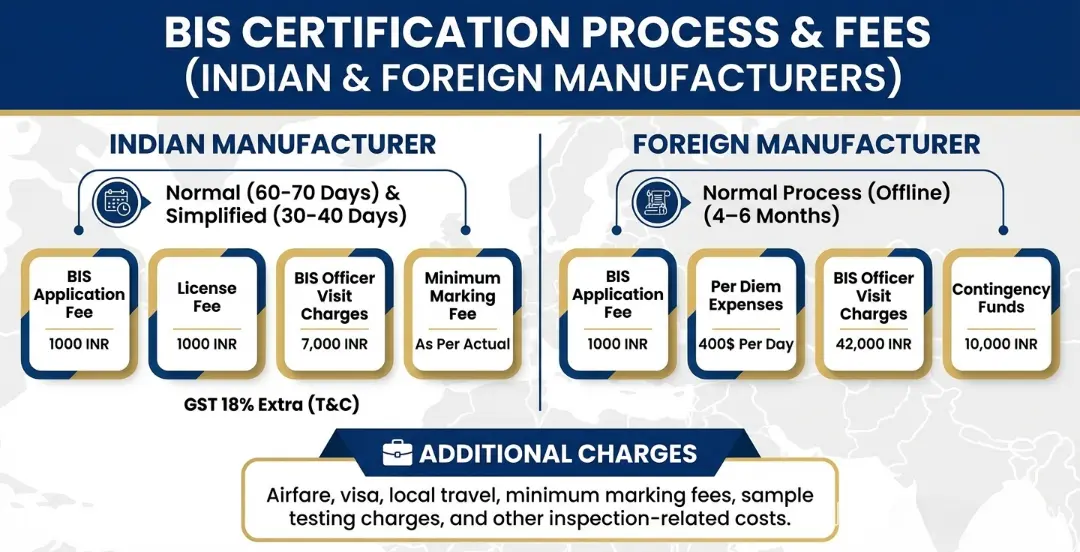
The BIS certification process for ACPs typically takes 30 to 60 days for Indian manufacturers and approximately 180 days for foreign manufacturers under the FMCS scheme.
The timeline depends on:
• completeness of application and documents at submission
• availability of BIS recognized laboratories with fire testing capability for FR-grade panel certification
• laboratory schedule for mechanical, fire, and weathering tests
• factory inspection scheduling by BIS
• number of ACP variants (FR/non-FR, thickness grades, coating types) being certified simultaneously
• response time to BIS queries — fire performance test queries may require detailed technical responses
BIS Certification Fees for Aluminium Composite Panels
The cost of BIS ISI Mark certification for aluminium composite panels under IS 17682:2021 includes the following standard fee components:
| S. No. | Particulars | Amount |
|---|---|---|
| 1 | APPLICATION FEE | INR 1,000/- |
| 2 | PRELIMINARY INSPECTION CHARGES | INR 7,000/- |
| 3 | ANNUAL LICENCE FEE | INR 1,000/- |
| 4 | MINIMUM MARKING FEE (Micro Scale 80% Off, Small 50%, Medium 20%) |
As Applicable |
| 5 | Sample Testing Fee (BIS Recognized Lab) | As Applicable |
Fire performance testing is the most significant variable cost for FR-grade ACP certification — fire tests require specialized laboratory facilities and typically carry higher testing charges than mechanical and dimensional tests. Manufacturers should obtain laboratory testing quotations specific to IS 17682:2021 fire tests from BIS recognized laboratories with fire testing capability before planning certification budgets.
Benefits of BIS ISI Mark Certification for Aluminium Composite Panels
1. Legal Market Access and Enforcement Protection
The most immediate benefit is the legal right to manufacture, import, and sell ACPs in India. BIS enforcement operations have resulted in seizure of large ACP consignments at ports and manufacturing facilities — IS 17682:2021 certification eliminates this operational and financial risk entirely.
2. Fire Safety Compliance Documentation for Buildings
For every building project in India that requires fire safety compliance — from RERA registrations to occupancy certificates — the ISI Mark on ACP panels provides architects, fire safety consultants, and building owners with the single most important product compliance document. A Gujarat-based developer constructing a 22-floor commercial tower in Ahmedabad specified ISI-marked FR-grade ACPs as a condition of their fire NOC application — and the ISI Mark test report was accepted by the fire department as the definitive proof of ACP quality compliance.
3. Government and Infrastructure Project Eligibility
CPWD, metro rail corporations, airport authority projects, and state PWD construction projects mandate BIS-certified building materials. An ACP manufacturer from Rajkot who obtained IS 17682:2021 certification was empanelled as an approved supplier for Gujarat's Smart City infrastructure projects — a channel that contributed over ₹3 crore in ACP supply within the first 12 months post-certification.
4. Architect and Specifier Confidence
Leading architectural firms and facade consultants in India — those working on premium commercial, hospitality, and institutional projects — increasingly include ISI Mark under IS 17682:2021 as a mandatory product qualification in their project specifications. Manufacturers with this certification are automatically included in the qualified product lists that these firms maintain for project procurement.
5. Consumer and Retailer Trust in a Market Flooded with Substandard Products
India's ACP retail market is extensively supplied with low-cost, often misrepresented panels. The ISI Mark provides building material dealers, contractors, and end-users with a credible quality assurance that the panel's aluminium skin thickness, peel strength, and FR grade are as declared — not inflated marketing claims. This trust is commercially valuable in a market where product misrepresentation has been widely documented.
6. Export Market Positioning
Indian ACP manufacturers exporting to the Middle East, Southeast Asia, and Africa benefit from the ISI Mark as a recognized quality signal. Buyers in markets like UAE, Saudi Arabia, and Kenya who are familiar with BIS as India's national standards body accept ISI-marked ACPs with confidence — reducing the documentation and qualification burden for Indian exporters in these markets.
BIS Enforcement and Penalties for Non-Compliant ACPs
BIS actively enforces the Aluminium Composite Panels QCO through market surveillance operations, import checks at major ports, and factory inspections across India's ACP manufacturing hubs — including the Rajkot and Ahmedabad clusters in Gujarat, and the NCR industrial areas.
Consequences of manufacturing, importing, or selling ACPs without BIS certification include:
• seizure of ACP stock at factories, warehouses, construction sites, or building material markets
• heavy fines under the BIS Act, 2016
• rejection of ACP import consignments at customs — particularly for containers from China and other manufacturing countries
• project-level disqualification and potential material replacement liability if non-certified ACPs are found installed in government-funded buildings
• suspension or cancellation of existing BIS licences for licence holders found non-compliant during surveillance
• reputational damage with architects, developers, and institutional buyers that is difficult to recover from in a specification-driven market
Surveillance and Licence Renewal
BIS ISI Mark certification for ACPs does not end with the grant of the licence. After approval, BIS conducts periodic surveillance to ensure the manufacturer continues to comply with IS 17682:2021 licence conditions.
Surveillance activities include:
• scheduled and surprise factory inspections verifying ongoing production compliance
• market sample testing of ISI-marked ACPs from building material dealers and project sites
• verification of aluminium skin thickness, peel strength, and FR core mineral content against declared specifications in the licence
• review of production records, quality control documentation, and raw material incoming inspection logs
The BIS ISI Mark licence must be renewed annually. Surveillance failures — particularly on skin thickness and peel strength — are the most common causes of BIS suspension notices to ACP manufacturers and must be proactively managed through consistent production quality controls.
Recent BIS Aluminium Composite Panel Certifications Delivered by Standphill India
Standphill India has successfully assisted aluminium composite panel manufacturers and importers across India in obtaining BIS ISI Mark certification under IS 17682:2021.
ACP Manufacturer – Rajkot, Gujarat
Product Certified
FR-grade and non-FR grade ACPs (3mm and 4mm, PVDF coated) — IS 17682:2021 — complete raw material review, fire test laboratory coordination, documentation preparation, factory inspection preparation, and ISI Mark licence approval
Building Materials Manufacturer – Ahmedabad, Gujarat
Product Certified
FR-grade ACPs for facade applications (4mm, PVDF coated) — IS 17682:2021 — end-to-end BIS certification including fire performance test scheduling at a BIS recognized laboratory, ManakOnline application filing, and ISI Mark licence approval
ACP Importer – Delhi NCR
Product Certified
Foreign manufacturer FMCS application support for FR and non-FR grade ACPs — IS 17682:2021 — AIR appointment, complete documentation preparation, BIS fire test laboratory coordination, and FMCS certification
Aluminium Products Manufacturer – Pune, Maharashtra
Product Certified
Non-FR grade ACPs (polyester coated, 3mm) for interior and signage applications — IS 17682:2021 — complete BIS certification support including in-house test equipment setup guidance and factory audit preparation
These projects demonstrate Standphill India's expertise in handling BIS certification for aluminium composite panels across FR and non-FR grades, PVDF and polyester coating systems, and both domestic manufacturing and import scenarios.
Why Choose Standphill India for BIS ACP Certification?
Standphill India is a leading BIS certification consultancy with over 20 years of experience and a proven track record of 10,000+ domestic and 400+ foreign product certifications completed across India and worldwide.
Our specific services for BIS ISI Mark certification of aluminium composite panels under IS 17682:2021 include:
• IS 17682:2021 compliance assessment for your specific ACP range — FR grade, non-FR grade, PVDF and polyester coated variants
• raw material specification review — aluminium skin alloy/temper verification and FR core mineral content confirmation
• identification and coordination with BIS recognized laboratories with fire testing capability for FR-grade panels
• complete documentation preparation and BIS ManakOnline application filing
• in-house testing equipment identification and SIT compliance support
• factory inspection preparation and pre-audit readiness support
• BIS query resolution — including technical responses to fire performance test queries
• ISI Mark licence approval support and post-licence surveillance and renewal assistance
• FMCS application support for foreign ACP manufacturers
Also Read
BIS FMCS Certification for Foreign Manufacturers
BIS ISI Mark Certification – Complete Guide for Manufacturers
Conclusion
BIS Certification for Aluminium Composite Panels under IS 17682:2021 is a mandatory legal, safety, and quality compliance requirement for all ACP manufacturers, importers, and sellers in India. The Aluminium Composite Panels Quality Control Order makes the ISI Mark compulsory — and in a product category with direct implications for building fire safety and structural integrity, this is both legally and morally the right standard to enforce.
IS 17682:2021 covers the complete quality spectrum of ACP performance — from aluminium skin thickness and peel strength to fire performance classification, coating durability, and flatness — ensuring that ISI-marked panels provide the building safety and service life performance that architects, developers, and building owners depend on. For FR-grade panels used in India's rapidly growing high-rise and commercial construction market, BIS certification is the definitive product quality and fire safety credential.
With Standphill India as your certification partner, ACP manufacturers and importers can complete the entire BIS ISI Mark certification journey — from IS 17682:2021 compliance assessment and fire test coordination to factory inspection and ISI Mark licence approval — with expert guidance and full regulatory confidence.
Get expert support for BIS certification for aluminium composite panels and bring your ACP products to India's construction market with the ISI Mark under IS 17682:2021.
Frequently Asked Questions (FAQ)
Q1. Is BIS certification mandatory for aluminium composite panels in India?
Yes. BIS ISI Mark certification is mandatory for all aluminium composite panels in India under the Aluminium Composite Panels Quality Control Order. ACPs without certification cannot be legally manufactured, imported, or sold in India. Non-compliance leads to product seizure and heavy fines under the BIS Act, 2016.
Q2. What is IS 17682:2021?
IS 17682:2021 is the Indian Standard for Aluminium Composite Panels – Specification, published by BIS. It specifies requirements for aluminium skin thickness, peel strength, tensile and flexural strength, fire performance (for FR grade), coating adhesion and hardness, flatness, weather resistance, and dimensional tolerances for ACPs used in building facades, cladding, signage, and interior applications.
Q3. What is the difference between FR and non-FR grade ACPs under IS 17682:2021?
FR (fire-retardant) grade ACPs have a mineral-filled core (typically with ≥70% inorganic content) that retards flame spread and reduces smoke generation. They must pass specific fire performance tests under IS 17682:2021 and are required for high-rise facades, airports, malls, hospitals, and fire-sensitive applications. Non-FR (standard) grade ACPs have a primarily PE core and are suitable for low-rise interiors, signage, and non-fire-critical applications.
Q4. What fire tests are required for FR-grade ACP BIS certification?
FR-grade ACPs must pass flame spread testing, smoke density testing, and combustibility classification tests as specified in IS 17682:2021. These tests require specialized fire testing equipment available at BIS recognized laboratories with fire test capability. Standphill India can identify and coordinate with the appropriate laboratory for your FR ACP certification.
Q5. What is the minimum aluminium skin thickness under IS 17682:2021?
IS 17682:2021 specifies minimum aluminium skin thickness requirements for ACPs. The specific minimum values depend on the declared nominal panel thickness. Standphill India can review your product specifications against IS 17682:2021 skin thickness requirements as part of the pre-certification compliance assessment.
Q6. How long does BIS certification for aluminium composite panels take?
Approximately 30 to 60 days for Indian manufacturers and approximately 180 days for foreign manufacturers under FMCS. FR-grade panel certification may take slightly longer due to fire test scheduling requirements at specialized BIS recognized laboratories.
Q7. Can multiple ACP variants (FR and non-FR, different thicknesses) be covered under one BIS licence?
Yes. Multiple ACP variants across different thicknesses and coating types within the same FR or non-FR category can often be covered under a single ISI Mark licence with each variant declared in the scope. FR and non-FR grade panels typically require separate testing and may be declared as separate product categories within the same or separate licence applications. Standphill India can advise on the optimal licence scope for your product range.
Q8. Can foreign ACP manufacturers get BIS certification for the Indian market?
Yes. Foreign manufacturers must apply under the BIS FMCS scheme and appoint an Authorized Indian Representative (AIR) in India. The IS 17682:2021 requirements, testing, and factory inspection process are the same as for Indian manufacturers. With India being one of Asia's largest ACP markets, FMCS certification is commercially essential for international manufacturers serious about Indian market access.
Q9. What happens if ACPs are found non-compliant during BIS market surveillance?
If ISI-marked ACPs fail BIS market surveillance testing — typically on skin thickness, peel strength, or FR core mineral content — BIS can issue a suspension notice to the licence holder, require corrective action, and withdraw the licence if the non-conformity is not resolved. This underscores the importance of consistent production quality control aligned with the declared IS 17682:2021 specifications.
Q10. Does Standphill India provide BIS ACP certification support across India?
Yes. Standphill India has a strong presence across all States and Union Territories of India and supports ACP manufacturers and importers nationwide with complete BIS ISI Mark certification consultancy under IS 17682:2021 — from compliance assessment and fire test laboratory coordination to factory inspection preparation and ISI Mark licence approval.
★ Why Standphill India?
- 20+ Years of BIS Certification Experience
- 10,000+ Certifications Delivered Globally
- Dedicated Teams for CRS, FMCS & ISI Mark
- End-to-End Documentation & Filing Support
- Fast Response & Practical Compliance Guidance
- Support for Indian & Foreign Manufacturers
Get Free Call Back
Our Services
- BIS (ISI Mark) for Foreign Manufacturers
- Domestic BIS (ISI Mark) Certification
- BIS Certificate of Conformity (CoC)
- BIS Hallmarking
- BIS Licence for Toys
- ECO Mark Certification
- TAC Approval for Automobile
- Drug Licence
- Peso Certification
- BIS (CRS) Registration
- WPC-ETA Approval
- BEE Certification
- E-Waste Management (EPR)
- EPR for Plastic Waste
- EPR for Battery Waste
- CE Certification
- UL Certification
- ROHS Licence
- Standardization Division
- Import / Export Licence
- FSSAI Certification
- ISO Registration
- Trademark Registration
- Make in India Support
- AG-Mark Licence
- Third Party Monitoring
Client Testimonials
Their team was very knowledgeable and helped us every step of the way. Standphill India is the best BIS certification consultants for any type of BIS certification.

Chintan Shah (AGM)
Sudeep Nutrition P.Ltd



Featured Guide
Complete BIS CRS certification guide for electronic products in India — free to read.
Read CRS Certification Guide📞 Contact Standphill India
+91-9667674225 info@standphillindia.in WhatsApp Now Greater Noida West, UPGet Expert BIS Certification Support for Your Business
Connect with Standphill India for complete support with BIS certification, CRS registration, WPC approval, FMCS compliance, and related regulatory services. Our team helps businesses with documentation, testing coordination, application support, and end-to-end compliance guidance.
Request Free Consultation
Share your requirement and our team will contact you shortly.