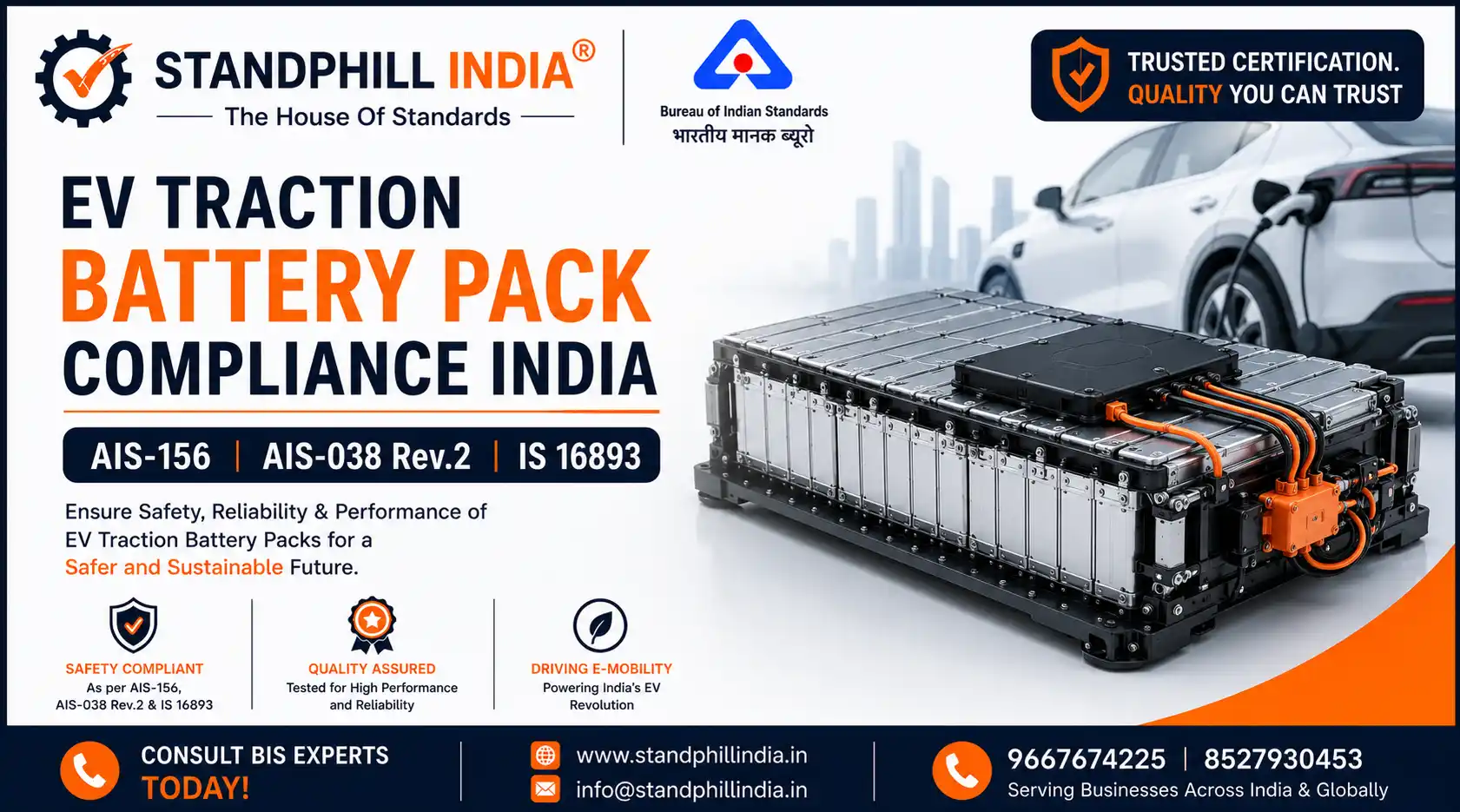
EV Traction Battery Pack Compliance – AIS-156, AIS-038 Rev.2 & IS 16893
AIS-156 (L-Category) · AIS-038 Rev.2 (M/N Category) · Mandatory Since Dec 2022 · 4th Revision Aug 2024 · IS 16893 Cell Testing · NOT a BIS QCO Product
Critical: EV Battery Packs Are NOT a BIS QCO Product – AIS Homologation Is the Mandatory Route
EV traction battery packs are mandatory under AIS-156 (L-category) and AIS-038 Rev.2 (M/N category) since December 2022 – through vehicle type approval under CMVR by MoRTH via ARAI/ICAT/NATRIP. This is NOT a BIS QCO or CRS product. A BIS certificate for an EV pack does not give AIS approval; an AIS certificate is not a BIS certificate. Getting this wrong has caused real compliance failures and customs problems for Indian EV players.
About EV Traction Battery Packs – NOT a BIS QCO Product
EV traction battery packs power electric vehicles. They are among the most intensively regulated products in India's battery landscape – but the regulation flows through vehicle homologation under the Central Motor Vehicles Rules (CMVR), not through a BIS Quality Control Order or CRS registration. This distinction is critical, and getting it wrong is the most expensive compliance mistake in the Indian EV industry.
BIS certification does NOT satisfy AIS-156 or AIS-038 requirements. AIS approval does NOT satisfy BIS QCO requirements. They are issued by different authorities under different laws. A BIS certificate for an EV battery pack does not mean your vehicle is type-approved. An AIS certificate is not a BIS certificate. Both may be required simultaneously for different purposes.
The Compliance Map – What Applies to Your EV Battery
Complete EV Battery Compliance Picture
Traction battery pack (complete assembled pack): Mandatory AIS-156 (L-category: 2W/3W/quadricycles) or AIS-038 Rev.2 (M/N category: buses, trucks) – mandatory since December 2022 via CMVR type approval. Not a BIS QCO product.
Lithium cells inside the pack: IS 16893 (Parts 2 & 3) testing at NABL-accredited labs mandatory within AIS Phase 2 (since March 2023). Voluntary BIS ISI licence against IS 16893 also available – increasing OEM procurement demand.
Portable lithium cells/batteries (if separately supplied in portable-application scope): Mandatory IS 16046 (Part 2) CRS registration under MeitY.
BWMR 2022 EPR: Mandatory for all EV battery producers, importers and brand owners – CPCB registration and annual obligations.
| Product | Regime | Mandatory? | Authority |
|---|---|---|---|
| EV traction pack (complete) | AIS-156 (L-cat) / AIS-038 Rev.2 (M/N cat) | Yes – since Dec 2022 | MoRTH via ARAI/ICAT/NATRIP |
| Lithium cells (within AIS) | IS 16893 P2/P3 testing within AIS framework | Yes (part of AIS) | AISC/MoRTH |
| Voluntary BIS for EV cells | IS 16893 ISI licence | Voluntary (OEM demand rising) | BIS |
| Portable lithium cells (if applicable) | IS 16046 (Part 2) CRS | Mandatory | MeitY / BIS |
| BWMR EPR | Battery Waste Management Rules 2022 | Mandatory | CPCB / MoEFCC |
AIS-156 vs AIS-038 Rev.2 – Which Applies
Vehicle category determines which standard applies:
| Vehicle Category | AIS Standard | Vehicle Types | Status |
|---|---|---|---|
| L-category | AIS-156 | 2-wheelers (e-scooters, e-motorcycles), 3-wheelers (e-autos, e-rickshaws, e-carts), quadricycles | Mandatory since Dec 2022 |
| M-category | AIS-038 Rev.2 | Passenger vehicles with more than 8 seats (e-buses, mini-buses) | Mandatory since Dec 2022 |
| N-category | AIS-038 Rev.2 | Commercial vehicles with electric powertrain (trucks, LCVs, HCVs) | Mandatory since Dec 2022 |
| 4th Revision | AIS-038 Rev.2 (Aug 2024) | All M/N category – updated requirements now in force | In force for new approvals |
What AIS-156 and AIS-038 Rev.2 Test on EV Battery Packs
The test regime covers the battery pack as a safety-critical vehicle component:
Thermal Propagation
Pack must contain thermal runaway to one cell/module without propagating further – the defining EV fire-safety test.
Overcharge / Overdischarge
BMS must cut off before dangerous limits – electrical abuse protection under automotive fault conditions.
Over-Temperature
BMS protects cells and pack from temperature extremes in all operating conditions including Indian summer heat.
IPX7 Water Ingress
Pack enclosure must resist water ingress to at least IPX7 level under vehicle operating conditions including monsoon.
Mechanical Shock & Vibration
Structural integrity under vehicle dynamics – road shock, vibration and mounting loads on Indian roads.
Microprocessor BMS
Full microprocessor-based BMS with cell-level protections (overcurrent, overtemp, overcharge, overdischarge, balancing) – Phase 2.
EMC Testing
BMS electromagnetic compatibility per AIS-004 – Phase 2 requirement.
RFID Traceability
RFID or QR code on cells and packs for lifetime traceability – Phase 2 requirement feeding subsidy verification.
Earth Leakage Detection
Mandatory earth leakage detection at the on-vehicle charger interface – August 2024 revision.
Audio-Visual Warning
Mandatory warning system for thermal events – August 2024 revision.
The August 2024 Revision of AIS-038 Rev.2 – What Changed
AISC issued the fourth revision of AIS-038 Rev.2 in August 2024, now in force for new type approvals of M and N category vehicles:
- Enhanced thermal propagation testing: updated test protocol based on global and Indian EV fire incident analysis
- Four BMS temperature sensors minimum: increased from previous requirement
- Active parallel circuit protection: specific protection requirements for active cell-balancing circuits
- Earth leakage detection for charger: mandatory at the on-vehicle charger interface
- Audio-visual thermal warning: mandatory in-vehicle warning triggered by BMS during thermal anomaly
- EMC testing updated: BMS EMC per AIS-004 with updated specifications
- RFID traceability refined: updated specifications for cell and pack RFID/QR marking
OEMs already type-approved under earlier AIS revisions: verify your approval certificate revision level and confirm with ARAI/ICAT whether updated testing is required for current or next production runs. We help navigate this.
IS 16893 – the Cell Standard Inside the AIS Framework
| IS Standard | What It Covers |
|---|---|
| IS 16893 (Part 2) | Performance testing of lithium-ion cells for propulsion of electric vehicles (capacity, discharge, cycle life) |
| IS 16893 (Part 3) | Safety requirements for lithium-ion cells for EV traction (abuse testing, thermal, mechanical, electrical) |
From AIS Phase 2 (31 March 2023), IS 16893 Parts 2 and 3 testing at NABL-accredited labs is embedded as a mandatory requirement within AIS type approval. This is a testing obligation within the AIS framework – distinct from, but available alongside, the voluntary BIS ISI licence for EV cells. For international cell manufacturers supplying Indian EV OEMs, a voluntary IS 16893 BIS licence is increasingly demanded as a procurement qualification document.
AIS Homologation Process – Step by Step
Identify applicable AIS standard
AIS-156 for L-category (2W/3W), AIS-038 Rev.2 for M/N category, and the correct revision level. Confirm Phase 1 and Phase 2 requirements for your vehicle type.
Cell-level testing at NABL lab
IS 16893 (Parts 2 & 3) testing of the cells used in the pack at a NABL-accredited laboratory – mandatory within AIS Phase 2.
Pack-level testing at authorised agency
Complete traction battery pack testing at ARAI, ICAT, NATRIP or VRDE against all AIS-156 or AIS-038 Rev.2 requirements including thermal propagation, BMS verification, IPX7, mechanical tests, RFID.
Type approval application
Submit cell test reports, pack test reports, vehicle system description and BMS documentation to the testing agency for type approval under CMVR.
CMVR type approval grant
Testing agency issues Type Approval Certificate covering the vehicle including the battery system – required for registration and sale in India.
BWMR EPR registration
Register on CPCB portal for Battery Waste Management Rules 2022 EPR compliance – mandatory for producers and importers regardless of homologation status.
We coordinate the AIS process alongside the testing agency: preparing cell documentation, pack specifications, BMS technical dossiers, and managing the interface between cell suppliers, pack manufacturers and homologation agencies.
FAME / PM E-Drive Subsidy and Battery Compliance
- Valid CMVR type approval under AIS-156 or AIS-038 Rev.2 is a hard eligibility condition for FAME-II and PM E-Drive subsidy
- RFID battery traceability (AIS Phase 2 requirement) feeds into the subsidy verification portal mechanism
- Make-in-India / ALMM frameworks specify minimum domestic value addition in the battery pack for government EV procurement
- Temporary relaxation (January 2026 – January 2027): Ministry of Power has eased strict ALMM localisation for bidders using lithium-ion cells under ToT arrangements where domestic cell manufacturing is limited
Complete Compliance Snapshot
| Item | Detail |
|---|---|
| L-category traction pack | AIS-156 – mandatory since December 2022; testing at ARAI/ICAT/NATRIP/VRDE. Authority: MoRTH. |
| M/N-category traction pack | AIS-038 Rev.2 – mandatory since December 2022; 4th revision August 2024 in force. Authority: MoRTH. |
| Lithium cells (within AIS) | IS 16893 (Parts 2 & 3) testing at NABL labs – mandatory within AIS Phase 2 (since March 2023). |
| Voluntary BIS for EV cells | IS 16893 ISI licence – voluntary, available from BIS, OEM procurement demand increasing. |
| Portable lithium cells | IS 16046 (Part 2) CRS – mandatory if within portable-application scope (MeitY). |
| Homologation agencies | ARAI, ICAT, NATRIP, VRDE – authorised under CMVR. |
| BWMR 2022 EPR | Mandatory – CPCB registration and annual obligations for producers and importers. |
| Subsidy compliance | AIS compliance + RFID traceability required for FAME-II / PM E-Drive eligibility. |
| BIS role | Voluntary IS 16893 ISI for EV cells; mandatory IS 16046 CRS for portable lithium cells; NO mandatory BIS QCO on the complete EV pack. |
Related Guides
BIS Certification for Batteries – Complete Map (Every Battery Type) Lithium-Ion Cells & Batteries (IS 16046 Part 2 – Mandatory CRS) Stationary BESS (IS 17424 + CEA 2026 Mandatory Framework) Solar Storage Batteries (IS 16270:2023 – Mandatory MNRE Order) BIS Consultant for Batteries BIS for Foreign Manufacturers (FMCS / AIR)Why Choose Standphill India
With 20+ years and 10,000+ certifications we work across every battery compliance route daily. We track regulatory changes and brief clients in week one, not month six. For lead-acid, BESS and EV batteries we handle the full compliance stack: ISI voluntary + BWMR EPR + CEA design advisory + AIS coordination.
Get Your EV Battery Compliance Mapped
AIS-156 / AIS-038 homologation coordination, IS 16893 cell testing, voluntary BIS ISI for cells, IS 16046 CRS for portable cells, BWMR EPR – complete EV battery compliance from one team.
Free Consultation +91-9667674225Frequently Asked Questions
Ask a Battery Compliance Expert – Free
Tell us your battery type and application – we map the exact route and confirm costs within 24 hours.
★ Why Standphill India?
- 20+ Years of BIS Certification Experience
- 10,000+ Certifications Delivered Globally
- Dedicated Teams for CRS, FMCS & ISI Mark
- End-to-End Documentation & Filing Support
- Fast Response & Practical Compliance Guidance
- Support for Indian & Foreign Manufacturers
Get Free Call Back
Our Services
- BIS (ISI Mark) for Foreign Manufacturers
- Domestic BIS (ISI Mark) Certification
- BIS Certificate of Conformity (CoC)
- BIS Hallmarking
- BIS Licence for Toys
- ECO Mark Certification
- TAC Approval for Automobile
- Drug Licence
- Peso Certification
- BIS (CRS) Registration
- WPC-ETA Approval
- BEE Certification
- E-Waste Management (EPR)
- EPR for Plastic Waste
- EPR for Battery Waste
- CE Certification
- UL Certification
- ROHS Licence
- Standardization Division
- Import / Export Licence
- FSSAI Certification
- ISO Registration
- Trademark Registration
- Make in India Support
- AG-Mark Licence
- Third Party Monitoring
Client Testimonials
Their team was very knowledgeable and helped us every step of the way. Standphill India is the best BIS certification consultants for any type of BIS certification.

Chintan Shah (AGM)
Sudeep Nutrition P.Ltd



Featured Guide
Complete BIS CRS certification guide for electronic products in India — free to read.
Read CRS Certification Guide📞 Contact Standphill India
+91-9667674225 info@standphillindia.in WhatsApp Now Greater Noida West, UPGet Expert BIS Certification Support for Your Business
Connect with Standphill India for complete support with BIS certification, CRS registration, WPC approval, FMCS compliance, and related regulatory services. Our team helps businesses with documentation, testing coordination, application support, and end-to-end compliance guidance.
Request Free Consultation
Share your requirement and our team will contact you shortly.