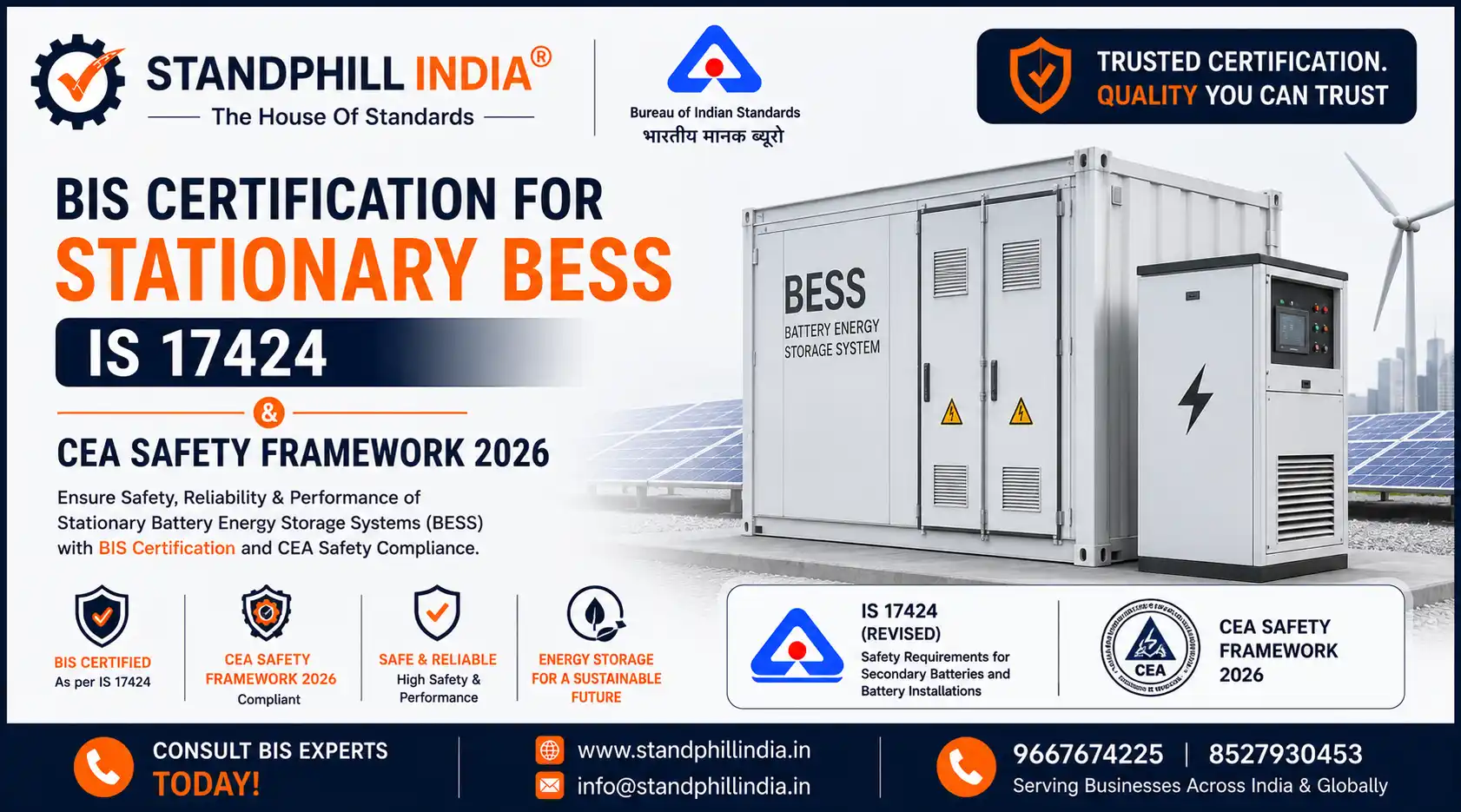
BIS Certification for Stationary BESS – IS 17424:2020 & CEA Safety Framework
IS 17424:2020 (Voluntary ISI) · IS 17092:2019 · CEA Safety Framework Mandatory 1 April 2027 · Cell IS 16046 Mandatory · BWMR EPR
Three Layers: Voluntary BIS + Mandatory CEA (Apr 2027) + Mandatory BWMR EPR
Stationary BESS has three compliance layers: (1) IS 17424:2020 / IS 17092:2019 – voluntary BIS ISI but the de-facto tender qualification standard across SECI, NTPC and utility procurement. (2) CEA Safety Framework – mandatory from 1 April 2027 for all BESS installations (two-fault tolerance, fire suppression, RFID traceability, SoH monitoring). (3) BWMR 2022 EPR – mandatory today for producers and importers. Plus: lithium cells inside need mandatory IS 16046 (Part 2) CRS.
About Stationary BESS - What This Certification Covers
Battery Energy Storage Systems (BESS) are container-scale, rack-scale and cabinet-scale battery installations for stationary applications: grid-scale energy storage co-located with solar and wind farms, substation frequency regulation, commercial and industrial behind-the-meter peak shaving, and microgrids. The CEA projects 47 GW of storage need by 2030; installed capacity was under 1 GW in early 2024. That gap is driving rapid regulatory action in 2025-26 - including a new mandatory CEA safety framework effective 1 April 2027.
Scope boundary: IS 17424 covers the installed BESS system. The lithium cells inside separately require mandatory IS 16046 (Part 2) CRS registration under MeitY if within portable-application scope. Both apply simultaneously for lithium BESS. System voluntary, cells mandatory.
Three-Layer Compliance Framework - Know All Three
BESS compliance in India in 2026 operates across three overlapping frameworks from three different authorities:
Status: Voluntary – no QCO
- IS 17424:2020 – Safety of Stationary BESS (system level)
- IS 17092:2019 – EES safety for grid-connected systems
- ISI Mark with CM/L number on certified BESS
- Required for SECI, NTPC, DISCOM tender qualification
Status: MANDATORY from 1 April 2027
- Two-fault tolerance design
- Fire detection & suppression mandatory
- RFID/QR code cell & pack traceability
- SoH monitoring, thermal runaway prevention
- Emergency response protocols + personnel training
Status: MANDATORY today
- Battery Waste Management Rules, 2022
- EPR registration on CPCB portal
- Annual collection & recycling targets
- Prescribed labelling on batteries
- Applies to all producers, importers, brand owners
The CEA 2026 safety framework effective 1 April 2027 is an engineering requirement, not a paperwork exercise. Two-fault tolerance, fire suppression integration, RFID cell traceability – these must be designed into the BESS now. Projects commissioning in 2027 and beyond must be CEA-compliant from day one.
What is IS 17424:2020?
IS 17424:2020 – Safety of Stationary Battery Energy Storage Systems – is a system-level standard covering the complete installed BESS:
| Coverage Area | What IS 17424:2020 Specifies |
|---|---|
| Battery system | Cells, modules, packs – electrical, thermal and safety requirements at each level |
| BMS | All protection functions: overcharge, overdischarge, overcurrent, overtemperature, cell balancing, SoC and SoH monitoring |
| Thermal management | Cooling system design, temperature uniformity, thermal runaway containment |
| Enclosure & installation | IP rating, clearances, ventilation, fire separation from adjacent structures |
| Fire safety interface | Detection sensor requirements, suppression system integration, gas and smoke venting |
| Grid interface | AC/DC power conditioning safety, grid protection relay requirements |
| Commissioning | Pre-commissioning checks, capacity verification, safety system function testing |
| Operation & maintenance | Periodic testing, capacity monitoring, degradation limits for continued operation |
The CEA Safety Framework 2026 - Mandatory from 1 April 2027
The most significant regulatory development for BESS: the CEA (Measures Relating to Safety and Electric Supply) Amendment Regulations, 2026, notified April 2026, effective 1 April 2027. This is mandatory for all BESS installations in India.
Key CEA Requirements Effective 1 April 2027
- Two-fault tolerance: BESS must operate safely or shut down safely after any two simultaneous independent faults (overcharge, overdischarge, short circuit, out-of-temperature-range)
- Fire detection & suppression: mandatory integrated fire detection and suppression systems at all BESS installations
- RFID/QR code traceability: cells and packs must have RFID or QR code marking for full lifecycle traceability
- SoH monitoring: continuous state-of-health monitoring with defined operational limits
- Thermal runaway prevention: design requirements to prevent thermal propagation between cells, modules and enclosures
- Earthing & insulation: comprehensive earthing and periodic insulation resistance testing
- Emergency response: mandatory on-site emergency response procedures, safety signage
- Personnel training: state governments to ensure fire safety personnel trained for BESS-specific risks (DGFS guidelines)
Project developers and EPCs: BESS projects being designed in 2026 for commissioning in 2027 must incorporate CEA requirements from the design stage. Retrofit compliance on commissioned BESS costs significantly more than building it in from the start.
Who Needs BESS Compliance
Solar + Storage Developers
Co-located BESS with solar farms – IS 17424 for tender qualification now; CEA framework mandatory from 1 April 2027.
C&I Behind-the-Meter
Peak shaving and demand management BESS – IS 17424 in procurement specs; CEA framework from April 2027.
BESS Importers
Container/rack-scale BESS for project integration – IS 17424 voluntary, cell-level IS 16046 obligations map separately.
BESS Manufacturers
Indian BESS assembly and integration – voluntary ISI positioning + CEA 2026 design compliance.
Utilities & Discoms
SECI/NTPC/DISCOM procurement – IS 17424 + IS 17092 in bid specs; CEA 2026 in O&M contracts.
EPC Contractors
Installing BESS in renewable projects – CEA 2026 safety design, installation and commissioning compliance.
What IS 17092:2019 Adds
IS 17092:2019 – Electrical Energy Storage Systems Safety Requirements – is designed for grid-connected storage, adding requirements beyond IS 17424 for: grid protection relay coordination, islanding prevention, power quality requirements, and fault ride-through capability. For utility-scale BESS with grid interconnection, IS 17092 is cited alongside IS 17424 in utility procurement specifications. Both are available for voluntary ISI certification from BIS.
How to Get Voluntary ISI Certification (IS 17424 / IS 17092)
System scope mapping & standard selection
Confirm whether IS 17424 alone or IS 17092 also applies (grid-connected systems). Map the system boundary: what components, what interfaces are in scope. BESS scope mapping is more complex than a single battery product.
CEA 2026 compliance gap assessment
For BESS commissioning 2027 onwards: assess the gap between current design and CEA requirements (two-fault tolerance, fire suppression, RFID traceability, SoH monitoring) so they are incorporated in design, not retrofit.
System-level testing at BIS-recognised lab
Testing against IS 17424 and IS 17092 at a BIS-recognised laboratory with appropriate test bench capacity for the system voltage and capacity. We identify the right lab and coordinate test planning.
Documentation in exact BIS format
System specification, single-line diagram, BMS description, thermal management docs, fire interface specification, test reports, factory quality docs, and marking artwork – all in exact BIS format.
BIS factory assessment and licence grant
Scheme-I voluntary ISI includes factory assessment. On approval, ISI Mark with CM/L number is granted. Typically 6–10 weeks total.
BWMR 2022 EPR registration runs in parallel – we handle both tracks together. Plan your BESS compliance with us.
Certification Snapshot
| Item | Detail |
|---|---|
| BIS voluntary standard | IS 17424:2020 (system-level) + IS 17092:2019 (grid-connected) |
| BIS status | Voluntary ISI – no QCO as of July 2026; ISI Mark with CM/L |
| CEA Safety Framework | Mandatory from 1 April 2027 – CEA (Measures Relating to Safety and Electric Supply) Amendment Regulations, 2026 |
| Lithium cell compliance | IS 16046 (Part 2) CRS – mandatory under MeitY if portable-application cells |
| Lead-acid cell compliance | IS 1651 / IS 15549 – voluntary ISI |
| BWMR 2022 EPR | Mandatory now – CPCB EPR registration and annual obligations |
| Key tender frameworks | SECI, NTPC, state DISCOM tenders specify IS 17424; ALMM/Make-in-India for domestic content |
| Factory audit | Yes – Scheme-I voluntary ISI includes BIS factory assessment |
| Average timeline | 6–10 weeks from prepared application including system-level testing |
| Validity | Up to 5 years per BIS (Conformity Assessment) Amendment Regulations, 2026 |
Related Guides
BIS Certification for Batteries – Complete Map (Every Battery Type) Solar Storage Batteries (IS 16270:2023 – Mandatory under MNRE 2025) Lead-Acid Batteries – Voluntary ISI & BWMR EPR EV Traction Battery Packs – AIS-156 / AIS-038 Compliance Guide Lithium-Ion Cells & Batteries (IS 16046 Part 2 – Mandatory CRS) BIS Consultant for BatteriesWhy Choose Standphill India
With 20+ years and 10,000+ certifications we work across every battery compliance route daily. We track regulatory changes and brief clients in week one, not month six. For lead-acid, BESS and EV batteries we handle the full compliance stack: ISI voluntary + BWMR EPR + CEA design advisory + AIS coordination.
Map Your BESS Compliance – Free Assessment
IS 17424 voluntary ISI, CEA 2026 design gap analysis, cell-level IS 16046 CRS, BWMR EPR – complete BESS compliance stack from one team.
Free Consultation +91-9667674225Frequently Asked Questions
Ask a Battery Compliance Expert – Free
Tell us your battery type and application – we map the exact route and confirm costs within 24 hours.
★ Why Standphill India?
- 20+ Years of BIS Certification Experience
- 10,000+ Certifications Delivered Globally
- Dedicated Teams for CRS, FMCS & ISI Mark
- End-to-End Documentation & Filing Support
- Fast Response & Practical Compliance Guidance
- Support for Indian & Foreign Manufacturers
Get Free Call Back
Our Services
- BIS (ISI Mark) for Foreign Manufacturers
- Domestic BIS (ISI Mark) Certification
- BIS Certificate of Conformity (CoC)
- BIS Hallmarking
- BIS Licence for Toys
- ECO Mark Certification
- TAC Approval for Automobile
- Drug Licence
- Peso Certification
- BIS (CRS) Registration
- WPC-ETA Approval
- BEE Certification
- E-Waste Management (EPR)
- EPR for Plastic Waste
- EPR for Battery Waste
- CE Certification
- UL Certification
- ROHS Licence
- Standardization Division
- Import / Export Licence
- FSSAI Certification
- ISO Registration
- Trademark Registration
- Make in India Support
- AG-Mark Licence
- Third Party Monitoring
Client Testimonials
Their team was very knowledgeable and helped us every step of the way. Standphill India is the best BIS certification consultants for any type of BIS certification.

Chintan Shah (AGM)
Sudeep Nutrition P.Ltd



Featured Guide
Complete BIS CRS certification guide for electronic products in India — free to read.
Read CRS Certification Guide📞 Contact Standphill India
+91-9667674225 info@standphillindia.in WhatsApp Now Greater Noida West, UPGet Expert BIS Certification Support for Your Business
Connect with Standphill India for complete support with BIS certification, CRS registration, WPC approval, FMCS compliance, and related regulatory services. Our team helps businesses with documentation, testing coordination, application support, and end-to-end compliance guidance.
Request Free Consultation
Share your requirement and our team will contact you shortly.