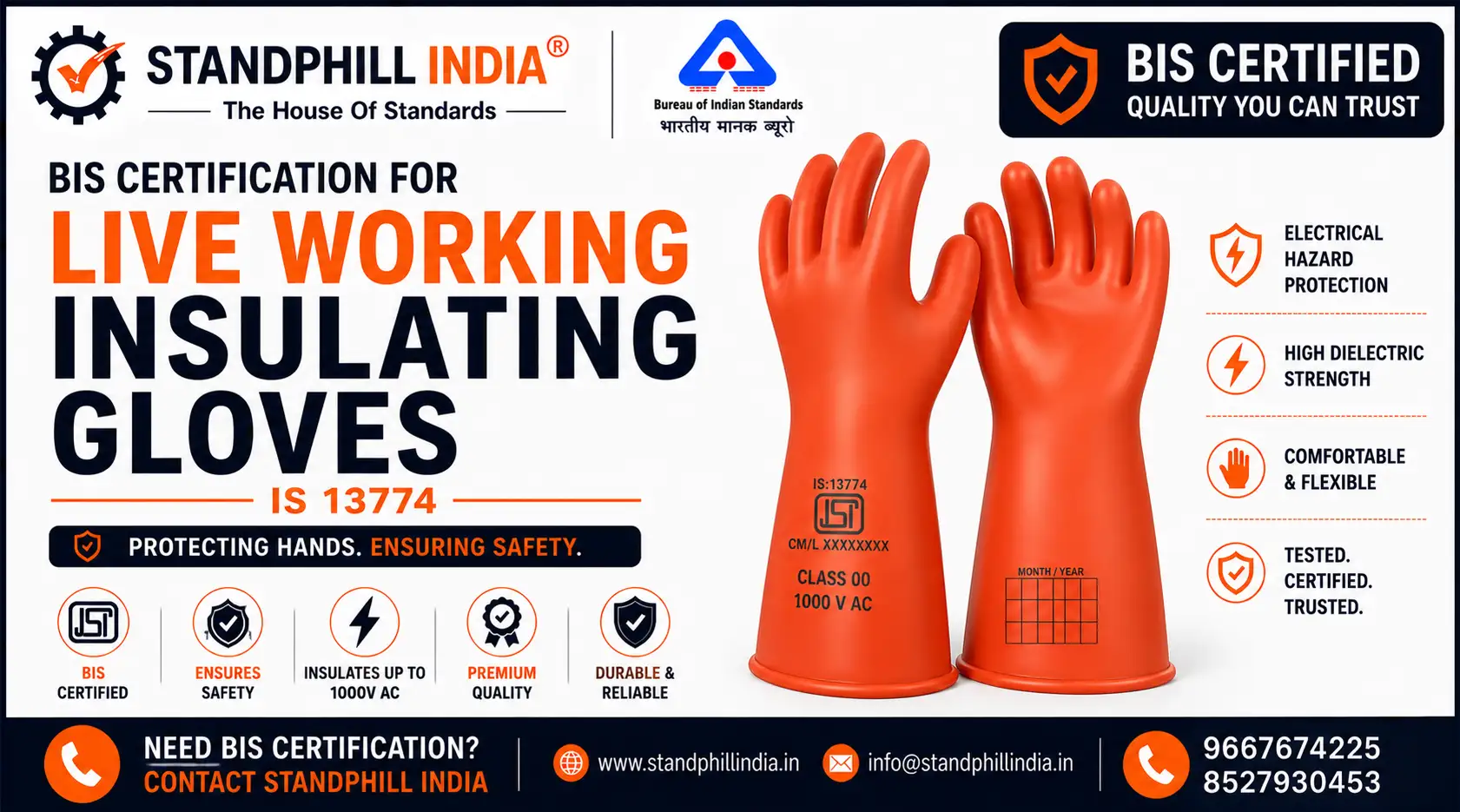
BIS Certification for Live Working Gloves of Insulating Material
IS 13774:2021 · ISI Mark - Mandatory Since 3 July 2024 - The PPE Between a Lineman and the Line
Mandatory for Live Working Insulating Gloves
Live working gloves of insulating material are notified under IS 13774:2021 by the Electrical Accessories (Quality Control) Order, 2023 (S.O. 43(E)). This certification is mandatory: compliance began on 3 July 2024 (Small Enterprises: 3 October 2024; Micro Enterprises: 3 January 2025) - all windows have closed, so it is a live legal requirement today.
About This Product - and What the Certification Covers
Among boxes, holders and trunking, this order contains one product that is pure PPE: the insulating glove a lineman or electrician wears to work on or near live conductors. When a hand grips an energised line, the glove is not an accessory - it is the entire safety system. Its insulating material, its freedom from pinholes, its behaviour after ageing, ozone and moisture: these decide, quite literally, whether the wearer goes home.
India employs hundreds of thousands of utility linemen, electricians and industrial maintenance staff, and electrocution during live work remains one of the country's persistent occupational killers. A counterfeit or degraded glove looks identical to a good one - the failure is invisible until the moment it matters. That is why live working gloves were pulled under compulsory certification: quality here can only be proven electrically, in a lab, before the glove ever reaches a worker.
This product is notified under the Electrical Accessories (Quality Control) Order, 2023 - S.O. 43(E), dated 1 January 2024, issued by the Ministry of Commerce and Industry (DPIIT) under Section 16 of the BIS Act, 2016, and amended by S.O. 187(E) on 13 January 2026. This certification is mandatory, not voluntary. Mandatory since 3 July 2024 for manufacturers in general; 3 October 2024 for Small Enterprises; 3 January 2025 for Micro Enterprises - all dates have passed, so the requirement is fully in force for every manufacturer and importer today.
What is IS 13774:2021?
IS 13774:2021 is the Indian Standard for Live Working Gloves of Insulating Material - a recently revised standard covering gloves of insulating material used for live electrical working. It specifies the classes of gloves by the voltages they are rated to protect against, and the dielectric, physical and ageing requirements each class must prove. The practical scope:
| Specification | Detail |
|---|---|
| Product | Live working gloves of insulating material |
| Indian Standard | IS 13774:2021 - latest version including amendments applies |
| Nature | Personal protective equipment for live electrical working |
| Classification | Classes rated by working voltage, per the standard - each class with its own proof requirements |
| Core concerns | Dielectric withstand, freedom from pinholes/defects, mechanical strength, ageing and environmental resistance |
For life-safety PPE, testing is not sampled generously: dielectric proof testing of gloves is the industry norm piece by piece - because one pinhole in one glove is one electrocution.
Why Is BIS Certification Mandatory for This Product?
Because the failure mode is death, and the defect is invisible. A glove with a microscopic pinhole, a batch cured wrongly, or rubber degraded by ozone and storage passes every visual inspection and fails only when current finds the flaw - through a human hand. No buyer, storekeeper or worker can verify insulating performance by looking. Only laboratory dielectric testing under a certification regime can - which is exactly what the QCO now legally mandates before a single glove is sold in India.
A Quality Control Order removes the choice: once notified, the product cannot be manufactured for sale, stocked, sold or imported in India without the ISI Mark under a valid BIS licence. This is a legal requirement enforced by BIS, with penalties under the BIS Act, 2016.
Who Wears These Gloves
Everyone whose hands go near live conductors:
Utility Linemen
Discom and transmission crews on live distribution work.
Electricians
Building and industrial electricians on energised systems.
Plant Maintenance
Factory electrical maintenance and switching operations.
Railways & Infrastructure
Electrical staff across traction and infrastructure networks.
What the Standard Tests
Testing is built around one question - will this glove insulate when it matters:
Dielectric Proof / Withstand
Gloves proven at test voltages for their class - the life-critical verification.
Leakage Current
Current through the glove at proof voltage within the class limits.
Freedom from Defects
Pinholes and physical defects screened - the invisible killers.
Tensile & Elongation
Mechanical strength of the insulating material.
Ageing & Environment
Performance retained after ageing and environmental conditioning.
Dimensions & Workmanship
Thickness, dimensions and finish per the standard.
Certification Snapshot - Mandatory Status, Ministry & Dates
| Item | Detail |
|---|---|
| Product | Live Working Gloves of Insulating Material |
| Indian Standard | IS 13774:2021 - latest version including amendments applies |
| Compliance status | Mandatory (not voluntary) - QCO notified under Section 16, BIS Act 2016 |
| Certification mark | ISI Mark (Standard Mark) with CM/L licence number |
| Scheme | Scheme-I, Product Certification (Schedule-II) |
| Governing order | Electrical Accessories (Quality Control) Order, 2023 - S.O. 43(E), 1 January 2024, as amended by S.O. 187(E), 13 January 2026 |
| Ministry | Ministry of Commerce and Industry (DPIIT) |
| Mandatory since | 3 July 2024 (general) · 3 October 2024 (Small Enterprises) · 3 January 2025 (Micro Enterprises) - all dates passed; in force for everyone today |
| Certifying authority | Bureau of Indian Standards (BIS) |
| Who can apply | Manufacturer only; foreign makers via AIR / FMCS |
| Validity | Up to 5 years per the BIS (Conformity Assessment) Amendment Regulations, 2026 - fee payable annually in advance; renewable for up to 5 years |
Who Needs the Licence - and Who is Exempt
Apply directly to BIS through the domestic ISI Mark (Scheme-I) route - sample testing, documentation and a factory assessment before the licence is granted. See our Indian manufacturers guide.
Apply through the Foreign Manufacturers Certification Scheme (FMCS) with an Authorized Indian Representative and an overseas factory audit.
This order is strict on exemptions. There is essentially one exemption: goods manufactured domestically purely for export. There is no exemption for goods imported as a component of a finished product, and no small-unit turnover exemption - Micro and Small Enterprises were only given later compliance dates (3 January 2025 and 3 October 2024 respectively), and both of those dates have now passed. Today the order applies with full force to every manufacturer, of every size, selling into India.
Benefits of Getting Certified
Certification is the law - but for serious manufacturers it is also a commercial upgrade:
- Legal market access: manufacture, stock, sell and import freely in India - no customs detention, no seizure risk.
- Buyer and tender qualification: electrical wholesalers, project contractors, utilities and government procurement all verify the CM/L licence before the price.
- Consumer trust: the ISI Mark is the most recognised quality mark in Indian electrical retail - it moves product off the shelf.
- Competitive moat: uncertified competitors - especially cheap imports - are now legally out of the market; certified early movers absorb their share.
- Longer licence stability: under the 2026 amendment to the BIS Conformity Assessment Regulations, licences now run up to 5 years, cutting renewal overhead dramatically.
Documents Required
BIS expects documentation in three broad groups. Getting the format right is the single biggest cause of delay for first-time applicants, which is exactly the part we take off your plate:
- Administrative: company registration, factory licence, trademark proof, and - for foreign makers - the Authorized Indian Representative appointment.
- Technical: product drawings and specification, raw-material details, machinery list, in-house test equipment list, and the recognised-lab test report.
- Quality control: the quality manual, competent QC personnel details, and the process and quality-control flow for the product.
Process & Average Timeline - in Brief
We keep this short here because we maintain dedicated step-by-step guides. In brief: map your product to the correct standard, prepare the factory and in-house testing, file the application in BIS format, clear the factory audit and sample drawal, pass independent lab testing, and receive your licence with its CM/L number. Indian manufacturers follow the domestic Scheme-I route - full detail on our BIS Certification for Indian Manufacturers page. Manufacturers outside India go through FMCS with an Authorized Indian Representative - full detail on our FMCS guide.
Average timeline: the official standard timeframe is about 30 days for a fully-prepared Indian application; realistically plan for a few weeks to a few months depending on lab queues and factory readiness. For foreign manufacturers under FMCS, the standard timeframe is about 180 days.
Discoms and industrial buyers procure gloves class-wise against tenders - certify the classes your market actually tenders for, and we will map that before the application. Ask us which classes.
Licence Validity & Renewal - Updated for 2026
This changed recently, and most websites have not caught up. Under the BIS (Conformity Assessment) Amendment Regulations, 2026 - notified on 25 February 2026 - a Scheme-I licence is now granted for periods of up to 5 years (previously the initial grant was typically up to 2 years), and on expiry it can be renewed for a further period of up to 5 years.
The trade-off: the applicable licence fee is now payable annually in advance, together with your production statement. Miss the due date and the licence can be suspended for up to 90 days (with a late fee to restore it), and continued default triggers the cancellation provisions. In practice: renewals are rarer, but the annual fee-and-production deadline is now a hard compliance event. Renewal process: apply through the BIS Manakonline portal before expiry, with production details for the period and the fee for the renewal period opted - we manage the full cycle for our clients so nothing lapses.
Marking Requirements
Once the licence is granted, BIS issues a unique licence number (the CM/L number). The ISI Mark together with that CM/L number must be applied to the product and its packaging in the manner the standard prescribes - it is what lets a buyer, an inspector or a tender authority verify the certificate is genuine. Selling a notified product that carries no mark, or a mark without a valid licence behind it, is treated as non-compliance.
Penalties for Non-Compliance
The Bureau of Indian Standards is the certifying and enforcing authority for this product, and non-compliance is dealt with under the BIS Act, 2016:
- Seizure of stock from the factory, warehouse or distribution chain.
- Customs detention of imported consignments that arrive without a valid licence and marking.
- Fines and imprisonment - for a first offence, imprisonment up to two years or a fine of at least two lakh rupees, rising steeply for repeat offences.
- Loss of buyers and tenders - wholesalers, contractors, utilities and government procurement require the ISI Mark as a precondition.
Related Guides
BIS Certification for Electrical Accessories - All Products & the QCO Insulating Mats for Electrical Purposes Switch-Socket-Outlets BIS Certification for Indian Manufacturers BIS Certification for Foreign Manufacturers (FMCS)Why Choose Standphill India for Electrical Accessories Certification
This order spans wiring accessories, life-safety PPE and cable materials - each under its own Indian Standard with its own test regime, and the product list itself changed as recently as January 2026. We track every amendment, work across the entire order as specialists, prepare every document to exact BIS format, and coordinate lab testing and the factory assessment so your file keeps moving - whether your plant is in India or overseas.
Certify Your Insulating Gloves
Free class-wise scope mapping, dielectric-test coordination, documentation, factory-audit preparation and the final ISI licence - for Indian and overseas manufacturers.
Free Consultation +91-9667674225Frequently Asked Questions
Ask About Your Electrical Accessory Certification
Tell us what you make - we will confirm your standard, scope and a quote. Clients in India and worldwide.
★ Why Standphill India?
- 20+ Years of BIS Certification Experience
- 10,000+ Certifications Delivered Globally
- Dedicated Teams for CRS, FMCS & ISI Mark
- End-to-End Documentation & Filing Support
- Fast Response & Practical Compliance Guidance
- Support for Indian & Foreign Manufacturers
Get Free Call Back
Our Services
- BIS (ISI Mark) for Foreign Manufacturers
- Domestic BIS (ISI Mark) Certification
- BIS Certificate of Conformity (CoC)
- BIS Hallmarking
- BIS Licence for Toys
- ECO Mark Certification
- TAC Approval for Automobile
- Drug Licence
- Peso Certification
- BIS (CRS) Registration
- WPC-ETA Approval
- BEE Certification
- E-Waste Management (EPR)
- EPR for Plastic Waste
- EPR for Battery Waste
- CE Certification
- UL Certification
- ROHS Licence
- Standardization Division
- Import / Export Licence
- FSSAI Certification
- ISO Registration
- Trademark Registration
- Make in India Support
- AG-Mark Licence
- Third Party Monitoring
Client Testimonials
Their team was very knowledgeable and helped us every step of the way. Standphill India is the best BIS certification consultants for any type of BIS certification.

Chintan Shah (AGM)
Sudeep Nutrition P.Ltd



Featured Guide
Complete BIS CRS certification guide for electronic products in India — free to read.
Read CRS Certification Guide📞 Contact Standphill India
+91-9667674225 info@standphillindia.in WhatsApp Now Greater Noida West, UPGet Expert BIS Certification Support for Your Business
Connect with Standphill India for complete support with BIS certification, CRS registration, WPC approval, FMCS compliance, and related regulatory services. Our team helps businesses with documentation, testing coordination, application support, and end-to-end compliance guidance.
Request Free Consultation
Share your requirement and our team will contact you shortly.