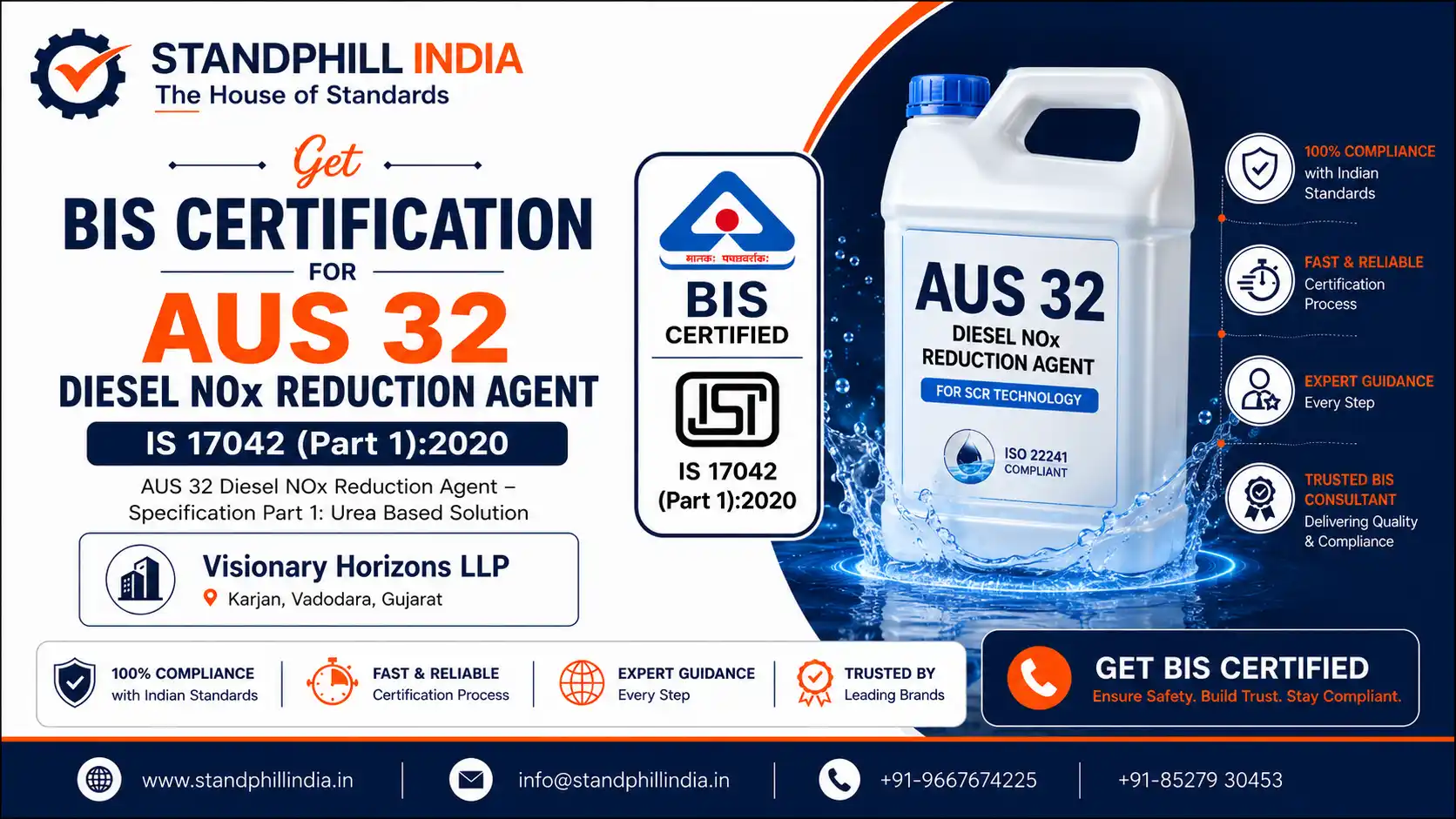
IS 17042 Part 1:2020 is the Bureau of Indian Standards specification for AUS 32 - the aqueous urea solution containing 32.5% high-purity urea used as a NOx reduction agent in diesel engine Selective Catalytic Reduction systems. This standard defines the quality requirements that AUS 32 manufacturers must meet to ensure the product performs correctly in SCR systems without causing catalyst damage, sensor fouling, or system malfunction.
AUS 32 is a chemically sensitive product. Even small contamination by metals, minerals, or incorrect urea concentration can damage the SCR catalyst - which is an expensive component in commercial vehicles and passenger cars. IS 17042 Part 1:2020 sets very precise chemical quality requirements to prevent this.
Key requirements under IS 17042 Part 1:2020 include:
1. ) Urea concentration - AUS 32 must contain 32.5% urea by weight within a defined tolerance of ±0.7%
2. ) Refractive index - used as a rapid verification parameter for urea concentration
3. ) Density - must fall within the defined range corresponding to 32.5% urea concentration
4. ) pH value - the solution must be within the specified alkalinity range
5. ) Biuret content - biuret is a urea decomposition product that damages SCR catalysts and must be below defined limits
6. ) Aldehyde content - must be within specified limits to prevent catalyst poisoning
7. ) Heavy metals - extremely low limits for iron, copper, zinc, chromium, and other metals that could damage the SCR catalyst
8. ) Calcium and magnesium content - must be within specified low limits
9. ) Sodium and potassium content - controlled to prevent SCR system contamination
10. ) Phosphate content - must be below the specified limit
11. ) Marking and labelling requirements for certified AUS 32 product batches
BIS certification under IS 17042 Part 1:2020 is mandatory for AUS 32 manufacturers under the BIS Act, 2016. Vehicle manufacturers, fleet operators, petrol pump dispensing systems, and automotive aftermarket channels all require BIS-certified AUS 32 - and the product is increasingly subject to enforcement at point of sale and during commercial vehicle inspections.