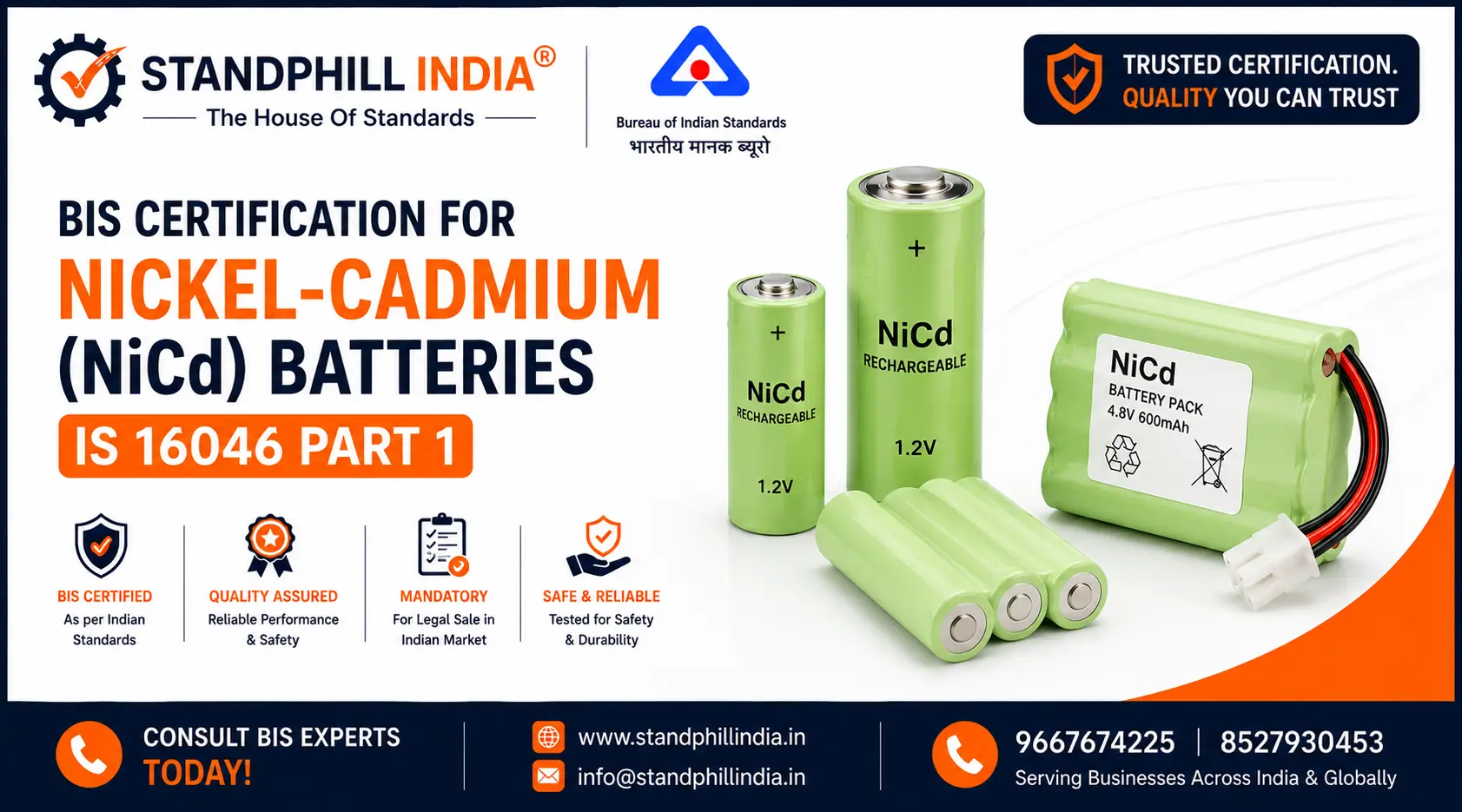
BIS Registration for Nickel-Cadmium (NiCd) Batteries
IS 16046 (Part 1):2018 · CRS Registration - Mandatory (MeitY) · Emergency Lighting · Aviation (IS 13300) · Railway (IS 13315) · 4-6 Weeks
Mandatory CRS Registration for NiCd Batteries - Including Aviation & Railway Specific Standards
Portable sealed secondary Nickel-Cadmium (NiCd) cells and batteries must conform to IS 16046 (Part 1):2018 (primary) plus applicable construction-specific standards (IS 13300 for aircraft, IS 13315 for locomotives, IS 10893/12956/14218 for cell types) and carry the Standard Mark with a valid R-number under the MeitY CRS Order, 2021. For NiMH and the broader nickel systems picture, see our Nickel System Cells and Batteries guide.
About Nickel-Cadmium (NiCd) Batteries - What This Certification Covers
Nickel-Cadmium batteries are the original rechargeable chemistry - tough, reliable, abuse-tolerant, and still the choice of professionals when high-rate discharge and extreme duty cycles matter more than energy density. The sub-C NiCd cells in a commercial emergency lighting pack, the NiCd battery bank keeping an aircraft's avionics live, the NiCd packs in professional-grade cordless tools used on construction sites: these are all nickel-cadmium batteries, and every one of them requires mandatory BIS CRS registration before it can be legally manufactured, imported or sold in India.
This page focuses specifically on NiCd. If your product is NiMH - the AA/AAA rechargeable cell for consumer devices - see our broader guide: BIS Certification for Nickel System Cells and Batteries, which covers both chemistries under IS 16046 (Part 1):2018.
Route check: NiCd batteries use CRS registration (Scheme-II) - R-number. This is completely different from the ISI Mark (Scheme-I) used for dry batteries and lead-acid products. No factory audit is required in the normal CRS course.
How NiCd Differs From NiMH - and Why It Matters
Both NiCd and NiMH fall under IS 16046 (Part 1):2018 - the same standard, the same CRS route. The BIS certification process is identical. But the two chemistries serve very different markets with very different compliance considerations:
| Parameter | NiCd | NiMH |
|---|---|---|
| Primary applications | Emergency lighting, professional power tools, aircraft batteries, railway batteries, industrial equipment | Consumer AA/AAA rechargeables, camera packs, toys, solar lanterns |
| Key advantage | High-rate discharge, extremely long cycle life, works in extreme temperatures, tolerates deep discharge | Higher energy density, cadmium-free, better for moderate-rate consumer use |
| Cadmium content | Yes - restricted substance under RoHS; requires cadmium-content declarations in supply chains | None |
| Additional IS standards | IS 10893:1984 (sealed button type), IS 10918:1984 (vent type), IS 12956:1990 (sealed cylindrical), IS 13300:1992 (aircraft), IS 13315:1992 (locomotives), IS 14218:1994 (sealed cylindrical rechargeable) - applicable by construction | Not applicable |
| BIS standard | IS 16046 (Part 1):2018 + applicable construction-specific IS | IS 16046 (Part 1):2018 |
| Market size India | Smaller, institutional - but high value per unit | Larger, consumer - high volume |
Cadmium compliance: NiCd batteries contain cadmium, a restricted substance under RoHS and similar frameworks. Institutional buyers in India - especially those exporting finished goods - increasingly require cadmium-content declarations alongside the BIS R-number. Your compliance file should include both.
What is IS 16046 (Part 1):2018 - and the Additional NiCd Standards?
IS 16046 (Part 1):2018 is the primary standard for all nickel-system secondary batteries, aligned with IEC 62133-1:2017. For NiCd specifically, one or more of the following construction-specific Indian Standards may also apply based on your cell's physical form:
| Indian Standard | What It Covers | Applicable Product |
|---|---|---|
| IS 16046 (Part 1):2018 | Safety requirements for portable sealed secondary cells and batteries - nickel systems (primary standard) | All NiCd cells and packs for portable applications |
| IS 10893:1984 | Sealed nickel-cadmium button-type rechargeable cells | Button/coin NiCd cells |
| IS 10918:1984 | Vent-type nickel-cadmium storage batteries | Vented (non-sealed) NiCd batteries |
| IS 12956:1990 | Sealed cylindrical nickel-cadmium cells | Cylindrical sealed NiCd cells |
| IS 13300:1992 | Nickel-cadmium aircraft batteries | Aviation NiCd battery packs |
| IS 13315:1992 | Nickel-cadmium batteries for electric locomotives | Rail traction NiCd batteries |
| IS 14218:1994 | Sealed cylindrical rechargeable nickel-cadmium cells | Sealed cylindrical rechargeable NiCd (sub-C, D-size etc.) |
Final applicability of the construction-specific standards is confirmed during the laboratory testing scope assessment. We identify the complete applicable standards for your specific cell construction before any samples are submitted to the lab.
Is BIS Certification Mandatory for NiCd Batteries in India?
Yes - unambiguously mandatory. Under the Electronics and IT Goods (Requirement of Compulsory Registration) Order, 2021 (MeitY), portable sealed secondary NiCd cells and batteries cannot be manufactured, imported, sold or distributed in India without a valid BIS CRS registration and Standard Mark with R-number. The battery entry dates to 7 November 2014 - this is a long-established obligation, not a new one.
Enforcement is active across three channels: customs verification at ports of entry, e-commerce platform compliance checks, and institutional buyer verification before vendor approval. Emergency lighting OEMs, aircraft MRO companies, railway procurement authorities and industrial EPC firms all check the R-number before supplier listing. For NiCd specifically, the institutional buyer base is the dominant market - and every one of those buyers checks.
Why Is BIS Certification Mandatory for NiCd Batteries?
NiCd batteries fail differently from lithium - the primary concerns are electrolyte venting, overheating in sealed spaces, and - uniquely - the cadmium content that makes a leaking NiCd cell a toxic hazard, not just a chemical one. In the applications where NiCd dominates, failure consequences are severe:
- Emergency lighting: a failed NiCd pack means a building without emergency lighting during a fire or power failure. Mandatory certification ensures the pack will deliver its rated capacity after months of float charging in a sealed luminaire.
- Aviation: aircraft NiCd batteries power avionics during ground operations and as emergency backup. A failed aviation battery pack is an airworthiness concern with direct safety implications.
- Railway traction: NiCd banks in railway applications power signalling, communications and safety systems. Certified cells are required by railway procurement standards.
Compulsory certification creates a verified baseline: every NiCd cell sold in India must pass the safety tests under IS 16046 (Part 1):2018 - and for professional applications, must meet the construction requirements of the applicable additional IS standard.
Where Certified NiCd Batteries Serve in India
Emergency Lighting
NiCd packs in exit signs, emergency luminaires and central battery systems for commercial and institutional buildings. The dominant NiCd application in India by volume.
Aviation
Aircraft NiCd battery packs - main and emergency battery banks - under IS 13300:1992. MRO facilities and aircraft operators require certified cells with full traceability.
Railway & Traction
NiCd banks under IS 13315:1992 for signalling, communications and safety systems across railway infrastructure. Indian Railways procurement requires BIS certification.
Professional Power Tools
High-rate discharge NiCd packs for professional cordless drills, saws and tools on construction sites. Smaller volume but high value - OEM supply chain requires the R-number.
Industrial & UPS
NiCd banks in industrial UPS, process control systems and field instruments where cycle life and temperature performance matter more than energy density.
Marine & Defence
NiCd battery packs for marine applications and defence equipment requiring certified, traceable cells with cadmium-content documentation.
What IS 16046 (Part 1) Tests on NiCd Batteries
The test regime reflects the real-world risks of nickel-cadmium chemistry - venting, leakage and overheating under fault conditions:
Thermal Abuse
Heating and temperature cycling - cell must not rupture or vent hazardously at temperatures well above rated range.
Electrical Abuse
External short circuit, overcharge and forced discharge - the most common field failure modes, each tested to safe-behaviour limits.
Mechanical Abuse
Crush, drop, shock and vibration - structural integrity under the transport and installation conditions of industrial and aviation products.
Venting & Leakage
Safe venting behaviour; no hazardous cadmium-containing electrolyte escape under stress. This is the NiCd-specific toxic hazard test - failed cells are a chemical hazard, not just a fire risk.
Case Integrity
Case stress and low-pressure (altitude) checks - critical for aviation and sealed luminaire applications.
Pack Protection
Protective function of assembled battery packs - BMS, fuse and protection circuit behaviour under fault conditions for multi-cell packs.
How to Get BIS CRS Registration for NiCd Batteries - Step by Step
Standard Mapping - IS 16046 Part 1 Plus Construction-Specific IS
Confirm IS 16046 (Part 1):2018 as the primary standard. Based on your NiCd cell's physical construction (button, vent-type, sealed cylindrical, aviation, locomotive), we identify which additional construction-specific standard (IS 10893, IS 10918, IS 12956, IS 13300, IS 13315, IS 14218) also applies and must be included in the lab test scope. Getting this right from the start avoids BIS scrutiny queries that require re-testing at additional cost. This mapping is free and happens before any samples ship.
Appoint Authorized Indian Representative (Foreign Manufacturers)
Foreign NiCd battery factories register through an AIR in India. Standphill India acts as AIR for NiCd manufacturers from China, South Korea, Japan, Taiwan, Germany and beyond - managing all BIS communication, application filing and ongoing compliance.
Laboratory Testing at BIS-Recognised Lab
Cell samples are tested at a BIS-recognised NABL-accredited laboratory against IS 16046 (Part 1):2018 and the applicable construction-specific IS standards. ISO 9001:2015 is mandatory for the application. Typical testing time: 4-6 weeks. We select the right lab for your cell construction, manage sample submission and ensure the report covers all required parameters.
Documentation in Exact BIS Format (In Parallel with Testing)
CCL/CDF forms, company and ISO documents, product specification with NiCd-specific parameters, label artwork and Declaration of Conformity - all prepared in exact BIS format while testing is underway. For aviation and railway applications, additional documentation relating to the construction-specific IS may be required.
BIS Application Filing and R-Number Grant
We file the CRS application on the BIS Manakonline portal with correct categorisation under IS 16046 (Part 1) (and construction-specific IS where applicable), pay government fees, and actively respond to all BIS scrutiny queries the same working day. On approval, the Standard Mark with R-number is granted - typically 4-6 weeks from complete submission.
Aviation and railway NiCd applications: institutional buyers in these sectors require test certificates traceable per batch in addition to the BIS R-number. We set up your batch-wise records to the depth aviation MRO and railway procurement actually demands, not just BIS minimum. Tell us your application and we will plan accordingly.
Benefits of BIS CRS Registration for NiCd Batteries
- Legal market access: manufacture, import and distribute NiCd batteries across India without customs detention or seizure risk. Every consignment clears on the R-number.
- Institutional and tender qualification: emergency lighting OEMs, aircraft MRO facilities, railway procurement and industrial EPC firms verify the R-number before vendor approval. Certification is the entry ticket to this market.
- Aviation and railway compliance: IS 13300 (aircraft) and IS 13315 (locomotives) are the referenced standards in aviation and railway procurement specifications. BIS registration against these standards demonstrates compliance with the applicable IS - not just safety testing.
- Supply chain documentation: institutional buyers increasingly require cadmium-content declarations alongside the BIS R-number for RoHS and downstream export compliance. We help structure both together.
- Brand protection: the R-number is traceable to your factory and product specification. It differentiates your certified product from uncertified alternatives in the institutional supply chain.
Documents Required for BIS CRS Registration - NiCd Batteries
- Company registration certificate (CIN for Indian companies; equivalent for foreign manufacturers)
- GST registration certificate (Indian manufacturers and importers) and Import Export Code (IEC)
- ISO 9001:2015 Quality Management System certificate - mandatory for all battery CRS applications
- Authorised signatory details with board resolution or authorisation letter
- AIR appointment documents - Authorisation Letter (notarised/apostilled) + AIR company registration proof (for foreign manufacturers)
- CCL (Cell Compliance List) - chemistry (NiCd), cell manufacturer, model, nominal capacity (mAh), nominal voltage (1.2V), construction type, dimensions
- CDF (Cell Data Form) - cell manufacturer technical data including capacity and safety characterisation
- Product specification datasheet with NiCd-specific parameters (capacity, voltage, charge current, temperature range, cycle life)
- Battery pack circuit diagram and protection details (for multi-cell packs)
- Product user manual and label artwork showing Standard Mark and R-number placement
- IS 16046 (Part 1):2018 test report from BIS-recognised NABL-accredited laboratory
- Additional test reports covering applicable construction-specific IS (IS 10893/IS 10918/IS 12956/IS 13300/IS 13315/IS 14218) where applicable
- Declaration of Conformity signed by authorised signatory
Certification Snapshot - All Key Details
| Item | Detail |
|---|---|
| Product | Portable sealed secondary NiCd (Nickel-Cadmium) cells and batteries |
| Primary standard | IS 16046 (Part 1):2018 / IEC 62133-1:2017 |
| Additional standards | IS 10893, IS 10918, IS 12956, IS 13300, IS 13315, IS 14218 - applicable by construction type |
| Compliance status | Mandatory |
| BIS route | CRS - Scheme-II of Schedule-II, BIS (Conformity Assessment) Regulations 2018 |
| Mark | Standard Mark with unique R-number |
| Ministry | Ministry of Electronics and Information Technology (MeitY) |
| Governing order | Electronics and IT Goods (Requirement of Compulsory Registration) Order, 2021 (battery entry first notified 7 November 2014) |
| Factory audit | Not required in normal CRS course |
| ISO 9001:2015 | Mandatory for all battery CRS applications |
| Who can apply | Manufacturer only, per factory location; foreign manufacturers via Authorized Indian Representative (AIR) |
| Average timeline | 4-6 weeks from complete submission with clean documentation and lab slots |
| Validity | Typically 2 years; renewable for periods up to 5 years. Cell supplier or construction changes during validity may require fresh testing. |
| Cost | BIS government fees + lab testing fees (IS 16046 P1 + applicable construction IS) + consultancy - complete breakdown within 24 hours of enquiry |
| Cadmium note | Institutional buyers increasingly require cadmium-content declarations alongside BIS R-number for RoHS and export compliance |
Validity, Renewal and BWMR Compliance
CRS registration is typically granted for 2 years and renewable. Cell construction, supplier or capacity changes during validity may require fresh testing. Beyond BIS, NiCd battery producers, importers and brand owners must comply with the Battery Waste Management Rules, 2022 (BWMR) - Extended Producer Responsibility (EPR) registration on the CPCB portal, annual collection/recycling targets and periodic returns. NiCd's cadmium content makes BWMR compliance particularly scrutinised; we handle both tracks together.
Related Guides
Nickel System Cells & Batteries (NiMH + NiCd) - The Full IS 16046 Part 1 Guide BIS Certification for Batteries - Complete Map (Every Battery Type) Lithium-Ion Cells & Batteries (IS 16046 Part 2 - CRS) BIS Consultant for Batteries - Our Services BIS for Foreign Manufacturers (FMCS / AIR)Why Choose Standphill India
With 20+ years and 10,000+ certifications we work across the complete battery compliance map daily. For nickel batteries specifically, we file Part 1 (NiMH/NiCd) and Part 2 (lithium) registrations together around shared documentation where possible, coordinate BIS-recognised lab testing, manage IATA DG compliance for lithium samples, and act as Authorized Indian Representative for foreign factories across China, South Korea, Japan, Taiwan and beyond.
Certify Your NiCd Batteries - Talk to Us Today
Construction-type mapping (IS 16046 + applicable IS 10893/13300/13315/12956/14218), BIS-recognised lab coordination, AIR arrangements for foreign factories, documentation and the final R-number - for Indian and overseas NiCd cell manufacturers.
Free Consultation +91-9667674225Frequently Asked Questions
Ask About Your NiCd Battery CRS Registration
Tell us your battery chemistry, capacity and application - we confirm the route, standard and cost within 24 hours.
★ Why Standphill India?
- 20+ Years of BIS Certification Experience
- 10,000+ Certifications Delivered Globally
- Dedicated Teams for CRS, FMCS & ISI Mark
- End-to-End Documentation & Filing Support
- Fast Response & Practical Compliance Guidance
- Support for Indian & Foreign Manufacturers
Get Free Call Back
Our Services
- BIS (ISI Mark) for Foreign Manufacturers
- Domestic BIS (ISI Mark) Certification
- BIS Certificate of Conformity (CoC)
- BIS Hallmarking
- BIS Licence for Toys
- ECO Mark Certification
- TAC Approval for Automobile
- Drug Licence
- Peso Certification
- BIS (CRS) Registration
- WPC-ETA Approval
- BEE Certification
- E-Waste Management (EPR)
- EPR for Plastic Waste
- EPR for Battery Waste
- CE Certification
- UL Certification
- ROHS Licence
- Standardization Division
- Import / Export Licence
- FSSAI Certification
- ISO Registration
- Trademark Registration
- Make in India Support
- AG-Mark Licence
- Third Party Monitoring
Client Testimonials
Their team was very knowledgeable and helped us every step of the way. Standphill India is the best BIS certification consultants for any type of BIS certification.

Chintan Shah (AGM)
Sudeep Nutrition P.Ltd



Featured Guide
Complete BIS CRS certification guide for electronic products in India — free to read.
Read CRS Certification Guide📞 Contact Standphill India
+91-9667674225 info@standphillindia.in WhatsApp Now Greater Noida West, UPGet Expert BIS Certification Support for Your Business
Connect with Standphill India for complete support with BIS certification, CRS registration, WPC approval, FMCS compliance, and related regulatory services. Our team helps businesses with documentation, testing coordination, application support, and end-to-end compliance guidance.
Request Free Consultation
Share your requirement and our team will contact you shortly.