Table of Contents
Introduction
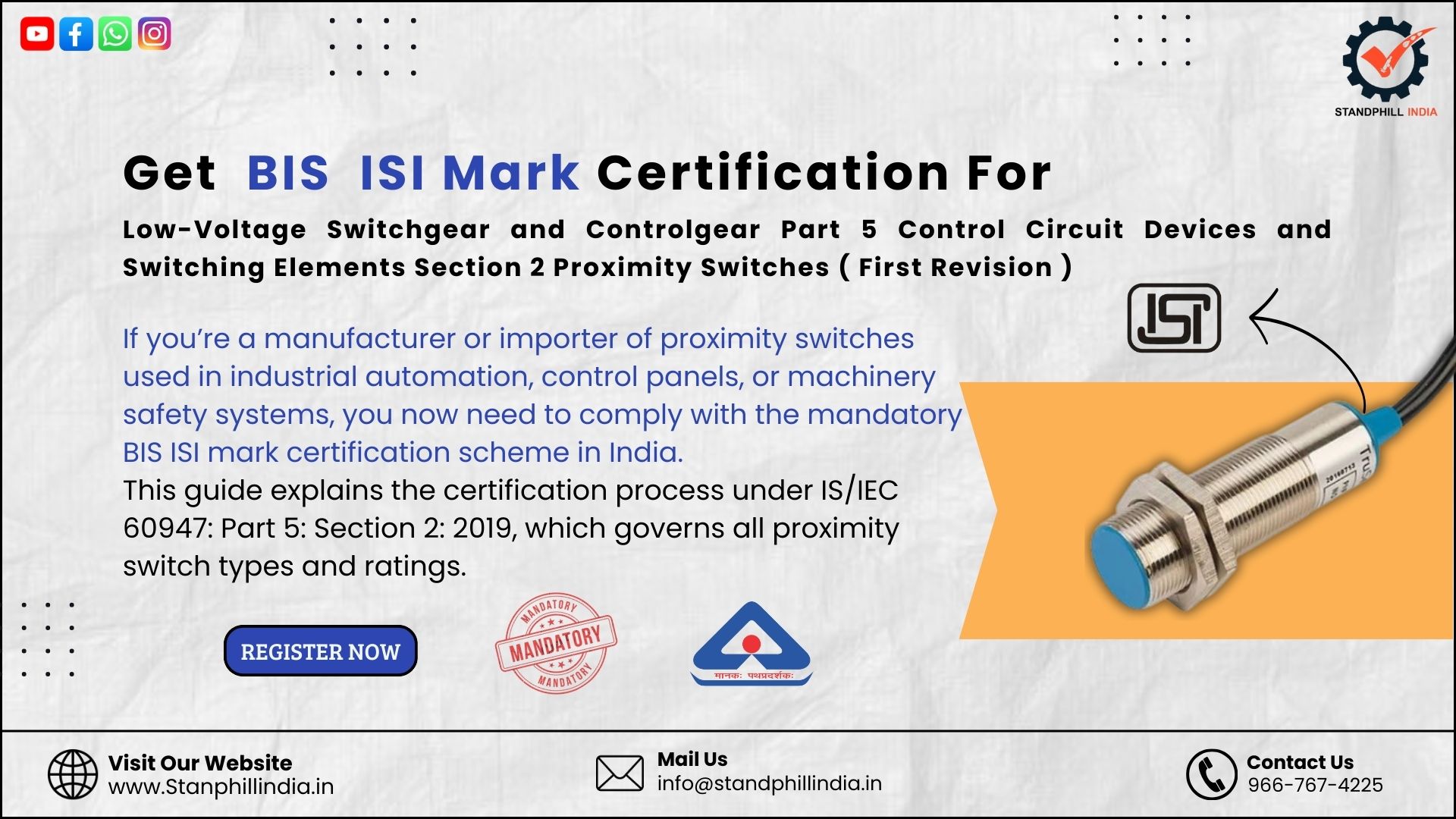
As industries shift toward smarter and more automated control systems, proximity switches have become essential components for non-contact sensing in automation, machinery, and safety systems. These sensors play a critical role in enhancing operational efficiency and reducing mechanical wear.
To regulate their quality and safety, the Bureau of Indian Standards (BIS) has mandated ISI mark certification for proximity switches under the Indian Standard IS/IEC 60947-5-2. This move ensures only compliant, reliable devices are used in industrial and commercial applications.
What Are Proximity Switches?
Proximity switches are contactless sensing devices that detect the presence or absence of an object within a specific range. They are commonly used in automation systems, conveyor belt operations, robotics, assembly lines, and security and safety mechanisms. Types of proximity switches include inductive, capacitive, photoelectric, magnetic, and ultrasonic switches. In India, they are covered under IS/IEC 60947-5-2 and certified under the BIS ISI Mark Scheme (Scheme I). Compliance with this standard is mandatory under the applicable Quality Control Order (QCO) issued by the Ministry of Heavy Industries/Department of Electricals.
Why BIS Certification Is Mandatory
BIS certification is mandatory for proximity switches because these devices operate in sensitive industrial environments where failure can lead to equipment damage or safety hazards. The certification ensures consistent product quality and performance, safe operation under various industrial conditions, conformity with global IEC standards, prevention of inferior or unsafe imports, and legal compliance for sale and use in India. As per the applicable Quality Control Order (QCO), it is illegal to manufacture, sell, distribute, or import non-certified proximity switches in the Indian market from the notified implementation date.
Key Testing Requirements Under IS/IEC 60947-5-2
Under IS/IEC 60947-5-2, proximity switches are tested for sensing distance and accuracy, hysteresis measurement, switching frequency, voltage and current ratings, short-circuit and overload protection, environmental resistance (including humidity, temperature, and vibration), as well as IP protection and mechanical durability. All tests must be carried out in BIS-recognized laboratories.
Documents Required
1. Company/Firm Registration
2. Product Specifications and Circuit Diagrams
3. Manufacturing Process Flowchart
4. List of Manufacturing and Testing Equipment
5. In-house Testing Reports (if available)
6. Label and Packaging Samples
7. Authorized Signatory Identity
8. Quality Control Manual
9. Power of Attorney (for foreign applicants)
Certification for Foreign Manufacturers
International brands must apply through the Foreign Manufacturers Certification Scheme (FMCS) and appoint an Authorized Indian Representative (AIR) to act as their liaison with BIS.
Approximate BIS Certification Fees
| Fee Component | Estimated Cost (INR) |
| Application Fee | 1,000 |
| Product Testing | 25,000 – 1,00,000 |
| Factory Audit | 7,000 – 15,000 |
| Annual License Fee | 1,000 |
| Marking Fee (per unit) | Based on production volume |
How Standphill India Can Help
Standphill India provides complete consultancy and implementation support to manufacturers—domestic and international- for BIS certification of proximity switches.
We Offer:
1. Standard interpretation and scope clarification
2. Document preparation and BIS portal application
3. Lab testing coordination and technical support
4. Factory audit readiness assistance
5. License grant follow-up and renewal support
With our expert guidance, you can achieve BIS certification smoothly, avoid costly delays, and ensure your product is legally marketable in India.
Conclusion
BIS certification under IS/IEC 60947-5-2 is now a critical regulatory requirement for proximity switches in India. It ensures the safety, reliability, and efficiency of components used in automation and control systems.
If you're a manufacturer or importer of proximity switches, it’s essential to act now and initiate the certification process before the QCO enforcement date. Standphill India is here to help you every step of the way.
For More Blogs Click Here.
- BIS Certification for Printers in India – Complete Process
- Get BIS Certification For Block Boards IS 1659:2004
- BIS Certification for Fire Extinguishers in India
- BIS Certification for Solar Water Heating Systems in India
- BIS Certification for Hand Tools - Process, Documents, Fees
- BIS Certification Guide for Hydrogenated Rice Bran Fatty Acids: Process, Documents & Fees
- BIS Certification for HDPE/PP Woven Sacks for Packaging of 50 kg Cement IS 11652
- BIS Certification for HDPE/PP Laminated Woven Sacks for Mail Sorting, Storage, Transportation and Distribution IS 17399
- BIS Certification for PP Woven Laminated Block Bottom Valve Sacks for 50 kg Cement Packaging IS 16709
- BIS Certification for Semiconductor Motor Controller & Soft Starter - IS/IEC 60947-4-2
- BIS Certification for Semiconductor Controllers & Contactors for Non-Motor Loads - IS/IEC 60947-4-3
Need BIS Certification Support?
Our experts can help you with documentation, testing, application filing and complete BIS approval process.