Table of Contents
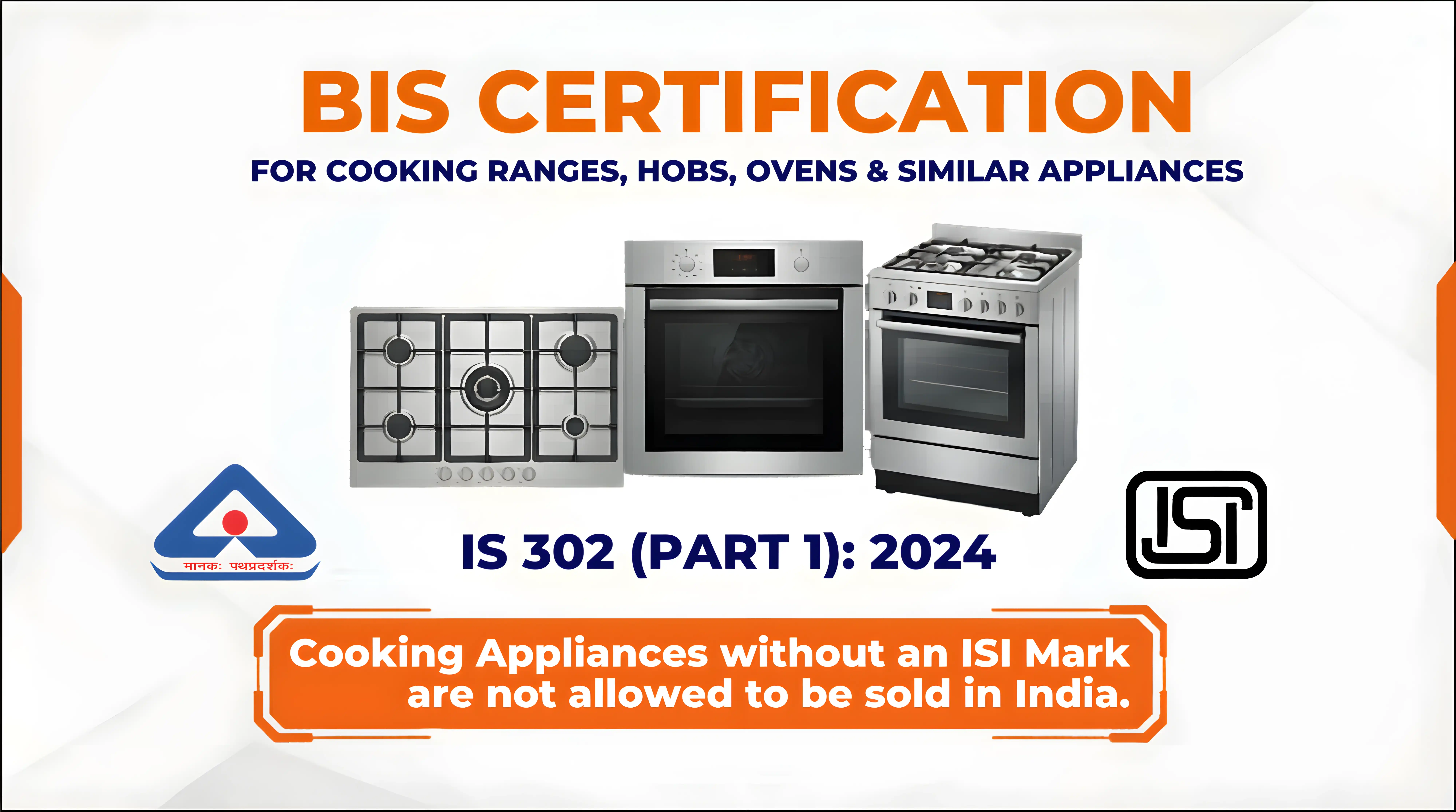
BIS Certification for Cooking Ranges, Hobs, Ovens & Similar Appliances
Is your cooking appliance business legally compliant in India? If you manufacture, import, or sell cooking ranges, gas hobs, ovens, or similar kitchen appliances in India, obtaining BIS certification is not a choice — it is a legal requirement. Failing to comply can result in your products being barred from sale, seized at ports, or subject to penalties. This guide walks you through everything you need to know about BIS certification for cooking ranges, hobs, ovens, and similar appliances — from applicable Indian Standards to the step-by-step process, documents, fees, and expert support.
What Is BIS Certification for Cooking Appliances?
BIS certification is an official product quality and safety certification issued by the Bureau of Indian Standards (BIS) under the BIS Act, 2016. For cooking appliances — including cooking ranges, hobs, ovens, grills, and microwave ovens — BIS certification confirms that the product meets the relevant Indian Standard (IS) for safety, performance, and quality.
Once certified, manufacturers are permitted to affix the ISI Mark on their products. The ISI Mark is India's most recognized and trusted quality symbol. It tells buyers, distributors, retailers, and consumers that the product is safe, reliable, and compliant with Indian regulatory standards.
For cooking appliances specifically, BIS certification falls under Scheme-I (Product Certification Scheme) for Indian manufacturers and under the Foreign Manufacturers Certification Scheme (FMCS) for overseas manufacturers exporting to India.
No ISI Mark on your cooking range, hob, or oven means no legal sale in India. It's that straightforward.
Why Is BIS Certification Mandatory for Cooking Ranges & Hobs?
Legal Obligation Under Quality Control Orders
The Government of India issues Quality Control Orders (QCOs) for product categories that require mandatory compliance with Indian Standards. Cooking appliances — including gas cooking ranges, built-in hobs, and domestic ovens — fall under regulated categories where the ISI Mark is compulsory before the product can be manufactured, sold, stocked, or imported into India.
Any manufacturer or importer found selling cooking appliances without a valid BIS licence is in direct violation of these QCOs and can face serious legal consequences including product recall, seizure of goods, cancellation of import consignments, and financial penalties.
Consumer Safety and Market Trust
Kitchen appliances deal with high heat, gas connections, and electrical components — all of which carry inherent safety risks. BIS certification ensures that every cooking range, hob, or oven sold in India has passed rigorous testing for:
• Thermal safety — preventing overheating and fire hazards
- Gas-tightness — ensuring no leakages in gas-operated appliances
- Electrical insulation — for electric ovens and induction appliances
- Structural stability — preventing tipping, collapse, or mechanical failure
- Material safety — ensuring no harmful materials are used in construction
The ISI Mark gives end consumers confidence that the kitchen appliance they are buying is safe for daily home use.
Which Cooking Appliances Require BIS Certification?
BIS certification is applicable to a wide range of cooking and kitchen heating appliances. The following product types commonly require ISI Mark certification:
• Gas Cooking Ranges — freestanding, built-in, table-top
- Built-in Hobs — gas hobs, electric hobs, induction hobs
- Domestic Gas Ovens
- Electric Ovens and Grills
- Microwave Ovens
- Combined Cooking Appliances — oven + hob combinations
- Rotisserie Ovens and Toaster Ovens
- Commercial-to-Domestic Hybrid Cooking Ranges
Key Takeaway: If your product generates heat for cooking purposes and is intended for domestic use or sale in India, there is a high probability it falls under BIS mandatory certification.
Applicable Indian Standards (IS) for Cooking Appliances
The Bureau of Indian Standards has specified distinct Indian Standards (IS codes) for different types of cooking appliances. Manufacturers must identify the correct IS standard before beginning the certification process.
IS 4246 — Domestic Gas Cooking Ranges
IS 4246 is the primary Indian Standard for domestic gas cooking ranges including freestanding gas stoves, table-top ranges, and built-under models powered by LPG or piped natural gas. This standard covers construction, performance, gas consumption, thermal efficiency, and safety requirements.
IS 15777 — Built-In Hobs
IS 15777 applies to built-in hobs for domestic use, including gas hobs, electric hobs, and combination hobs. It specifies requirements related to heat output, surface temperatures, ignition systems, and safety cut-offs.
IS 302-2-6 — Electric Ovens, Grills & Similar Appliances
IS 302 Part 2 Section 6 covers the safety requirements for domestic electric cooking ranges, hobs, ovens, and grills. This standard aligns with IEC 60335-2-6 and addresses electrical safety, temperature limits, protection against electric shock, and mechanical hazards.
Other Relevant Standards
• IS 302-2-25 — Microwave Ovens
- IS 302-2-9 — Toasters and similar small cooking appliances
- IS 302-2-13 — Deep fat fryers, frying pans, and related appliances
It is important to identify the exact IS standard applicable to your specific product before filing the BIS application. Standphill India helps manufacturers determine the correct standard based on product type and specifications.
BIS Certification Process for Cooking Appliance Manufacturers
The BIS certification process for cooking ranges, hobs, and ovens follows a structured, multi-stage approach. Here is a complete breakdown:
Step 1 – Application Submission
The manufacturer submits the BIS application online through the BIS portal along with:
• Complete product and technical details
- Factory location and production capacity information
- Required documents (see next section)
- Application fee payment
Step 2 – Product Sample Testing
BIS nominates a BIS-recognized laboratory to test product samples. Cooking appliance samples are tested against all requirements of the applicable IS standard. This covers:
• Thermal performance tests
- Gas flow and combustion tests (for gas appliances)
- Electrical safety tests (for electric appliances)
- Structural and mechanical tests
- Material compliance checks
Samples may be submitted by the manufacturer or collected by BIS from the market or factory.
Step 3 – Factory Inspection
A BIS officer visits the manufacturing facility to verify:
• Manufacturing machinery and production setup
- In-house testing equipment and calibration records
- Quality control documentation and process controls
- Storage and raw material handling practices
- Compliance with the Scheme of Inspection and Testing (SIT) defined by BIS
Step 4 – Evaluation and Licence Grant
BIS reviews all test reports and inspection findings. If the product and manufacturing facility meet all requirements under the applicable IS standard, BIS grants the ISI Mark Licence and the manufacturer is authorized to use the ISI Mark on certified cooking appliances.
Also Read
BIS FMCS Certification for Foreign Manufacturers
BIS ISI Mark Certification – Complete Guide for Manufacturers
Documents Required for BIS Certification
Preparing the right documentation is one of the most critical steps in the BIS certification process. Commonly required documents for cooking appliance certification include:
• Factory registration certificate — GST registration, factory licence
- Manufacturing licence or trade licence
- Product technical file — drawings, specifications, BOM
- Manufacturing process flow chart
- Factory layout plan
- List of production machinery with specifications
- List of testing equipment available in-house
- Calibration certificates for all testing instruments
- Quality control procedures and records
- Product test reports from BIS-recognized laboratories
- Raw material test certificates
- Declaration of Conformity (if applicable)
Incomplete or incorrectly prepared documentation is one of the most common reasons for BIS application delays. Standphill India provides end-to-end documentation support to ensure all submissions are accurate and complete from day one.
BIS Certification Fees for Cooking Appliances
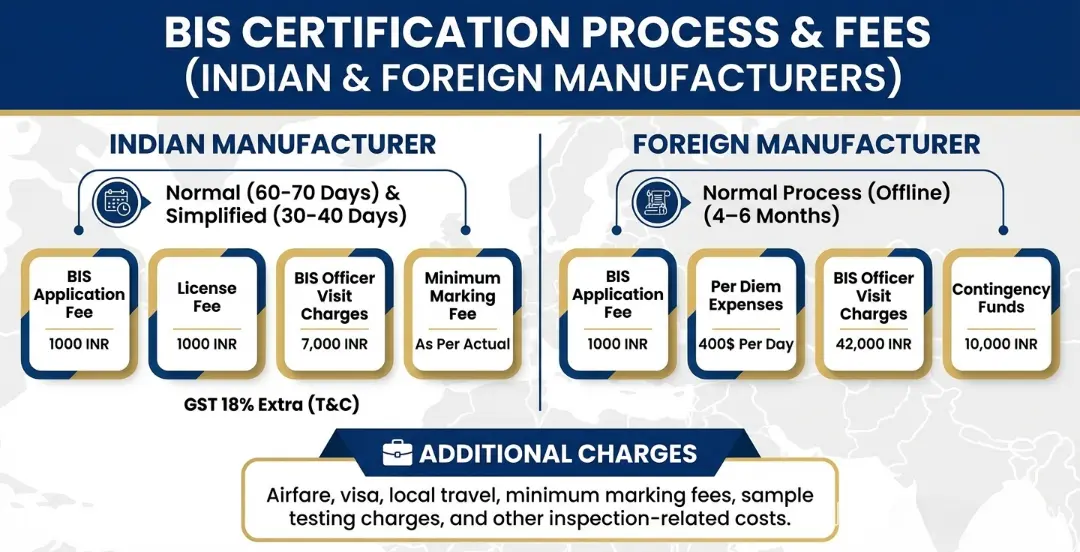
The standard fee structure for BIS Scheme-I certification is as follows:
• Application Fee: 1,000/-
- Preliminary Inspection Charges: 7,000/-
- Annual Licence Fee: 1,000/-
- Minimum Marking Fee: As per scale (discounts for MSMEs)
- Product Sample Testing Fee: As per laboratory rates
MSME Concessions:
• Micro Scale Enterprises: 80% discount on marking fee
- Small Scale Enterprises: 50% discount
- Medium Scale Enterprises: 20% discount
The total cost of certification varies depending on the product category, the IS standard, number of product models, and testing complexity.
How Long Does BIS Certification Take?
The typical timeline for BIS ISI Mark certification for cooking appliances is 30 to 60 working days from the date of complete application submission. This timeline may vary based on:
• Product testing duration at the BIS-recognized laboratory
- BIS officer availability for factory inspection scheduling
- Completeness and accuracy of documentation submitted
- Response time to any BIS clarification queries
Manufacturers with well-prepared documentation and compliant manufacturing practices tend to complete certification faster. Standphill India's structured approach helps reduce unnecessary delays at each stage.
Common Challenges in BIS Certification for Cooking Appliances
Manufacturers often encounter specific hurdles during BIS certification for cooking appliances. Being aware of these in advance can save significant time and cost:
1. Selecting the wrong IS standard — Applying under an incorrect standard leads to rejection and restarts the process.
2. Incomplete documentation — Missing documents like calibration certificates or updated layout plans cause application hold-ups.
3. Test failures at BIS labs — Products not designed to Indian Standard specifications fail testing. Redesign and retesting add to timelines.
4. Factory inspection non-conformances — Unpreparedness during the BIS factory audit results in non-conformances that must be rectified before licence grant.
5. Communication gaps with BIS — Delayed responses to BIS queries can significantly extend certification timelines.
Working with an experienced BIS certification consultant helps manufacturers anticipate and resolve these challenges proactively.
Real-Life Scenario: The Cost of Non-Compliance
Consider the case of Meera, a kitchen appliance importer based in Mumbai. She had been successfully selling premium built-in hobs and ovens from a European brand. Without fully understanding Indian regulatory requirements, she had not obtained BIS certification for her products.
During a routine market surveillance operation, Legal Metrology officials visited her warehouse and discovered that her products did not carry the mandatory ISI Mark. Her entire stock — valued at over ?25 lakhs — was seized immediately. She faced penalties, legal notices, and a complete halt to her business operations for nearly four months.
After engaging Standphill India, Meera's supplier obtained BIS FMCS certification, and she was able to resume compliant operations. This experience underscores that international certifications like CE or ISO do not substitute for BIS certification in India.
How Standphill India Helps You Get BIS Certification
Standphill India is one of India's most trusted BIS certification consultancies with 20+ years of experience and a track record of 10,000+ successful certifications across Indian and international clients.
For manufacturers of cooking ranges, hobs, ovens, and similar appliances, Standphill India provides complete end-to-end certification support:
• Correct IS Standard Identification — We determine the exact applicable Indian Standard for your product.
- Documentation Preparation — We prepare and review all required documents to BIS standards.
- Product Testing Coordination — We coordinate with BIS-recognized laboratories for fast and accurate sample testing.
- Factory Inspection Preparation — We prepare your team and facility for the BIS factory audit.
- Application Filing — We handle online application submission on your behalf.
- Follow-Up and Liaison — We track your application and respond promptly to any BIS queries.
- Post-Certification Support — We assist with licence renewals and ongoing BIS compliance.
Standphill India has supported manufacturers across Delhi, Greater Noida, Mumbai, Pune, Hyderabad, Bengaluru, Chennai, and all other major industrial zones in India.
Contact Standphill India — Get Your Free BIS Certification Consultation Today
Call: +91-9667674225
Email: info@standphillindia.in
Office: A-1024, 10th Floor, T-3, NX One, Greater Noida West, UP
Conclusion
BIS certification for cooking ranges, hobs, ovens, and similar appliances is a legal necessity for every manufacturer and importer operating in the Indian market. It ensures product safety, regulatory compliance, consumer trust, and uninterrupted market access. Understanding the applicable IS standards, preparing accurate documentation, and navigating the factory inspection process correctly are all critical to getting your ISI Mark without unnecessary delays.
Ready to get your cooking appliance BIS certified? Partner with Standphill India — India's trusted BIS certification consultants with 20+ years of experience and 10,000+ successful certifications. Contact us today for a free consultation and let us simplify your BIS certification journey.
Get in touch with Standphill India — your expert BIS certification partner.
Other Certification Services Offered by Standphill India
1. BIS ISI Mark Certification – Scheme I (Indian Manufacturers)
The ISI Mark certification under Scheme I is the primary BIS product certification for Indian manufacturers. It confirms that the product complies with the applicable Indian Standard and allows the manufacturer to use the ISI Mark. Standphill India provides end-to-end support for ISI Mark certification across all regulated product categories.
Read More: BIS Certification for Indian Manufacturers
2. BIS FMCS Certification – Foreign Manufacturers Certification Scheme
The FMCS scheme allows foreign manufacturers to obtain the ISI Mark licence for products they export to India. BIS conducts factory inspections overseas, and product samples are tested against Indian Standards. Standphill India provides complete FMCS support including AIR appointment, documentation, inspection preparation, and application management.
Read More: BIS FMCS Certification for Foreign Manufacturers
3. BIS CRS Registration – Compulsory Registration Scheme
The CRS scheme is the mandatory BIS registration system for notified electronic and IT products in India. It requires product testing in a BIS recognized laboratory, application submission, and BIS registration approval before the product can be sold in India. Standphill India handles complete CRS registration for electronic and IT product manufacturers.
Read More: BIS CRS Registration for Electronic Products
Need BIS Certification Support?
Our experts can help you with documentation, testing, application filing and complete BIS approval process.