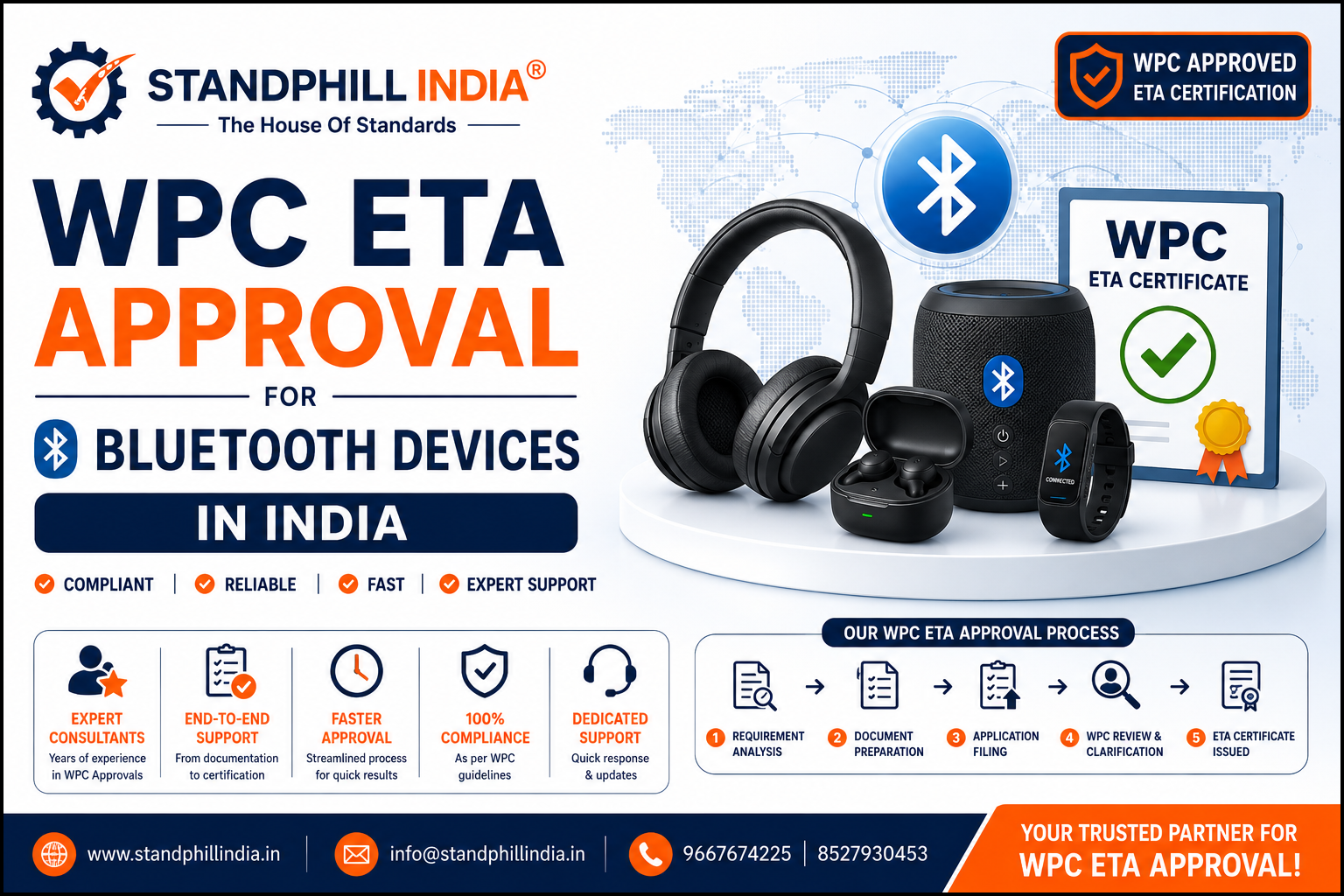
WPC ETA Approval for Bluetooth Devices - Process, Fees
Mandatory WPC Equipment Type Approval for Every Bluetooth Product - Earbuds, Speakers, Headsets, Wearables & Modules
Every Bluetooth device sold in India - earbuds, speakers, headsets, keyboards, fitness bands - needs WPC ETA approval because Bluetooth operates in the de-licensed 2.4 GHz band regulated by the WPC Wing. The government fee is Rs 10,000 per model, it is filed on the Saral Sanchar portal, and the certificate has lifetime validity. Standphill India handles the entire WPC ETA process end-to-end. Call +91-9667674225.
If you manufacture or import Bluetooth products for the Indian market, there is one approval you cannot work around - the WPC ETA certificate. Bluetooth, by its very nature, transmits over radio frequency in the 2.4 GHz band, and in India every device that uses that spectrum falls squarely under the authority of the Wireless Planning and Coordination Wing. It does not matter whether you are selling a premium pair of true-wireless earbuds, a portable speaker, a gaming headset, or a simple Bluetooth keyboard; if it has a Bluetooth radio inside, it needs a WPC ETA before it can legally reach an Indian customer.
We mention this upfront because Bluetooth is one of those categories where businesses are most often caught out. The products are small, they are frequently imported in bulk from manufacturers in China and Southeast Asia, and many sellers assume that an FCC or CE mark from the country of origin is enough. It is not. Those approvals mean nothing to Indian customs - the only thing that clears your Bluetooth shipment, keeps your e-commerce listings live, and keeps your business on the right side of the law is a valid WPC ETA in your name.
The good news is that Bluetooth devices usually qualify for the faster self-declaration route, so with the right preparation the approval is quite straightforward. The trick is getting the RF test report and the application exactly right the first time - and that is precisely the part we take care of for you.
Importing Bluetooth Earbuds or Speakers? Get WPC ETA First
Customs will hold any Bluetooth shipment that lacks WPC ETA. Talk to us before your goods are dispatched and we will have your approval ready.
Why Bluetooth Devices Need WPC ETA
The reason comes down to how Bluetooth actually works. Bluetooth is a short-range wireless technology that operates in the 2.4 GHz ISM band - the same de-licensed band used by Wi-Fi, many IoT devices, and a host of other wireless products. Because this band is shared by so many devices, the government regulates who can transmit in it and at what power levels, precisely to stop everything from interfering with everything else. WPC ETA is the mechanism through which the WPC Wing confirms that your particular Bluetooth product stays within India's permitted frequency and power limits.
This applies to a much wider range of products than people realise. It is not just standalone Bluetooth gadgets - any finished product that has Bluetooth built in needs its own ETA, even if the underlying Bluetooth module was certified separately by the chipset maker. The reason is that the finished device behaves differently once the module is inside a real enclosure, with a real antenna and real operating conditions, so the WPC Wing assesses the complete product as it is actually sold. So whether your catalogue includes wireless earbuds, neckbands, party speakers, soundbars, smart-home audio, or Bluetooth-enabled appliances, each distinct model needs its own approval.
The consequence of skipping it is not theoretical. Bluetooth products without WPC ETA are routinely detained at Indian ports, and the major e-commerce marketplaces have become strict about asking sellers for valid certificates - a missing certificate can mean your listing is pulled overnight, taking your reviews and ranking with it. For a fast-moving consumer category like Bluetooth audio, that kind of interruption is genuinely costly.
WPC ETA Process for Bluetooth Devices
For Bluetooth products the process is entirely online and, because most Bluetooth devices qualify for the self-declaration route, it is usually one of the quicker WPC ETA categories. Here is how we run it for you, end to end.
Assessment
Identify all RF modules
RF Testing
NABL / ILAC report
AIR (Foreign)
If overseas maker
File
Saral Sanchar + fee
Scrutiny
Handle queries
Certificate
ETA granted
For most Bluetooth devices the self-declaration route means approval is often granted within a few days to about two weeks once a complete RF test report is in hand. No factory inspection is required. The two things that most often slow Bluetooth applications down are an RF report that does not cover the exact operating profile of the device, and a model number that does not match across the report, the label and the form - both of which we check before filing.
Documents Required
The documentation for a Bluetooth WPC ETA is fairly compact, but every piece needs to be accurate and internally consistent. Here is what is required:
- RF Test Report for the 2.4 GHz Bluetooth radio - from a NABL-accredited Indian lab or an ILAC-accredited foreign lab
- Technical specifications - Bluetooth version, frequency, output power (in dBm), antenna details
- Block diagram showing the Bluetooth/RF section
- User manual and clear product photographs
- Company documents - GST, Certificate of Incorporation / PAN
- Authorization letter / NOC from the manufacturer
- Import Export Code (IEC) for importers
- Self-declaration for the model
Output power must be entered as the exact measured value (e.g. 8.5 dBm), not a rounded or nominal figure - mismatches here are a common cause of WPC queries. We make sure the report and the application agree precisely.
Bluetooth Devices WPC ETA - Fees & Validity
The cost of a Bluetooth WPC ETA has three parts: the fixed government fee of Rs 10,000 per model, the RF testing charges (which depend on the lab and the device), and our professional fee for handling everything. The single most reassuring part for most clients is the validity - once granted, your Bluetooth ETA lasts for the lifetime of that model with no renewal, so it is genuinely a one-time exercise unless you revise the product.
| Issuing Authority | WPC Wing, Department of Telecommunications (DoT) |
| Approval | Equipment Type Approval (ETA), per product model |
| Portal | Saral Sanchar (saralsanchar.gov.in); fee via BharatKosh |
| Government Fee | Rs 10,000 per model |
| Validity | Lifetime (no renewal unless the product changes) |
| Factory Inspection | Not required |
| Foreign Applicants | Must appoint an Authorized Indian Representative (AIR) |
Get Your Bluetooth Devices WPC-Certified the Easy Way
From a single earbud model to a full audio range, we will assess your products, arrange the RF testing, file on Saral Sanchar, and hand you valid WPC ETA certificates - acting as your AIR if you are an overseas brand.
Why Choose Standphill India
Bluetooth audio is one of the categories we handle most often, which means we know exactly how these applications behave and where they tend to snag. We coordinate the right RF testing for the 2.4 GHz profile, prepare a clean and consistent application, file it correctly on Saral Sanchar, and deal with any WPC query on your behalf - and for foreign earbud and speaker brands, we act as your Authorized Indian Representative so you can sell into India without setting up an Indian company. One team, one point of contact, from first question to certificate in hand.
Related WPC ETA Guides
WPC ETA Certification - Complete Process, Fees & Validity Guide WPC ETA Certification Consultant - Talk to an Expert WPC ETA Approval for Wireless Earbuds WPC ETA Approval for SmartwatchesFrequently Asked Questions
Ask About Bluetooth Devices WPC ETA
Tell us your product – we reply with your WPC ETA requirement & a quote within one business day.
★ Why Standphill India?
- 20+ Years of BIS Certification Experience
- 10,000+ Certifications Delivered Globally
- Dedicated Teams for CRS, FMCS & ISI Mark
- End-to-End Documentation & Filing Support
- Fast Response & Practical Compliance Guidance
- Support for Indian & Foreign Manufacturers
Get Free Call Back
Our Services
- BIS (ISI Mark) for Foreign Manufacturers
- Domestic BIS (ISI Mark) Certification
- BIS Certificate of Conformity (CoC)
- BIS Hallmarking
- BIS Licence for Toys
- ECO Mark Certification
- TAC Approval for Automobile
- Drug Licence
- Peso Certification
- BIS (CRS) Registration
- WPC-ETA Approval
- BEE Certification
- E-Waste Management (EPR)
- EPR for Plastic Waste
- EPR for Battery Waste
- CE Certification
- UL Certification
- ROHS Licence
- Standardization Division
- Import / Export Licence
- FSSAI Certification
- ISO Registration
- Trademark Registration
- Make in India Support
- AG-Mark Licence
- Third Party Monitoring
Client Testimonials
Their team was very knowledgeable and helped us every step of the way. Standphill India is the best BIS certification consultants for any type of BIS certification.

Chintan Shah (AGM)
Sudeep Nutrition P.Ltd



Featured Guide
Complete BIS CRS certification guide for electronic products in India — free to read.
Read CRS Certification Guide📞 Contact Standphill India
+91-9667674225 info@standphillindia.in WhatsApp Now Greater Noida West, UPGet Expert BIS Certification Support for Your Business
Connect with Standphill India for complete support with BIS certification, CRS registration, WPC approval, FMCS compliance, and related regulatory services. Our team helps businesses with documentation, testing coordination, application support, and end-to-end compliance guidance.
Request Free Consultation
Share your requirement and our team will contact you shortly.