WPC ETA Approval for IoT Devices - Process, Fees, Consultant
Mandatory WPC Equipment Type Approval for Smart Plugs, Locks, Sensors, Hubs & Connected Devices
Every IoT and smart-home device sold in India needs WPC ETA approval because connected devices use Wi-Fi, Bluetooth, Zigbee or similar radios regulated by the WPC Wing. The fee is Rs 10,000 per model, filed on Saral Sanchar, with lifetime validity. Mains-powered devices may also need BIS CRS. Standphill India handles the entire WPC ETA process end-to-end. Call +91-9667674225.
The whole promise of the Internet of Things is connectivity - smart plugs, locks, bulbs, cameras, sensors and hubs that talk to each other and to your phone. But connectivity means radio, and radio means regulation. In India, every IoT device that transmits wirelessly needs a WPC ETA certificate before it can be imported, manufactured or sold, no matter how small or simple the gadget appears. If your business is building or importing a smart-home range, this is the approval that sits between your products and the Indian market.
IoT is one of the broadest and most varied categories we deal with, and that variety is exactly what makes a careful upfront assessment so valuable. The wireless technology differs enormously from product to product - a smart plug might use Wi-Fi, a door sensor might use Zigbee, a smart lock might combine Bluetooth and Wi-Fi, and a hub might bridge several protocols at once. Each of those radios needs to be identified, tested and declared. On top of the radio question, many IoT devices are mains-powered, which can bring BIS CRS for electrical safety into the picture as well. We work out the full compliance map for your specific products before anything else.
Because IoT ranges often contain many SKUs, there is also real efficiency to be gained by handling the whole catalogue in a coordinated way rather than one product at a time - and that is something we are set up to do.
Building a Smart-Home Range for India? Get the Compliance Map First
IoT devices vary widely in what they need. Tell us your product list and we will map WPC ETA - and any BIS CRS - across the whole range.
Why IoT Devices Need WPC ETA
Every connected device earns its name through a radio. Whether it is Wi-Fi, Bluetooth, Zigbee, Z-Wave, or a low-power protocol like LoRa, an IoT product is by definition transmitting and receiving on the airwaves - and in India those airwaves are managed by the WPC Wing. WPC ETA is the approval that confirms your particular device operates only within the permitted de-licensed bands and power levels, so that the growing swarm of connected devices in Indian homes and businesses does not interfere with each other or with licensed networks.
What makes IoT distinctive is the sheer diversity of wireless technology across the category, and the fact that a single device can use more than one protocol. A smart-home hub, for instance, might speak Wi-Fi to your router, Zigbee to your sensors and Bluetooth to your phone all at once - and an ETA for such a device has to cover every one of those radios. This is why a blanket assumption never works for IoT; each product has to be assessed on its own terms to identify exactly which radios it contains and what each one requires. Getting that right is the difference between a certificate that genuinely covers the product and one that leaves a gap.
There is also the safety angle, which is easy to overlook. A great many IoT devices plug into the mains - smart plugs, smart switches, hubs, cameras - and that brings them within the scope of BIS CRS for electrical safety, entirely separately from their WPC ETA for radio. Where both apply, both are needed, and handling them together across a product range is far more efficient than tackling them piecemeal.
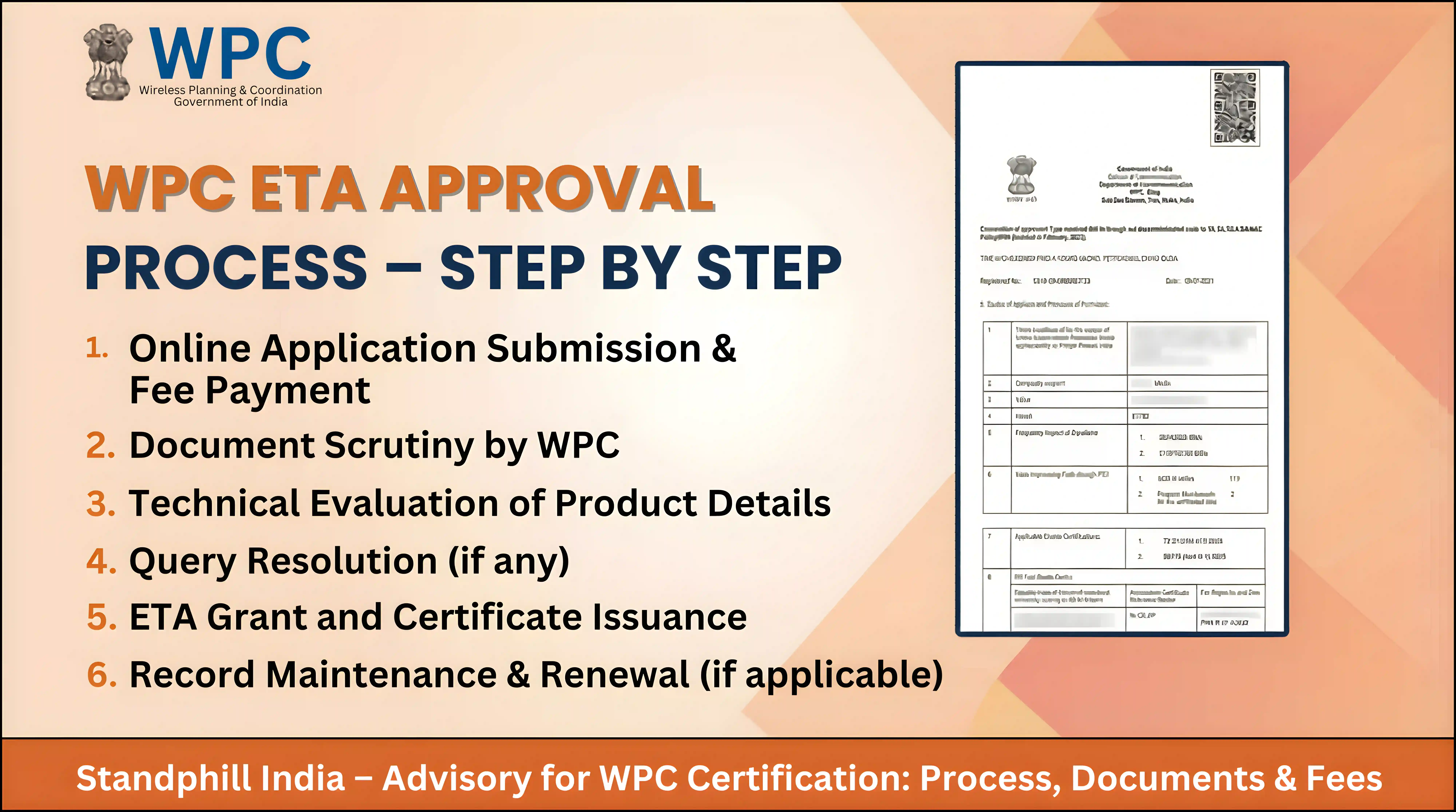
WPC ETA Process for IoT Devices
The WPC ETA process for IoT devices follows the standard online route, with the assessment stage doing the heavy lifting because of the protocol diversity. Here is how we run it for you.
Assessment
Identify all RF modules
RF Testing
NABL / ILAC report
AIR (Foreign)
If overseas maker
File
Saral Sanchar + fee
Scrutiny
Handle queries
Certificate
ETA granted
Many IoT devices qualify for the faster self-declaration route once a complete RF report is ready. No factory inspection is required for WPC ETA. The usual delay with IoT comes from a device using a protocol that was not tested - which is why we map every radio in every product before testing starts.
Documents Required
IoT documentation depends on the protocols each device uses, but the standard package is:
- RF Test Report covering every wireless protocol the device uses (Wi-Fi, Bluetooth, Zigbee, etc.) - NABL or ILAC accredited
- Technical specifications - all wireless technologies, frequency bands, output power
- Block diagram showing the radio sections
- User manual and product photographs
- Company documents - GST, Certificate of Incorporation / PAN
- Authorization letter / NOC from the manufacturer
- Import Export Code (IEC) for importers
- Self-declaration for the model
Identify every protocol the device uses. A smart hub with Wi-Fi + Zigbee + Bluetooth needs all three in the RF report. We map the full wireless profile of each product so nothing is left uncovered.
IoT Devices WPC ETA - Fees & Validity
The government fee is Rs 10,000 per model, so for a multi-SKU IoT range the per-model fee adds up - which is one reason it pays to plan the whole catalogue together. RF testing charges depend on the protocols involved, and where a device also needs BIS CRS that is a separate, clearly-stated cost. The validity, as always, is lifetime per model, so each approval is a one-time exercise.
| Issuing Authority | WPC Wing, Department of Telecommunications (DoT) |
| Approval | Equipment Type Approval (ETA), per product model |
| Portal | Saral Sanchar (saralsanchar.gov.in); fee via BharatKosh |
| Government Fee | Rs 10,000 per model |
| Validity | Lifetime (no renewal unless the product changes) |
| Factory Inspection | Not required |
| Foreign Applicants | Must appoint an Authorized Indian Representative (AIR) |
Get Your IoT Range WPC-Certified - Efficiently, Across Every SKU
We map WPC ETA and BIS CRS across your entire smart-home catalogue, arrange the right testing for each protocol, file everything on Saral Sanchar, and deliver your certificates - with AIR services for overseas IoT brands.
Why Choose Standphill India
IoT rewards a consultant who can see the whole board - the varied protocols, the multi-radio devices, and the BIS CRS overlap for mains-powered products. We map the complete compliance picture across your range, coordinate testing for every protocol, file cleanly on Saral Sanchar, and handle WPC queries for you, all while acting as AIR for foreign brands. For a category with many SKUs and mixed requirements, having one team own the entire job is what keeps it efficient and error-free.
Related WPC ETA Guides
WPC ETA Certification - Complete Process, Fees & Validity Guide WPC ETA Certification Consultant - Talk to an Expert WPC ETA Approval for Wi-Fi Routers WPC ETA Approval for RFID DevicesFrequently Asked Questions
Ask About IoT Devices WPC ETA
Tell us your product – we reply with your WPC ETA requirement & a quote within one business day.
★ Why Standphill India?
- 20+ Years of BIS Certification Experience
- 10,000+ Certifications Delivered Globally
- Dedicated Teams for CRS, FMCS & ISI Mark
- End-to-End Documentation & Filing Support
- Fast Response & Practical Compliance Guidance
- Support for Indian & Foreign Manufacturers
Get Free Call Back
Our Services
- BIS (ISI Mark) for Foreign Manufacturers
- Domestic BIS (ISI Mark) Certification
- BIS Certificate of Conformity (CoC)
- BIS Hallmarking
- BIS Licence for Toys
- ECO Mark Certification
- TAC Approval for Automobile
- Drug Licence
- Peso Certification
- BIS (CRS) Registration
- WPC-ETA Approval
- BEE Certification
- E-Waste Management (EPR)
- EPR for Plastic Waste
- EPR for Battery Waste
- CE Certification
- UL Certification
- ROHS Licence
- Standardization Division
- Import / Export Licence
- FSSAI Certification
- ISO Registration
- Trademark Registration
- Make in India Support
- AG-Mark Licence
- Third Party Monitoring
Client Testimonials
Their team was very knowledgeable and helped us every step of the way. Standphill India is the best BIS certification consultants for any type of BIS certification.

Chintan Shah (AGM)
Sudeep Nutrition P.Ltd



Featured Guide
Complete BIS CRS certification guide for electronic products in India — free to read.
Read CRS Certification Guide📞 Contact Standphill India
+91-9667674225 info@standphillindia.in WhatsApp Now Greater Noida West, UPGet Expert BIS Certification Support for Your Business
Connect with Standphill India for complete support with BIS certification, CRS registration, WPC approval, FMCS compliance, and related regulatory services. Our team helps businesses with documentation, testing coordination, application support, and end-to-end compliance guidance.
Request Free Consultation
Share your requirement and our team will contact you shortly.