Table of Contents
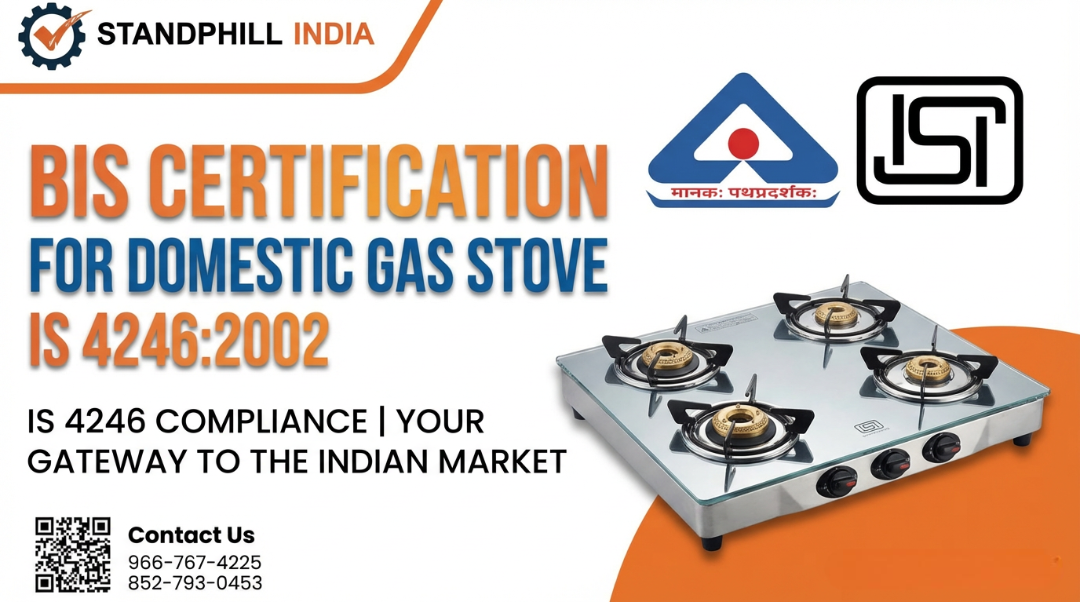
BIS Certification for Gas Stove IS 4246:2002 | ISI Mark Consultant - Standphill India
Domestic gas stoves are essential household appliances used daily by millions of Indian families, directly connected to LPG usage and cooking requirements. Due to the inherent risks associated with gas leakage, fire hazards, and potential explosions, ensuring the safety and performance of gas stoves is critical for consumer protection. To address these safety concerns and maintain uniform product quality, the Bureau of Indian Standards (BIS) has made BIS Certification mandatory for all domestic gas stoves under IS 4246:2002.
The standard IS 4246:2002 – Domestic Gas Stoves for Use with LPG – Specification establishes strict requirements for design, construction, materials, safety, and performance. Only gas stoves that comply with this standard are permitted to be manufactured, imported, sold, or distributed in India with the ISI Mark. For manufacturers, importers, and brands in the kitchen appliance sector, obtaining BIS certification is not just a regulatory requirement—it's a fundamental necessity for market access and consumer trust.
What is BIS Certification for Gas Stoves Under IS 4246:2002?
BIS Certification for Gas Stoves is a compulsory conformity assessment process through which BIS verifies that a domestic LPG gas stove meets all safety, quality, and performance requirements specified in IS 4246:2002. Upon successful certification, manufacturers receive authorization to affix the ISI Mark on their products, indicating that the appliance has been tested, validated, and deemed safe for household use.
This mandatory certification ensures:
• Safe operation and prevention of gas leakage incidents
• Protection against fire hazards and potential explosions
• Consistent product quality across manufacturers and batches
• Legal compliance under the Bureau of Indian Standards Act, 2016
• Consumer confidence through government-recognized quality assurance
Critical Requirement: Without valid BIS Certification, gas stoves cannot be legally manufactured, imported, sold, or distributed in the Indian market—whether through offline retail channels or e-commerce platforms.
Why Is BIS Certification Mandatory for Domestic Gas Stoves?
Gas stoves involve the controlled combustion of highly flammable LPG, where even minor manufacturing defects or material deficiencies can lead to catastrophic accidents. To mitigate these risks and protect consumers, the Government of India has mandated BIS Certification to ensure that only safe, standardized, and reliable gas stoves reach households across the country.
Primary Objectives of Mandatory Certification:
• Protect consumers from unsafe and substandard products
• Eliminate hazardous gas stoves from the market
• Enforce uniform safety and performance standards across the industry
• Hold manufacturers accountable for product quality and safety
• Build consumer confidence through standardized quality benchmarks
Legal Implications: Manufacturing, importing, or selling uncertified gas stoves constitutes a punishable offense under the BIS Act, 2016, attracting severe penalties including fines, product seizure, and legal prosecution.
Scope and Coverage of IS 4246:2002 Standard
The IS 4246:2002 standard applies comprehensively to all domestic gas stoves designed to operate with Liquefied Petroleum Gas (LPG), regardless of:
• Number of burners (single, double, triple, or more)
• Design configuration, size, or form factor
• Material composition or construction methodology
• Brand, price segment, or target market
Key Specifications Covered:
| Specification Category | Specific Requirements |
|---|---|
| Design & Construction | Structural integrity, stability, component assembly |
| Burner Performance | Thermal efficiency, flame stability, heat distribution |
| Material Quality | Burners, valves, knobs, pipes, body materials |
| Safety Features | Leak prevention, overheating protection, flame failure devices |
| Performance Testing | Endurance, durability, and reliability under continuous use |
| Marking & Labeling | ISI Mark placement, manufacturer details, safety instructions |
Who Needs BIS Certification for Gas Stoves?
The mandatory certification requirement applies to all entities involved in the gas stove supply chain for the Indian market:
| Entity Category | Specific Requirements |
|---|---|
| Indian Manufacturers | Must obtain ISI Mark license from BIS for domestic production |
| Foreign Manufacturers (FMCS) | Must apply under Foreign Manufacturers Certification Scheme for exports to India |
| Importers & Distributors | Must ensure imported products have valid BIS certification before customs clearance |
| Brand Owners / OEMs | Responsible for ensuring outsourced manufacturing complies with BIS requirements |
| E-commerce Sellers | Platforms like Amazon, Flipkart mandate BIS certification for product listings |
| Retailers & Dealers | Must verify BIS certification before stocking or selling gas stoves |
Key Requirements for BIS Certification Under IS 4246:2002
To obtain and maintain BIS Certification, manufacturers must demonstrate comprehensive compliance across multiple parameters:
1. Product Design & Construction Compliance
Gas stoves must adhere to all design specifications, construction standards, and safety features mandated by IS 4246:2002, including proper burner alignment, secure valve fittings, and adequate structural stability.
2. Approved Raw Materials & Components
All components—including burners, valves, control knobs, connecting pipes, and body materials—must meet BIS-specified quality standards and material composition requirements.
3. Mandatory Laboratory Testing
Comprehensive testing in BIS-recognized laboratories is required for:
• Flame Stability Test: Ensures consistent flame under varying pressure conditions
• Gas Leakage Test: Verifies zero leakage at connections and valves
• Thermal Efficiency Test: Measures heat transfer efficiency to cooking vessels
• Safety & Endurance Test: Evaluates performance under continuous operation
• Material Durability Test: Assesses component resistance to heat and corrosion
4. Quality Control System Implementation
Manufacturers must establish and maintain an internal quality control system with documented procedures, regular testing protocols, calibrated equipment, and trained quality personnel.
5. Factory Inspection & Audit
BIS officials conduct on-site factory inspections to verify manufacturing capabilities, quality control processes, testing facilities, and overall compliance with certification requirements.
6. Proper ISI Marking & Labeling
Upon certification approval, each gas stove must prominently display the ISI Mark along with manufacturer details, model information, and other required markings as specified by BIS.
Documentation Requirements for BIS Certification
The certification process requires comprehensive documentation, including:
• BIS-recognized laboratory test reports for the product model
• Factory license or trade license for manufacturing operations
• Detailed product specifications, technical drawings, and bill of materials
• Quality control manual with testing procedures and frequency
• Factory layout diagram and list of manufacturing machinery
• Raw material details and supplier quality certificates
• Calibration certificates for testing equipment
• Organizational chart with quality personnel responsibilities
Step-by-Step BIS Certification Process for Gas Stoves
| Step | Process Description | Typical Timeline |
|---|---|---|
| 1. Application Submission | Filing BIS application with complete documentation and fees | 1-2 Weeks |
| 2. Sample Testing | Comprehensive testing in BIS-approved laboratory | 3-4 Weeks |
| 3. Test Report Review | BIS evaluation of laboratory results and compliance | 1-2 Weeks |
| 4. Factory Inspection | On-site audit by BIS officials of manufacturing facility | 2-3 Weeks |
| 5. Compliance Verification | Final scrutiny of all documents and inspection reports | 1-2 Weeks |
| 6. Grant of ISI License | Issuance of BIS Certification with authorization for ISI Mark | 1 Week |
| Total Estimated Duration | Complete Certification Process | 8-12 Weeks |
Cost Components for BIS Certification
The total investment in BIS certification includes multiple components:
• BIS Application Fees: Government charges for processing the application
• Laboratory Testing Charges: Costs for comprehensive product testing
• Factory Inspection Expenses: Fees for BIS audit team visits
• Annual License & Marking Fees: Recurring charges for certification maintenance
• Consultancy & Documentation: Professional support for efficient compliance
Standphill India Advantage: Our expertise helps optimize certification costs by preventing application rejections, minimizing retesting requirements, and streamlining the entire process.
Penalties for Non-Compliance with BIS Requirements
Manufacturing, importing, or selling gas stoves without valid BIS certification attracts severe consequences under the BIS Act, 2016:
• Heavy Financial Penalties: Significant fines for each violation
• Product Seizure & Confiscation: Removal of non-compliant stock from market
• License Suspension/Cancellation: Revocation of manufacturing or import privileges
• Sales Ban: Prohibition from selling through any channel
• Legal Prosecution: Potential imprisonment for serious violations
• Brand Reputation Damage: Loss of consumer trust and market credibility
Why Choose Standphill India for Gas Stove BIS Certification?
Standphill India has established itself as one of India's most trusted BIS certification consultants, with specialized expertise in kitchen appliance compliance and IS 4246:2002 requirements.
Our Comprehensive Services Include:
• End-to-end BIS certification support from application to license grant
• Expert guidance on IS 4246:2002 compliance and testing requirements
• Fast-track application processing and coordination with BIS authorities
• Laboratory testing coordination with BIS-recognized facilities
• Factory readiness assessment and preparation for BIS audits
• Documentation preparation and management for error-free submission
• Transparent pricing with no hidden costs or surprises
• High approval success rate through meticulous compliance attention
• Post-certification support for renewals, surveillance, and compliance maintenance
"A leading kitchen appliance manufacturer reduced their certification timeline by 40% through Standphill India's streamlined processes, enabling faster market entry and competitive advantage."
Conclusion: Ensure Safety and Market Access Through Timely Certification
BIS Certification for Gas Stoves under IS 4246:2002 represents more than regulatory compliance—it embodies a commitment to consumer safety, product quality, and industry standards. As India continues to prioritize household safety and appliance standardization, timely certification becomes increasingly critical for market access and business continuity.
With growing consumer awareness about product safety and increasing regulatory enforcement across retail and e-commerce channels, certified products gain significant competitive advantage while uncertified products face increasing market barriers and legal risks.
Don't let certification complexities delay your market entry or expose your business to compliance risks. Partner with Standphill India to navigate the BIS certification process efficiently, ensuring your gas stoves meet all regulatory requirements while accelerating your access to India's vast and growing kitchen appliance market.
[ Begin Your Gas Stove BIS Certification Journey – Contact Standphill India Today ]
Need BIS Certification Support?
Our experts can help you with documentation, testing, application filing and complete BIS approval process.