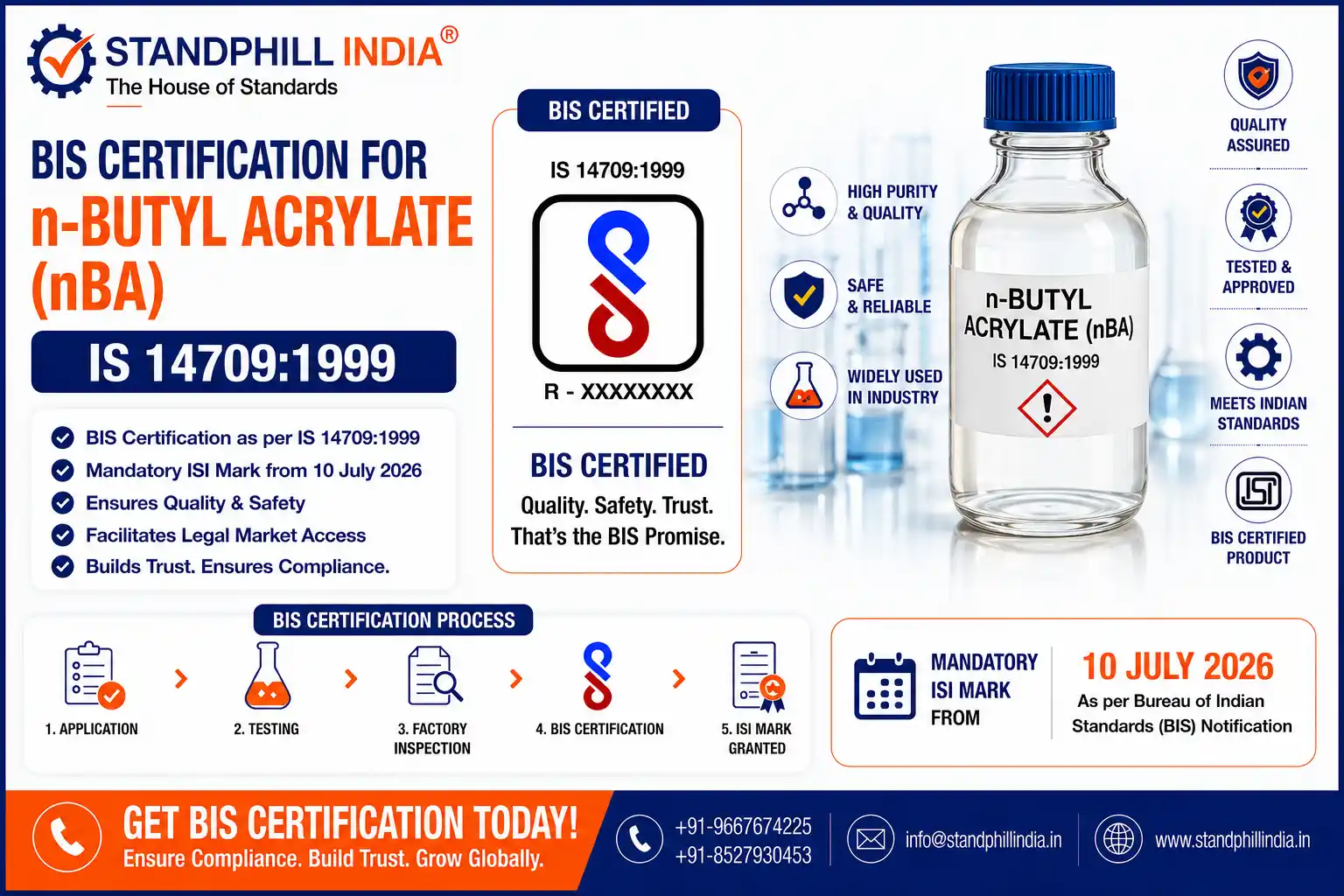
BIS Certification for n-Butyl Acrylate (nBA) - IS 14709:1999
Mandatory ISI Mark from 10 July 2026 - Quality Control Order by Department of Chemicals & Petrochemicals | MSME Manufacturers Get Up to 80% Off on Marking Fees
This is the final confirmed deadline after a long series of extensions since 2020. No further postponement is expected.
BIS ISI Mark Certification for n-Butyl Acrylate (nBA) is mandatory in India under the Methyl Acrylate, Ethyl Acrylate and n-Butyl Acrylate (Quality Control) Order, 2020, issued by the Department of Chemicals and Petrochemicals, Ministry of Chemicals and Fertilizers. The applicable Indian Standard is IS 14709:1999 - n-Butyl Acrylate Specification. Every manufacturer or importer of n-Butyl Acrylate supplying to the Indian market must hold a valid BIS licence (CM/L Number) before 10 July 2026. n-Butyl Acrylate is almost entirely imported into India - which means the FMCS (Foreign Manufacturers Certification Scheme) route is critical for overseas suppliers. If you have not started the BIS process yet, start immediately.
What is n-Butyl Acrylate - and Why India's Paint, Adhesive & Polymer Industries Depend on It
n-Butyl Acrylate (CAS No. 141-32-2, chemical formula C₇H₁₂O₂, molecular weight 128.17 g/mol) is a reactive acrylic ester monomer produced by the esterification of acrylic acid with n-butanol. It is a colourless, mobile liquid with a characteristic pungent ester odour, a boiling point of approximately 145–148 °C, and a flash point of around 39–40 °C. n-Butyl Acrylate is one of the most strategically important acrylic monomers used in Indian manufacturing - not as a finished product, but as a critical reactive building block in polymer and co-polymer systems that underpin several major industries.
n-Butanol
(Esterification)
(nBA Monomer)
Polymerisation
(with Inhibitor)
Paints, Textiles,
Construction
Required on
All nBA Supply
India is a major and rapidly growing consumer of n-Butyl Acrylate, driven by expanding construction, packaging, and textile finishing industries. Because domestic production capacity is very limited, the vast majority of India's n-Butyl Acrylate requirement is met through imports - primarily from manufacturers in South Korea, Taiwan, Japan, China, and the Middle East. Key end-use applications include:
- BOPP tape adhesives and pressure-sensitive adhesives (PSA) - the single largest application. nBA-based acrylic PSAs are used in packaging tapes, medical adhesives, graphic tapes, and protective films throughout India's massive e-commerce and FMCG supply chain.
- Emulsion polymers for paints and coatings - nBA is co-polymerised with other acrylates and styrene to produce acrylic latex binders used in exterior wall paints, industrial coatings, wood primers, and floor coatings. Every major Indian paint manufacturer depends on nBA supply.
- Textile binders and auxiliaries - nBA-based emulsions are used in pigment printing, nonwoven fabric bonding, and fibre sizing. India's textile industry is one of the world's largest consumers of synthetic binders.
- Leather finishing binders - soft, flexible acrylic coatings for leather surface finishing in India's footwear and leather goods sector use nBA as a core polymer building block.
- Construction chemicals - acrylic sealants, waterproofing membranes, tile adhesives, and concrete admixtures made with nBA copolymers are in high demand as India's infrastructure sector expands.
- Paper coatings - nBA-based binders improve the surface strength, printability, and ink receptivity of paper and paperboard used in packaging and publishing.
- Acrylic rubber and elastomers - specialty nBA-based rubbers are used in automotive seals, O-rings, and industrial gaskets requiring heat and oil resistance.
Why Inhibitor Control is the Critical Safety and Quality Factor for nBA: n-Butyl Acrylate is a reactive monomer - it can undergo spontaneous exothermic polymerisation if inhibitors are depleted, leading to runaway reactions, vessel rupture, and fire. IS 14709:1999 specifies strict limits on the inhibitor level (MEHQ - Monomethyl Ether of Hydroquinone) in each shipment. Too little inhibitor risks spontaneous polymerisation in storage tanks. Too much inhibitor interferes with the downstream polymerisation process, causing product quality failures in the final adhesive or coating. BIS certification under IS 14709:1999 ensures every batch of nBA arriving in India has verified, in-specification inhibitor levels - protecting both industrial safety and product quality.
QCO Timeline - Six Years of Extensions and the Final 10 July 2026 Deadline
The n-Butyl Acrylate QCO has one of the longest extension histories of any chemical QCO in India - spanning from its original 2020 notification through multiple postponements. Understanding this timeline explains why the 10 July 2026 deadline is final and why the government and BIS will not grant another extension:
Six Years of Extensions - Why There Will Not Be a Seventh
The government has extended the n-Butyl Acrylate QCO more times than almost any other chemical QCO in India. Each extension has been driven by the genuine challenge of certifying primarily overseas manufacturers through FMCS. However, BIS is now actively processing FMCS applications for nBA, licences are being granted, and the supply chain has had six years of notice. The 10 July 2026 deadline represents the absolute end of the government's patience. Foreign manufacturers who have not yet applied should file their FMCS application immediately - the FMCS process alone takes 14–20 weeks from application to licence grant.
IS 14709:1999 - What the Standard Specifies and What the Lab Tests for Each Batch
IS 14709:1999 is the Indian Standard titled "n-Butyl Acrylate - Specification", published by the Bureau of Indian Standards under Division PCD 9 (Petroleum, Coal and Related Products - Organic Chemicals). It is the primary quality standard for n-Butyl Acrylate intended for industrial use in India, specifying the exact purity, impurity limits, inhibitor levels, and analytical test methods that every compliant batch must pass. Here is a complete reference overview:
| Standard Detail | Information |
|---|---|
| Standard Number | IS 14709:1999 |
| Full Title | n-Butyl Acrylate - Specification |
| BIS Division & Section | PCD 9 - Organic Chemicals, Alcohols and Allied Products and Dye Intermediates |
| CAS Number | 141-32-2 |
| Chemical Formula | C₇H₁₂O₂ (Mol. Wt. 128.17) |
| Appearance | Clear, colourless liquid with a characteristic pungent ester odour |
| Production Method | Esterification of acrylic acid with n-butanol (or acrylonitrile route) |
| QCO | Methyl Acrylate, Ethyl Acrylate and n-Butyl Acrylate (Quality Control) Order, 2020 - Department of Chemicals & Petrochemicals, Ministry of Chemicals and Fertilizers |
| Certification Scheme | ISI Mark Scheme I (domestic) / FMCS (foreign manufacturers) |
| Packing Requirement | Appropriate containers as agreed between purchaser and supplier; each container labelled as per IS 14709:1999 marking requirements including ISI Mark and CM/L Number |
| Hazard Note | Flammable (Flash Point ~39°C), reactive monomer - inhibitor level is a safety-critical parameter |
5 Key Quality Parameters Tested Under IS 14709:1999
The laboratory testing under IS 14709:1999 is precision analytical chemistry performed at a BIS-recognized NABL-accredited laboratory. Five mandatory parameters must be tested per the standard, and each has direct relevance to safety in storage and performance in downstream polymer applications:
Assay (Purity)
Primary purity test - measures the actual n-Butyl Acrylate content of the sample by gas chromatography (GC). High assay ensures consistent polymer molecular weight, glass transition temperature, and performance in adhesive, paint, and textile applications. Low assay indicates off-spec product with excess by-products, affecting downstream yields.
Minimum 99.0% (typical commercial: 99.5%+)Acidity (as Acrylic Acid)
Measures residual acrylic acid and other acidic impurities in nBA. Excess acidity causes corrosion of storage and transport equipment (tanks, valves, pumps), accelerated inhibitor depletion, and uncontrolled polymerisation side reactions. Critical for safe storage and for achieving correct polymer performance.
Maximum 0.01% w/w (as acrylic acid)Colour (Pt-Co Scale)
Visual quality indicator measured on the Platinum-Cobalt (APHA) colour scale per IS 8768. n-Butyl Acrylate should be water-white to very pale. Elevated colour (above 10 APHA) indicates degradation, contamination, or improper inhibitor management, which leads to colour problems in the finished polymer product.
Maximum 10 APHA (Pt-Co scale)Water Content (% by Mass)
Water in nBA is measured by Karl Fischer titration (IS 2362 / IS 1448 Part 182). Moisture causes hydrolysis of the ester bond, generating acrylic acid and n-butanol - directly degrading product quality, increasing acidity, and reducing shelf life. Water also inhibits emulsion polymerisation processes in downstream manufacturing.
Maximum 0.05% w/w (Karl Fischer)Inhibitors (as MEHQ)
The most safety-critical parameter. MEHQ (Monomethyl Ether of Hydroquinone) is the stabiliser added to prevent spontaneous polymerisation during storage and transport. The IS 14709:1999 standard specifies an acceptable MEHQ range - too low risks runaway polymerisation; too high impairs downstream polymer initiation efficiency and product properties.
Specified MEHQ range per IS 14709 AnnexWhy Inhibitor (MEHQ) Testing Is the Most Critical Parameter Under IS 14709:1999: n-Butyl Acrylate undergoes spontaneous, highly exothermic polymerisation if heated or if inhibitor levels drop below specification - even in ordinary storage conditions. Multiple industrial incidents worldwide have involved nBA tanks rupturing due to runaway polymerisation caused by sub-specification inhibitor levels in received product. BIS certification under IS 14709:1999 enforces verified inhibitor levels per batch - making the ISI Mark a genuine safety assurance mechanism, not merely a quality label. Indian downstream users - adhesive manufacturers, paint producers, and textile chemical plants - are legally and operationally protected when they source BIS-certified nBA.
MSME Discount on BIS Marking Fees - Up to 80% Off for Eligible Manufacturers
If your n-Butyl Acrylate manufacturing unit is registered as a Micro, Small, or Medium Enterprise under Udyam Registration, you are eligible for substantial concessions on BIS ISI Mark marking fees - the per-unit fee paid to BIS based on your annual production or sales volume. While most nBA certification involves large overseas manufacturers seeking FMCS licences, any domestic Indian manufacturer with MSME status benefits significantly from these concessions.
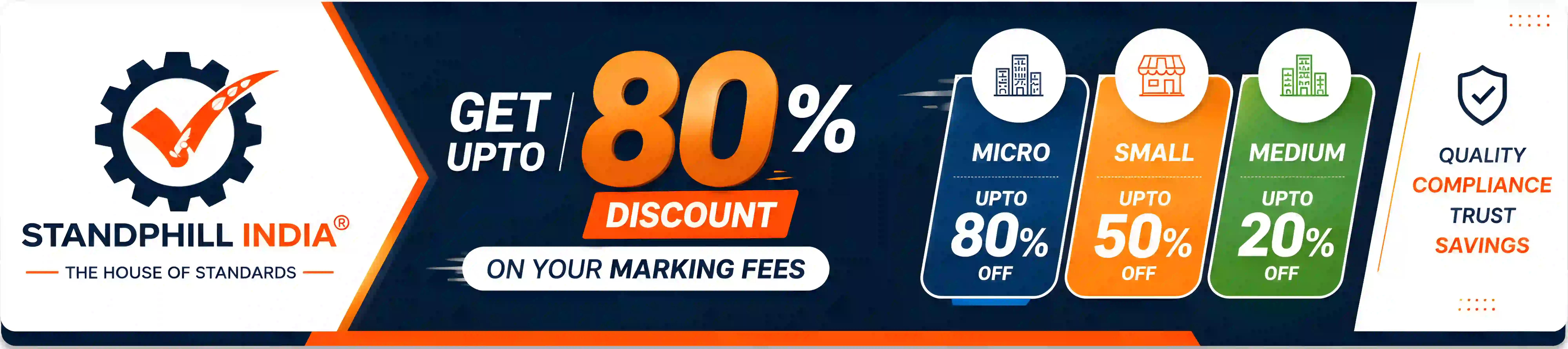
How to Claim Your MSME Discount: Your valid Udyam Registration Certificate must be submitted with your BIS application. The classification at the time of application (Micro / Small / Medium) determines the discount tier. Standphill India verifies your MSME eligibility, applies the correct marking fee slab in your BIS application, and ensures you never overpay. We also track MSME status at annual renewal to maintain discount entitlement.
BIS Certification for n-Butyl Acrylate - Quick Reference
| Detail | Information |
|---|---|
| Product | n-Butyl Acrylate (nBA) - CAS 141-32-2, C₇H₁₂O₂ |
| Indian Standard | IS 14709:1999 - n-Butyl Acrylate Specification |
| QCO | Methyl Acrylate, Ethyl Acrylate and n-Butyl Acrylate (Quality Control) Order, 2020 |
| Issuing Ministry | Department of Chemicals & Petrochemicals, Ministry of Chemicals and Fertilizers |
| Mandatory From | 10 July 2026 (current confirmed enforcement date per BIS official list) |
| QCO History | Originally notified 2020; extended multiple times (Dec 2022 → Jun 2023 → Dec 2023 → 2024 → 2025 → 10 Jul 2026) |
| Key Test Parameters | Assay, Acidity (as acrylic acid), Colour (Pt-Co), Water content (% m/m), Inhibitors (as MEHQ) |
| Certification Scheme | ISI Mark Scheme I (domestic) / FMCS (foreign manufacturers) |
| Factory Inspection | Yes - mandatory BIS factory inspection before licence is granted |
| Licence Validity | 1 year - annual renewal required |
| Applicant | Only the manufacturer. Foreign manufacturers must appoint an Authorized Indian Representative (AIR). |
| MSME Benefit | Micro: 80% off | Small: 50% off | Medium: 20% off on marking fees |
| BIS Licence No. Format | CM/L-XXXXXXX (ISI Mark licence number - must appear on all container labels) |
| Import Relevance | Very high - India imports nearly all its nBA requirement. FMCS certification is critical for Korean, Taiwanese, Japanese, and Chinese manufacturers. |
4 Rules Every n-Butyl Acrylate Manufacturer & Importer Must Know
Manufacturer Only - Not Traders
BIS grants the ISI Mark licence only to the actual nBA producer. Indian importers, distributors, and traders cannot apply - the overseas manufacturer must apply via FMCS.
FMCS Is the Primary Route
Since India imports most of its nBA, the Foreign Manufacturers Certification Scheme applies. Overseas manufacturers need an Authorized Indian Representative (AIR) to apply.
Factory Inspection Is Mandatory
A BIS officer visits the production plant - domestically or internationally - to verify production systems, QC lab, inhibitor handling, and safety records before granting the licence.
Annual Renewal Required
ISI Mark licence for nBA is valid for 1 year. Renewal must be filed before expiry. Selling nBA under an expired BIS licence is a BIS Act violation with penalties and potential seizure.
BIS ISI Mark Certification Process for n-Butyl Acrylate - Step by Step
| Step | What Happens |
|---|---|
| STEP 1 | Appoint Authorized Indian Representative - AIR (foreign manufacturers only) - The AIR manages all BIS communication, document submission, fee payments, and factory inspection coordination on behalf of the overseas nBA manufacturer. The AIR must be an Indian-registered company. Standphill India provides this service. |
| STEP 2 | nBA sample testing at BIS-recognized NABL laboratory - Representative samples are drawn per IS 14709:1999 sampling method and tested for all 5 parameters: Assay (GC), Acidity (titration), Colour (Pt-Co), Water content (Karl Fischer), and Inhibitors (MEHQ, GC or colorimetric). Testing typically takes 2–3 weeks at a qualified chemical analysis laboratory. |
| STEP 3 | Complete document preparation - BIS application form, factory/plant registration, process flow diagram (esterification process + inhibitor addition system), QC manual, in-house lab instrument list, NABL test report, ISI marking label artwork, Udyam certificate (if MSME), and AIR appointment letter (FMCS only). |
| STEP 4 | Online application on BIS ManakOnline portal - Complete application with NABL test report and all supporting documents submitted online. Government application fee paid at this stage. Foreign manufacturers submit under the FMCS module. |
| STEP 5 | BIS factory inspection - BIS officer visits the nBA production plant to verify esterification reactor capacity, inhibitor addition and monitoring systems, in-house QC lab (GC, Karl Fischer titrator, colorimeter, acidity titration setup), production records, batch documentation, and safety protocols for handling this reactive monomer. |
| STEP 6 | BIS technical scrutiny and query response - BIS reviews the full application, NABL test report, and inspection findings. Any technical queries from BIS must be answered within the specified window. Standphill India handles all BIS correspondence and query responses professionally. |
| STEP 7 | ISI Mark Licence (CM/L Number) Granted - Print ISI Mark, CM/L number, IS 14709:1999 reference, and manufacturer details on every nBA container or IBC label. Renew annually. BIS surveillance visits conducted per licence conditions. |
Total timeline: 10–14 weeks (domestic plants) · 14–20 weeks (overseas factories with international inspection travel).
Documents Required for BIS ISI Mark - n-Butyl Acrylate IS 14709:1999
- BIS application form (ManakOnline)
- NABL lab test report - IS 14709:1999 (all 5 parameters)
- Factory / plant registration certificate
- Factory address proof
- Manufacturing process flow diagram
- In-house QC lab instrument list (GC, KF titrator, colorimeter)
- Trademark certificate / authorization letter
- ISI marking label artwork / container label design
- KYC of authorized signatory (Aadhaar/Passport)
- Inhibitor handling & safety procedure document
- ISO 9001 / ISO 14001 / REACH (if available)
- Udyam Registration Certificate (for MSME discount)
- AIR appointment letter + Indian company registration (FMCS only)
- Import/export history of nBA (for FMCS applications)
Complete document checklist, format guidance, and preparation support provided by Standphill India on engagement.
BIS Certification Cost for n-Butyl Acrylate - Quick Reference Guide
Cost Components - IS 14709:1999 ISI Mark Certification (nBA)
All government fees subject to BIS revision. Contact Standphill India for a plant-specific, written cost estimate - free of charge - before committing.
10 July 2026 Is Weeks Away - Don't Let Your nBA Supply Chain Stop
The FMCS process for overseas nBA manufacturers takes 14–20 weeks.
Every week you delay increases the risk of your nBA shipments being
rejected at Indian ports - and your adhesive, paint, and textile manufacturing
customers losing their certified raw material source.
Start your IS 14709:1999 BIS application with Standphill India today.
Also Read
BIS FMCS Certification for Foreign Manufacturers - Complete Guide Authorized Indian Representative (AIR) for BIS Certification BIS Certification for Linear Alkyl Benzene (LAB) - IS 12795:2020 BIS Certification for Morpholine - IS 12084:2018 BIS Licence Renewal - How to Apply Before Expiry Quality Control Orders (QCOs) - Complete List & StatusWhy n-Butyl Acrylate Manufacturers & Importers Choose Standphill India for IS 14709:1999 BIS Certification
- Acrylic monomer expertise - we have handled BIS ISI Mark certifications across reactive monomers, petrochemicals, and specialty chemicals. We understand the specific testing protocols, inhibitor handling documentation, and BIS scrutiny patterns unique to IS 14709:1999 - including the safety requirements that BIS inspectors specifically focus on for reactive monomers like nBA.
- FMCS specialisation for overseas nBA manufacturers - since India imports virtually all its nBA, the vast majority of IS 14709:1999 certifications involve foreign manufacturers. Standphill India provides full Authorized Indian Representative (AIR) services for Korean, Taiwanese, Japanese, Chinese, and Middle Eastern nBA producers. We manage the entire FMCS process end-to-end.
- Right NABL lab, right analytical methods - we direct your nBA samples to BIS-recognized NABL-accredited laboratories specifically experienced in acrylic monomer testing. The GC assay method, Karl Fischer water determination, MEHQ inhibitor assay, and APHA colour test for nBA must be done by labs experienced in volatile organic chemical testing - not general chemistry labs.
- Factory inspection preparation for reactive monomer plants - before any BIS inspection date, we provide a plant-readiness checklist specific to nBA production, covering the inhibitor monitoring system, in-house GC and KF titrator calibration, batch production log formats, and safety procedures that BIS inspectors specifically verify for reactive monomer facilities.
- Indian importer advisory - if you import nBA into India and your overseas supplier is not yet BIS-certified, we proactively coordinate with your supplier to initiate their FMCS application. We explain the compliance risk to your operations and ensure supply continuity through the transition period.
- MSME discount maximisation - for domestic nBA manufacturers with MSME status, we verify Udyam classification and ensure the correct discount tier (up to 80% for Micro enterprises) is applied in the BIS application.
- Urgent timeline management - with 10 July 2026 approaching and the FMCS process requiring 14–20 weeks, we prioritize nBA certifications and work to compress timelines through parallel processing of lab testing, document preparation, and application filing.
- Full post-certification compliance - BIS ISI Mark validity is annual. We track your renewal date and initiate renewal 60 days before expiry. Annual surveillance visits are managed without disrupting plant operations.
- Transparent, written cost estimates - before any engagement, we provide a detailed cost breakdown specific to your plant location, production volume, and MSME classification at no charge.
Start Your nBA BIS Certification Before 10 July 2026
Share your plant location (or country of manufacture), annual production capacity, and MSME status - we will send you a precise cost and timeline estimate within 24 hours. Standphill India - The House of Standards.
Get Your Free Quote Now Call +91-9667674225Frequently Asked Questions - BIS Certification for n-Butyl Acrylate IS 14709:1999
Ask Us About BIS Certification for n-Butyl Acrylate
Our expert team responds within a few hours - plain answers, no jargon, no obligation.
★ Why Standphill India?
- 20+ Years of BIS Certification Experience
- 10,000+ Certifications Delivered Globally
- Dedicated Teams for CRS, FMCS & ISI Mark
- End-to-End Documentation & Filing Support
- Fast Response & Practical Compliance Guidance
- Support for Indian & Foreign Manufacturers
Get Free Call Back
Our Services
- BIS (ISI Mark) for Foreign Manufacturers
- Domestic BIS (ISI Mark) Certification
- BIS Certificate of Conformity (CoC)
- BIS Hallmarking
- BIS Licence for Toys
- ECO Mark Certification
- TAC Approval for Automobile
- Drug Licence
- Peso Certification
- BIS (CRS) Registration
- WPC-ETA Approval
- BEE Certification
- E-Waste Management (EPR)
- EPR for Plastic Waste
- EPR for Battery Waste
- CE Certification
- UL Certification
- ROHS Licence
- Standardization Division
- Import / Export Licence
- FSSAI Certification
- ISO Registration
- Trademark Registration
- Make in India Support
- AG-Mark Licence
- Third Party Monitoring
Client Testimonials
Their team was very knowledgeable and helped us every step of the way. Standphill India is the best BIS certification consultants for any type of BIS certification.

Chintan Shah (AGM)
Sudeep Nutrition P.Ltd



Featured Guide
Complete BIS CRS certification guide for electronic products in India — free to read.
Read CRS Certification Guide📞 Contact Standphill India
+91-9667674225 info@standphillindia.in WhatsApp Now Greater Noida West, UPGet Expert BIS Certification Support for Your Business
Connect with Standphill India for complete support with BIS certification, CRS registration, WPC approval, FMCS compliance, and related regulatory services. Our team helps businesses with documentation, testing coordination, application support, and end-to-end compliance guidance.
Request Free Consultation
Share your requirement and our team will contact you shortly.