BIS certification for Morpholine under IS 12084:2018 is mandatory from 1 July 2026 under the Morpholine (Quality Control) Order, 2020, issued by the Department of Chemicals and Petrochemicals. Originally notified on 16 June 2020, this QCO has been extended nine times over six years. The 1 July 2026 date is the final confirmed enforcement date as listed on the BIS official website. Morpholine is used as a corrosion inhibitor in boiler waters, as a solvent, and as a key intermediate in agro-chemicals and pharmaceutical synthesis. All manufacturers and importers of Morpholine supplying to the Indian market must hold a valid BIS licence (CM/L Number) from this date. MSME manufacturers are eligible for up to 80% off on BIS marking fees. Standphill India provides end-to-end BIS certification consultancy for both domestic and foreign Morpholine manufacturers.
Table of Contents
BIS Certification for Morpholine - IS 12084:2018 | Mandatory from 1 July 2026 | Complete Guide
BIS ISI Mark Certification for Morpholine is mandatory in India under the Morpholine (Quality Control) Order, 2020, issued by the Department of Chemicals and Petrochemicals, Ministry of Chemicals and Fertilizers. The applicable Indian Standard is IS 12084:2018 - Morpholine Specification (First Revision). The enforcement date confirmed on the Bureau of Indian Standards' official Upcoming QCOs page is 1 July 2026. Every manufacturer and importer of Morpholine supplying to the Indian market must hold a valid BIS ISI Mark licence with a CM/L Number before this date.
This QCO was first notified on 16 June 2020. It has been extended nine times over six years - making it one of the most-extended chemical QCOs in India's regulatory history. The 1 July 2026 date is the final enforcement date. No further extension is expected. If you have not started the BIS certification process yet, you must begin immediately - the certification process takes 10 to 16 weeks, and the deadline is weeks away.
Applicable Indian Standard for Morpholine - Quick Reference
| Product | Morpholine — CAS No. 110-91-8, Chemical Formula C?H?NO, Mol. Wt. 87.12 g/mol |
| Standard Number | IS 12084:2018 (including Amendment 1) |
| Standard Title | Morpholine — Specification (First Revision) |
| Replaces | IS 12084:1987 (original standard) |
| BIS Committee | CHD 13 — Solvents and Allied Products Sectional Committee, Chemical Division Council |
| Certification Type | ISI Mark Scheme I (domestic manufacturers) / FMCS (foreign manufacturers) |
| Regulating Authority | Bureau of Indian Standards (BIS) |
| QCO | Morpholine (Quality Control) Order, 2020 — originally notified 16 June 2020 via S.O. 1893(E) |
| Issuing Ministry | Department of Chemicals and Petrochemicals, Ministry of Chemicals and Fertilizers |
| Mandatory From | 1 July 2026 — current confirmed enforcement date per BIS official Upcoming QCOs list |
| Factory Inspection | Yes — mandatory BIS factory inspection before licence is granted |
| Licence Validity | 1 year — annual renewal required |
| MSME Benefit | Micro: 80% off | Small: 50% off | Medium: 20% off on BIS marking fees |
| BIS Licence Number Format | CM/L-XXXXXXX — must appear on all container labels |
| Requirement Type | Mandatory as per Quality Control Order (QCO) |
What is Morpholine - and Why India's Boiler, Agro-Chemical, and Pharmaceutical Industries Depend on It
Morpholine (chemical formula C?H?NO, CAS No. 110-91-8, molecular weight 87.12 g/mol) is a colourless, hygroscopic liquid with a faint but characteristic amine-like odour. Chemically, it is tetrahydro-1,4-oxazine — an aminoether that contains both an amine group and an ether group within the same six-membered ring. This dual functionality gives Morpholine an unusually versatile chemical behaviour that makes it valuable across multiple industrial sectors simultaneously.
Morpholine is produced industrially by the acid-catalysed dehydration of diethanolamine, or alternatively by the reaction of diethylene glycol with ammonia under high temperature and pressure. India imports a significant portion of its Morpholine requirement from manufacturers in China, Germany, and other chemical-exporting countries, which is why the Foreign Manufacturers Certification Scheme (FMCS) route to BIS certification is particularly important for this product.
The key industrial applications of Morpholine in India include:
1. Corrosion inhibitor in boiler water treatment. This is the primary application addressed by IS 12084:2018. Morpholine has the unusual property of remaining highly volatile even in aqueous solution — which means when added to boiler feedwater, it volatilises with the steam and condenses throughout the entire steam-condensate system. This provides uniform pH control and corrosion protection across boilers, steam lines, heat exchangers, and condensate return lines. Power plants, sugar mills, textile processing units, chemical plants, and every facility running a steam boiler system in India uses Morpholine or Morpholine-based formulations for this purpose. The quality of Morpholine used in boiler treatment directly affects the longevity of boiler components, maintenance costs, and operational safety.
2. Solvent for resins, dyes, and waxes. Morpholine is a powerful solvent for a wide range of solid organic compounds that are otherwise difficult to dissolve. It is used in the formulation of surface coating systems, shoe polishes, textile finishing auxiliaries, and speciality cleaning compounds where its solvent power, low evaporation rate, and miscibility with water are valuable properties.
3. Agricultural chemical intermediate. Morpholine is a key starting material and intermediate in the synthesis of several agricultural fungicides. Tridemorph, fenpropimorph, and dimethomorph — important systemic fungicides used in wheat, barley, fruit, and vegetable crop protection — are all Morpholine derivatives. India's crop protection chemical industry is a major consumer of pharmaceutical and technical grade Morpholine for this purpose.
4. Pharmaceutical synthesis intermediate. Morpholine is used as a building block in the synthesis of several active pharmaceutical ingredients (APIs) and drug candidates. Its ring structure is incorporated into molecules used in cardiovascular, anti-infective, and central nervous system drug development. As India's pharmaceutical sector continues to expand, so does its consumption of high-purity Morpholine.
5. Rubber chemicals and accelerators. Morpholine derivatives such as ZMBT (Zinc Mercaptobenzothiazole) and CBS (N-Cyclohexyl-2-benzothiazole sulfenamide) are used as rubber vulcanisation accelerators. These accelerators control the rate and extent of vulcanisation in the manufacture of tyres, industrial rubber goods, and moulded rubber products.
6. Food-grade wax coatings. In some applications, highly pure Morpholine is used in the production of food-grade wax coatings for fresh fruits and vegetables to extend shelf life and improve appearance. This use requires strict purity control, making IS 12084:2018 compliance directly relevant to food safety in these applications.
The breadth of Morpholine's industrial use means that BIS certification under IS 12084:2018 is not merely a regulatory box-ticking exercise — it is a quality assurance mechanism that protects downstream users across power generation, agriculture, pharmaceuticals, and food processing from receiving sub-standard product.
Complete QCO History - Nine Extensions Over Six Years, and Why 1 July 2026 Is Truly Final
The Morpholine QCO has the distinction of being one of the most-extended Quality Control Orders in India's regulatory history. Understanding the complete extension history is essential — because it explains both why manufacturers have been complacent and why the government will not grant a tenth extension. All extensions are documented through official Gazette of India notifications.
16 June 2020 — QCO Originally Notified (S.O. 1893(E))
The Morpholine (Quality Control) Order, 2020 was published in the Gazette of India on 16 June 2020 by the Department of Chemicals and Petrochemicals, Ministry of Chemicals and Fertilizers. The QCO mandated BIS ISI Mark certification under IS 12084:2018 for all Morpholine manufactured or imported in India. The original enforcement date was set 180 days from the date of notification — placing the first deadline around December 2020.
25 May 2021 - First Extension (S.O. 2030(E)) - COVID-19 Disruption
The original December 2020 deadline was never enforced. The COVID-19 pandemic severely disrupted supply chains, halted international factory inspections, and created genuine uncertainty across Indian industry. The first extension was granted via Gazette notification S.O. 2030(E) dated 25 May 2021, pushing the enforcement date further into 2021. This extension was widely considered justified given the extraordinary circumstances of the global pandemic.
31 January 2022 - Second Extension (S.O. 399(E)) - Post-COVID Recovery
The enforcement deadline was extended again via Gazette notification S.O. 399(E) dated 31 January 2022. Post-COVID recovery challenges and the ongoing difficulty of processing FMCS applications for overseas Morpholine manufacturers — who could not travel to India to facilitate inspections — contributed to this extension.
27 July 2022 - Third Extension (S.O. 3457(E)) - Industry Readiness
A third extension was granted via Gazette notification S.O. 3457(E) dated 27 July 2022. By this point, the pattern of extensions was becoming established, and many manufacturers — particularly overseas suppliers — had still not initiated their BIS certification process. The extension was cited as necessary to give the industry time to fully prepare and for BIS to build its capacity to process FMCS applications for amine-class chemicals.
2 February 2023 - Fourth Extension (S.O. 529(E)) - Persistent Deferral
The fourth extension arrived via Gazette notification S.O. 529(E) dated 2 February 2023. This pushed the enforcement date further into 2023. The repeated extensions had the unintended effect of creating a culture of non-urgency around Morpholine compliance, with many manufacturers deferring the BIS process on the assumption that yet another extension would always follow. At this stage regulatory tracking agencies began describing the Morpholine QCO as one of the most persistently deferred QCOs in the chemical sector.
21 July 2023 - Fifth Extension (S.O. 3291(E))
The fifth extension was granted via Gazette notification S.O. 3291(E) dated 21 July 2023, moving the enforcement date toward the end of 2023 or early 2024. The QCO was now three years old and had never been enforced for a single day.
30 January 2024 - Sixth Extension (S.O. 373(E)) - Deadline Pushed to 1 August 2024
The sixth extension was published via Gazette notification S.O. 373(E) dated 30 January 2024, pushing the enforcement date to 1 August 2024. At this stage, several regulatory tracking agencies publicly noted that the repeated extensions were undermining the credibility of the QCO framework and that the government needed to hold a firm line. Industry had been given four years of notice and continued to delay compliance.
1 August 2024 - Seventh Extension - Extended on the Very Day of Enforcement
In one of the most striking moments in this QCO's history, the enforcement date of 1 August 2024 was extended on the same day it was supposed to take effect. The date was moved to 1 November 2024. This was granted in response to continued industry feedback - particularly from overseas manufacturers - that additional preparation time was required to update manufacturing processes and obtain BIS licences. The DCPC emphasised that manufacturers could continue to produce, store, or trade Morpholine under existing regulations until the QCO formally took effect.
30 October 2024 - Eighth Extension - Pushed to 1 May 2025
The enforcement date of 1 November 2024 was extended to 1 May 2025 via a Gazette notification dated 30 October 2024. This was the second time in a single year that the Morpholine QCO was deferred, and it was widely described in regulatory publications as one of the most persistent deferral sequences in Indian chemical regulation. The QCO had now been extended eight times and had never been in force for a single day since its notification four years earlier.
March 2025 - Ninth Extension - Pushed to 1 July 2026 (Largest Single Extension)
The enforcement date of 1 May 2025 was extended to 1 July 2026 via Gazette notification published in March 2025. This ninth extension moved the deadline by over 14 months in a single notification — the largest single extension in the QCO's entire history. It was part of a broader DCPC action that extended eight chemical QCOs simultaneously, reflecting continued challenges with overseas manufacturer certification readiness and supply security concerns. This extension was the final one.
1 July 2026 - Current Confirmed Hard Enforcement Date - No Further Extension
The Bureau of Indian Standards' official Upcoming QCOs page now lists Morpholine with an enforcement date of 1 July 2026. BIS is actively accepting applications and granting licences under IS 12084:2018. After nine extensions spanning six years, the government's regulatory credibility is directly on the line. A tenth extension would fundamentally undermine the entire QCO framework for chemical products in India. The 1 July 2026 date is final.
The critical point every Morpholine manufacturer must understand: Nine extensions have created a dangerous complacency in the Morpholine supply chain. Many manufacturers and importers have operated under the assumption that there will always be another extension. That assumption is now extremely dangerous. BIS is accepting applications, licences are being granted, and the regulatory infrastructure is fully in place. The process takes 10 to 16 weeks for domestic plants and 14 to 20 weeks for overseas factories with international inspection travel. If you start in June 2026, your licence will arrive in September or October 2026 - meaning a period of non-compliance after 1 July 2026. Submit your application immediately.
Complete Timeline of All Nine Extensions at a Glance
| Sl. No. | Date | Event | Gazette Notification |
| - | 16 June 2020 | QCO Originally Notified - enforcement ~December 2020 | S.O. 1893(E) |
| 1st Extension | 25 May 2021 | Extended - COVID-19 disruption | S.O. 2030(E) |
| 2nd Extension | 31 January 2022 | Extended - post-COVID recovery | S.O. 399(E) |
| 3rd Extension | 27 July 2022 | Extended - industry readiness | S.O. 3457(E) |
| 4th Extension | 2 February 2023 | Extended - persistent deferral | S.O. 529(E) |
| 5th Extension | 21 July 2023 | Extended - pushed to early 2024 | S.O. 3291(E) |
| 6th Extension | 30 January 2024 | Extended - pushed to 1 August 2024 | S.O. 373(E) |
| 7th Extension | 1 August 2024 | Extended on the very day of enforcement - pushed to 1 November 2024 | Gazette notification 1 August 2024 |
| 8th Extension | 30 October 2024 | Extended - pushed to 1 May 2025 | Gazette notification 30 October 2024 |
| 9th Extension | March 2025 | Extended - pushed to 1 July 2026 (largest single extension - 14+ months) | Gazette notification March 2025 |
| FINAL | 1 July 2026 | Hard Enforcement Date - Confirmed on BIS Official Website - No Further Extension | BIS Upcoming QCOs List |
What IS 12084:2018 Specifies - Standard Requirements for Morpholine
IS 12084:2018 is the Indian Standard titled Morpholine - Specification (First Revision), published by the Bureau of Indian Standards under Committee CHD 13 (Solvents and Allied Products Sectional Committee). It is the First Revision of the original IS 12084:1987 and specifies the quality requirements, sampling methods, and test procedures for Morpholine used in industrial applications, with primary emphasis on its use as a corrosion inhibitor in boiler water treatment. The standard also has one Amendment (Amendment 1) that must be applied alongside the base 2018 standard - all new BIS applications must comply with IS 12084:2018 as amended.
Appearance and General Requirements
Under IS 12084:2018, Morpholine must be a clear, colourless to very light yellow mobile liquid with a characteristic amine-like odour. It must be completely free from visible suspended matter, turbidity, and sediment. The standard specifically requires that the material must not contain free ammonia or any substances that decompose into ammonia or other chemicals that are hazardous to boiler metals and piping - this is a direct safety requirement for the boiler water treatment application that makes Morpholine unique among industrial solvents.
Key Quality Parameters Tested Under IS 12084:2018
The laboratory testing for IS 12084:2018 is precision analytical chemistry. A BIS-recognized NABL-accredited chemical laboratory analyses Morpholine samples against all specified parameters. Every parameter must pass before the product can carry the ISI Mark:
1. Assay (Purity) - The primary quality indicator. Measures the actual Morpholine content of the sample, typically by gas chromatography (GC) or high-performance liquid chromatography (HPLC). High-purity Morpholine (minimum 99.0% assay) is essential for consistent performance in boiler water treatment. Low assay indicates presence of diethanolamine (unreacted starting material), diethylene glycol, water, or other by-products that impair the corrosion inhibition mechanism and can damage boiler system components.
2. Boiling Range / Distillation Range - Morpholine boils at approximately 128–129°C. The distillation range test verifies that the product falls within the specified temperature band, confirming correct identity and purity. Off-specification distillation range indicates contamination with high-boiling impurities (diethanolamine) or low-boiling materials. In the boiler water application, the volatility of Morpholine — its ability to carry through the steam system - depends directly on its having the correct boiling point.
3. Density / Specific Gravity - Measured at a specified temperature (typically 20°C). Morpholine has a specific gravity of approximately 1.000–1.004 g/cm³. Density measurement provides a rapid complementary check of product identity and purity. Deviations from the specified range indicate composition anomalies not detected by the primary assay.
4. Refractive Index - The refractive index of pure Morpholine at 20°C is approximately 1.4540–1.4560. Refractive index measurement is a rapid optical property test that provides additional confirmation of product purity and identity, complementing the GC/HPLC assay determination.
5. Water Content - Morpholine is hygroscopic - it absorbs moisture from the atmosphere readily. Excess water content directly dilutes the active Morpholine concentration, reduces the effective dosage rate in boiler water treatment, and can cause phase separation or handling problems. IS 12084:2018 specifies a maximum water content, measured by Karl Fischer titration.
6. Colour (APHA / Pt-Co Scale) - Morpholine should be water-white to very light yellow. Elevated colour (above the specified limit on the APHA scale) indicates degradation, oxidation, or contamination - typically presence of aldehydes, ketones, or oxidised amine by-products. In boiler applications, coloured Morpholine can indicate impurities that may cause foaming or deposits in boiler systems.
7. Residue on Evaporation - Measures the non-volatile residue remaining after complete evaporation of the Morpholine sample. Non-volatile residue indicates presence of involatile impurities - salts, heavy organic compounds, or diethanolamine - that would accumulate in boiler systems over time, causing scaling, fouling, and reduced heat transfer efficiency in steam generators.
8. Absence of Free Ammonia - IS 12084:2018 specifically mandates that Morpholine must be free from detectable free ammonia. This is the most critical safety-related parameter in the standard. Ammonia is corrosive to copper and copper alloys used in condenser tubes and heat exchanger components of boiler systems. Morpholine's key advantage over ammonia-based alkalising agents for boiler water treatment is precisely that it does not attack copper alloys — this advantage is completely negated if the product contains free ammonia as an impurity.
Why BIS Certification is Mandatory for Morpholine
The Department of Chemicals and Petrochemicals, under the Morpholine (Quality Control) Order, 2020, has made BIS ISI Mark certification compulsory for Morpholine. This requirement serves multiple important objectives:
It ensures that Morpholine entering the Indian market has been verified for safe chemical composition and correct purity levels before use in boiler systems, pharmaceutical synthesis, and food-contact wax applications. It prevents the circulation of low-grade, adulterated, or incorrectly labelled Morpholine that could damage industrial equipment or create safety hazards. It protects human health and the environment by ensuring that only quality-verified Morpholine is used in applications ranging from steam boilers to food coatings. It provides legal authorisation to manufacture, sell, import, or distribute Morpholine in India - without a valid BIS CM/L licence, Morpholine cannot legally enter the Indian market from 1 July 2026.
ISI Marking and Labelling Requirements for Morpholine
Once a BIS ISI Mark licence (CM/L Number) is granted, every Morpholine container - whether drum, IBC, or bulk tanker - must carry the ISI Mark with the following information:
1. Standard number: IS 12084:2018
2. Manufacturer's name and trademark
3. BIS Licence number: CM/L-XXXXXXX
4. Batch number and date of manufacture
5. Net quantity / volume
6. Hazard and precautionary labels as applicable to Morpholine (flammable, harmful if swallowed, skin and eye irritant)
This label on every container confirms that the product has been tested and certified to meet IS 12084:2018 and carries the full authority of the BIS ISI Mark.
MSME Discount on BIS Marking Fees - Up to 80% Off for Eligible Manufacturers
If your Morpholine manufacturing unit is registered as a Micro, Small, or Medium Enterprise under Udyam Registration, you are eligible for significant concessions on BIS ISI Mark marking fees — the annual per-unit or per-tonne fee paid to BIS based on your production volume. This government policy directly reduces the certification cost for MSME-scale manufacturers:
| MSME Category | Discount on BIS Marking Fees | Eligibility |
| Micro Enterprise | Up to 80% off | Valid Udyam Registration - Micro classification |
| Small Enterprise | Up to 50% off | Valid Udyam Registration - Small classification |
| Medium Enterprise | Up to 20% off | Valid Udyam Registration - Medium classification |
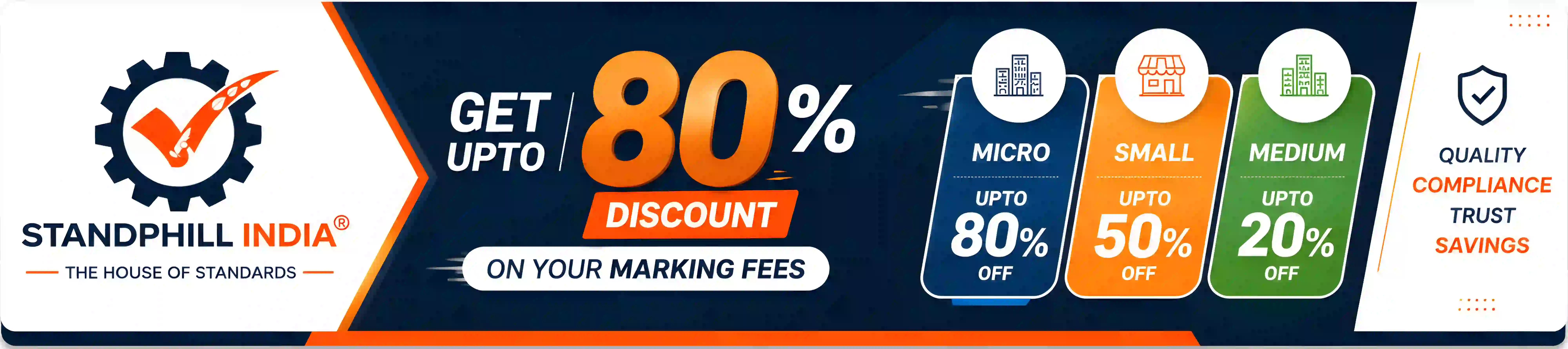
To claim your MSME discount, your valid Udyam Registration Certificate must be submitted with your BIS application. The enterprise classification at the time of application - Micro, Small, or Medium - determines the applicable discount tier. Standphill India verifies your MSME eligibility, applies the correct marking fee slab in your BIS application, and ensures you never overpay. We also track your MSME classification at annual renewal to maintain your discount entitlement year after year.
4 Fundamental Rules Every Morpholine Manufacturer Must Know Before Applying
Rule 1 - Manufacturer Only, Not Traders or Distributors. BIS grants the ISI Mark licence exclusively to the actual Morpholine producer. Indian importers, distributors, trading companies, and resellers cannot apply for BIS certification in their own name. The overseas manufacturer must apply directly through the FMCS route with an Authorized Indian Representative.
Rule 2 - Plant-Specific Licence. Each manufacturing plant or production location requires its own separate BIS licence with its own CM/L Number. A licence granted for one production facility does not cover another plant - even within the same company group. If a manufacturer operates two Morpholine plants, two separate BIS applications and two separate licences are required.
Rule 3 - Factory Inspection Is Mandatory Before Licence Is Granted. A BIS officer physically visits your Morpholine production plant - domestically or internationally - to verify production infrastructure, quality control systems, in-house testing capability, and production records before the licence is approved. No licence is issued without a successful factory inspection.
Rule 4 - Annual Renewal Is Mandatory. The ISI Mark licence for Morpholine under IS 12084:2018 is valid for 1 year only. Annual renewal must be filed and approved before the expiry date. Selling or distributing Morpholine under an expired BIS licence is a violation of the BIS Act, 2016, with the same penalties as operating without a licence at all.
BIS Certification Process for Morpholine - Step by Step
Step 1 - Appoint an Authorized Indian Representative / AIR (Foreign Manufacturers Only)
The AIR is an Indian-registered company that manages all BIS communication, document submission, fee payments, factory inspection coordination, and follow-up on behalf of the overseas Morpholine manufacturer. The AIR appointment is mandatory for all FMCS applications. Standphill India provides full AIR services for Morpholine manufacturers from China, Germany, Netherlands, and other countries supplying to India.
Step 2 - Morpholine Sample Testing at a BIS-Recognized NABL-Accredited Laboratory
Representative samples are drawn per the IS 12084:2018 sampling method and tested for all specified parameters - assay (GC or HPLC), boiling range, density, refractive index, water content (Karl Fischer), colour (APHA), residue on evaporation, and absence of free ammonia. Testing at a properly equipped chemical analysis laboratory typically takes 2 to 4 weeks. Standphill India identifies the correct BIS-recognized NABL lab experienced in amine and solvent product testing.
Step 3 - Complete Document Preparation
BIS application form (ManakOnline portal), factory and plant registration certificate, manufacturing process flow diagram (diethanolamine dehydration route or diethylene glycol-ammonia route), quality control manual, in-house QC lab instrument list, NABL-accredited test report covering all IS 12084:2018 parameters, ISI marking label artwork and container label design, trademark certificate or authorization, KYC of authorized signatory, ISO 9001 or other quality certifications if available, Udyam Registration Certificate for MSME discount, and AIR appointment letter with Indian company registration documents for FMCS applications.
Step 4 - Online Application Submission on BIS ManakOnline Portal
The complete application with NABL test report and all supporting documents is submitted online through the BIS ManakOnline portal. The government application fee is paid at this stage. Foreign manufacturers submit under the FMCS application module.
Step 5 - BIS Factory Inspection
A BIS officer visits your Morpholine production plant to verify the production reactor and distillation system capacity, in-house analytical laboratory (GC or HPLC, Karl Fischer titrator, density meter, refractometer, APHA colorimeter), batch production records and QC release certificates, raw material inspection records for diethanolamine or diethylene glycol feedstock, documented sampling procedures, and the system for marking Morpholine containers with the CM/L Number and IS reference. Standphill India provides a complete plant-readiness checklist before the inspection date is confirmed.
Step 6 - BIS Technical Scrutiny and Query Response
BIS reviews the full application, NABL test report, and factory inspection findings. Any technical queries from BIS must be answered within the specified response window. Standphill India handles all BIS correspondence and query responses professionally, preventing delays caused by incomplete or incorrectly formatted answers.
Step 7 - ISI Mark Licence (CM/L Number) Granted
Print the ISI Mark, CM/L number, IS 12084:2018 reference, manufacturer name and address, batch number, and quantity on every Morpholine container label - whether drums, IBCs, or bulk tankers. Renew the licence annually before expiry. BIS surveillance visits are conducted as per licence conditions and must be facilitated by the licence holder.
Total timeline: 10 to 14 weeks for domestic plants. 14 to 20 weeks for overseas factories with international inspection travel.
For Foreign Manufacturers - FMCS Route
Since India imports a significant portion of its Morpholine requirement, the Foreign Manufacturers Certification Scheme (FMCS) is the primary certification route for overseas suppliers. If you manufacture Morpholine in China, Germany, Netherlands, or any other country and supply to Indian customers, you must obtain BIS ISI Mark certification under FMCS before 1 July 2026.
As part of the FMCS process you are required to:
1. Appoint an Authorized Indian Representative (AIR) - a mandatory Indian-registered entity that represents you before BIS
2. Send representative Morpholine product samples to BIS-recognized NABL-accredited laboratories in India for testing as per IS 12084:2018
3. Facilitate a BIS factory audit at your manufacturing facility - a BIS officer will travel to your plant internationally
4. Submit the complete FMCS application through the BIS ManakOnline portal via your AIR
5. Obtain the ISI Mark licence (CM/L Number) before exporting Morpholine to India
Standphill India provides comprehensive AIR services and manages the end-to-end FMCS process for overseas Morpholine manufacturers. We handle all BIS correspondence in English, coordinate factory inspection scheduling and logistics, and ensure smooth licence grant.
Documents Required for BIS ISI Mark Certification - Morpholine IS 12084:2018
1. BIS application form (ManakOnline portal)
2. NABL-accredited lab test report covering all IS 12084:2018 parameters (assay, boiling range, density, refractive index, water content, colour, residue on evaporation, free ammonia)
3. Factory / plant registration certificate
4. Factory address proof
5. Manufacturing process flow diagram
6. In-house QC lab instrument list (GC or HPLC, Karl Fischer titrator, density meter, refractometer, colorimeter)
7. Quality control manual
8. Trademark certificate or authorization letter
9. ISI marking label artwork and container label design
10. KYC of authorized signatory (Aadhaar or Passport)
11. ISO 9001 or ISO 14001 certificate if available
12. Udyam Registration Certificate (for MSME discount)
13. AIR appointment letter and Indian company registration documents (FMCS applications only)
Complete document checklist, format guidance, and preparation support are provided by Standphill India on engagement.
BIS Certification Cost for Morpholine IS 12084:2018
| Cost Component | Estimated Amount |
| BIS Application Fee | INR 1,000 (one-time, paid at filing) |
| Annual Licence Fee | INR 1,000 to INR 15,000 (based on annual production value slab) |
| NABL Lab Testing - IS 12084:2018 | INR 12,000 to INR 30,000 per sample batch (all parameters - assay, boiling range, density, refractive index, Karl Fischer water, APHA colour, residue, free ammonia) |
| BIS Marking Fee | Per-tonne or per-year fee based on annual production volume. MSME discount applies: Micro 80% off, Small 50% off, Medium 20% off |
| Domestic Factory Inspection Fee | INR 5,000 to INR 25,000 for domestic plant visit |
| FMCS International Inspection | International travel, accommodation, and per-diem for BIS officer — varies by country of manufacture |
| Licence Validity | 1 year - annual renewal required before expiry |
Note: All government fees are subject to revision by BIS. Contact Standphill India for a plant-specific, written cost estimate before committing. This estimate is provided free of charge.
Why Morpholine Manufacturers and Importers Choose Standphill India for IS 12084:2018 BIS Certification
Chemical product expertise across the QCO landscape. Standphill India has handled BIS ISI Mark certifications across solvents, chemicals, petrochemicals, and specialty chemical products. We understand the specific test methods, sampling protocols, and BIS scrutiny patterns for IS 12084:2018 - not just the form-filling. For Morpholine, the absence-of-ammonia test and the boiling range verification are areas where BIS inspectors pay particular attention, and we prepare applicants thoroughly for both.
Nine extensions have created dangerous complacency - we cut through it. Most Morpholine manufacturers have postponed the BIS process repeatedly, assuming another extension will follow. That assumption is now wrong. We work with manufacturers who have zero compliance timeline, compress the process where possible, and submit applications immediately to establish a good-faith compliance position even when the licence will arrive after 1 July 2026.
FMCS specialisation for overseas Morpholine manufacturers. Since India imports significant quantities of Morpholine from China, Germany, Netherlands, and other countries, the FMCS route is the primary certification pathway. Standphill India provides full Authorized Indian Representative services - managing the complete BIS certification process on behalf of the overseas manufacturer, coordinating factory inspection logistics, handling all BIS correspondence in English, and ensuring smooth licence grant.
Right NABL lab, right analytical methods. We direct your Morpholine samples to BIS-recognized NABL-accredited laboratories specifically experienced in amine and solvent product testing. The GC or HPLC assay method for Morpholine, Karl Fischer water determination, APHA colour testing, and the free-ammonia test must be performed by labs familiar with this class of chemicals - not general chemistry labs that may not have the correct reference methods.
Factory inspection preparation tailored to amine production facilities. Before any BIS inspection date is confirmed, we provide a complete plant-readiness checklist specific to Morpholine production - covering GC or HPLC system calibration, Karl Fischer titrator verification, batch record formats, raw material inspection documentation, and the safety handling procedures for Morpholine that BIS inspectors specifically verify.
Indian importer advisory and supplier coordination. If you import Morpholine into India and your overseas supplier is not yet BIS-certified, we proactively reach out to your supplier to initiate their FMCS application. From 1 July 2026, your supply chain stops if your supplier has no BIS licence. We ensure supply continuity through the certification transition.
MSME discount maximisation. For domestic Morpholine manufacturers with MSME status, we verify your Udyam classification and apply the correct discount tier - up to 80% for Micro enterprises - in your BIS application. We prevent the common error of claiming a lower discount tier than you are actually entitled to.
Full post-certification compliance management. ISI Mark validity is annual. We track your renewal date and initiate the renewal process 60 days before expiry. BIS surveillance visits are managed professionally without disrupting your plant operations.
Transparent, written cost estimates. Before any engagement begins, we provide a detailed written cost breakdown specific to your plant location, annual production volume, MSME classification, and domestic or FMCS route. No surprises, no hidden fees.
Standphill India has 20+ years of experience, 10,000+ certifications completed, 400+ foreign clients served, and coverage across all states and Union Territories of India.
Start Your Morpholine BIS Certification Before 1 July 2026 - Contact Standphill India Today
The Morpholine (Quality Control) Order, 2020 has been extended nine times over six years. That runway is now over. The BIS ISI Mark certification deadline of 1 July 2026 is confirmed and final. BIS is actively accepting applications and granting licences under IS 12084:2018.
The certification process - sample testing, document preparation, application filing, factory inspection, technical scrutiny, and licence grant - takes 10 to 16 weeks for domestic plants and 14 to 20 weeks for overseas factories. If you start today, you may not have your licence in hand by 1 July 2026. But submitting your BIS application before the deadline demonstrates good-faith compliance effort and initiates the process before enforcement begins.
Do not wait. Share your plant location or country of manufacture, annual production capacity, and MSME status with us - we will send you a precise cost and timeline estimate within 24 hours.
Call us at +91-9667674225. WhatsApp us. Fill our enquiry form. Email us.
Standphill India - The House of Standards.
Need BIS Certification Support?
Our experts can help you with documentation, testing, application filing and complete BIS approval process.